Kirjojen hintavertailu. Mukana 11 244 527 kirjaa ja 12 kauppaa.

Kirjahaku

Etsi kirjoja tekijän nimen, kirjan nimen tai ISBN:n perusteella.

1000 tulosta hakusanalla Max Morold

Max Weber and the Culture of Anarchy
This is a specially commissioned set of essays on the themes of Max Weber, culture, anarchy and politics. It presents the first complete publication (in both English and German) of a series of letters written by Max Weber in 1913 and 1914 during his stays at the anarchist settlement of Ascona. The letters show Weber debating with the issues of free love, eroticism, patriarchy, anarchism, terrorism, pacifism, political and personal convictions and power. These themes are taken up by the contributors in a wider discussion of the relation of culture and politics.
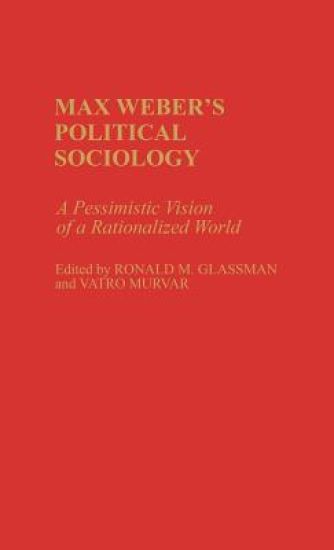
Max Weber's Political Sociology

Max Weber's Political Sociology

Ronald Glassman; Vatro Murvar

Praeger Publishers Inc
1984
sidottu
This collection of essays focuses on Weber's political ideology as well as his political sociology. This interdisciplinary work draws upon the expertise of a number of writers and challenges major schools of thought on Weber. In the first section on ideology, scholars question whether Weber's political predictions were based on a realistic appraisal of social development or if his objectivity was compromised by events in Weimar Germany. They then address Weber's attitudes toward socialism in light of contemporary sociology and his early writings. Part two examines Weber's theory: the concept of rationalization; ideas about charisma; and the decline of charisma in light of the growing role of the media. A study of Weber's analysis of the 1917 events in Russia concludes the volume.
Max Reger

Max Reger

William E. Grim

Greenwood Press
1988
sidottu
Professor Grim's bio-bibliography is the first publication in English to bring together the considerable amount of scholarship that has been devoted to Reger's life and work and to his role in the transition from late romanticism to modernism. The volume begins with a brief biography and a discussion of Reger's works and his reputation among musicians, scholars, and the public. There follows a complete listings of works and performances and a discography of commercially produced recordings. The annotated bibliography includes writings by and about Max Reger and his music, compositional style, and performances, with passages from the more important publications quoted. Appendixes list Reger's compositions chronologically and by genre, and a comprehensive name index conludes the volume. The revival of critical interest in romantic and late romantic composers make this bibliography especially timely.
Max Weber

Max Weber

Peter Kivisto; William H. Swatos

Greenwood Press
1988
sidottu
Max Weber is surpassed only by Karl Marx in the breadth of his influence as a social scientist. This bio-bibliography presents a complete listing of printed translations of Weber's works into English and a comprehensive, annotated bibliography of the secondary literature in English about Weber and his work. The first part contains chapter-length biographies of Weber, an overview of Weber's reception in Anglo-America, and a brief discussion of archival holdings for those interested in primary sources. Kivisto and Swatos offer an assessment of existing studies of Weber's life and thought in lieu of a conventional biography. The bulk of the volume is devoted to providing a bibliographic guide to the secondary literature on Weber in English. Annotated entries are arranged in five topical chapters that focus on biography and intellectual history, social science methodology, religion, politics and social class, and modernity, rationality, and bureaucracy.Additional access to information is provided by two indexes: the author index lists the authors of all entries and the number(s) of their respective citations; the name and subject index identifies names that appear in titles or bibliographic entries and guides the researcher to subjects that may be treated in more than one chapter. This first annotated bibliography of works by and about one of modern sociology's founding fathers is a reference book for both scholars and students of social theory, historical sociology, the sociology of religion, and organizational sociology.
Max Steiner's Now, Voyager

Max Steiner's Now, Voyager

Kate Daubney

Greenwood Press
2000
sidottu
Max Steiner's contribution to the formulation of early Hollywood scoring techniques is significant, particularly through his music for King Kong (1933) and The Informer (1935). The Academy Award winning score for Now, Voyager reflects the maturation of the composer's understanding of the dramatic function of music in film. The primary resources incorporated in the analysis include, from the Max Steiner collection at Brigham Young University, Steiner's letters and scrapbooks and his unpublished autobiography Notes to You. In addition to contributing to the composer's own perspective on the music for this film and on scoring practice in general, these papers contribute to a broader debate about how films are interpreted and the part music plays in these schemes of criticism. This study of the film score occurs within the broader theoretical and historical debates currently characterizing film musicology and explores, from varied perspectives, how the score is meaningful and important to the film. Devoted to a single score, this study brings together for analysis all the contingent factors in the score's creation, use, and reception and will appeal to film music scholars and to scholars of music and of film. The scope of the analysis will also interest scholars involved in music in multi-disciplinary art forms, feminist musicologists and film scholars, and students of musical theater. Separate chapters discuss Steiner's musical background, his technique of film scoring, historical and critical contexts of the film, the music and its context, and an analysis of the score. Musical examples illustrate the text and an appendix of selected film scores by Steiner is included along with a selected bibliography.
Max Einstein: Rebels with a Cause

Max Einstein: Rebels with a Cause

James Patterson; Chris Grabenstein

Jimmy Patterson
2019
sidottu
"A fast-paced, science-filled caper." --The Wall Street JournalMax Einstein is the first and only children's adventure series officially approved by the Albert Einstein Archives. Max Einstein's typical day is not your average 12-year-old's. She...- TEACHES classes at a New York college- Dodges KIDNAPPING attempts with her best friends- Goes on SECRET MISSIONS for her billionaire boss- Has a MYSTERIOUS CONNECTION to Albert EinsteinJust a day in the life of the Change Makers Institute's top agent What does an Irish town and a village in India have in common? A water crisis that only a group of kid geniuses can fix Max and her CMI friends attempt to use their smarts to find solutions, but it's hard to save the world when you're trying not to be kidnapped A greedy corporation with an eye on capturing Max seems to know their every move. It's almost like the bad guys have a spy inside the Change Makers...
Max Einstein: Saves the Future

Max Einstein: Saves the Future

James Patterson; Chris Grabenstein

Jimmy Patterson
2020
sidottu
The world's #1 bestselling author has teamed up with the world's most famous genius to entertain, educate and inspire a generation of kids--with the first and only kids' book series officially approved by the Albert Einstein Archives.Albert Einstein + James Patterson = A Must Read Max is back with a thrilling new adventure that involves time travel, creepy bad guys, killer drones, and a shocking mystery about her past that she will stop at nothing to solve Under constant danger of being kidnapped by the shadowy Corporation, Max is on the run from New York to London and beyond. But soon the call comes for the Change Maker kids' next mission: make sure no kid ever goes hungry again If anyone can tackle a problem this big, Max and her genius friends can.But mysterious clues about her past keep distracting Max's focus. She always wanted to know who her parents were and why they abandoned her as a baby. If she manages to build a time machine, she could find them and get all the answers What's more important - her past, or the future of the Change Makers?
Max Einstein: The Genius Experiment

Max Einstein: The Genius Experiment

James Patterson; Chris Grabenstein

Jimmy Patterson
2019
nidottu
What Harry Potter did for magic, Max Einstein does for kids' imaginations Max leads a group of kid geniuses in this #1 New York Times bestseller officially approved by the Albert Einstein archives.Max Einstein is not your typical genius. She . . .Hacks the computer system at NYU to attend classesBuilds inventions to help the homelessAnd talks to Albert Einstein (Okay, that's just in her imagination)But everything changes when Max is recruited by a mysterious organization Their mission: solve some of the world's toughest problems using science. She's helped by a diverse group of young geniuses from around the globe as they invent new ways to power the farthest reaches of the planet. But that's only if the sinister outfit known only as The Corporation doesn't get to her first . . .Max Einstein is a heroine for the modern age and will be looked up to by readers for generations to come." A] fast-paced, science-filled caper." -- The Wall Street Journal
Max is Missing

Max is Missing

Peter Porter

Picador
2001
pokkari
Few poets now writing share Porter’s sense of the big picture, his ability to read the small event against the waxings and wanings of culture and empire. Whether these poems look at Europe through the strata of its Golden Ages, revisit the Australia of his childhood or turn their surreal wit to the quieter domestic landscape, together they amount to a sustained meditation on the spirit that bears comparison with the late poems of Wallace Stevens. Magisterial in its perspective and possessed of a rare intellectual sanity, Max is Missing is Porter’s most charged and direct work since The Cost of Seriousness.
Max Weber and the Culture of Anarchy
This is a specially commissioned set of essays on the themes of Max Weber, culture, anarchy and politics. It presents the first complete publication (in both English and German) of a series of letters written by Max Weber in 1913 and 1914 during his stays at the anarchist settlement of Ascona. The letters show Weber debating with the issues of free love, eroticism, patriarchy, anarchism, terrorism, pacifism, political and personal convictions and power. These themes are taken up by the contributors in a wider discussion of the relation of culture and politics.

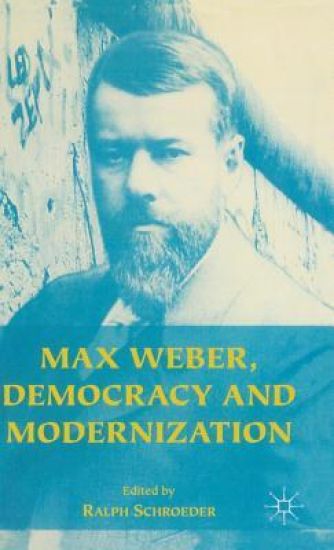
Max Weber, Democracy and Modernization
These essays bring Weber's sociology to bear on the current transformation of the political landscape. After the collapse of communism, many states are faced with the challenges of democratization: they need to establish their legitimacy in an uncertain economic climate and within a new geopolitical order. The essays in this volume develop Weberian concepts and apply his comparative-historical method to deepen our understanding of these problems. They cover a wide range of examples, from the United States to Western and Eastern Europe, and from Russia and Japan to the Islamic states.
Max Weber, Democracy and Modernization
These essays bring Weber's sociology to bear on the current transformation of the political landscape. After the collapse of communism, many states are faced with the challenges of democratization: they need to establish their legitimacy in an uncertain economic climate and within a new geopolitical order. The essays in this volume develop Weberian concepts and apply his comparative-historical method to deepen our understanding of these problems. They cover a wide range of examples, from the United States to Western and Eastern Europe, and from Russia and Japan to the Islamic states.
Max Weber and the Culture of Anarchy
This is a specially commissioned set of essays on the themes of Max Weber, culture, anarchy and politics. It presents the first complete publication (in both English and German) of a series of letters written by Max Weber in 1913 and 1914 during his stays at the anarchist settlement of Ascona. The letters show Weber debating with the issues of free love, eroticism, patriarchy, anarchism, terrorism, pacifism, political and personal convictions and power. These themes are taken up by the contributors in a wider discussion of the relation of culture and politics.

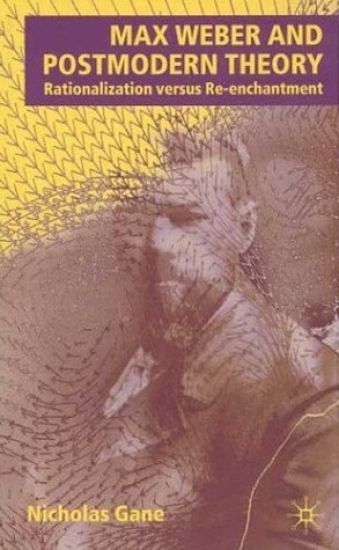
Max Weber and Postmodern Theory

Max Weber and Postmodern Theory

N. Gane

Palgrave Macmillan
2002
sidottu
This book explores the contemporary nature of Max Weber's work by looking in detail at his key concepts of rationalization and disenchantment. Thematic parallels are drawn between Weber's rationalization thesis and the critiques of contemporary culture developed by Jean-Francois Lyotard, Michel Foucault and Jean Baudrillard. It is suggested that these three 'postmoden' thinkers develop and respond to Weber's analysis of modernity by pursuing radical strategies of affirmation and re-enchantment. Examining the work of these three key thinkers in this way casts new light both on postmodern theory and on Weber's sociology of rationalization.
Max Weber's Interpretive Sociology of Law
This book presents a clear and precise account of the structure and content of Max Weber's sociology of law: situating its methodological and epistemological specificity in relation to other approaches to the sociology of law; as well as offering a critical evaluation of Weber's usefulness for contemporary socio-legal research. The book is divided into three parts. The first part deals with the methodological foundations of Weber's sociology of law. The second analyses the central theme of this sociology, the rationalisation of law, from the perspective of its internal logical coherence, its empirical validity, and finally its legitimacy. The third part questions the present-day relevance of the Weberian sociology of law for socio-legal research, notably with regard to legal pluralism. Max Weber, it is demonstrated, is not merely a 'founding father' of the sociology of law; rather, his methodology, concepts, and empirical analyses remain highly useful to the further development of work in this area.
Max Weber's Sociology of Civilizations: A Reconstruction
This volume examines civilizations through the broad lens articulated by the works of Max Weber. In focusing upon his comparative-historical mode of analysis and his causal explanations for the sources, contours, and trajectories of civilizations, this study reconstructs Weber’s sociology in a manner that provides clear guidelines to researchers seeking to investigate civilizations systematically. Through detailed interpretations of the West’s unique development from Antiquity to the Modern era, precise comparisons to the long-range and singular pathways taken by China and India, and careful demarcations of the "particular rationalisms" of several civilizations, the author addresses Weber’s powerful model-building on the one hand and his opposition to organic holism and structural presuppositions on the other hand. Both a broad-ranging conceptual framework and case-based empirical investigations are pivotal to Weber. His research strategy emphasizes further the "subjective meanings" of actors East and West and the deep cultural origins of groups. Finally, this volume masterfully conveys Weber’s contextual and multi-causal methodology rooted in a tight interweaving of the present with the past. Max Weber’s Sociology of Civilizations: A Reconstruction will appeal to comparative sociologists and historians, as well as to theorists of all persuasions. The social scientist pursuing a cross-civilizational agenda will here discover the distinct contribution of Weber’s "interpretive understanding" procedures to the now-essential field of civilizational analysis.
Max Weber's Sociology of Civilizations: A Reconstruction
This volume examines civilizations through the broad lens articulated by the works of Max Weber. In focusing upon his comparative-historical mode of analysis and his causal explanations for the sources, contours, and trajectories of civilizations, this study reconstructs Weber’s sociology in a manner that provides clear guidelines to researchers seeking to investigate civilizations systematically. Through detailed interpretations of the West’s unique development from Antiquity to the Modern era, precise comparisons to the long-range and singular pathways taken by China and India, and careful demarcations of the "particular rationalisms" of several civilizations, the author addresses Weber’s powerful model-building on the one hand and his opposition to organic holism and structural presuppositions on the other hand. Both a broad-ranging conceptual framework and case-based empirical investigations are pivotal to Weber. His research strategy emphasizes further the "subjective meanings" of actors East and West and the deep cultural origins of groups. Finally, this volume masterfully conveys Weber’s contextual and multi-causal methodology rooted in a tight interweaving of the present with the past. Max Weber’s Sociology of Civilizations: A Reconstruction will appeal to comparative sociologists and historians, as well as to theorists of all persuasions. The social scientist pursuing a cross-civilizational agenda will here discover the distinct contribution of Weber’s "interpretive understanding" procedures to the now-essential field of civilizational analysis.
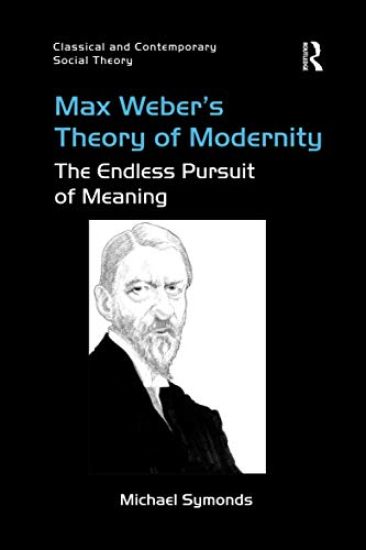
Max Weber's Theory of Modernity

Max Weber's Theory of Modernity

Michael Symonds

Routledge
2020
nidottu
This book illuminates an important dimension of the work of Max Weber. Weber’s theory of meaning and modernity is articulated through an understanding of his account of the way in which the pursuit of meaning in the modern world has been shaped by the loss of Western religion and how such pursuit gives sense to the phenomena of human suffering and death. Through a close, scholarly reading of Weber’s extensive writings and Vocation Lectures, the author explores the concepts of ’paradox’ and ’brotherliness’ as found in Weber’s work, in order to offer an original exposition of Weber’s actual theory of how meaning and meaninglessness work in the modern world. In addition to making a substantial and highly original contribution to the sociology of modernity, the book applies the theory of meaning extracted from Weber’s thought, addressing the claim that Weber’s work has been rendered out-dated by the supposed re-enchantment of the modern world, as well as discussing the ways this theory can contribute to our understanding of the development of specific forms of modernity. A rigorous examination of the thought of one of the most important figures in classical sociology, this volume will appeal to scholars of sociology, social theory and philosophy with interests in modernity, Weber and the concept of meaning.
Max Weber Matters
This volume clearly communicates that Weber’s influence is of great significance to the history of social science, and to appreciating the theoretical work of other social scientists in the modern age. Its insightful and timely publication comprises topical and innovative work discussing Weber in a range of historical and contemporary questions including: the controversy surrounding the Da Vinci code; the charismatic role of martyrs; the nuclear weapons strategy in a post-cold-war age and the affinity between Hindu belief systems and disenchanted computer science. Max Weber Matters illustrates the multidisciplinary and continued relevance of Weber’s work and will be of interest to scholars across a range of disciplines, including historians, sociologists, political scientists and social theorists.
Max Weber and the Path from Political Economy to Economic Sociology
This book examines the largely-neglected shift in Max Weber’s work from political economy to economic sociology. Considering the importance of his recognition—made during his research on the Protestant Ethic—of the reciprocal influences that exist between economics and society and the role of this realization in prompting him to rethink the study of political economy, the author sheds fresh light on his emerging belief that the study of the relationship between economic factors and social issues required a new discipline. A study that charts an important development in the thought of one of the founding figures of sociology, this volume will appeal to scholars of social theory with interests in the history of the field and the legacy of Max Weber.