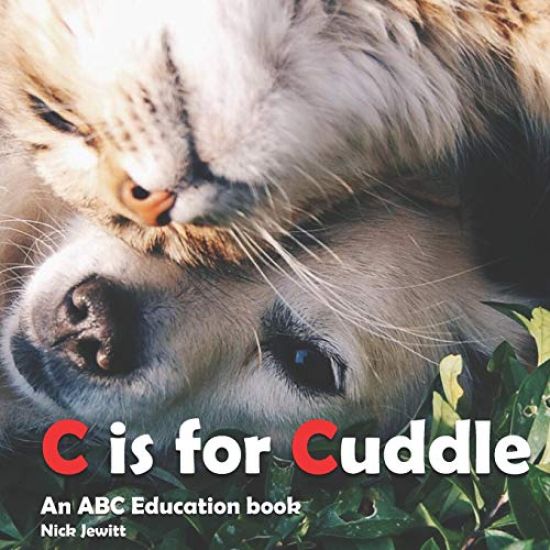
One of the most beautiful ABC books you'll find. Filled with rich and vibrant images that your little one will be sure to enjoy. Each word has been carefully selected, so that you can engage and act them out. Research has shown that children learn more through play or interaction and this book taps into that insight.
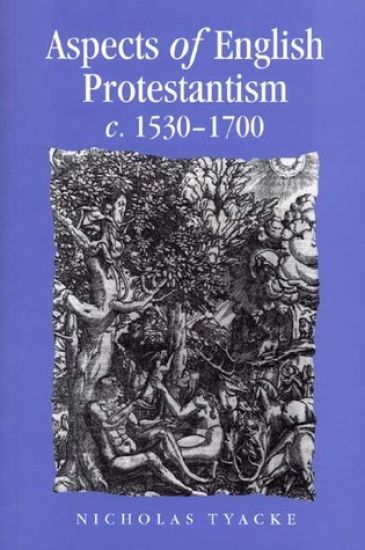
During the sixteenth century, England underwent a religious revolution. This book examines the reverberations of this Protestant Reformation, which continued to be felt until at least the end of the seventeenth century. Brings together twelve essays by Nicholas Tyacke about English Protestantism, which range from the Reformation itself, and the new market-place of ideas opened up, to the establishment of freedom of worship for Protestant nonconformists in 1689. For this collection the author has written a substantial introduction, and updated the essays by incorporating new research.
This extensive new work joins the internationally acclaimed series of bibliographies of Charles Dickens's work edited by Professor Duane DeVries. The detailed listings, full annotations, and evaluative notes will prove indispensable to scholars. The two volumes represent many years of work by the distinguished Dickens scholar Professor C. Hanna.
This extensive new work joins the internationally acclaimed series of bibliographies of Charles Dickens's work edited by Professor Duane DeVries. The detailed listings, full annotations, and evaluative notes will prove indispensable to scholars. The two volumes represent many years of work by the distinguished Dickens scholar Professor C. Hanna.
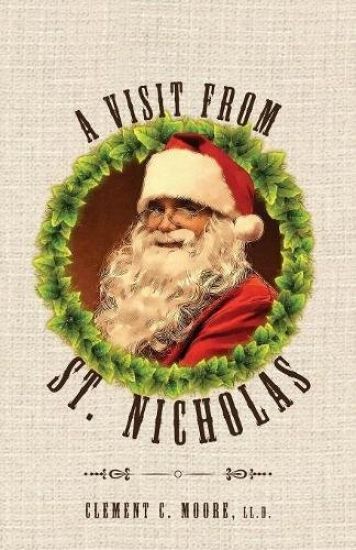
"Twas the night before Christmas, and all through the house..." So begins the immortal lines that begin one of America's most famous poems adding magic to one of America's most favorite holidays. Written in the 1820s, Clement C. Moore did not openly acknowledge that he was the author until almost 1840. That makes this edition, with original woodcut illustrations by T. C. Boyd, one of the earliest published editions of this timeless classic. Imagine sitting at the foot of the bed of your child reading from an edition that is nearly identical to what children were familiar with for more than 100 years And it gets better than that. The real Saint Nicholas was a real person who lived in the 4th century, famed for his generosity. What better way to celebrate Christmas than paying homage to one who knew the real 'reason for the season'? Available in both soft and hard cover editions, with bulk discounts available directly from the publisher.
"Twas the night before Christmas, and all through the house..." So begins the immortal lines that begin one of America's most famous poems adding magic to one of America's most favorite holidays. Written in the 1820s, Clement C. Moore did not openly acknowledge that he was the author until almost 1840. That makes this edition, with original woodcut illustrations by T. C. Boyd, one of the earliest published editions of this timeless classic. Imagine sitting at the foot of the bed of your child reading from an edition that is nearly identical to what children were familiar with for more than 100 years And it gets better than that. The real Saint Nicholas was a real person who lived in the 4th century, famed for his generosity. What better way to celebrate Christmas than paying homage to one who knew the real 'reason for the season'? This hard cover would make a great gift edition Available in both soft and hard cover editions, with bulk discounts available directly from the publisher.
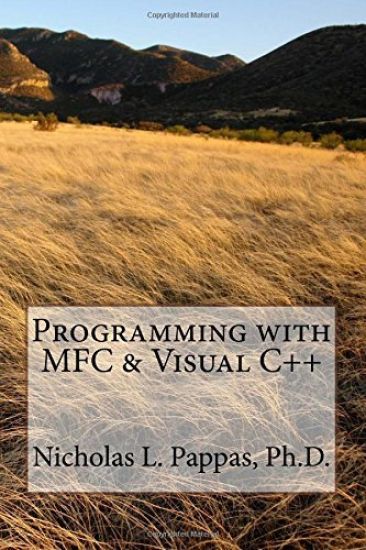
Computer Science Design Series Programming with MFC & Visual C++ Prerequisite: Microsoft Visual C++ 6.0 or equivalent. Recommended especially if you are new to MFC: Jeff Prosise "Programming Windows with MFC" (1337 pages, ISBN 1572 316 950) This text is about how to use Windows Microsoft Foundation Classes (the MFC) and the software program Visual C++ to write programs using windows without knowing how to write the complex code that produces the windows. The MFC/Visual C++ combination immensely simplifies the writing of any program that uses one or more windows. Second, this is about learning how program with MFC from the bottom up so that you can produce the projects presented here. Many MFC classes and functions replace/obsolete many C, C++, and C# classes and functions. Consequently you can go directly to MFC, and save a lot of time and energy. Programming with MFC allows you to work at the top of the C hierarchy, while avoiding the limitations of C, C++, and C#. This text BEGINS to show you how to program with MFC by using Visual C++ to produce skeleton programs on the Visual C++ screen. Skeletons that include code producing the windows in which your programs will be presented. For example, creating front panels using dialog boxes in which you place controls (push button, combo box, slider, text box, etc.) in precise positions and how to initialize/program the controls. We say begin, because learning how to program in any language is an endless task. Especially MFC with its hundreds of functions. At this point we believe it is very important that you view the table of contents to know what we have chosen to present from the thousands of possibilities. We believe our choices represent the basic know-how one needs to get going with MFC. There is an unavoidable "cook book" element to using Visual C++ that dictates how to create the skeletons, and where to enter code in the skeletons. This text is different. Instead of referring you to code on a disk (with few if any comments), and instead of offering partial explanations in the text, requiring you have to go back and forth from book to disk, and wondering what to do next, we show you how code is written that actually creates programs that run on any computer using the windows operating system. That is why only the Visual C++ disk is required. We briefly explain most of the code lines used to produce the functions required by the projects. We expect the reader to have a basic programming capability. This text uses the Jeff Prosise text "Programming Windows with MFC", as a very useful reference.With Jeff Prosise's text supporting us we were able to write programs using windows, while knowing nothing about windows programming and very little about MFC and the various C languages. JP's text gave us a great start with the design process producing programs presented in one or more windows. That experience brings us to this point. We wrote this text, because even with the JP reference we learned that we had to answer many "How-do-we-do-that?" questions. Answers we needed in order to produce programs that run. Answers we share with you by presenting selected topics in the form of working projects. Many types of programs can be implemented with MFC. We focus on dot exe (name.exe) executing programs. JP's text makes very clear the fact that there is much, much more to MFC then what is presented here.
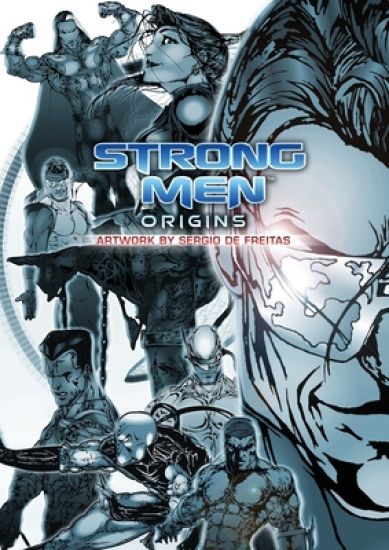
In the beginning there was a danger so great it brought on a team of inter-dimensional beings who were able to keep back Nicholas Grimble. But who created Nicholas and why is Michael Strong so seemingly connected to the men and women who meet underground.STRONGMEN has become something of an underground phenomenon. It has both a cult following and a mainstream magnetism that defies understanding. The 1996-1999 TVseries was viewed by 65million people in 18 countries. Recently the film production team who brought the Strongmen to life pitched, developed and filmed a movie calledSTRONGMEN "Lucky Break" which is set to explode across global screens soon. But a deeper story has yet to be told, one that unravels how a committed team of superhero loving creators took on the likes of the two largest graphic novel companies in the world and introduced the world to a newkind of character, one who has evolved beyond brawn and even now claims a place in the next evolutionary pantheonof humans.
Exam board: WJECLevel: AS/A-levelSubject: HistoryFirst teaching: September 2015First exams: Summer 2016 (AS); Summer 2017 (A-level)Put your trust in the textbook series that has given thousands of A-level History students deeper knowledge and better grades for over 30 years.Updated to meet the demands of today's A-level specifications, this new generation of Access to History titles includes accurate exam guidance based on examiners' reports, free online activity worksheets and contextual information that underpins students' understanding of the period.- Develop strong historical knowledge: in-depth analysis of each topic is both authoritative and accessible- Build historical skills and understanding: downloadable activity worksheets can be used independently by students or edited by teachers for classwork and homework- Learn, remember and connect important events and people: an introduction to the period, summary diagrams, timelines and links to additional online resources support lessons, revision and coursework- Achieve exam success: practical advice matched to the requirements of your A-level specification incorporates the lessons learnt from previous exams- Engage with sources, interpretations and the latest historical research: students will evaluate a rich collection of visual and written materials, plus key debates that examine the views of different historians
Ever wonder why that relationship just didn't work out or why that job you pursued so hard didn't come through as expected? Do you ever wonder why your best efforts were not enough to help that person make the right decision that could have spared them so much pain? You are not alone, and there is a solution to those questions. The world of today is sprinkled with multiple challenges stemming from racial, political, religious, and significant cultural differences that are smeared with misunderstandings. These challenges only seem to grow larger as time moves forward. Furthermore, the diverse ideologies of life are only growing more polarizing, and the responsibility to establish stability remains unclaimed and unfulfilled. This is the world we are living in right now, and it is having a massive effect on how human beings engage with one another. The 5 Phases of Human Engagement (5PHE(c)) was birthed with the intention of confronting this problem directly. Thankfully, this approach has provided outcomes of success for over 3,000 youth, families, and professionals to date. The humbling truth is there are still millions of individuals begging for this system to reach them.
Italy had long experienced literacy under Roman rule, but what happened to literacy in Italy under the rule of a barbarian people? This book examines the evidence for the use of literacy in Lombard Italy c. 568–774, a period usually considered as the darkest of the Dark Ages in Italy due to the poor survival of written evidence and the reputation of the Lombards as the fiercest of barbarian hordes ever to invade Italy. A careful examination of the evidence, however, reveals quite a different story. Originally published in 2003, this study considers the different types of evidence in turn and offers a re-examination of the nature of Lombard settlement in Italy and the question of their cultural identity. Far from constituting a Dark Age in the history of literacy, Lombard Italy possessed a relatively sophisticated written culture prior to the so-called Carolingian Renaissance of the ninth century.
Italy had long experienced literacy under Roman rule, but what happened to literacy in Italy under the rule of a barbarian people? This book examines the evidence for the use of literacy in Lombard Italy c. 568–774, a period usually considered as the darkest of the Dark Ages in Italy due to the poor survival of written evidence and the reputation of the Lombards as the fiercest of barbarian hordes ever to invade Italy. A careful examination of the evidence, however, reveals quite a different story. Originally published in 2003, this study considers the different types of evidence in turn and offers a re-examination of the nature of Lombard settlement in Italy and the question of their cultural identity. Far from constituting a Dark Age in the history of literacy, Lombard Italy possessed a relatively sophisticated written culture prior to the so-called Carolingian Renaissance of the ninth century.
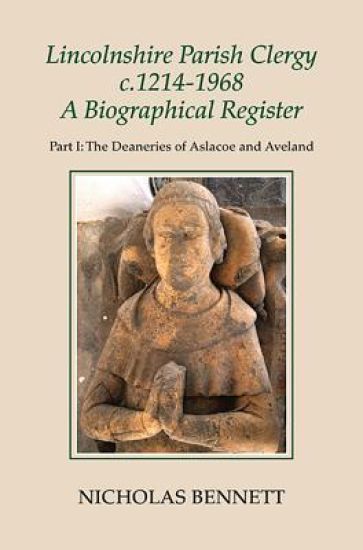
The first volume in what will be a complete biographical record of all parish priests in Lincolnshire. The parish churches of Lincolnshire are justly celebrated. The spires of Grantham and Louth, and the famous Boston Stump, provide a focal point from the surrounding landscape of fen, wold and marsh. The charms of remote country churches along the byways of the county have been extolled in prose and verse by writers such as Henry Thorold and Sir John Betjeman. Their architecture, their stained glass and sculpture, furniture and fabric, have all been carefully recorded. Yet little is known of the people who served these churches, the rectors and vicars who, in word and sacrament, taught the Christian faith to successive generations of parishioners. This volume forms the first part of a much-needed survey of Lincolnshire parish clergy. The starting point is 1214, when Bishop Hugh of Wells introduced the earliest system of episcopal registration in Western Europe. The magnificent series of Lincoln bishop'sregisters provides a framework for the parish lists, setting out the succession of rectors or vicars for each church. Brief biographical sketches demonstrate the rich variety of the county's parsons - pastors, scholars, travellers and writers, soldiers and schoolmasters; while some, like John Wycliffe, achieved a wider fame. This biographical register gives to each of them their place in the history of Lincolnshire. Dr Nicholas Bennett is General Editor of the Lincoln Record Society. Prior to retirement, he was Vice-Chancellor and Librarian of Lincoln Cathedral, where he was responsible for the historic collections of books and manuscripts.
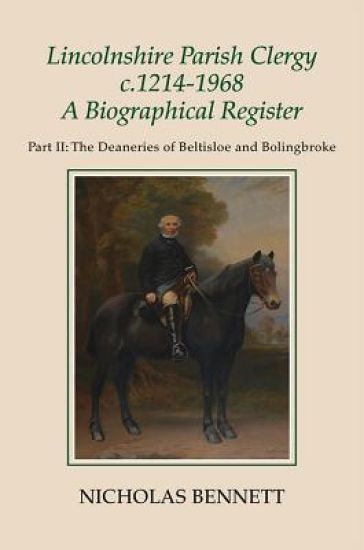
The second volume in what will be a complete biographical record of all parish priests in Lincolnshire. The parish churches of Lincolnshire are justly celebrated. The spires of Grantham and Louth, and the famous Boston Stump, provide a focal point from the surrounding landscape of fen, wold and marsh. The charms of remote country churches along the byways of the county have been extolled in prose and verse by writers such as Henry Thorold and Sir John Betjeman. Their architecture, their stained glass and sculpture, furniture and fabric, have all been carefully recorded. Yet little is known of the people who served these churches, the rectors and vicars who, in word and sacrament, taught the Christian faith to successive generations of parishioners. This volume forms the second part of a much-needed survey of Lincolnshire parish clergy. It covers the deaneries of Beltisloe, comprising twenty-one parishes clustered around Colsterworth and Corby, and of Bolingbroke, with twenty-five parishes centred on Spilsby. Starting from 1214, when Bishop Hugh of Wells introduced the earliest system of episcopal registration in Western Europe, the parish lists set out the succession of rectors or vicars for each church. Brief biographical sketches demonstrate the rich variety of the county's parsons - pastors, scholars, athletes, travellers and writers, soldiers and schoolmasters. This register gives to each of them his place in the history of Lincolnshire. DrNicholas Bennett is Visiting Senior Fellow of the University of Lincoln.