Kirjojen hintavertailu. Mukana 11 342 296 kirjaa ja 12 kauppaa.

Kirjahaku

Etsi kirjoja tekijän nimen, kirjan nimen tai ISBN:n perusteella.

585 tulosta hakusanalla Olli Rauste

Pisteet lopussa (näköispainos)
Pakinamestarin 45 juttua "meikäläisistä, hölmöläisistä ja ryssistäkin" vuodelta 1941. "Tuo hänen ainutlaatuinen, kuivan humoristinen tyylinsä on keskittynyt yhä suppeampaan ja nerokkaampaan sanontaan, joka ilman muuta takaa hänelle tietyn klassikon aseman kirjallisuudessamme koserian alalla." (Mika Valtari, lainattu takakannessa). Näköispainos.
Hedelmäsuola Pomosin (näköispainos)
35 juttua, joissa esiintyvät niin ystävä ja huonetoveri Kalle Niemeläinen, rouva Jakari kuin Mustapartainen mies. Pakinoissa irvitään lempeästi ja sivalletaan milloin mitäkin, vaikkapa kaksoissisarusten samankaltaisuuden avulla:"Toisen löi vihastunut naapuri kuoliaaksi, ja myös toinen oli pianotaiteilija. Toinen myi sekä osti lehmiä ja myös toinen oli taitava poliitikko. Toinen oli teatterinjohtaja ja myös toinen oli kaikkien vainoama. Toinen ei koskaan viitsinyt lukea aloittamaansa kirjaa loppuun ja myös toinen oli kirjallisuusarvostelija. Toisen perhe-elämä oli kokonaan rappiolla ja myös toinen ratkaisi ristisana-arvoituksia.--"
Finland in the Second World War

Finland in the Second World War

Olli Vehviläinen

Palgrave Macmillan
2002
sidottu
This book describes the struggle for power between two totalitarian dictatorships in the north of Europe and the battle for survival of a small nation caught between them. In the Winter War of 1939-1940 Finland successfully fought off a Soviet invasion. Then, with none to turn to but Germany, it became the only democratic state on the Axis side. Ultimately, it succeeded in extricating itself from the war and, despite the shadow of Russia looming over it, averted a Communist takeover.
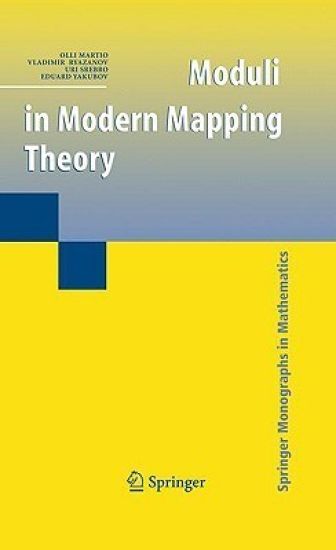
Moduli in Modern Mapping Theory

Moduli in Modern Mapping Theory

Olli Martio; Vladimir Ryazanov; Uri Srebro; Eduard Yakubov

Springer-Verlag New York Inc.
2008
sidottu
The purpose of this book is to present modern developments and applications of the techniques of modulus or extremal length of path families in the study of m- n pings in R , n? 2, and in metric spaces. The modulus method was initiated by Lars Ahlfors and Arne Beurling to study conformal mappings. Later this method was extended and enhanced by several other authors. The techniques are geom- ric and have turned out to be an indispensable tool in the study of quasiconformal and quasiregular mappings as well as their generalizations. The book is based on rather recent research papers and extends the modulus method beyond the classical applications of the modulus techniques presented in many monographs. Helsinki O. Martio Donetsk V. Ryazanov Haifa U. Srebro Holon E. Yakubov 2007 Contents 1 Introduction and Notation ...1 2 Moduli and Capacity ...7 2. 1 Introduction ...7 2. 2 Moduli in Metric Spaces...7 2. 3 Conformal Modulus ...11 2. 4 Geometric De nition for Quasiconformality ...13 2. 5 Modulus Estimates ...14 2. 6 Upper Gradients and ACC Functions ...17 p n 2. 7 ACC Functions in R and Capacity...21 p 2. 8 Linear Dilatation ...25 2. 9 Analytic De nition for Quasiconformality...31 n 2. 10 R as a Loewner Space ...34 2. 11 Quasisymmetry ...40 3 Moduli and Domains ...47 3. 1 Introduction ...47 3. 2 QED Exceptional Sets ...48 3. 3 QED Domains and Their Properties ...52 3. 4 UniformandQuasicircleDomains ...
Mathematics Without Borders

Mathematics Without Borders

Olli Lehto

Springer-Verlag New York Inc.
1997
sidottu
At its meeting in April 1990 at the University of Cambridge, the Executive Committee of the International Mathematical Union (IMU) decided that the largely unorganized archives of the Union should be properly arranged and catalogued. Simultaneously, the Executive Committee expressed the wish that a history of the Union should be written [1). As Secretary of the Union, I had proposed that these issues be dis­ cussed at the Cambridge meeting, but without having had in mind any personal role in the practical execution of such projects. At that time, the papers of the IMU were stored in Zurich, at the Eidgenossische Technische Hochschule, and I saw no reason why they could not remain there. At about this time, Professor K. Chandrasekharan produced a handwritten article titled "The Prehistory of the International Mathematical Union" [2), and it seemed to me that this might serve as the beginning of a more compre­ hensive history. I had first thought that Tuulikki MakeUiinen, who during eight years as the Office Secretary ofthe IMU had become well acquainted with the Union, would do the arranging of the archives in Zurich. She had a preliminary look at the material there, but it soon became clear that the amount of work required to bring order to it was too great to be accomplished in a few short visits from Helsinki. The total volume of material was formidable.
Intelligent Networks

Intelligent Networks

Olli Martikainen; Jarmo Harju; Tapani Karttunen

Chapman and Hall
1995
sidottu
Substantial new breakthroughs are happening in telecommunications technology. This volume presents a state-of-the-art review of the current research activities in intelligent network technology. It contains the proceedings of a workshop on intelligent networks organized by the International Federation of Information Processsing and held as part of the Third Summer School on Telecommunications in Lappeenranta, Finland, August 1994.
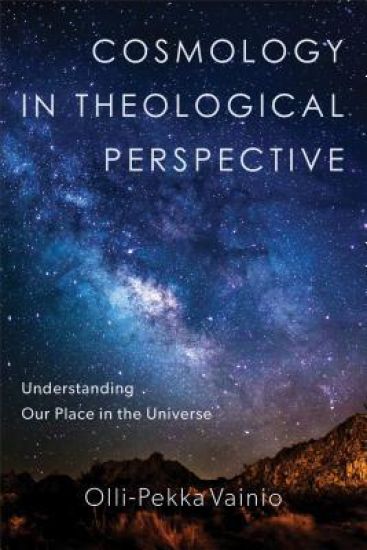
Cosmology in Theological Perspective – Understanding Our Place in the Universe

Cosmology in Theological Perspective – Understanding Our Place in the Universe

Olli–pekka Vainio

Baker Academic, Div of Baker Publishing Group
2018
nidottu
Olli-Pekka Vainio, a leading expert in science and theology, explores questions concerning the place and significance of humans in the cosmos. Vainio introduces cosmology from a "state of the question" perspective, examining the history of the idea in dialogue with C. S. Lewis. This work, which is related to a NASA-funded project on astrobiology, ties into the ongoing debate on the relationship between Christian theism and scientific worldview and shows what the stakes are for religion and theology in the rise of modern science.
Beyond Fideism

Beyond Fideism

Olli-Pekka Vainio

Taylor Francis Ltd
2021
nidottu
After the postmodern turn, every tradition seeks the right to have their own rules of rational discourse. The crucial question is: are there ways to communicate between the traditions so that the traditions do not need to give up their identities in order to take part in conversation? Vainio examines the basic assumptions behind well known types of Christian theology and seeks ways in which they might interact with one other and with other non-Christian traditions without capitulation of their identities. Vainio claims that there are religious identities that can be negotiated and communicated, and that there are ecclesiastical doctrines which can be meaningfully discussed among churches. This book explores three key areas: analysis of the uses of 'fideism' within classical Christian theology; clarification of different types of theological method that seek to express the task of theology in contemporary setting; an explanation of the contours of religious identity and rationality which takes seriously both classical Christian identity and pluralistic contexts where most of the Christian communities dwell nowadays. The proposal for "negotiability" of Christian identity draws together ideas from, among others, virtue epistemology, reformed epistemology, communitarianism, and feminist sensibilities.
Faith in Certain Terms

Faith in Certain Terms

Olli-Pekka Vainio

TAYLOR FRANCIS LTD
2023
sidottu
This book considers how certainty and faith are related in the Christian faith. It asks: How certain can Christian believers be about their beliefs about God? Should Christians doubt the assurance of their salvation? The chapters provide a historical analysis of both certainty of faith and assurance from the early Church to modern times while also paying attention to confessional differences. The author explores contemporary debates in analytic epistemology on the certainty and fallibility of our beliefs and argues for a fallibilist understanding of Christian faith. The book also addresses some less-discussed arguments that threaten the certainty of faith and offers an account of faith as cognitive practice. It will be of interest to scholars of both theology and philosophy.
Faith in Certain Terms

Faith in Certain Terms

Olli-Pekka Vainio

TAYLOR FRANCIS LTD
2025
nidottu
This book considers how certainty and faith are related in the Christian faith. It asks: How certain can Christian believers be about their beliefs about God? Should Christians doubt the assurance of their salvation? The chapters provide a historical analysis of both certainty of faith and assurance from the early Church to modern times while also paying attention to confessional differences. The author explores contemporary debates in analytic epistemology on the certainty and fallibility of our beliefs and argues for a fallibilist understanding of Christian faith. The book also addresses some less-discussed arguments that threaten the certainty of faith and offers an account of faith as cognitive practice. It will be of interest to scholars of both theology and philosophy.
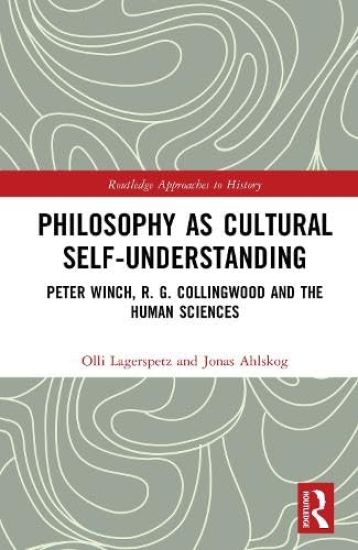
Philosophy as Cultural Self-Understanding

Philosophy as Cultural Self-Understanding

Olli Lagerspetz

TAYLOR FRANCIS LTD
2026
sidottu
This book argues for the value of reading Peter Winch (1926–1997), one of the important philosophers of the 20th century and known especially for his work on Wittgenstein and the philosophy of the social sciences, paired with R. G. Collingwood (1889–1942), famous for his philosophy of history. Both Winch’s and Collingwood’s seminal works made a deep impact on debates on the aims and methods of the human sciences. Moreover, their similarity on those topics rested on a shared vision of philosophy in general. This is the first book-length treatment of the two philosophers together. The authors make use of untapped manuscript sources and posthumous material published only in the last decades to show that Winch and Collingwood were much closer than expected, and to lay to rest some pervasive misunderstandings. Underneath their shared views on the autonomy of the human sciences was a contextualising approach to logic, language and metaphysics. An accessible articulation of Winch’s and Collingwood’s thinking on key points, this volume is valuable reading for students and scholars interested in the philosophy of history and social science, presenting a vision of philosophy as an intellectual and existential pursuit.
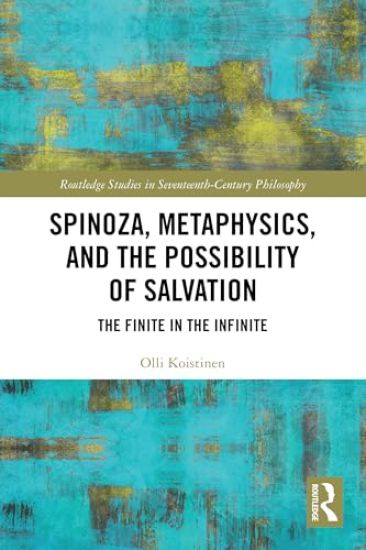
Spinoza, Metaphysics, and the Possibility of Salvation
This book offers a novel interpretation of Spinoza’s basic metaphysics of God, body, and mind. It considers the fundamental question of how finite things, especially human minds, are in God. Moreover, because for Spinoza God is identical with the universe, the question becomes how finite things are in the universe. This book shows that for Spinoza finite things are closer to God than what is thought in most contemporary Spinoza studies. It claims that the essences of finite things are degrees or, in a very specific sense of the term “part,” parts of the infinite essence of God. This book also shows how Spinoza’s basic metaphysics attempts to give us the possibility to unite with God so that we can share some of God’s perspective with the world. This new knowledge, Spinoza claims, provides the mind with eternity and a kind of individual salvation that is deeply meaningful. This book is not only a study of Spinoza’s basic concepts, but it also takes seriously what kind of epistemic attitude is required for experiencing the world truly. It is difficult to see and experience oneself in Spinoza’s monistic system where God is the only existing substance. This book offers a novel and engaging interpretation of the Ethics that takes seriously the ontological experience of Spinoza’s philosophy. Spinoza, Metaphysics, and the Possibility of Salvation is an essential resource for scholars and graduate students working on Spinoza, early modern philosophy, and metaphysics.
Spinoza, Metaphysics, and the Possibility of Salvation
This book offers a novel interpretation of Spinoza’s basic metaphysics of God, body, and mind. It considers the fundamental question of how finite things, especially human minds, are in God. Moreover, because for Spinoza God is identical with the universe, the question becomes how finite things are in the universe.This book shows that for Spinoza finite things are closer to God than what is thought in most contemporary Spinoza studies. It claims that the essences of finite things are degrees or, in a very specific sense of the term “part,” parts of the infinite essence of God. This book also shows how Spinoza’s basic metaphysics attempts to give us the possibility to unite with God so that we can share some of God’s perspective with the world. This new knowledge, Spinoza claims, provides the mind with eternity and a kind of individual salvation that is deeply meaningful. This book is not only a study of Spinoza’s basic concepts, but it also takes seriously what kind of epistemic attitude is required for experiencing the world truly. It is difficult to see and experience oneself in Spinoza’s monistic system where God is the only existing substance. This book offers a novel and engaging interpretation of the Ethics that takes seriously the ontological experience of Spinoza’s philosophy.Spinoza, Metaphysics, and the Possibility of Salvation is an essential resource for scholars and graduate students working on Spinoza, early modern philosophy, and metaphysics.
Religious Language

Religious Language

Olli-Pekka Vainio

Cambridge University Press
2020
pokkari
What does it mean to use language religiously? How does religious language differ from our ordinary linguistic practices? Can religious language have meaning? Among others, these questions are part of the so-called problem of religious language, which originates from the peculiar object of many religious claims, that is, the transcendent, or more precisely, God.
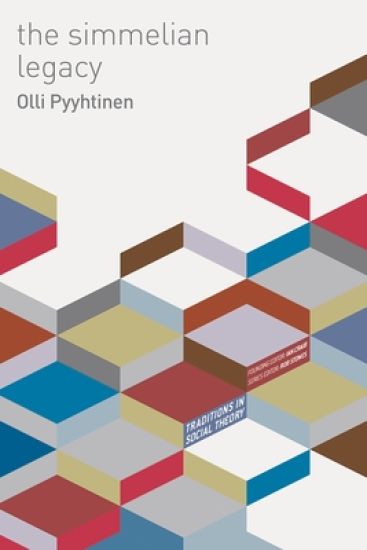
The Simmelian Legacy

The Simmelian Legacy

Olli Pyyhtinen

Red Globe Press
2017
sidottu
While Georg Simmel is widely known, the impact of his work has been far from straightforward, with the ways in which his ideas have been taken up by later thinkers as complex and diverse as the ideas themselves. The Simmelian Legacy is a comprehensive study of the work of this influential sociologist and philosopher and its reception in the Anglophone, German, and French intellectual worlds.By returning to Simmel and his legacy, this text gives voice to a corpus of vast significance and great potential that has lived too much in the shadows. It examines how his relational mode of thought transforms the landscape of sociological problems to subvert conventional conceptions of Simmel’s oeuvre as well as of sociology’s history. It not only rediscovers key dimensions of Simmel’s thought, but also explores its gradual and uneven re-emergence within subsequent scholarship.This is an engaging and lucid, intellectually illuminating and thoroughly accessible overview of the thought of one of sociology’s key thinkers that will be essential reading for both scholars and students of sociology and social theory.
The Simmelian Legacy

The Simmelian Legacy

Olli Pyyhtinen

Red Globe Press
2017
nidottu
While Georg Simmel is widely known, the impact of his work has been far from straightforward, with the ways in which his ideas have been taken up by later thinkers as complex and diverse as the ideas themselves. The Simmelian Legacy is a comprehensive study of the work of this influential sociologist and philosopher and its reception in the Anglophone, German, and French intellectual worlds.By returning to Simmel and his legacy, this text gives voice to a corpus of vast significance and great potential that has lived too much in the shadows. It examines how his relational mode of thought transforms the landscape of sociological problems to subvert conventional conceptions of Simmel’s oeuvre as well as of sociology’s history. It not only rediscovers key dimensions of Simmel’s thought, but also explores its gradual and uneven re-emergence within subsequent scholarship.This is an engaging and lucid, intellectually illuminating and thoroughly accessible overview of the thought of one of sociology’s key thinkers that will be essential reading for both scholars and students of sociology and social theory.
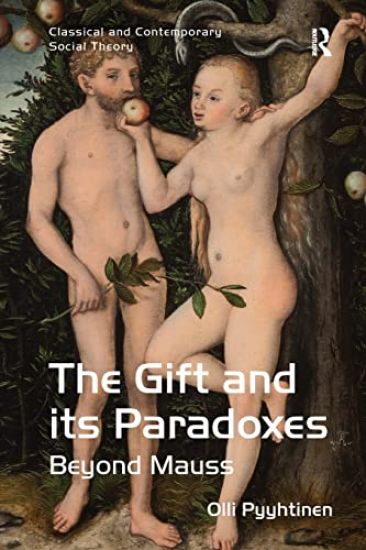
The Gift and its Paradoxes

The Gift and its Paradoxes

Olli Pyyhtinen

Routledge
2016
nidottu
Bringing social theory and philosophy to bear on popular movies, novels, myths, and fairy tales, The Gift and its Paradoxes explores the ambiguity of the gift: it is at once both a relation and a thing, alienable and inalienable, present and poison. Challenging the nature of giving as reciprocal, the book engages critically with the work of Mauss and develops a new theory of the gift according to which the gift cannot be reduced to a model of exchange, but must instead entail a loss or sacrifice. Ultimately, the gift is examined in the book as the impossible occurrence of gratuitous giving. In addition to exploring the conditions of possibility and impossibility of the gift, the book draws on the thought of figures such as Derrida, Serres, Simmel, Cixous, Irigaray and Heidegger to argue for the relevance of the phenomenon of the gift to broader issues in contemporary social sciences. It takes up questions concerning the constitution of community and the processes by which people are included in or excluded from it, gender relations, materiality, the economy, and the possibility that death itself could be a gift, in the form of euthanasia or self-sacrifice. A rigorous yet accessible examination of the phenomenon of the gift in relation to a range of contemporary concerns, The Gift and its Paradoxes will appeal to scholars and students within sociology, philosophy, anthropology, political theory and film and literature studies.