Kirjojen hintavertailu. Mukana 11 244 527 kirjaa ja 12 kauppaa.

Kirjahaku

Etsi kirjoja tekijän nimen, kirjan nimen tai ISBN:n perusteella.

416 tulosta hakusanalla Ovidia Yu

P. Ovidii Nasonis Metamorphoseon Libri XV. Cum Versione Anglica, ... Or, Ovid's Metamorphoses, with an English Translation, ... by John Clarke, ... the Seventh Edition.
The 18th century was a wealth of knowledge, exploration and rapidly growing technology and expanding record-keeping made possible by advances in the printing press. In its determination to preserve the century of revolution, Gale initiated a revolution of its own: digitization of epic proportions to preserve these invaluable works in the largest archive of its kind. Now for the first time these high-quality digital copies of original 18th century manuscripts are available in print, making them highly accessible to libraries, undergraduate students, and independent scholars.Western literary study flows out of eighteenth-century works by Alexander Pope, Daniel Defoe, Henry Fielding, Frances Burney, Denis Diderot, Johann Gottfried Herder, Johann Wolfgang von Goethe, and others. Experience the birth of the modern novel, or compare the development of language using dictionaries and grammar discourses. ++++The below data was compiled from various identification fields in the bibliographic record of this title. This data is provided as an additional tool in helping to insure edition identification: ++++National Library of ScotlandN009931Latin text with English prose translation.London: printed for J. F. and C. Rivington; T. Longman, and T. Evans, 1779. viii,479, 1]p.; 8
Pub. Ovidii Nasonis Epistolarum heroidum liber
The 18th century was a wealth of knowledge, exploration and rapidly growing technology and expanding record-keeping made possible by advances in the printing press. In its determination to preserve the century of revolution, Gale initiated a revolution of its own: digitization of epic proportions to preserve these invaluable works in the largest archive of its kind. Now for the first time these high-quality digital copies of original 18th century manuscripts are available in print, making them highly accessible to libraries, undergraduate students, and independent scholars.Western literary study flows out of eighteenth-century works by Alexander Pope, Daniel Defoe, Henry Fielding, Frances Burney, Denis Diderot, Johann Gottfried Herder, Johann Wolfgang von Goethe, and others. Experience the birth of the modern novel, or compare the development of language using dictionaries and grammar discourses. ++++The below data was compiled from various identification fields in the bibliographic record of this title. This data is provided as an additional tool in helping to insure edition identification: ++++British LibraryT099242Londini: impensis H. Bonwick, Jo. Nicolson, & T. Newborough, 1702. 4],242, 64]p.; 8
P. Ovidii Nasonis metamorphoseon libri XV. Cum variis lectionibus ... With Abbé Banier's arguments and explanations of the history of mythology of each fable in English.
The 18th century was a wealth of knowledge, exploration and rapidly growing technology and expanding record-keeping made possible by advances in the printing press. In its determination to preserve the century of revolution, Gale initiated a revolution of its own: digitization of epic proportions to preserve these invaluable works in the largest archive of its kind. Now for the first time these high-quality digital copies of original 18th century manuscripts are available in print, making them highly accessible to libraries, undergraduate students, and independent scholars.Western literary study flows out of eighteenth-century works by Alexander Pope, Daniel Defoe, Henry Fielding, Frances Burney, Denis Diderot, Johann Gottfried Herder, Johann Wolfgang von Goethe, and others. Experience the birth of the modern novel, or compare the development of language using dictionaries and grammar discourses. ++++The below data was compiled from various identification fields in the bibliographic record of this title. This data is provided as an additional tool in helping to insure edition identification: ++++Huntington LibraryT099263Londini: impensis Sam. Harding, 1747. xv, 1],607, 11]p.; 8
P. Ovidii Nasonis Metamorphoseon libri XV. Cum versione Anglica, ... or, Ovid's Metamorphoses, with an English translation, ... By John Clarke, ... The seventh edition.
The 18th century was a wealth of knowledge, exploration and rapidly growing technology and expanding record-keeping made possible by advances in the printing press. In its determination to preserve the century of revolution, Gale initiated a revolution of its own: digitization of epic proportions to preserve these invaluable works in the largest archive of its kind. Now for the first time these high-quality digital copies of original 18th century manuscripts are available in print, making them highly accessible to libraries, undergraduate students, and independent scholars.Western literary study flows out of eighteenth-century works by Alexander Pope, Daniel Defoe, Henry Fielding, Frances Burney, Denis Diderot, Johann Gottfried Herder, Johann Wolfgang von Goethe, and others. Experience the birth of the modern novel, or compare the development of language using dictionaries and grammar discourses. ++++The below data was compiled from various identification fields in the bibliographic record of this title. This data is provided as an additional tool in helping to insure edition identification: ++++National Library of ScotlandN009931Latin text with English prose translation.London: printed for J. F. and C. Rivington; T. Longman, and T. Evans, 1779. viii,479, 1]p.; 8
P. Ovidii Nasonis Metamorphoseon, cum Versione Anglica, ad Verbum, Quantum Fieri Potuit, Facta. Or, Ovid's Metamorphoses. With an English Translation, as Literal as Possible, of all the Parts That are Read in Schools
The 18th century was a wealth of knowledge, exploration and rapidly growing technology and expanding record-keeping made possible by advances in the printing press. In its determination to preserve the century of revolution, Gale initiated a revolution of its own: digitization of epic proportions to preserve these invaluable works in the largest archive of its kind. Now for the first time these high-quality digital copies of original 18th century manuscripts are available in print, making them highly accessible to libraries, undergraduate students, and independent scholars.Western literary study flows out of eighteenth-century works by Alexander Pope, Daniel Defoe, Henry Fielding, Frances Burney, Denis Diderot, Johann Gottfried Herder, Johann Wolfgang von Goethe, and others. Experience the birth of the modern novel, or compare the development of language using dictionaries and grammar discourses. ++++The below data was compiled from various identification fields in the bibliographic record of this title. This data is provided as an additional tool in helping to insure edition identification: ++++British LibraryT120172Dublin: printed by H. Saunders, 1770. viii,280p.; 8
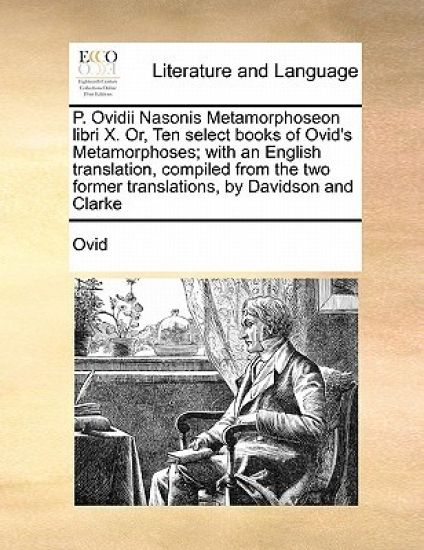
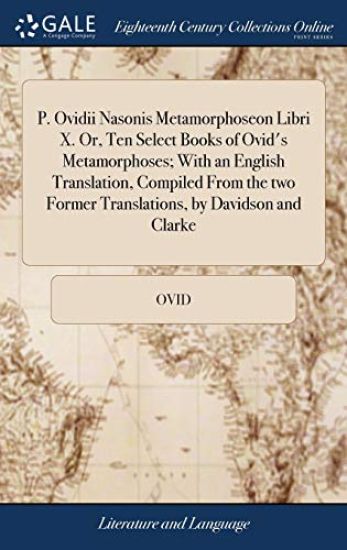
P. Ovidii Nasonis Metamorphoseon Libri X. Or, Ten Select Books of Ovid's Metamorphoses; With an English Translation, Compiled From the two Former Translations, by Davidson and Clarke
The 18th century was a wealth of knowledge, exploration and rapidly growing technology and expanding record-keeping made possible by advances in the printing press. In its determination to preserve the century of revolution, Gale initiated a revolution of its own: digitization of epic proportions to preserve these invaluable works in the largest archive of its kind. Now for the first time these high-quality digital copies of original 18th century manuscripts are available in print, making them highly accessible to libraries, undergraduate students, and independent scholars.Western literary study flows out of eighteenth-century works by Alexander Pope, Daniel Defoe, Henry Fielding, Frances Burney, Denis Diderot, Johann Gottfried Herder, Johann Wolfgang von Goethe, and others. Experience the birth of the modern novel, or compare the development of language using dictionaries and grammar discourses. ++++The below data was compiled from various identification fields in the bibliographic record of this title. This data is provided as an additional tool in helping to insure edition identification: ++++Library of CongressW027557Philadelphia: Printed by William Spotswood, M.DCC.XC. 1790]. iv, 40], 328 p.; 12
Pub. Ovidii Nasonis Tristia

Pub. Ovidii Nasonis Tristia

Ovid

Gale Ecco, Print Editions
2018
sidottu
The 18th century was a wealth of knowledge, exploration and rapidly growing technology and expanding record-keeping made possible by advances in the printing press. In its determination to preserve the century of revolution, Gale initiated a revolution of its own: digitization of epic proportions to preserve these invaluable works in the largest archive of its kind. Now for the first time these high-quality digital copies of original 18th century manuscripts are available in print, making them highly accessible to libraries, undergraduate students, and independent scholars.Western literary study flows out of eighteenth-century works by Alexander Pope, Daniel Defoe, Henry Fielding, Frances Burney, Denis Diderot, Johann Gottfried Herder, Johann Wolfgang von Goethe, and others. Experience the birth of the modern novel, or compare the development of language using dictionaries and grammar discourses. ++++The below data was compiled from various identification fields in the bibliographic record of this title. This data is provided as an additional tool in helping to insure edition identification: ++++British LibraryT099834With a notice of the royal licence printed on the verso of the initial leaf. With a glossary.London: printed, with His Majesty's royal licence and privilege, for Thomas Astley, and sold by R. Baldwin, jun., 1752. 6],176,80p.; 8
John of Garland, "Integumenta Ovidii"

John of Garland, "Integumenta Ovidii"

Medieval Institute Publications
2022
sidottu
The renowned scholar-poet John of Garland wrote the Integumenta Ovidii (“Allegories on Ovid”) in early thirteenth-century Paris at a time of renewed interest in Classical Latin literature. In this short poem, John offers a series of dense, highly allusive allegories on various Greek and Roman myths in Ovid’s Metamorphoses. This important but difficult work has fascinated and challenged generations of modern students and scholars. The text is here edited and translated for the first time in 90 years, drawing on the evidence of over two dozen manuscripts. Comprehensive explanatory notes help readers to understand John’s condensed allegories in their medieval context. Textual notes discuss the various difficulties in the transmitted text of the poem, and offer several improvements on the texts of the older editions.
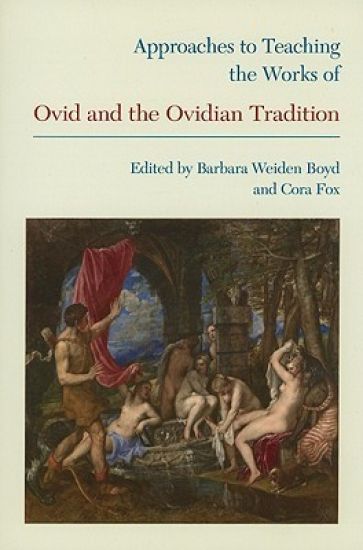
Approaches to Teaching the Works of Ovid and the Ovidian Tradition
Ovid and his influence are studied in classrooms as various as his poetry, and this Approaches volume aims to help instructors in those diverse teaching environments. Part 1, “Materials,” is fittingly collaborative and features brief overviews designed to give nonspecialists background on the more challenging aspects of teaching Ovid. Contributors examine his life and legacy, religion, and relation to the visual arts as well as his afterlife in the Latin classroom, in various translations, and in the Ovide moralisé. The editors detail the contexts in which Ovid is taught, identify trends in teaching his work and the Ovidian tradition, and recommend editions and resources for classroom use.The introduction to part 2, “Approaches,” considers Ovid’s relation to Vergil and the development of Ovid’s influence and reception, from the medieval and early modern period to the reinvigoration of Ovid studies in the twentieth century. In the four sections that follow, contributors provide practical ideas for classroom instruction, examine the political and moral discourses shaping Ovid and his legacy, explore how gender and the body are represented in Ovid and the Ovidian tradition, and look at various ways Ovid’s works have been used and transformed by writers as diverse as Dante, Cervantes, and Ransmayr.