Kirjojen hintavertailu. Mukana 11 342 296 kirjaa ja 12 kauppaa.

Kirjahaku

Etsi kirjoja tekijän nimen, kirjan nimen tai ISBN:n perusteella.

1000 tulosta hakusanalla Peter J. Perry

Idioms of Uncertainty

Idioms of Uncertainty

Peter J. Burgard

Pennsylvania State University Press
1992
sidottu
Goethe's essays have been culled for their literary, aesthetic, and scientific content, by the textuality and their location at the nexus of genre and literary history have not received the critical attention they deserve. In Idioms of Uncertainty, Peter Burgard analyzes the rhetorical strategies, structure, and style of pivotal essays and relates them to the essay traditions as represented by Montaigne and Johnson. By formulating the critique of systematic philosophy inherent in the essays and by investigating their participation in the principal aesthetic dialogue of the age—the Laocoön debate, which spanned nearly half a century—Burgard situates them in the context of eighteenth-century critical discourse.Furthermore, by disclosing the connection between the anti-systematic, dialogic impetus of Goethe's essayism and the theme of community in his literary works, Idioms of Uncertainty both draws out the broader social implications of the essay and shows how the analysis of Goethe's work in the genre can illuminate his entire oeuvre.In the course of the study Burgard articulates a theory of the essay as a genre by drawing on twentieth-century theoretical perspectives for his exposition of Goethe's textual strategies: theories of the essay from Lukacs, Bense, and Adorno; the textual theories of Bakhtin, Kristeva, Barthes, and Derrida; and Rorty's notion of literary-philosophical conversation. Idioms of Uncertainty thus holds interest for those concerned with genre theory and literary theory in general; and through its challenging of clichés about German literature at the time it assumed international significance, the book will be useful not only for Goethe scholars but also for scholars of the eighteenth century across disciplines and national boundaries.
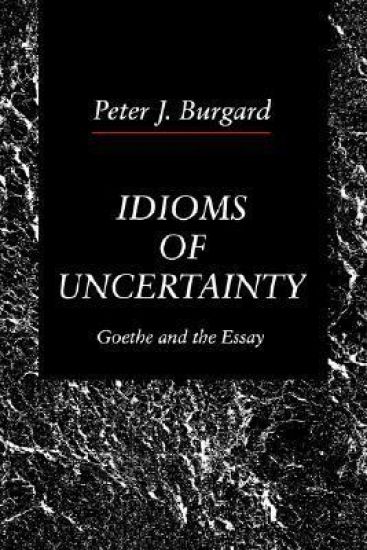
Idioms of Uncertainty

Idioms of Uncertainty

Peter J. Burgard

Pennsylvania State University Press
1992
pokkari
Goethe's essays have been culled for their literary, aesthetic, and scientific content, by the textuality and their location at the nexus of genre and literary history have not received the critical attention they deserve. In Idioms of Uncertainty, Peter Burgard analyzes the rhetorical strategies, structure, and style of pivotal essays and relates them to the essay traditions as represented by Montaigne and Johnson. By formulating the critique of systematic philosophy inherent in the essays and by investigating their participation in the principal aesthetic dialogue of the age—the Laocoön debate, which spanned nearly half a century—Burgard situates them in the context of eighteenth-century critical discourse.Furthermore, by disclosing the connection between the anti-systematic, dialogic impetus of Goethe's essayism and the theme of community in his literary works, Idioms of Uncertainty both draws out the broader social implications of the essay and shows how the analysis of Goethe's work in the genre can illuminate his entire oeuvre.In the course of the study Burgard articulates a theory of the essay as a genre by drawing on twentieth-century theoretical perspectives for his exposition of Goethe's textual strategies: theories of the essay from Lukacs, Bense, and Adorno; the textual theories of Bakhtin, Kristeva, Barthes, and Derrida; and Rorty's notion of literary-philosophical conversation. Idioms of Uncertainty thus holds interest for those concerned with genre theory and literary theory in general; and through its challenging of clichés about German literature at the time it assumed international significance, the book will be useful not only for Goethe scholars but also for scholars of the eighteenth century across disciplines and national boundaries.

Organizations and the Psychological Contract

Organizations and the Psychological Contract

Peter J. Makin; Cary L. Cooper; Charles J. Fox

Praeger Publishers Inc
1996
nidottu
Contracts in employment are of two kinds: the formal, written contract and the equally important, informal and unwritten psychological contract—how people think they should be treated. Both involve rights, obligations and expectations on the part of the employer and the employee, and a breach in one can have important effects on the other. For example, how people feel they are being treated by the organization can affect their perception of their levels of pay. Organizations and the Psychological Contract has two main aims in exploring these issues: to act as a handbook for practicing managers, and as a basic text in management courses. Organizations and the Psychological Contract has two main aims in exploring these issues in the organizational context: to act as a handbook for practicing managers, and as a basic text in management courses. Relevant theories are explained and developed using practical examples, self-assessment exercises, and case studies. This is a revised and much expanded version of Managing People at Work, with the addition of chapters on Selection and Career Development, Understanding and Coping with Change, Empowerment and Self-Management, and the Behavioural Approach to Motivation. As well as undertaking research into many aspects of organizational life, the authors have many years' experience as consultants, acting for industrial and commercial organizations in all sectors of the economy.
The Human Genome Project and Minority Communities

The Human Genome Project and Minority Communities

Peter J. Balint; Raymond A. Zilinskas

Praeger Publishers Inc
2000
sidottu
Zilinskas and Balint and their contributors examine the divisions between minority groups and the scientific community, particularly in the area of medical and genetic research. Minorities have reasons to be skeptical of medical research in general and genetics research in particular. The sad history of the Tuskegee experiment, in which black men with syphilis were left untreated so that the course of the disease could be studied, undermined confidence in the ethics of medical researchers. More recently, publication of The Bell Curve reanimated controversy over purported genetic distinctions among the races that could have powerfully negative social implications.In contrast, as the essays make clear, the Human Genome Project, conducted in accordance with the highest ethical standards, has the potential to make dramatic positive contributions to the health of all human beings. Members of minority communities in particular—who statistically are at high risk of adverse health outcomes in the United States—have much to gain from innovative medical diagnostics and therapies that will result from the study of human genetics. Therefore, if we are to benefit fully from this new knowledge, it is vital that the distrust, skepticism, and misconceptions relating to genetics research be overcome. This is a provocative collection for scholars, students, researchers, and community leaders involved with minority and public health issues.
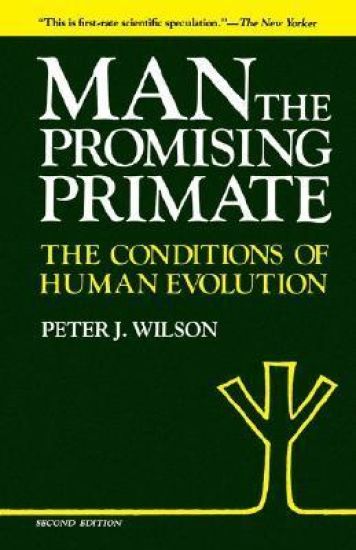
Man, The Promising Primate

Man, The Promising Primate

Peter J. Wilson

Yale University Press
1983
pokkari
In spite of recent advances in the study of evolution, scholars have shied away from the most intriguing problem of all—how and why animal nature became human nature. In confronting this problem, Peter Wilson leads his readers on a fascinating exploration. What made it possible, he asks, for one genus of the order Primates, living in Africa in the Plio-Pleistocene era, to become human and to develop culture? Continuing the tradition of bold speculation fathered by the philosophical anthropology of Hobbes and Rousseau, Wilson seeks to unravel the evidence for such basic human adaptations as self-conscious thought, symbolic kinship, ritual behavior, and objective reasoning. While genetics may account for potentialities and limits, Wilson argues that the actual evolution of a species can be understood only in relation to the changing conditions of its environment. Rejecting the idea of a human evolutionary leap as contradicting Darwin’s theory, Wilson shows how the continuity of the genus Homo within the order Primates is to be found in generalization. Man was and is a promising primate, of endless potential coupled with a vulnerable need to exchange promises. From these emerge kinship systems, society, and culture. This incisive and gracefully written book offers both a new synthesis and a fresh starting point for evolutionists in several disciplines. Its central argument and special insights—into fatherhood, the incest taboo, marriage, and the relation of food to thought—challenge current emphasis on biogenetic determinism and provide a new approach to anthropological theorizing.
The Domestication of the Human Species

The Domestication of the Human Species

Peter J. Wilson

Yale University Press
1991
pokkari
In the exciting book Peter J. Wilson takes domestication as the starting point for his continued inquiry into human evolution. Wilson argues that settling down into a built environment was the most radical and far-reaching innovation in human development and that it had a crucial effect on human psychology and social relations. The insights of this book point the way toward amendments to social theories that will challenge the professional reader and at the same time offer to the general reader an enriched understanding of human behavior and human history. “This book is a rare occurrence: a total rethinking of a set of closely related fundamental problems in the understanding of human evolution….[An] immensely ambitious undertaking.”—Paul Wheatley, Contemporary Sociology“This approach merges societies in surprising ways….It certainly leads to some provocative and stimulating generalizations.”—John Bodley, American journal of Physical Anthropology“Perhaps this book is revolutionary…asking us to rethink human nature, its causes, its cures…It holds out the real possibilities of redoing the human condition by reconceptualizing the power of our environs….[Wilson] has given is a book that is hard to put down once begun, and one whose ideas are even harder to dismiss.”—Harvey B. Sarles, Contemporary Psychology“This is definitely a book on which to sharpen one’s wits….The author invites the reader to think with him about matters not only past but also present which have much relevance for our future. This book makes lively and mind-stretching reading.”—Ashley Montagu
William Clark's World

William Clark's World

Peter J. Kastor

Yale University Press
2011
sidottu
William Clark, co-captain of the famous Lewis and Clark Expedition, devoted his adult life to describing the American West. But this task raised a daunting challenge: how best to bring an unknown continent to life for the young republic? Through Clark's life and career, this book explores how the West entered the American imagination. While he never called himself a writer or an artist, Clark nonetheless drew maps, produced books, drafted reports, surveyed landscapes, and wrote journals that made sense of the West for a new nation fascinated by the region’s potential but also fearful of its dangers. William Clark’s World presents a new take on the manifest destiny narrative and on the way the West took shape in the national imagination in the early nineteenth century.
Into the Black

Into the Black

Peter J. Westwick

Yale University Press
2011
pokkari
In the decades since the mid-1970s, the Jet Propulsion Laboratory in Pasadena, California, has led the quest to explore the farthest reaches of the solar system. JPL spacecraft—Voyager, Magellan, Galileo, the Mars rovers, and others—have brought the planets into close view. JPL satellites and instruments also shed new light on the structure and dynamics of earth itself, while their orbiting observatories opened new vistas on the cosmos. This comprehensive book recounts the extraordinary story of the lab's accomplishments, failures, and evolution from 1976 to the present day.This history of JPL encompasses far more than the story of the events and individuals that have shaped the institution. It also engages wider questions about relations between civilian and military space programs, the place of science and technology in American politics, and the impact of the work at JPL on the way we imagine the place of humankind in the universe.
The Nation's Crucible

The Nation's Crucible

Peter J. Kastor

Yale University Press
2012
pokkari
In 1803 the United States purchased Louisiana from France. This seemingly simple acquisition brought with it an enormous new territory as well as the country’s first large population of nonnaturalized Americans—Native Americans, African Americans, and Francophone residents. What would become of those people dominated national affairs in the years that followed. This book chronicles that contentious period from 1803 to 1821, years during which people proposed numerous visions of the future for Louisiana and the United States.The Louisiana Purchase proved to be the crucible of American nationhood, Peter Kastor argues. The incorporation of Louisiana was among the most important tasks for a generation of federal policymakers. It also transformed the way people defined what it meant to be an American.
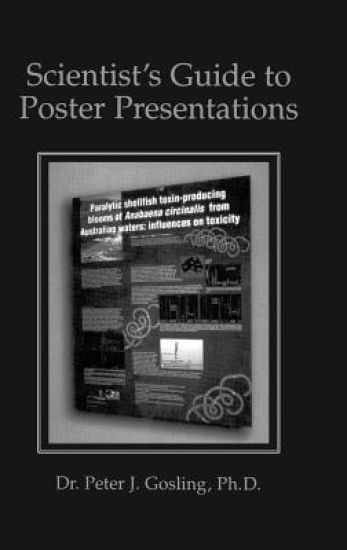
Scientist’s Guide to Poster Presentations

Scientist’s Guide to Poster Presentations

Peter J. Gosling

Kluwer Academic/Plenum Publishers
1999
sidottu
Scientific information is increasingly being communicated at both national and international scientific conferences in the form of poster presentations. A recent international conference, for example, which involved nearly 500 delegates from over 50 different countries, included information presented in 331 posters. Recent experience has shown, however, that the presentational stan­ dard of such posters, even at the international level, varies immensely. Individuals presenting well-designed, eye-catching, and engaging post­ ers are at a distinct advantage in promoting their scientific information. In doing so, they also promote themselves as credible scientists, as well as promoting the reputation of their establishments and countries of origin. However, producing a poster of high quality requires considerable plan­ ning and the acquisition of specific presentational skills. This book provides detailed practical guidance on all aspects of pre­ senting scientific information in the form of posters. It is assumed that the presenter has access, either at home, at work, or through libraries, to a computer or word processor, a color printer, and photocopiers. The book is intended to help scientists to gain poster presentational skills in a man­ ner that enables adoption of an individualistic style of presenting infor­ mation in a credible fashion. The book has relevance internationally and is primarily targeted at research workers, including postgraduate students and all scientific professionals who are required to present visual commu­ nication of scientific information.
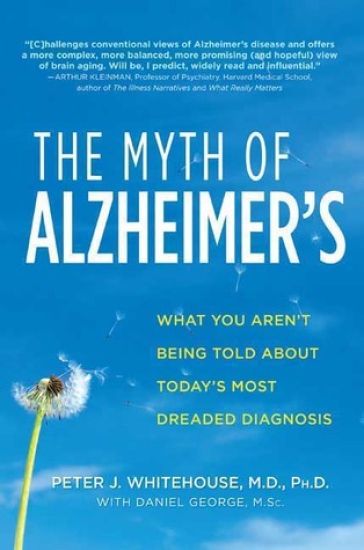
The Myth of Alzheimer's

The Myth of Alzheimer's

Peter J. Whitehouse; Daniel George

St. Martin's Griffin
2008
nidottu
Dr. Peter Whitehouse will transform the way we think about Alzheimer's disease. In this provocative and ground-breaking book he challenges the conventional wisdom about memory loss and cognitive impairment; questions the current treatment for Alzheimer's disease; and provides a new approach to understanding and rethinking everything we thought we knew about brain aging.The Myth of Alzheimer's provides welcome answers to the questions that millions of people diagnosed with Alzheimer's disease - and their families - are eager to know: Is Alzheimer's a disease?What is the difference between a naturally aging brain and an Alzheimer's brain?How effective are the current drugs for AD? Are they worth the money we spend on them? What kind of hope does science really have for the treatment of memory loss? And are there alternative interventions that can keep our aging bodies and minds sharp?What promise does genomic research actually hold? What would a world without Alzheimer's look like, and how do we as individuals and as human communities get there? Backed up by research, full of practical advice and information, and infused with hope, THE MYTH OF ALZHEIMER'S will liberate us from this crippling label, teach us how to best approach memory loss, and explain how to stave off some of the normal effects of aging. "I don't have a magic bullet to prevent your brain from getting older, and so I don't claim to have the cure for AD; but I do offer a powerful therapy--a new narrative for approaching brain aging that undercuts the destructive myth we tell today. Most of our knowledge and our thinking is organized in story form, and thus stories offer us the chief means of making sense of the present, looking into the future, and planning and creating our lives. New approaches to brain aging require new stories that can move us beyond the myth of Alzheimer's disease and towards improved quality of life for all aging persons in our society. It is in this book that your new story can begin." -Peter Whitehouse, M.D., Ph.D.
The Transformation of Rhode Island, 1790-1860

The Transformation of Rhode Island, 1790-1860

Peter J. Coleman

Praeger Publishers Inc
1985
sidottu
Coleman analyzes demographics, revealing a central factor in Rhode Island's history--the extraordinary disparity from one town to another. There are sharp differences ranging from growth rates, population density, and the degree of urbanization to ethnic composition, mobility, and the incidence of illiteracy. Far from being homogeneous, as many believe, Rhode Island actually comprised a bundle of discreet entities, each of which responded distinctively to its opportunities.
Mozart in Person

Mozart in Person

Peter J. Davies

Praeger Publishers Inc
1989
sidottu
The real key to this distinctive book lies in its subtitle. The book's core is an astonishingly detailed medical history of Mozart, spanning his entire life, compiled with great ingenuity and skill from varied and sometimes surprising sources. Davies, a British physician specializing in internal medicine, has already established his credentials with a series of substantial journal articles concerning Mozart's final illness and death. Here he expands and consolidates his research, offering a presumably definitive account of the intricate cluster of ailments and disabilities, some stretching back over many years, that eventually contributed to Mozart's early death. After reading Davies, one wonders not at Mozart's early end but, rather, how he survived for so long. . . . Davies advances unexpected medical causes for some Mozartean peculiarities of behavior, and surely these ideas will provoke much interest among Mozart scholars. For college or university libraries that already have the `basic' Mozart items, here is a unique and most rewarding addition. Choice There have been many studies of Mozart, but few offer as rich an understanding of the composer's character as this book. Mozart in Person appraises the physical, mental, and spiritual aspects of Mozart's health and its effect on his creativity. As Erna Schwerin says in the introduction, Mozart emerges as a human being, realistically perceived with twentieth-century sensibility, yet retrospectively in the light of eighteenth-century mores. This is the first volume to describe all of Mozart's known illnesses and to present a detailed discussion of the controversial cause of his premature death, with a convincing refutation of the alleged poisoning theories. Davies defines Mozart's enigmatic, complex personality, and presents fascinating insights into Mozart's relationships with his pastimes and stresses. The health of Mozart's family, especially the personality, illnesses, and death of his father are discussed. The author explores many of the myths surrounding this great and often misunderstood composer and clarifies our understanding of Mozart's flaws and shortcomings through authentic documentation, thereby eliminating some of the distortions created in recent popular plays and films. There is a detailed review of Mozartian economics, including the composer's debts, extravagance, and gambling proclivities. Yet another highlight of the book is an up-to-date account of exciting recent research on Mozart's skull and the bronze death mask. The first book in English devoted entirely to Mozart's physical and mental health, Mozart in Person contains a comprehensive bibliography of books and articles from musical and medical literatures. The state of medical knowledge in eighteenth-century Europe and glossary of medical terms are presented. Although suitable for nonspecialist research, this volume will also have wide academic appeal in the study of medicine, psychology, and music, and will be a welcome addition to all general libraries.
Beethoven in Person

Beethoven in Person

Peter J. Davies

Praeger Publishers Inc
2001
sidottu
This critical reevaluation of the causes of many of Beethoven's illnesses offers detailed accounts of the treatments applied by his physicians and a comprehensive rendering of the composer's final illness, death, and burial. Separate chapters discuss the causes of many of Beethoven's illnesses, his autopsy and the exhumations. Following the rediscovery of the original Latin autopsy report in 1970, the author has discovered two faulty translations, which he argues contributed to errors in earlier medical assumptions. New evidence disputes earlier assertions that Beethoven's deafness resulted from syphilis. This fascinating account of Beethoven's ailments should appeal to Beethoven enthusiasts and to both the medical and music communities.
The Character of a Genius

The Character of a Genius

Peter J. Davies

Praeger Publishers Inc
2001
sidottu
Beethoven's often-discussed dark side--marked by paranoia, narcissism, and obsession--is brought into focus by Peter J. Davies, who examines both the composer's genetic roots and the familial cruelty and neglect that defined his childhood. But this book is more than a biography, eschewing facile psychoanalysis in favor of a real exploration of how Beethoven's character shaped the work now universally regarded as among the best music ever written. Davies acutely observes the ways in which suffering can bring, at the same time, both madness and genius. The author begins by tracing the medical history of mental disorders in Beethoven's family, and then goes on to detail the composer's religious beliefs and attitudes, his daily work habits and pastimes, and elements of his character including manic depression. Though the work does not purport to be a musical analysis, it does consider the many ways in which the things that shape an artist go on to shape his art.
COPD, An Issue of Clinics in Chest Medicine

COPD, An Issue of Clinics in Chest Medicine

Peter J Barnes

Elsevier - Health Sciences Division
2014
sidottu
This issue of Clinics in Chest Medicine is Guest Edited by Peter J. Barnes FRS, FMedSci from Imperial College London and will fosus on COPD. Article topics include epidemiology, pathophysiology, cellular and molecular mechanisms and comorbidities of COPD, diagnosis and phenotype of COPD, pulmonary rehabilitation, asthma and COPD, biomarkers, bronchodilators, non invasive ventialtion, and new drug therapies.
Endocrine Surgery, An Issue of Surgical Clinics

Endocrine Surgery, An Issue of Surgical Clinics

Peter J. Mazzaglia

Elsevier - Health Sciences Division
2014
sidottu
Editor Peter Mazzaglia and authors review the current management and procedures in endocrine surgery. Articles will cover: central compartment lymph node dissection for papillary thyroid cancer; evaluation of thyroid incidentaloma; the role of genetic markers in the evaluation and management of thyroid nodules; medical therapy for advanced forms of thyroid cancer; follicular lesions of the thyroid; controversy over radio-iodine ablation: who benefits?; minimizing cost while maximizing success in the pre-operative localization strategy for primary hyperparathyroidism; operative treatment for primary hyperparathyroidism; evaluation of adrenal incidentalomas: biochemical and radiographic characterization; hyperaldosteronism: diagnosis, lateralization, and treatment; subclinical Cushing's syndrome; adrenocortical cancer update; and pancreatic neuroendocrine tumors.
Obstetric and Gynecologic Emergencies, An Issue of Critical Care Clinics

Obstetric and Gynecologic Emergencies, An Issue of Critical Care Clinics

Peter J. Papadakos; Susan E. Dantoni

Elsevier - Health Sciences Division
2015
sidottu
This issue of Critical Care Clinics focuses on Obstetric and Gynecologic Emergencies in the ICU. Articles include: Respiratory Failure and Mechanical Ventilation in the Pregnant Patient, Anesthetic Complications in Pregnancy, Neurologic Complications in Pregnancy, Renal Failure in Pregnancy, Management Complex Cardiac Issues in the Pregnant Patient, Liver Failure in Pregnancy, Hypertensive Emergencies in Pregnancy, Ethical Issues in Pregnancy, and more!
Netter's Integrated Musculoskeletal System

Netter's Integrated Musculoskeletal System

Peter J. Ward

Elsevier - Health Sciences Division
2021
nidottu
Netter's Integrated Musculoskeletal System is an innovative new text that brings together basic science material from several domains, providing a solid foundation prior to delving into topics of increasing complexity and clinical importance -all highlighted by superb Netter illustrations throughout. Initial chapters give a general overview of the human body, while the remaining chapters examine all facets of the musculoskeletal system, the injuries that affect it at the macroscopic and microscopic levels, and the process of development. As the scientific content becomes more complex, the clinical correlations become more specific. This progressively constructed narrative guides readers efficiently and effectively through the intricacies of the musculoskeletal system in a way that is easy to understand and remember-all in a single, time-saving resource for busy students. Takes an integrated approach including gross anatomy, physiology, biochemistry, neuroscience, histology, and other relevant sciences to better help readers understand the musculoskeletal system. Presents essential content in an easy-to-understand manner, puts it in context, and then elaborates on it with more detail-making connections between content areas and reducing the need for multiple study resources. Features clinical correlations boxes throughout; includes an appendix of commonly-used eponyms to help readers communicate across disciplines and an appendix of Latin/Greek/Arabic roots for anatomical terms. Designed to be used effectively in longitudinally-designed, integrated curricula-for a wide range of health-science students-with carefully organized, concise reading assignments and discrete areas of study for each lesson. Enhanced eBook version included with purchase. Your enhanced eBook allows you to access all of the text, figures, and references from the book on a variety of devices.