Kirjojen hintavertailu. Mukana 11 627 220 kirjaa ja 12 kauppaa.

Kirjahaku

Etsi kirjoja tekijän nimen, kirjan nimen tai ISBN:n perusteella.

1000 tulosta hakusanalla Phyllis Phillips

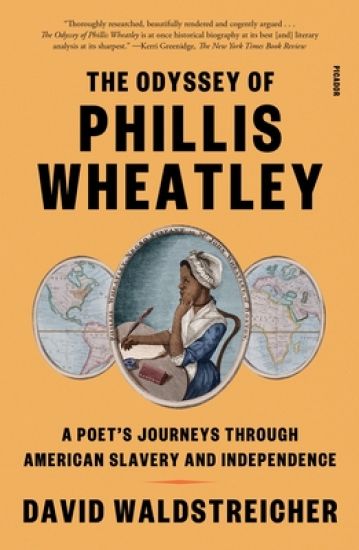
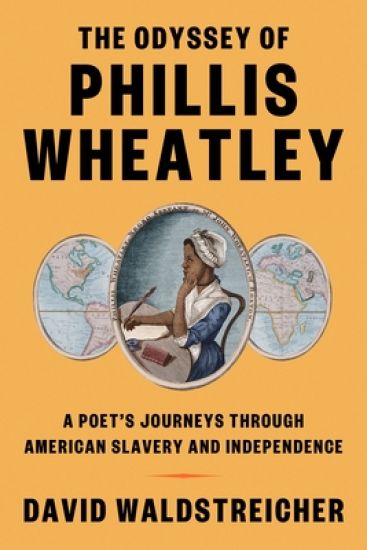
The Odyssey of Phillis Wheatley: A Poet's Journeys Through American Slavery and Independence
A New York Times notable book of 2023 A finalist for the Los Angeles Times Book Prize for biography Winner of the 2024 George Washington Prize" An] erudite, enlightening new biography . . . Waldstreicher's] interpretations equal Wheatley's own intentional verse, making it a joy to follow along as he unpacks her words and their arrangement." --Tiya Miles, The Atlantic"Thoroughly researched, beautifully rendered and cogently argued . . . The Odyssey of Phillis Wheatley is . . .] historical biography at its best." --Kerri Greenidge, The New York Times Book Review (Editors' Choice)A paradigm-shattering biography of Phillis Wheatley, whose extraordinary poetry set African American literature at the heart of the American Revolution. Admired by George Washington, ridiculed by Thomas Jefferson, published in London, and read far and wide, Phillis Wheatley led one of the most extraordinary American lives. Seized in West Africa and forced into slavery as a child, she was sold to a merchant family in Boston, where she became a noted poet at a young age. Mastering the Bible, Greek and Latin translations, and the works of Pope and Milton, she composed elegies for local elites, celebrated political events, praised warriors, and used her verse to variously lampoon, question, and assert the injustice of her enslaved condition. "Can I then but pray / Others may never feel tyrannic sway?" By doing so, she added her voice to a vibrant, multisided conversation about race, slavery, and discontent with British rule; before and after her emancipation, her verses shook up racial etiquette and used familiar forms to create bold new meanings. She demonstrated a complex but crucial fact of the times: that the American Revolution both strengthened and limited Black slavery. In this new biography, the historian David Waldstreicher offers the fullest account to date of Wheatley's life and works, correcting myths, reconstructing intimate friendships, and deepening our understanding of her verse and the revolutionary era. Throughout The Odyssey of Phillis Wheatley, he demonstrates the continued vitality and resonance of a woman who wrote, in a founding gesture of American literature, "Thy Power, O Liberty, makes strong the weak / And (wond'rous instinct) Ethiopians speak."
The Age of Phillis

The Age of Phillis

Honorée Fanonne Jeffers

WESLEYAN UNIVERSITY PRESS
2022
nidottu
In 1773, a young, African American woman named Phillis Wheatley Peters published a book of poetry that challenged Western prejudices about African and female intellectual capabilities. Based on fifteen years of archival research, The Age of Phillis, by award-winning writer Honorée Fanonne Jeffers, imagines the life and times of Wheatley: her childhood in the Gambia, West Africa, her life with her white American owners, her friendship with Obour Tanner, and her marriage to the enigmatic John Peters. Woven throughout are poems about Wheatley's "age" - the era that encompassed political, philosophical, and religious upheaval, as well as the transatlantic slave trade. For the first time in verse, Wheatley's relationship to black people and their individual "mercies" is foregrounded, and here we see her as not simply a racial or literary symbol, but a human being who lived and loved while making her indelible mark on history.
The Odyssey of Phillis Wheatley

The Odyssey of Phillis Wheatley

David Waldstreicher

St Martin's Press
2024
nidottu
Admired by George Washington, ridiculed by Thomas Jefferson, published in London, and read far and wide, Phillis Wheatley led one of the most extraordinary American lives. Seized in West Africa and forced into slavery as a child, she was sold to a merchant family in Boston, where she became a noted poet at a young age. Mastering the Bible, Greek and Latin translations, and the works of Pope and Milton, she composed elegies for local elites, celebrated political events, praised warriors, and used her verse to variously lampoon, question, and assert the injustice of her enslaved condition. “Can I then but pray / Others may never feel tyrannic sway?” By doing so, she added her voice to a vibrant, multisided conversation about race, slavery, and discontent with British rule; before and after her emancipation, her verses shook up racial etiquette and used familiar forms to create bold new meanings. She demonstrated a complex but crucial fact of the times: that the American Revolution both strengthened and limited Black slavery. In this new biography, the historian David Waldstreicher offers the fullest account to date of Wheatley’s life and works, correcting myths, reconstructing intimate friendships, and deepening our understanding of her verse and the revolutionary era. Throughout The Odyssey of Phillis Wheatley, he demonstrates the continued vitality and resonance of a woman who wrote, in a founding gesture of American literature, “Thy Power, O Liberty, makes strong the weak / And (wond’rous instinct) Ethiopians speak.”
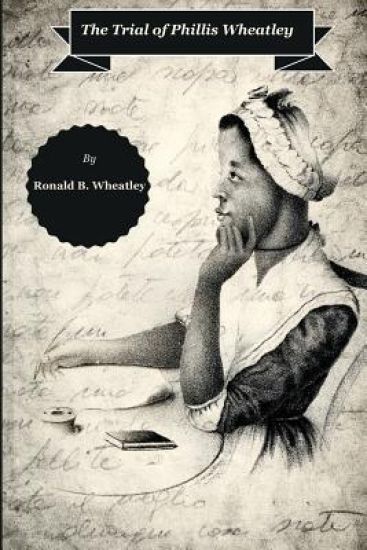
The Trial of Phillis Wheatley

The Trial of Phillis Wheatley

Ronald Brian Wheatley

Createspace Independent Publishing Platform
2014
nidottu
The "The Trial of Phillis Wheatley" selected as winner in eLit awards for 2015 for drama, and named a Best Book of the year by Kirkus Review. "The Trial of Phillis Wheatley"By Ronald Wheatley In a preface to the book "Phillis Wheatley and Her Poetry," Professor Henry Louis Gates asked of an assemblage of distinguished men who gathered at the Governor's Council Chamber room in the Old State House ("Common House") in Boston in the fall of 1772: "Why had this august group been assembled? Why had it seen fit to summon this young African girl, scarcely eighteen years old, before it?" This group of 'the most respectable Characters in Boston, ' as it would later define itself, had assembled to question closely the African adolescent on the slender sheaf of poems that she claimed to have 'written by herself.'" This young "African girl" was Phillis Wheatley."The Trial of Phillis Wheatley" is a courtroom drama because it "depicts" what happened in the Governor's Council Chamber room that day. However, as important as she is to our history and to the drama, the play is not just about Phillis. The play is also about the men in that room and the test that they were facing. The test of overcoming their own prejudices to be willing to put their signature on a document attesting that this African household slave of John and Susannah Wheatley had written a number of poemscompiled in a small manuscript. A Negro slave author was a phenomenon that was unique to these men, to Boston, and to a young America. Only if the largely older and all white men in that room were willing to put their names to this attestation would this manuscript have a chance of being published. The consequences of this action for these men were possible ridicule, and the threat of physical violence from an external force, the Boston gang, under theleadership of Ebenezer Mackintosh, street brawler and charismatic leader of the South End Gang.The final verdict would change American History
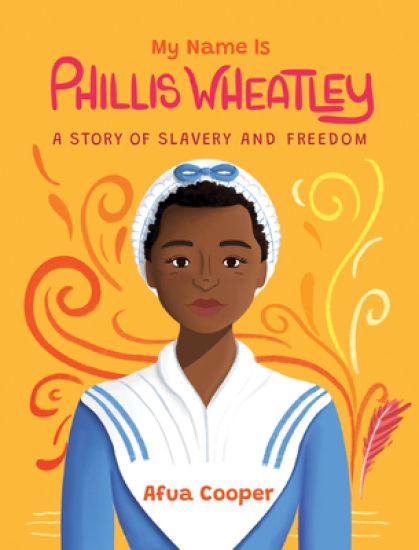
My Name Is Phillis Wheatley

My Name Is Phillis Wheatley

Afua Cooper

Kids Can Press
2023
nidottu
This is the remarkable story of Phillis Wheatley, who is born into an African family of griots, or storytellers, but captured by slave raiders and forced aboard a slave ship, where appalling conditions spell death for many of her companions. Numerous sharks follow the ship, feeding on the corpses of slaves thrown overboard. Weakened by the voyage and near death in a Boston slave market, Wheatley is bought by a kind family who nurses her back to health and teaches her to read and write. Soon her mistress recognizes that the girl is a quick learner and talented. At the age of 12, a torrent of poetry begins to flow out of Wheatley. Proud of her achievements, her mistress organizes readings in Boston's finest parlors and drawing rooms, and Wheatley's fame spreads. But even when many in Boston are calling her a prodigy and a genius, some remain unsure that a slave should be able to write, much less write poetry. When Phillis travels to London she is a media sensation, feted by the cream of English society. A book of her poems is published, and she finally gains her freedom. This amazing story, wide in scope, is based on fact and told convincingly from young Wheatley's point of view.
New Essays on Phillis Wheatley

New Essays on Phillis Wheatley

University of Tennessee Press
2011
sidottu
The first African American to publish a book on any subject, poet Phillis Wheatley (1753?–1784) has long been denigrated by literary critics who refused to believe that a black woman could produce such dense, intellectual work, let alone influence Romantic-period giants like Samuel Taylor Coleridge. Indeed, Thomas Jefferson once declared that “the compositions published under her name are below dignity of criticism.” In recent decades, however, Wheatley’s work has come under new scrutiny as the literature of the eighteenth century and the impact of African American literature have been reconceived. In these never-before-published essays, fourteen prominent Wheatley scholars consider her work from a variety of angles, affirming her rise into the first rank of American writers. The pieces in the first section show that perhaps the most substantial measure of Wheatley’s multilayered texts resides in her deft handling of classical materials. The contributors consider Wheatley’s references to Virgil’s Aeneid and Georgics and to the feminine figure Dido as well as her subversive critique of white readers attracted to her adaptation of familiar classics. They also discuss Wheatley’s use of the Homeric Trojan horse and eighteenth-century verse to mask her ambitions for freedom and her treatment of the classics as political tools. Engaging Wheatley’s multilayered texts with innovative approaches, the essays in the second section recontextualize her rich manuscripts and demonstrate how her late-eighteenth-century works remain both current and timeless. They ponder Wheatley’s verse within the framework of queer theory, the concepts of political theorist Hannah Arendt, rhetoric, African studies, eighteenth-century “salon culture,” and the theoretics of imagination. Together, these essays reveal the depth of Phillis Wheatley’s literary achievement and present concrete evidence that her extant oeuvre merits still further scrutiny. John C. Shields is Distinguished Professor of English at Illinois State University. He is the editor of The Collected Works of Phillis Wheatley and author of The American Aeneas: Classical Origins of the American Self, a Choice Outstanding Academic Book; Phillis Wheatley and the Romantics; and Phillis Wheatley’s Poetics of Liberation; and awarded honorable mention in competition for the American Comparative Literature Association’s Harry Levin Prize. As well, Shields serves as director of the Center for Classicism and American Culture and General Editor for the series of monographs on Classicism in American Culture to be published by the University of Tennessee Press. Eric D. Lamore is an assistant professor of English at the University of Puerto Rico, Mayaguez, and a contributor to The Greenwood Encyclopedia of American Poets and Poetry.
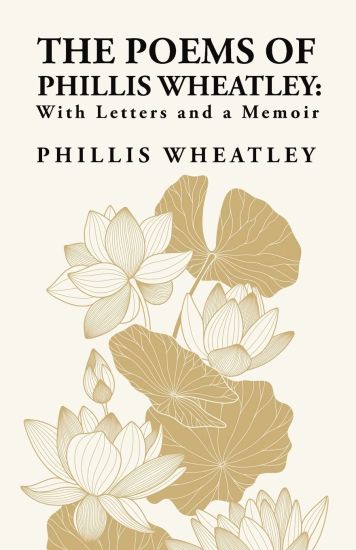
The Poems of Phillis Wheatley
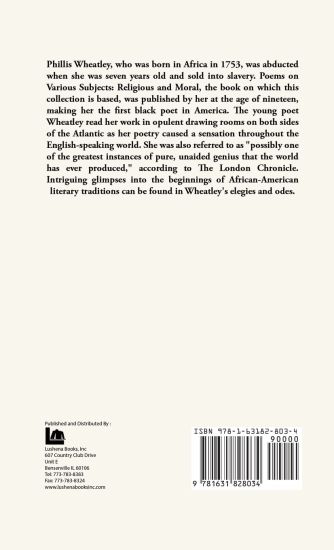
Born in Africa in 1753, Phillis Wheatley was kidnapped at the age of seven and sold into slavery. At nineteen, she became the first Black American poet to publish a book, Poems on Various Subjects: Religious and Moral, on which this volume is based. Wheatley's poetry created a sensation throughout the English-speaking world, and the young poet read her work in aristocratic drawing rooms on both sides of the Atlantic. The London Chronicle went so far as to declare her "perhaps one of the greatest instances of pure, unassisted genius that the world ever produced." Wheatley's elegies and odes offer fascinating glimpses into the origins of African-American literary traditions. Most of the poems express the effects of her religious and classical New England education, consisting of elegies for the departed and odes to Christian salvation. This edition of Wheatley's historic works includes letters and a biographical note written by one of the poet's descendants. Includes a selection from the Common Core State Standards Initiative: "On Being Brought from Africa to America."
The Poems of Phillis Wheatley
Born in Africa in 1753, Phillis Wheatley was kidnapped at the age of seven and sold into slavery. At nineteen, she became the first Black American poet to publish a book, Poems on Various Subjects: Religious and Moral, on which this volume is based. Wheatley's poetry created a sensation throughout the English-speaking world, and the young poet read her work in aristocratic drawing rooms on both sides of the Atlantic. The London Chronicle went so far as to declare her "perhaps one of the greatest instances of pure, unassisted genius that the world ever produced." Wheatley's elegies and odes offer fascinating glimpses into the origins of African-American literary traditions. Most of the poems express the effects of her religious and classical New England education, consisting of elegies for the departed and odes to Christian salvation. This edition of Wheatley's historic works includes letters and a biographical note written by one of the poet's descendants. Includes a selection from the Common Core State Standards Initiative: "On Being Brought from Africa to America."
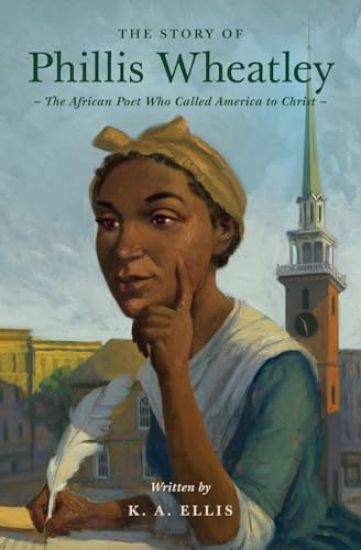
The Story of Phillis Wheatley

The Story of Phillis Wheatley

K. A. Ellis

Crossway Books
2026
pokkari
Middle-Grade Biography Highlights Phillis Wheatley’s Life of Faith, Determination, and Intellect Phillis Wheatley, ripped away from her family and sold into a life of slavery, would one day negotiate her way to freedom. Unwilling to succumb to the brokenness around her, Wheatley believed God had a redemptive plan for her life. Through her poetry and prayer, Wheatley beautifully expressed her trust in the Lord and called the nation and important American figures to Christ, while advocating for freedom from injustices that plagued the country. This short and lively biography invites middle-grade readers to explore the life of Phillis Wheatley, highlighting her inspiring testimony and remarkable work as a poet, abolitionist, and wife. Through her story, readers learn that God works even in the harshest circumstances, ensuring that nothing can separate them from his love, word, and salvation. Featuring illustrations, maps, timelines, bonus sidebars, and study questions, this addition to the Lives of Faith and Grace series engages kids ages 8–13 in the drama of history, showing how God worked in the past through ordinary people like them. Lively Biography: Explores the influential life of Phillis Wheatley, a remarkable African poet who inspired spiritual and social change through a revival of true biblical Christianity Written for Kids Ages 8–13: This short format includes illustrations, maps, timelines, and bonus sidebars that help explain the history of slavery, the Revolutionary War, and other events of the 18th century Honest: Details the cruel realities of slavery, and explains its presence in the Bible as a sinful result of the fall Inspiring Testimony: Phillis Wheatley believed that God uses all circumstances, including her own suffering, for his glory and her good Part of the Lives of Faith and Grace Series: Engages kids with the real-life stories of Christian men and women from history
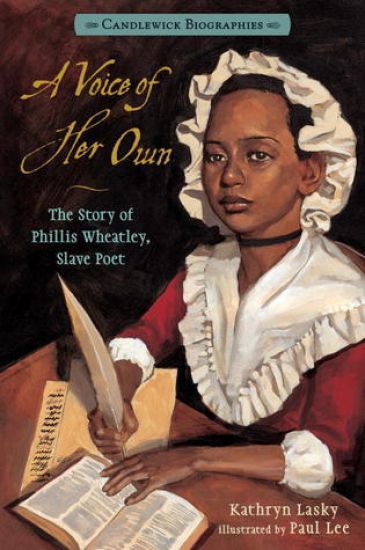
A Voice of Her Own: The Story of Phillis Wheatley, Slave Poet: Candlewick Biographies
"Lasky shows not only the facts of Wheatley's life but also the pain of being an accomplished black woman in a segregated world." -- Booklist In 1761, a young girl was sold to the Wheatley family in Boston, who named her Phillis after the slave schooner that had carried her. Kidnapped from her home in Africa and shipped to America, she'd had everything taken from her-her family, her name, and her language. But Phillis had a passion to learn. Amid the tumult of the Revolutionary War, Phillis Wheatley became a poet and ultimately had a book of verse published, establishing herself as the first African- American woman poet this country had ever known.Back matter includes an author's note, an illustrator's note, sources, and an index.
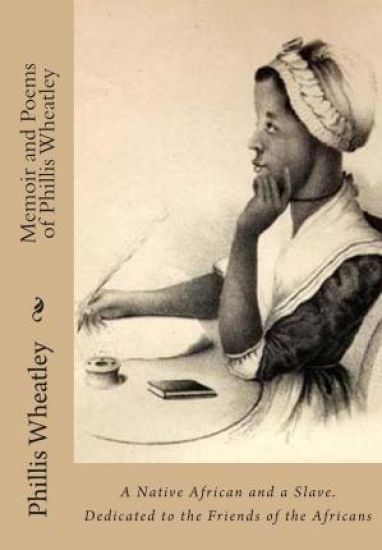
The Slave Poet from Boston - Collected Writings on Phillis Wheatley
Phillis Wheatley (c. 1753-1784) was an American freed slave and poet who wrote the first book of poetry by an African-American. Sold into slavery in West Africa at the age of around seven, she was taken to North America, where she served the Wheatley family of Boston. Phillis was tutored in reading and writing by Mary, the Wheatleys' 18-year-old daughter, and was reading Latin and Greek classics from the age of twelve. Encouraged by the progressive Wheatleys who recognised her incredible literary talent, she wrote "To the University of Cambridge" when she was 14. By 20 had found patronage in Selina Hastings, countess of Huntingdon. Her works garnered acclaim in both England and the colonies, and she became the first African American to make a living as a poet. This volume contains a fantastic collection of assorted writings by various authors on the subject of Wheatley, exploring her interesting life and influential work. Contents include: "Introduction from Memoir and Poems of Phillis Wheatley, 1834", "Letter from George Washington to Phillis", "An Address to Miss Phillis Wheatley by Jupiter Hammon", "A Memoir from Memoir and Poems of Phillis Wheatley, 1834", "Phillis Wheatley by William Wells Brown", "Phillis Wheatley by L. Maria Child", "Phillis Wheatley by A. Mott And M. S. Wood", "An Excerpt by George Washington Williams", "Phillis Wheatley by Benjamin Griffith Brawley", "Jupiter Hammon and Phillis Wheatley by Robert Thomas Kerlin", etc. Brilliant Women are proudly publishing this brand new collection of classic essays and excerpts for a new generation of readers.