Kirjojen hintavertailu. Mukana 11 342 296 kirjaa ja 12 kauppaa.

Kirjahaku

Etsi kirjoja tekijän nimen, kirjan nimen tai ISBN:n perusteella.

1000 tulosta hakusanalla Richard J. Perry

Introduction to Quantum Algorithms via Linear Algebra

Introduction to Quantum Algorithms via Linear Algebra

Richard J. Lipton; Kenneth W. Regan

MIT Press
2021
sidottu
Quantum computing explained in terms of elementary linear algebra, emphasizing computation and algorithms and requiring no background in physics.This introduction to quantum algorithms is concise but comprehensive, covering many key algorithms. It is mathematically rigorous but requires minimal background and assumes no knowledge of quantum theory or quantum mechanics. The book explains quantum computation in terms of elementary linear algebra; it assumes the reader will have some familiarity with vectors, matrices, and their basic properties, but offers a review of the relevant material from linear algebra. By emphasizing computation and algorithms rather than physics, it makes quantum algorithms accessible to students and researchers in computer science who have not taken courses in quantum physics or delved into fine details of quantum effects, apparatus, circuits, or theory.
The New Constellation

The New Constellation

Richard J. Bernstein

MIT Press
1992
pokkari
During the last two decades Richard Bernstein has established a worldwide reputation as one of the few philosophers able to bridge different traditions of thought and to clarify, through sympathetic criticism, the key intellectual issues of our time. In these 10 essays he explores the ethical and political dimensions of the modernity/postmodernity debates.Bernstein argues that modernity/postmodernity should be understood as a pervasive mood - what Heidegger calls a Stimmung - one that is amorphous, shifting, and protean but that nevetheless exerts a powerful influence on our current ways of thinking and acting. Focusing on such thinkers as Heidegger, Derrida, Foucault, Rorty, and Habermas, Bernstein seeks to demonstrate the strengths and weaknesses of their work and to highlight the ways in which they have contributed to the formation of a new and distinctive constellation of ideas and themes.Richard J. Bernstein is Vera List Professor of Philosophy at the New School for Social Research.The Essays: Philosophy, History, and Critique. The Rage Against Reason. Incommensurability and Otherness Revisited. Heidegger's Silence? Ethos and Technology.Foucault: Critique as a Philosophic Ethos. Serious Play: The Ethical-Political Horizon of Derrida. An Allegory of Modernity/Postmodernity: Habermas and Derrida. One Step Forward, Two Steps Backward: Rorty on Liberal Democracy. Rorty's Liberal Utopia, Reconciliation/Rupture.
Electron-Stream Interaction with Plasmas

Electron-Stream Interaction with Plasmas

Richard J. Briggs

MIT Press
1964
pokkari
This study considers the instabilities that result when an electron beam is injected into a plasma. A number of different models of the system are considered, and all instabilities are classified according to whether they are convective instabilities (amplifying waves) or nonconvective (absolute) instabilities. The study also analyzes the instabilities in unbounded beam-plasma systems and in systems of finite extent transverse to the electron stream and gives a detailed consideration of the possibility of a strong interaction with the ions in a hot-electron plasma. In addition, the author presents mathematical criteria for identifying absolute instabilities and amplifying waves. These criteria are based only on an analysis of the dispersion equation of the system and are not restricted to beam-plasma systems.wo things need to be said about this book: the chapter on absolute and convective instabilities makes an important contribution to the field. Second, it should be pointed out that the theoretical results are reduced to a form which make them readily available to an experimentalist. Plasma physicists and electronic engineers will be interested in this work.
Innovation Matters

Innovation Matters

Richard J. Gilbert

MIT PRESS LTD
2022
pokkari
A proposal for moving from price-centric to innovation-centric competition policy, reviewing theory and evidence on economic incentives for innovation. Competition policy and antitrust enforcement have traditionally focused on prices rather than innovation. Economic theory shows the ways that price competition benefits consumers, and courts, antitrust agencies, and economists have developed tools for the quantitative evaluation of price impacts. Antitrust law does not preclude interventions to encourage innovation, but over time the interpretation of the laws has raised obstacles to enforcement policies for innovation. In this book, economist Richard Gilbert proposes a shift from price-centric to innovation-centric competition policy. Antitrust enforcement should be concerned with protecting incentives for innovation and preserving opportunities for dynamic, rather than static, competition. In a high-technology economy, Gilbert argues, innovation matters. Gilbert considers both theory and available empirical evidence on the relationships among market structure, firm behavior, and the production of new products and services. He reviews the distinctive features of the high-tech economy and why current analytical tools used by antitrust enforcers aren't up to the task of assessing innovation concerns. He considers, from the perspective of innovation competition, Kenneth Arrow's "replacement effect" and the Schumpeterian theory of market power and appropriation; discusses the effect of mergers on innovation and future price competition; and reviews the empirical literature on competition, mergers, and innovation. He describes examples of merger enforcement by US and European antitrust agencies; examines cases brought against Microsoft and Google; and discusses the risks and benefits of interoperability standards. Finally, he offers recommendations for competition policy. The open access edition of this book was made possible by generous funding from Arcadia - a charitable fund of Lisbet Rausing and Peter Baldwin.
The Concept of Matter in Modern Philosophy

The Concept of Matter in Modern Philosophy

Richard J Blackwell

UNIVERSITY OF NOTRE DAME PRESS
1978
sidottu
This anthology represents the first large-scale attempt to present--and draw some morals and predictions from--the complex history of the concept of matter from Thales and Plato down to Marx and Heisenberg. The Concept of Matter is a collection of twenty-seven papers, each by a philosopher or scientist whose particular contribution to the dialogue on the concept is well known and here summarized and extended. From the symposium held in the fall of 1961 at the University of Notre Dame, Father McMullin has included not only the revised versions of those twenty-seven papers, but also an edited selection of comments and interchanges at the symposium itself--the dialogues of a distinguished gathering, some of the world's greatest scholars. The discussions bridge the concept of matter from the Greek and medieval interpretations through the transformation of the concept of matter into the redefinition of the concept of mass, to finally the dematerialization of matter by "modern science." A study of the evolution of this crucial concept illuminates the interrelation between the philosophical and the scientific approaches to Nature which can be more thoroughly grasped in terms of the development and constantly changing views towards related concepts like matter and mass. Contributors: C. Lejewski, L. Esliek, J. Fitzgerland, J. Owens, N. Luyten, E. McMullin, A. Wolter, M. Fisk, M. B. Hall, C. Taliaferro, M. B. Hesse, C. Mast, J. Smith, A.R. Caponigri, N. Lobkowiez, K. Sayre, R. Rorty, R. Johann, N.R. Hnason, A.E. Woodruff, C. Misner.
God Who Commands, the

God Who Commands, the

Richard J. Mouw

University of Notre Dame Press
1991
nidottu
In this book Richard J. Mouw, one of the foremost thinkers in the field of Christian ethics, develops a constructive theological ethic, employing primarily Calvinist themes. Exploring issues that are at the intersection of philosophical and theological discussions, he sets forth an ethical perspective in which obedience to divine commands occupies a central place. After responding to some secularist objections to divine command theory, Mouw looks at the ways in which treatments of divine authority relate to contemporary philosophical discussions of moral justification. He then discusses the divine command perspective, turning to a specific examination of the Reformation emphasis on "naked selfhood." He defends Reformational selfhood against critiques of Protestantism and explores the differences and similarities between the conceptions of moral selfhood portrayed in classical Calvinism and recent existentialism. Examining Protestant, and especially Calvinist, emphases on divine command, Mouw argues that a divine command perspective need not be viewed as antithetical to the claims made by recent defenders of "narrativist" ethics. He explores the ways in which differing intratrinitarian emphases influence Christian moral experience, and he argues that a strong God-the-Father emphasis needs to be supplemented by perspectives that attend more to divine "nearness," as in contemporary feminism and Pentecostalism. He concludes with some reflections on the way in which a divine command ethical perspective speaks in positive ways to the contemporary moral quest.
Galileo, Bellarmine, and the Bible

Galileo, Bellarmine, and the Bible

Richard J. Blackwell

University of Notre Dame Press
1991
sidottu
Considered the paradigm case of the troubled interaction between science and religion, the conflict between Galileo and the Church continues to generate new research and lively debate. Richard J. Blackwell offers a fresh approach to the Galileo case, using as his primary focus the biblical and ecclesiastical issues that were the battleground for the celebrated confrontation. Blackwell's research in the Vatican manuscript collection and the Jesuit archives in Rome enables him to re-create a vivid picture of the trends and counter-trends that influenced leading Catholic thinkers of the period: the conservative reaction to the Reformation, the role of authority in biblical exegesis and in guarding orthodoxy from the inroads of "unbridled spirits," and the position taken by Cardinal Bellarmine and the Jesuits in attempting to weigh the discoveries of the new science in the context of traditional philosophy and theology. A centerpiece of Blackwell's investigation is his careful reading of the brief treatise Letter on the Motion of the Earth by Paolo Antonio Foscarini, a Carmelite scholar, arguing for the compatibility of the Copernican system with the Bible. Blackwell appends the first modern translation into English of this important and neglected document, which was placed on the Index of Forbidden Books in 1616. Though there were differing and competing theories of biblical interpretation advocated in Galileo's time—the legacy of the Council of Trent, the views of Cardinal Bellarmine, the most influential churchman of his time, and, finally, the claims of authority and obedience that weakened the abillity of Jesuit scientists to support the new science—all contributed to the eventual condemnation of Galileo in 1633. Blackwell argues convincingly that the maintenance of ecclesiastical authority, not the scientific issues themselves, led to that tragic trial.
Galileo, Bellarmine, and the Bible

Galileo, Bellarmine, and the Bible

Richard J. Blackwell

University of Notre Dame Press
1991
nidottu
Considered the paradigm case of the troubled interaction between science and religion, the conflict between Galileo and the Church continues to generate new research and lively debate. Richard J. Blackwell offers a fresh approach to the Galileo case, using as his primary focus the biblical and ecclesiastical issues that were the battleground for the celebrated confrontation. Blackwell's research in the Vatican manuscript collection and the Jesuit archives in Rome enables him to re-create a vivid picture of the trends and counter-trends that influenced leading Catholic thinkers of the period: the conservative reaction to the Reformation, the role of authority in biblical exegesis and in guarding orthodoxy from the inroads of "unbridled spirits," and the position taken by Cardinal Bellarmine and the Jesuits in attempting to weigh the discoveries of the new science in the context of traditional philosophy and theology. A centerpiece of Blackwell's investigation is his careful reading of the brief treatise Letter on the Motion of the Earth by Paolo Antonio Foscarini, a Carmelite scholar, arguing for the compatibility of the Copernican system with the Bible. Blackwell appends the first modern translation into English of this important and neglected document, which was placed on the Index of Forbidden Books in 1616. Though there were differing and competing theories of biblical interpretation advocated in Galileo's time—the legacy of the Council of Trent, the views of Cardinal Bellarmine, the most influential churchman of his time, and, finally, the claims of authority and obedience that weakened the abillity of Jesuit scientists to support the new science—all contributed to the eventual condemnation of Galileo in 1633. Blackwell argues convincingly that the maintenance of ecclesiastical authority, not the scientific issues themselves, led to that tragic trial.
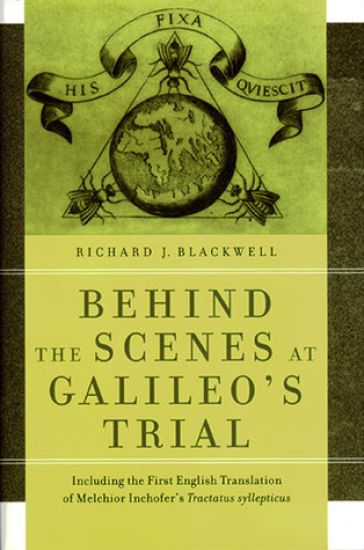
Behind the Scenes at Galileo's Trial

Behind the Scenes at Galileo's Trial

Richard J. Blackwell

University of Notre Dame Press
2008
nidottu
Galileo's trial in 1633 before the Roman Inquisition is one of the most frequently mentioned topics in the history of science. Galileo's encounter with the Catholic Church was not only a major turning point in the history of western culture; it is the paradigm case of the clash between the institutional authority of religion and the authority of scientific reason, a clash that has helped to define the modern era. Blackwell's new contribution to "the Galileo affair" concerns the official theological position against Galileo. The centerpiece of his project is the treatise entitled Tractatus syllepticus, written by Melchior Inchofer, S.J., whose judgment of the orthodoxy of Galileo's Dialogue had been requested earlier by the Holy Office and was then incorporated into the proceedings of the trial. At the time, Inchofer's judgment against Galileo's book was both detailed and harsh. That judgment formed the basis for Inchofer's subsequent Tractatus, the first English translation of which is included in this volume. Inchofer's text provides a new and fascinating way of looking at the defense of the guilty verdict. Blackwell's analysis of this material greatly enriches our knowledge of Galileo and his trial. Both legal and theological behind-the-scenes aspects of Galileo's trial are discussed. Because of a weak legal case, a plea bargain was arranged, extrajudicially, then sabotaged in the Holy Office before the final decision of the case. Through his close scrutiny of the specifics of the trial, Blackwell renders a picture that is more complex, and ominous, than the usual portrayal of the trial.
Edible Wild Plants of Pennsylvania and Neighboring States

Edible Wild Plants of Pennsylvania and Neighboring States

Richard J. Medve; Mary Lee Medve

Pennsylvania State University Press
1990
pokkari
Ralph Waldo Emerson defined a weed as a "plant whose virtues have not yet been discovered." To the wild-plant enthusiast who has discovered the virtues of many plants, there are relatively few weeds. After using this book, you will never again consider lamb's-quarters a weed. Instead, you will nurture it with respect and even encourage its growth in your garden.Edible Wild Plants of Pennsylvania and Neighboring States contains botanically accurate, up-to-date information essential for the identification of more than one hundred delectable wild plants. Each plant entry provides characteristics, habitat, distribution, edible parts, food uses, precautions, and preparation, followed by tasty recipes and interesting remarks about the plant's botanical history. The plants are arranged according to height, with the ground-huggers appearing first and the trees last. Each plant is also cross-referenced by common and scientific names.The authors have written this book with the novice forager in mind, including useful tips on foraging from where to search for food to precautions to take. They also provide a list of toxic look-alikes, a nutrient composition chart, and a glossary of terms.
Peru and the United States, 1960–1975

Peru and the United States, 1960–1975

Richard J. Walter

Pennsylvania State University Press
2010
sidottu
The period 1960-1975 was a time when the United States paid more than the usual amount of attention to relations with Latin America, contending with Castro's efforts to export the Revolution and with Allende's efforts to establish a socialist government in Chile, for example. During this turbulent era, U.S. relations with Peru were fraught with tensions and difficulties, too, as the Kennedy administration wrestled with the question of how to deal with the military regime that took over by coup in 1962, the administration of Lyndon Johnson tangled with Peru over its expropriation of the International Petroleum Company and its effort to establish a two-hundred-mile limit for its territorial waters, and the government under presidents Richard Nixon and Gerald Ford had to contend with the policies of a reformist military regime that took an even harder line on expropriation and fishing rights than its civilian predecessor. Using newly declassified records from the U.S. State Department as well as records from the archives of the Peruvian Foreign Ministry, supplemented by interviews with participants from both sides, Richard Walter provides a nuanced look at the complexities of Peruvian-U.S. relations during this important period, highlighting especially the hitherto neglected role of the ambassadors from each country in managing the relationship and influencing the outcomes.
Peru and the United States, 1960–1975

Peru and the United States, 1960–1975

Richard J. Walter

Pennsylvania State University Press
2014
pokkari
The period of 1960 to 1975 was a time when the United States paid more than the usual amount of attention to relations with Latin America, contending with Fidel Castro’s efforts to export the revolution and with Salvador Allende’s efforts to establish a socialist government in Chile, for example. During this turbulent era, U.S. relations with Peru were fraught with tensions and difficulties, too: the Kennedy administration wrestled with the question of how to deal with the military regime that took over by coup in 1962, the administration of Lyndon Johnson tangled with Peru over its expropriation of the International Petroleum Company and its effort to establish a two-hundred-mile limit for its territorial waters, and the government under presidents Richard Nixon and Gerald Ford had to contend with the policies of a reformist military regime that took an even harder line on expropriation and fishing rights than its civilian predecessor. Using newly declassified records from the U.S. State Department as well as records from the archives of the Peruvian Foreign Ministry, supplemented by interviews with participants from both sides, Richard Walter provides a nuanced look at the complexities of Peruvian-U.S. relations during this important period, highlighting especially the hitherto neglected role of the ambassadors from each country in managing the relationship and influencing the outcomes.
An Economic Record of Presidential Performance

An Economic Record of Presidential Performance

Richard J. Carroll

Praeger Publishers Inc
1995
sidottu
For the first time, trends in 20 major economic and federal budget indicators, most reported since World War II, are presented in a single source. The economic performances under each presidential administration are ranked for each indicator, as well as for their overall performance. The results are often surprising and counter-intuitive, challenging many popular beliefs. This presentation of averages, trends, and illustrations will allow scholars, students, and others interested in economics, politics, and history, to interpret economic news more effectively.
From Autarchy to Market

From Autarchy to Market

Richard J. Hunter; Leo Ryan

Praeger Publishers Inc
1998
sidottu
From the ashes of World War II to the impending obstacles of the new millennium, this multidisciplinary study examines Poland's recent economic and political development. It examines the creation and collapse of the system of central planning, the pre-Solidarity period, the rise of KOR and the Solidarity Movement, and the Polish August of 1980— leading to the imposition of Martial Law in December 1981. This comprehensive and integrated view of nearly a half-century of change is presented in a clear, non-technical manner, encompassing economic, financial, legal, and political issues.
The Socialist Party of Argentina, 1890–1930

The Socialist Party of Argentina, 1890–1930

Richard J. Walter

University of Texas Press
1977
nidottu
In the early part of the twentieth century, Argentina's Socialist Party became the largest and most effective socialist organization in Latin America. Richard J. Walter's interpretive study begins with the party's origins in the 1890s, traces its development through 1912, and then offers a comprehensive analysis of its activities and programs during the almost two decades of civilian, democratic government that ended with the military coup of 1930. His aim has been to provide a detailed case study of a Latin American political party within a specific historical context. The work gives particular attention to the nature of party leadership, internal party organization, attempts to win the support of the Argentine working class, party activities in national elections and the National Congress, and internal disputes and divisions. In discussing these topics, Walter draws heavily on government documents, including national and municipal censuses, ministerial reports, and the Argentine Congressional Record. He also makes extensive use of national and party newspapers and journals, political memoirs, and collections of essays by party leaders. Walter concludes that the party enjoyed relative electoral and legislative success because of efficient organization, capable leadership, and specific, well-reasoned programs. On the other hand, it failed to create a firm working-class base or to extend its influence much beyond Buenos Aires, mainly because of its inability to relate adequately to the needs of the proletariat and to the growth of nationalist sentiment. The analysis of these successes and failures also provides an important background for understanding the rise to power of Juan Perón and Peronism.
Tales from the German Underworld

Tales from the German Underworld

Richard J. Evans

Yale University Press
2012
pokkari
Through the means of four powerful and extraordinary narratives from the nineteenth-century German underworld, this book deftly explores an intriguing array of questions about criminality, punishment, and social exclusion in modern German history. Drawing on hitherto unexplored legal documents and police files, Richard J. Evans recounts the epic adventures of an art teacher imprisoned for forging bank notes, then transported to Siberia with a gang of violent Prussian felons in 1802; the tragic sufferings of a drunken female vagrant whipped repeatedly by the authorities in Bremen in the 1820s and 30s; the comical and fantastic deceptions of a con man arrested in the 1860s for not paying his hotel bill; and the ironic career of a young woman who drifts into prostitution after bearing an illegitimate child and discovers the underworld to be much less cruel and immoral than the "respectable" society from which she has been rejected. Each of these narratives sheds light on German penal policy in the nineteenth century, when a regime of public and often symbolic physical punishment was transformed into one of silent, regimented incarceration. Using these fascinating cases as starting points for a wider consideration of crime and justice, Evans investigates the complexity of the relations between deviance and control, the ambiguities of criminality in modern German history, and the ways literary models influenced perceptions of—and behavior in—the criminal underworld.
Florence

Florence

Richard J. Goy

Yale University Press
2015
pokkari
Each year, millions of visitors travel to Florence to admire the architectural marvels of this famous Renaissance city. In this compact yet comprehensive volume, architect and architectural historian Richard J. Goy offers a convenient, accessible guide to the city’s piazzas, palazzos, basilicas, and other architectural points of interest, as well as pertinent historical details regarding Florence’s unique urban environment. Clearly laid out and fully illustrated, this handbook is designed around a series of expertly planned walking tours that encompass not only the city’s most admired architectural sites, but also its lesser-known gems. Maps are tailored to each walking tour and provide additional references and insights, along with introductory chapters on the city’s architectural history, urban design, and building materials and techniques. Featuring a complete bibliography, glossary of key terms, and other useful reference materials, Goy’s guide will appeal both to travelers who desire a greater architectural context and analysis than that offered by a traditional guide and to return visitors looking to rediscover Florence’s most enchanting sites.
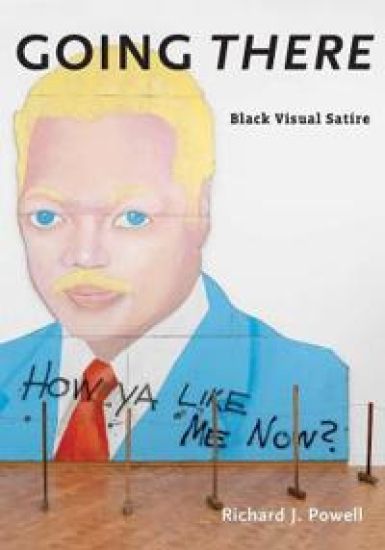
Going There

Going There

Richard J. Powell

Yale University Press
2020
sidottu
A kaleidoscopic survey of black satire in 20th- and 21st-century American art In this groundbreaking study, Richard J. Powell investigates the visual forms of satire produced by black artists in 20th- and 21st-century America. Underscoring the historical use of visual satire as antiracist dissent and introspective critique, Powell argues that it has a distinctly African American lineage. Taking on some of the most controversial works of the past century—in all their complexity, humor, and provocation—Powell raises important questions about the social power of art. Expansive in both historical reach and breadth of media presented, Going There interweaves discussions of such works as the midcentury cartoons of Ollie Harrington, the installations of Kara Walker, the paintings of Robert Colescott, and the movies of Spike Lee. Other artists featured in the book include David Hammons, Arthur Jafa, Beverly McIver, Howardena Pindell, Betye Saar, and Carrie Mae Weems. Thoroughly researched and rich in context, Going There is essential reading in the history of satire, racial politics, and contemporary art.Published in association with the Hutchins Center for African & African American Research
Chesapeake Prehistory

Chesapeake Prehistory

Richard J. Dent Jr.

Kluwer Academic/Plenum Publishers
1995
sidottu
Chesapeake Prehistory is the first book in almost a century to synthesize the archaeological record of the region offering new interpretations of prehistoric lifeways. This up-to-date work presents a new type of regional archaeology that explores contemporary ideas about the nature of the past. In addition, the volume examines prehistoric culture and history of the entire region and includes supporting lists of radiocarbon assays. A unique feature is a reconstruction of the dramatic transformation of the regional landscape over the past 10-15,000 years.