Kirjojen hintavertailu. Mukana 11 342 296 kirjaa ja 12 kauppaa.

Kirjahaku

Etsi kirjoja tekijän nimen, kirjan nimen tai ISBN:n perusteella.

1000 tulosta hakusanalla Richard Testrake

Richard Brauer: Collected Papers

Richard Brauer: Collected Papers

Richard Brauer

MIT Press
2003
pokkari
Richard Brauer (1901-1977) was one of the leading algebraists of this century. Although he contributed to a number of mathematical fields, Brauer devoted the major share of his efforts to the study of finite groups, a subject of considerable abstract interest and one that underlies many of the more recent advances in combinatorics and finite geometries.
Richard Brauer: Collected Papers

Richard Brauer: Collected Papers

Richard Brauer

MIT Press
1980
pokkari
Richard Brauer (1901-1977) was one of the leading algebraists of this century. Although he contributed to a number of mathematical fields, Brauer devoted the major share of his efforts to the study of finite groups, a subject of considerable abstract interest and one that underlies many of the more recent advances in combinatorics and finite geometries. The 120 papers collected in this volume were first published between 1926 and 1979. Brauer's mathematical impulse was remarkably steady, and his papers are equally distributed between those written before his fiftieth year and those written thereafter, including a number of contributions that were published after his formal retirement as Perkins Professor of Mathematics as Harvard in 1971. The papers are grouped into six sections following an autobiographical preface written for this collection. The first section contains twenty papers on the theory of algebras and is introduced by Oscar Goldman. The seventy-four papers on finite groups make up the second and largest section, which spans all three volumes. The final four sections complete the third volume and represent Brauer's contribution to Lie groups, number theory, polynomials and equations, geometries and biographies of Artin and Thompson.
Richard Serra

Richard Serra

MIT Press
2000
pokkari
A critical primer on artist Richard Serra's work.Richard Serra is considered by many to be the most important sculptor of the postwar period. The essays in this volume cover the complete span of Serra's work to date-from his first experiments with materials and processes through his early films and site works to his current series of "torqued ellipses." There is a special emphasis on those moments when Serra extended aesthetic convention and/or challenged political authority, as in the famous struggle with the General Services Administration over the site-specific piece Tilted Arc. October Files October Files is a new series of inexpensive paperback books. Each book will address a body of work by an artist of the postwar period who has altered our understanding of art in significant ways and prompted a critical literature that is sophisticated and sustained. Each book will trace not only the development of an important oeuvre but also the construction of the critical discourse inspired by it. The series editors are Hal Foster, Benjamin H. D. Buchloh, Annette Michelson, Yve-Alain Bois, and Rosalind Krauss.
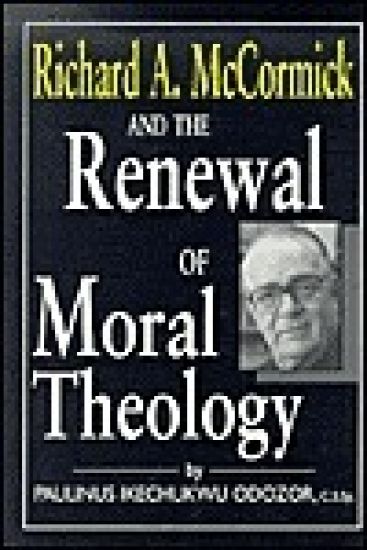
Richard A. McCormick and the Renewal of Moral Theology

Richard A. McCormick and the Renewal of Moral Theology

Odozor Paulinus Ikechukwu

University of Notre Dame Press
1995
sidottu
In a career that spanned the periods before, during, and after the Second Vatican Council, Richard A. McCormick, S.J. (1922–2000), was one of the major American theologians who demonstrated broad interest in Christian theological ethics and has written extensively on the issues of fundamental and special theology. When the Second Vatican Council directed that attention should be paid to the renewal of moral theology, McCormick answered that challenge. In this study Paulinus Ikechukwu Odozor, C.S.Sp., examines McCormick’s thought and work in detail and sets it against the backdrop of larger developments that have taken place within the Church and the field of moral theology. Odozor begins by establishing McCormick’s contribution to the renewal of moral theology and reconstructs McCormick’s theological program by situating him within various social, theological, and professional contexts. He then goes on to show whether and to what extent McCormick has been consistent and coherent in his moral theological discourse. To effectively pursue the aims of this study, Odozor divided it into seven chapters. The first chapter delineates the parameters of pre-Vatican II moral theology and situates McCormick and his work in a larger context by defining the historical, social, and ecclesial contexts of his formation. The next five chapters take up themes central to understanding McCormick’s work, including the nature of Christian ethics, the Church as moral teacher, proportionate reasoning, anthropology, and casuistry. In addition to his insightful analysis of McCormick’s contributions to the field, Odozor includes a sensitive treatment of the complex interactions between McCormick as an individual scholar and the world in relation to which his identity as a scholar was formed and transformed.
Richard a. McCormick and the Renewal of Moral Theology

Richard a. McCormick and the Renewal of Moral Theology

Paulinus Ikechukwu Odozor

University of Notre Dame Press
2017
nidottu
In a career that spanned the periods before, during, and after the Second Vatican Council, Richard A. McCormick, S.J. (1922–2000), was one of the major American theologians who demonstrated broad interest in Christian theological ethics and has written extensively on the issues of fundamental and special theology. When the Second Vatican Council directed that attention should be paid to the renewal of moral theology, McCormick answered that challenge. In this study Paulinus Ikechukwu Odozor, C.S.Sp., examines McCormick's thought and work in detail and sets it against the backdrop of larger developments that have taken place within the Church and the field of moral theology. Odozor begins by establishing McCormick's contribution to the renewal of moral theology and reconstructs McCormick's theological program by situating him within various social, theological, and professional contexts. He then goes on to show whether and to what extent McCormick has been consistent and coherent in his moral theological discourse. To effectively pursue the aims of this study, Odozor divided it into seven chapters. The first chapter delineates the parameters of pre-Vatican II moral theology and situates McCormick and his work in a larger context by defining the historical, social, and ecclesial contexts of his formation. The next five chapters take up themes central to understanding McCormick's work, including the nature of Christian ethics, the Church as moral teacher, proportionate reasoning, anthropology, and casuistry. In addition to his insightful analysis of McCormick's contributions to the field, Odozor includes a sensitive treatment of the complex interactions between McCormick as an individual scholar and the world in relation to which his identity as a scholar was formed and transformed.
Richard Aldington

Richard Aldington

Pennsylvania State University Press
1992
sidottu
In the most comprehensive selection of his letters ever published, Norman Gates allows Richard Aldington to tell the story of his life in his own words. Unlike Aldington's autobiography, Life for Life's Sake, published twenty years before his death, these letters include those two important decades of his life and do not depend upon memory. Gates provides an introduction to each of the book's five sections, sketching Aldington's biography during that decade, but the reader may then listen to Aldington's own voice speaking through his letters.Richard Aldington was married to the American poet H. D. and was a friend to many other writers and artists at the center of the Modern period. His comments on his colleagues and their work, his efforts to promote their literary fortunes, his passionate love for two wives and two mistresses, are all a part of these letters. So, too, are his experiences on the editorial staffs of the Egoist and the Criterion, which brought him to touch with European and American writers. For a clear picture of the literary world of this time, Aldington's letters are indispensable.
Richard Aldington

Richard Aldington

Pennsylvania State University Press
1992
pokkari
In the most comprehensive selection of his letters ever published, Norman Gates allows Richard Aldington to tell the story of his life in his own words. Unlike Aldington's autobiography, Life for Life's Sake, published twenty years before his death, these letters include those two important decades of his life and do not depend upon memory. Gates provides an introduction to each of the book's five sections, sketching Aldington's biography during that decade, but the reader may then listen to Aldington's own voice speaking through his letters.Richard Aldington was married to the American poet H. D. and was a friend to many other writers and artists at the center of the Modern period. His comments on his colleagues and their work, his efforts to promote their literary fortunes, his passionate love for two wives and two mistresses, are all a part of these letters. So, too, are his experiences on the editorial staffs of the Egoist and the Criterion, which brought him to touch with European and American writers. For a clear picture of the literary world of this time, Aldington's letters are indispensable.
Richard Wagner and Festival Theatre

Richard Wagner and Festival Theatre

Simon Williams

Praeger Publishers Inc
1994
nidottu
In contrast to most books on Richard Wagner, this biography focuses primarily on Wagner as an important figure in the development of the theatre. While his contribution to music history has been exhaustively documented and analyzed, his theatrical ventures, in particular the founding of the Bayreuth Festival, have not been the object of much research by English-speaking theatre historians. Nevertheless, the Festival was a crucial event in the development of the European theatre: while Bayreuth established the paradigm for all modern theatre and music festivals, the Festival Theatre itself has provided the most widely imitated architectural configuration in twentieth-century theatre building.
Richard Nixon, Watergate, and the Press

Richard Nixon, Watergate, and the Press

Louis W. Liebovich

Praeger Publishers Inc
2003
sidottu
It's time to revisit Watergate. In this compelling reexamination, Liebovich draws extensively from newly available sources, including recently released Nixon Oval Office tapes, FBI reports, and personal reminiscences of cover-up leader John Dean. Liebovich sheds new light on the Nixon administration's extensive foul play, zeal to battle and manipulate the press, scandalous miring, and eventual political disgrace. After detailing the nation's news media coverage of the Watergate debacle and the ensuing breakup of American politics, Liebovich recounts the scandal's long-lasting, corrosive effect on presidential and popular politics. Scholars and students of the media and latter-20th-century American political malaise will be provoked and persuaded by Liebovich's argument that much of the public's cynicism toward the press, the president, and politics stems from the bitter battles-fought in the White House, on the front pages, and on television screens-between the press and Nixon's administration. The book focuses on the fight against a press perceived as hostile to the President and charts how the nation's major newspapers and magazines covered the unfolding scandal. Newly released sources show how Nixon and his advisors immersed themselves so deeply in a maze of deception and mistrust that none involved could extricate themselves, creating a political tragedy that haunts us to this day.
Richard the Lionheart

Richard the Lionheart

Jean Flori

Praeger Publishers Inc
2007
sidottu
Richard I, the Lionheart, remains forever (and perhaps wrongly) the mythical king of England who preferred to wage war than to rule over his empire. The familiar epithet conveys all the principal features of his indomitable character: courage, valor, prowess, the pursuit of glory, the thirst for fame, generosity in war and peace, a sense of honor combined with a sort of haughty dignity made up of both arrogance and pride. In this book, Jean Flori examines both Richard's role as prince and king in history, and also analyses the different and sometimes controversial elements which, for the chroniclers of his day, helped to make Richard a true model of chivalry. Among the questions addressed are: What influences formed his character and determined his behavior, real or assumed? Why did the image of Richard as a king who was also a knight so quickly and so soon supplant all others, creating a quasi-definitive point of reference? Why did Richard deliberately, it would appear, choose to present himself in this chivalric guise and disseminate this image of himself by what we would today call a media campaign, using all the methods then at his disposal, limited perhaps but by no means ineffective? Last but not least, what is the historical and ideological significance of the choice and, even more, success of this image, which has been adopted by history and disseminated by legend, an image based on historical accounts and documents in which history and legend are sometimes inextricably interwoven? The first part of the book takes a straightforward chronological approach to Richard's life, from his birth in 1157, through conflict with his father, Henry II, and his brothers, to his coronation and his years of crusading and fighting the French; culminating in his death in battle in 1199. The second part analyses Richard's image in relation to medieval chivalry.
Richard Dawkins, C. S. Lewis and the Meaning of Life
In this pithy, entertaining guide to what really matters, Alister McGrath brings together Richard Dawkins and C.S. Lewis, two intriguing and well-known writers, in 'conversation'. The two men could hardly have more different perspectives; these arguments provide an excellent means of sharpening our own thinking on the meaning of life.
Richard Owen

Richard Owen

Nicolaas A. Rupke

Yale University Press
1994
sidottu
Richard Owen (1804-92) was, after Darwin, the leading naturalist of nineteenth-century Britain. A distinguished anatomist and paleontologist, he was influential in Victorian scientific reform and in the debate over natural selection. Leader of the nineteenth-century museum movement, he founded London's monumental Natural History Museum, wrote and published copiously, and won every professional honor. This first full-fledged biography of Owen presents the complete range of his scientific and intellectual achievements.Nicolaas Rupke discusses Owen's epic power struggles with colleagues, the most notorious of which were with Darwin and Huxley. As a renowned opponent of natural selection, Owen became the bête noire of the Darwinian evolution debate. Rupke argues, however, that Owen should no longer be judged by the evolution dispute that was only a minor part of his work yet has come to dominate his memory. Instead, Rupke emphasizes and throws new light on a wide area of Owen's other activities. In particular, he explains the central division in Owen's scientific oeuvre between the functionalism of Oxbridge natural theology and the transcendentalism of German nature philosophy. Rupke shows that this was a fundamental extension of the intellectual and political maneuvering for control of Victorian cultural institutions and an inextricable part of the rise to public authority of the most articulate proponents of the scientific study of nature.
Richard Rodgers

Richard Rodgers

William G. Hyland

Yale University Press
1998
sidottu
Richard Rodgers, a musical genius whose Broadway career spanned six successful decades, composed more than a thousand songs for the American stage. Although he reaped wealth, success, and recognition that included two shared Pulitzer Prizes, Rodgers found happiness elusive. In this first comprehensive biography of Rodgers, William G. Hyland tells the full story of the complex man and his incomparable music. Hyland’s portrait of Rodgers (1902-79) begins with his childhood in an affluent Jewish family living in the Harlem neighborhood of Manhattan. During college years at Columbia University and early work on the amateur circuit and Broadway, Rodgers entered into a historic collaboration with the lyricist Lorenz Hart. The team produced a dozen popular shows and such enduring songs as "The Lady Is a Tramp." Rodgers’ next partnership, with Oscar Hammerstein II, led to the creation of the musical play, a new and distinctively American art form. Beginning with Oklahoma! in 1943, this pair dominated Broadway for almost twenty years with a string of hits that remain beloved favorites: Carousel, South Pacific, The King and I, and The Sound of Music. When Hammerstein died in 1960, Rodgers began a new phase in his career, writing the lyrics to his own music, then joining lyricists Stephen Sondheim, Sheldon Harnick, and Martin Charnin. Despite periods of depression, excessive drinking, hypochondria, and devastating illness at different points in his life, Rodgers’ outpouring of music seemed little affected, and he continued to compose until his death at age seventy-seven. An icon of the musical theater, Rodgers left a legacy of timeless songs that audiences return to hear over and again.
Richard II

Richard II

Nigel Saul

Yale University Press
1999
pokkari
Richard II is one of the most enigmatic of English kings. Shakespeare depicted him as a tragic figure, an irresponsible, cruel monarch who nevertheless rose in stature as the substance of power slipped from him. By later writers he has been variously portrayed as a half-crazed autocrat or a conventional ruler whose principal errors were the mismanagement of his nobility and disregard for the political conventions of his age. This book—the first full-length biography of Richard in more than fifty years—offers a radical reinterpretation of the king.Nigel Saul paints a picture of Richard as a highly assertive and determined ruler, one whose key aim was to exalt and dignify the crown. In Richard's view, the crown was threatened by the factiousness of the nobility and the assertiveness of the common people. The king met these challenges by exacting obedience, encouraging lofty new forms of address, and constructing an elaborate system of rule by bonds and oaths. Saul traces the sources of Richard's political ideas and finds that he was influenced by a deeply felt orthodox piety and by the ideas of the civil lawyers. He shows that, although Richard's kingship resembled that of other rulers of the period, unlike theirs, his reign ended in failure because of tactical errors and contradictions in his policies. For all that he promoted the image of a distant, all-powerful monarch, Richard II's rule was in practice characterized by faction and feud. The king was obsessed by the search for personal security: in his subjects, however, he bred only insecurity and fear.A revealing portrait of a complex and fascinating figure, the book is essential reading for anyone with an interest in the politics and culture of the English middle ages.
Richard III

Richard III

Charles Ross

Yale University Press
2011
pokkari
Richard III ruled England for a mere twenty-six months, yet few English monarchs remain as compulsively fascinating, and none has been more persistently vilified. In his absorbing and universally praised account, Charles Ross assesses the king within the context of his violent age and explores the critical questions of the reign: why and how Richard Plantagenet usurped the throne; the belief that he ordered the murder of "the Princes in the Tower"; the events leading to the battle of Bosworth in 1485; and the death of the Yorkist dynasty with Richard himself. In a new foreword, Professor Richard A. Griffiths identifies the attributes that have made Ross's account the leading biography in the field, and assesses the impact of the research published since the book first appeared in 1981. "A fascinating study on a perennially fascinating topic… the base against which will be measured any future research."--Times Higher Education Supplement
Richard I

Richard I

John Gillingham

Yale University Press
2002
pokkari
Neither a feckless knight-errant nor a king who neglected his kingdom, Richard I was in reality a masterful and businesslike ruler. In this wholly rewritten version of a classic account of the reign of Richard The Lionheart, John Gillingham scrutinizes the reasons for the King’s fluctuating reputation over successive centuries and provides a convincing new interpretation of the significance of the reign. This edition includes a complete annotation and expanded bibliography.
Richard III

Richard III

William Shakespeare

Yale University Press
2008
pokkari
The Annotated Shakespeare series enables readers to fully understand and enjoy the plays of the world’s greatest dramatist Treacherous, power-hungry, untempered by moral restraint, and embittered by physical deformity, Richard, the younger brother of King Edward IV, is ablaze with ambition to take England’s throne. Richard III, Shakespeare’s long chronicle of Richard’s machinations to be king, is a tale of murder upon murder. He gains the throne, but only briefly. In a terrible dream, the ghosts of his victims visit the now-despised monarch to foretell his demise. Richard’s death in battle the next day concludes his reign of evil, ushering in at last a new and hopeful era of peace for England. This fully annotated version of Richard III makes the play completely accessible to readers in the twenty-first century. It has been carefully assembled with students, teachers, and the general reader in mind. Eminent linguist and translator Burton Raffel offers generous help with vocabulary and usage of Elizabethan English, pronunciation, prosody, and alternative readings of phrases and lines. His on-page annotations provide readers with all the tools they need to comprehend the play and begin to explore its many possible interpretations.
Richard Strauss

Richard Strauss

Raymond Holden

Yale University Press
2011
sidottu
Renowned today as the gifted composer of a string of masterworks, Richard Strauss (1864-1949) is less often remembered for his achievement as a major conductor. Yet he held important conducting posts in Munich, Berlin, and Vienna and influenced generations of younger conductors. This important book is the first to consider Strauss's career as a conductor and place it in relation to his life as a composer. With unique access to extensive materials in the Strauss family's private archives, Raymond Holden corrects misconceptions about Strauss and discusses the musician's understanding of composing and conducting as intertwined processes. Holden throws new light on Strauss's relationships, on his disputed role during the Third Reich, and particularly on his performance practices and principles.
Richard Parkes Bonington

Richard Parkes Bonington

Patrick Noon

Yale University Press
2008
sidottu
Only twenty-five at the time of his death in 1828, young Richard Parkes Bonington nevertheless was a seminal figure in the development of modernism in nineteenth-century French painting. This catalogue raisonné of his oil and watercolor paintings represents the first attempt to establish and present the artist’s complete known oeuvre. Drawing on 25 years of research, Patrick Noon catalogues, analyzes, and reproduces 400 artworks now indisputably attributed to Bonington. Many of these paintings have never before been published. The book sets Bonington’s achievement in the context of the intellectual, social, and artistic ferment of high romanticism in Paris and London, and it shows the profound effect of his style on his friend and contemporary, Eugène Delacroix, and many others. Noon’s detailed and accurate study will inform all future discourse on Bonington and his remarkable legacy.Published for the Paul Mellon Centre for Studies in British Art