Kirjojen hintavertailu. Mukana 12 459 402 kirjaa ja 12 kauppaa.

Kirjahaku

Etsi kirjoja tekijän nimen, kirjan nimen tai ISBN:n perusteella.

1000 tulosta hakusanalla Robert M Workman

Comic Faith

Comic Faith

Robert M. Polhemus

University of Chicago Press
1982
nidottu
"Polhemus sketches several distinctions between nineteenth- and twentieth-century novelists and concludes that what most characterizes the nineteenth century, from the perspective of the twentieth, is the tendency in its comic fiction to criticize and to undermine the dogma and institutions of religion and to put faith instead of the existence of the comic perspective. Comic Faith is a virtuoso performance of impressive stature; I suspect the book will be influential for many years to come."—John Halperin, Modern Fiction Studies
Patents for Power

Patents for Power

Robert M. Farley; Davida H. Isaacs

University of Chicago Press
2020
sidottu
In an era when knowledge can travel with astonishing speed, the need for analysis of intellectual property (IP) law—and its focus on patents, trade secrets, trademarks, and issues of copyright—has never been greater. But as Robert M. Farley and Davida H. Isaacs stress in Patents for Power, we have long overlooked critical ties between IP law and one area of worldwide concern: military technology. This deft blend of case studies, theoretical analyses, and policy advice reveals the fundamental role of IP law in shaping how states create and transmit defense equipment and weaponry. The book probes two major issues: the effect of IP law on innovation itself and the effect of IP law on the international diffusion, or sharing, of technology. Discussing a range of inventions, from the AK-47 rifle to the B-29 Superfortress bomber to the MQ-1 Predator drone, the authors show how IP systems (or their lack) have impacted domestic and international relations across a number of countries, including the United States, Russia, China, and South Korea. The study finds, among other results, that while the open nature of the IP system may encourage industrial espionage like cyberwarfare, increased state uptake of IP law is helping to establish international standards for IP protection. This clear-eyed approach to law and national security is thus essential for anyone interested in history, political science, and legal studies.
Quantum Field Theory in Curved Spacetime and Black Hole Thermodynamics
In this book, Robert Wald provides a pedagogical introduction to the formulation of quantum field theory in curved spacetime. He begins with a treatment of the ordinary one-dimensional quantum harmonic oscillator, progresses through the construction of quantum field theory in flat spacetime to possible constructions of quantum field theory in curved spacetime, and, ultimately, to an algebraic formulation of the theory. In his presentation, Wald disentangles essential features of the theory from inessential ones (such as a particle interpretation) and clarifies relationships between various approaches to the formulation of the theory. He also provides a comprehensive, up-to-date account of the Unruh effect, the Hawking effect, and some of its ramifications. In particular, the subject of black hole thermodynamics, which remains an active area of research, is treated in depth. This book is intended for students and researchers who have had introductory courses in general relativity and quantum field theory, and should be of interest to scientists in general relativity and related fields.
Space, Time, and Gravity

Space, Time, and Gravity

Robert M. Wald

University of Chicago Press
1992
sidottu
Writing for the general reader or student, Wald has completely revised and updated this highly regarded work to include recent developments in black hole physics and cosmology. Nature called the first edition "a very readable and accurate account of modern relativity physics for the layman within the unavoidable constraint of almost no mathematics...A well written, entertaining and authoritative book."
Space, Time, and Gravity

Space, Time, and Gravity

Robert M. Wald

University of Chicago Press
1992
nidottu
Writing for the general reader or student, Wald has completely revised and updated this highly regarded work to include recent developments in black hole physics and cosmology. Nature called the first edition "a very readable and accurate account of modern relativity physics for the layman within the unavoidable constraint of almost no mathematics. . . . A well written, entertaining and authoritative book."
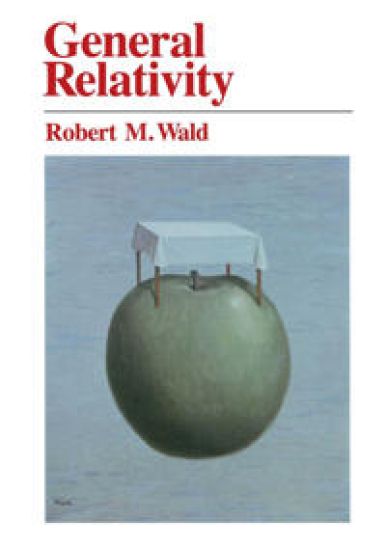
General Relativity

General Relativity

Robert M. Wald

University of Chicago Press
1984
nidottu
"Wald's book is clearly the first textbook on general relativity with a totally modern point of view; and it succeeds very well where others are only partially successful. The book includes full discussions of many problems of current interest which are not treated in any extant book, and all these matters are considered with perception and understanding."—S. Chandrasekhar "A tour de force: lucid, straightforward, mathematically rigorous, exacting in the analysis of the theory in its physical aspect."—L. P. Hughston, Times Higher Education Supplement"Truly excellent. . . . A sophisticated text of manageable size that will probably be read by every student of relativity, astrophysics, and field theory for years to come."—James W. York, Physics Today
Black Holes and Relativistic Stars

Black Holes and Relativistic Stars

Robert M. Wald

University of Chicago Press
1998
sidottu
The inevitability of gravitational collapse for stellar bodies of sufficient mass was convincingly demonstarted by S. Chandrasekhar in the 1930s, black holes and neutron stars played a minor role in serious analyses of physical or astrophysical phenomena until the discovery of quasars and pulsars in the 1960s. Black holes and neutron stars are now generally recognized as key components of many astrophysical systems, and play a central role in the understanding of gravitational phenomena at both the classical and quantum levels. Based on a symposium held in honour of S. Chandrasekhar, these papers provide a comprehensive summary of progress made in the 1990s on the theory of black holes and relativistic stars.
Preserving the Penultimate

Preserving the Penultimate

Robert M. Jaggs-Fowler

JAMES CLARKE CO LTD
2025
sidottu
Preserving the Penultimate brings two of the 20th century's most renowned Christian thinkers, Dietrich Bonhoeffer and Albert Schweitzer, into conversation around the emerging possibilities of healthcare. Here Bonhoeffer's theology meets Schweitzer's philosophy and praxis to examine the place that healthcare should hold within the Church and its mission. Using the crisis within the National Health Service in the United Kingdom as an example, the insights which these renowned thinkers bring to healthcare are explored. Is the Church ignoring a part of its mission having retreated from the world of healthcare? Taking Bonhoeffer's notion of redeeming the penultimate (our present reality), as well as Schweitzer's emphasis on the practical application of Christian tenets, Preserving the Penultimate courses a path through the overlaps of these two thinkers, ultimately leading to a 're-envisioning the praxis of healthcare as theologically central to the mission of the Church.' As questions around healthcare become more urgent than ever, the role of Christianity to offer alternatives and inspire a broader vision of care is illuminated, considering not only the physical but the spiritual well-being of the person.
Transforming America

Transforming America

Robert M. Collins

Columbia University Press
2006
sidottu
By the end of the 1980s, the "malaise" that had once pervaded American society was replaced by a renewed sense of confidence and national purpose. However, beneath this veneer of optimism was a nation confronting the effects of massive federal deficits, a reckless foreign policy, AIDS, homelessness, and a growing "cultural war." In Transforming America, renowned historian Robert Collins examines the decade's critical and controversial developments and the unmistakable influence of Ronald Reagan. Moving beyond conventional depictions that either demonize or sanctify Reagan, Collins offers fresh insights into his thought and influence. He portrays Reagan as a complex political figure who combined ideological conservatism with political pragmatism to achieve many of his policy aims. Collins demonstrates how Reagan's policies helped to limit the scope of government, control inflation, reduce the threat of nuclear war, and defeat communism. Collins also shows how the simultaneous ascendancy of the right in politics and the left in culture created a divisive legacy. The 1980s witnessed other changes, including the advent of the personal computer, a revolution in information technology, a more globalized national economy, and a restructuring of the American corporation. In the realm of culture, the creation of MTV, the popularity of self-help gurus, and the rise of postmodernism in American universities were the realization of the cultural shifts of the postwar era. These developments, Collins suggests, created a conflict in American society that continues today, pitting cultural conservatism against a secular and multicultural view of the world. Entertaining and erudite, Transforming America explores the events, movements, and ideas that defined a turbulent decade and profoundly changed the shape and direction of American culture and politics.
Transforming America

Transforming America

Robert M. Collins

Columbia University Press
2009
pokkari
By the end of the 1980s, the "malaise" that had once pervaded American society was replaced by a renewed sense of confidence and national purpose. However, beneath this veneer of optimism was a nation confronting the effects of massive federal deficits, a reckless foreign policy, AIDS, homelessness, and a growing "cultural war." In Transforming America, renowned historian Robert Collins examines the decade's critical and controversial developments and the unmistakable influence of Ronald Reagan. Moving beyond conventional depictions that either demonize or sanctify Reagan, Collins offers fresh insights into his thought and influence. He portrays Reagan as a complex political figure who combined ideological conservatism with political pragmatism to achieve many of his policy aims. Collins demonstrates how Reagan's policies helped to limit the scope of government, control inflation, reduce the threat of nuclear war, and defeat communism. Collins also shows how the simultaneous ascendancy of the right in politics and the left in culture created a divisive legacy. The 1980s witnessed other changes, including the advent of the personal computer, a revolution in information technology, a more globalized national economy, and a restructuring of the American corporation. In the realm of culture, the creation of MTV, the popularity of self-help gurus, and the rise of postmodernism in American universities were the realization of the cultural shifts of the postwar era. These developments, Collins suggests, created a conflict in American society that continues today, pitting cultural conservatism against a secular and multicultural view of the world. Entertaining and erudite, Transforming America explores the events, movements, and ideas that defined a turbulent decade and profoundly changed the shape and direction of American culture and politics.

Ministers of Reform

Ministers of Reform

Robert M. Crunden

University of Illinois Press
1985
nidottu
Ministers of Reform vividly depicts the spiritual odyssey of an entire generation and shows how Protestant roots and a common "climate of creativity" nurtured a host of Progressive leaders from all walks of life. Crunden demonstrates that the same spirit of nnovation and moral rectitude so typical of the era's politics also characterized its artistic endeavors.
The Black Hand

The Black Hand

Robert M. Lombardo

University of Illinois Press
2010
sidottu
This book examines the history of Black Hand crime in Chicago primarily from 1905 to 1920 and challenges the belief that the Black Hand was an extension of the Sicilian Mafia. A crude method of extorting money from primarily wealthy Italians, the Black Hand involved sending victims a letter stating that they would come to harm if the blackmailers' demands were not met; the threatening letter often included a drawing of a black hand or other frightening symbols.While many criminologists and scholars believe that Black Hand crime originated in Italy, that only Southern Italians and Sicilians committed Black Hand crime, and that only Southern Italians and Sicilians were Black Hand victims, Robert M. Lombardo argues that Black Hand crime actually evolved as the result of social conditions within American society such as the isolation of the Italian community, political corruption, and an ineffective criminal justice system. He shows that this association of the Black Hand and the Sicilian Mafia is a media construction, resulting from a narrative created by the news media despite the fact that many non-Italians also committed Black Hand crimes. Looking at the Black Hand from a sociological perspective, the book discusses the "news-making criminology" that tied Black Hand crime to the Sicilian Mafia and Neapolitan Camorra and the evolution of traditional organized crime in Chicago and elsewhere.