Kirjojen hintavertailu. Mukana 12 400 011 kirjaa ja 12 kauppaa.

Kirjahaku

Etsi kirjoja tekijän nimen, kirjan nimen tai ISBN:n perusteella.

1000 tulosta hakusanalla Robert M. Fowler

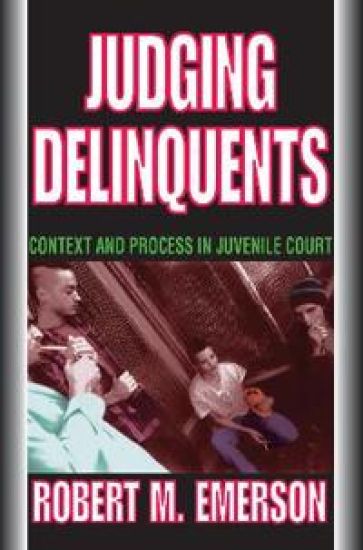
Judging Delinquents

Judging Delinquents

Robert M. Emerson

AldineTransaction
2007
nidottu
Juvenile court has elicited the interest and criticism of lawyers, social workers, and criminologists, but less attention from sociologists. This book adds to growing sociological literature on the operations of legal institutions. It describes some critical aspects of the functioning of the juvenile court, an institution charged with judging and treating delinquents. To this end, it analyzes the nature of the court operation, the handling of delinquents, and the court's functions in relation to the wider social and legal system.
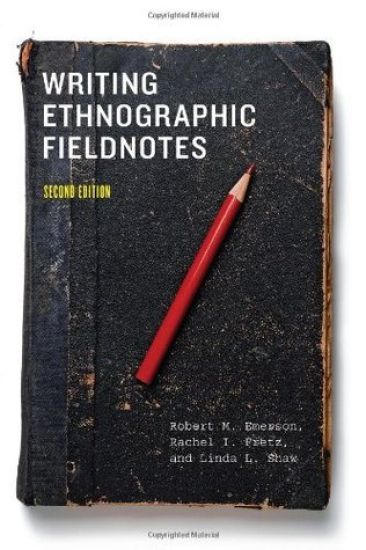
Writing Ethnographic Fieldnotes, Second Edition

Writing Ethnographic Fieldnotes, Second Edition

Robert M. Emerson; Rachel I. Fretz; Linda L. Shaw

University of Chicago Press
2011
nidottu
In "Writing Ethnographic Fieldnotes", Robert M. Emerson, Rachel I. Fretz, and Linda L. Shaw present a series of guidelines, suggestions, and practical advice for creating useful fieldnotes in a variety of settings, demystifying a process that is often assumed to be intuitive and impossible to teach. Using actual unfinished notes as examples, the authors illustrate options for composing, reviewing, and working fieldnotes into finished texts. They discuss different organizational and descriptive strategies and show how transforming direct observations into vivid descriptions results not simply from good memory but from learning to envision scenes as written. A good ethnographer, they demonstrate, must learn to remember dialogue and movement like an actor, to see colors and shapes like a painter, and to sense moods and rhythms like a poet. This new edition reflects the extensive feedback the authors have received from students and instructors since the first edition was published in 1995. As a result, they have updated the race, class, and gender section, created new sections on coding programs and revising first drafts, and provided new examples of working notes. An essential tool for budding social scientists, the second edition of "Writing Ethnographic Fieldnotes" will be invaluable for a new generation of researchers entering the field.
Projections of Power – Framing News, Public Opinion, and U.S. Foreign Policy
To succeed in foreign policy, U.S. presidents have to sell their versions or framings of political events to the news media and to the public. But since the end of the Cold War, journalists have increasingly resisted presidential views, even offering their own spin on events. What, then, determines whether the media will accept or reject the White House perspective? And what consequences does this new media environment have for policymaking and public opinion?To answer these questions, Robert M. Entman develops a powerful new model of how media framing works—a model that allows him to explain why the media cheered American victories over small-time dictators in Grenada and Panama but barely noticed the success of far more difficult missions in Haiti and Kosovo. Discussing the practical implications of his model, Entman also suggests ways to more effectively encourage the exchange of ideas between the government and the media and between the media and the public. His book will be an essential guide for political scientists, students of the media, and anyone interested in the increasingly influential role of the media in foreign policy.
Projections of Power

Projections of Power

Robert M Entman

University of Chicago Press
2003
nidottu
To succeed in foreign policy, U.S. presidents have to sell their versions or framings of political events to the news media and to the public. But since the end of the Cold War, journalists have increasingly resisted presidential views, even offering their own spin on events. What, then, determines whether the media will accept or reject the White House perspective? And what consequences does this new media environment have for policymaking and public opinion?To answer these questions, Robert M. Entman develops a powerful new model of how media framing works—a model that allows him to explain why the media cheered American victories over small-time dictators in Grenada and Panama but barely noticed the success of far more difficult missions in Haiti and Kosovo. Discussing the practical implications of his model, Entman also suggests ways to more effectively encourage the exchange of ideas between the government and the media and between the media and the public. His book will be an essential guide for political scientists, students of the media, and anyone interested in the increasingly influential role of the media in foreign policy.
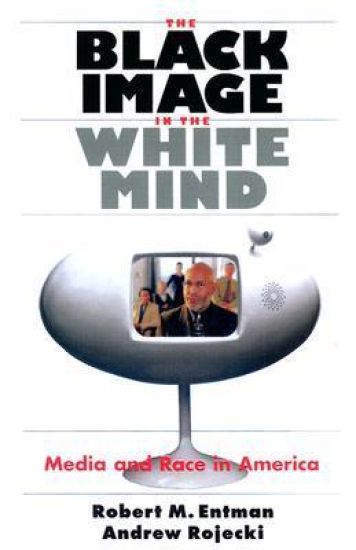
The Black Image in the White Mind – Media and Race in America

The Black Image in the White Mind – Media and Race in America

Robert M. Entman; Andrew Rojecki

University of Chicago Press
2001
nidottu
Living in a segregated society, white Americans learn about African Americans not through personal relationships but through the images the media show them. "The Black Image in the White Mind" offers the most comprehensive look at the intricate racial patterns in the mass media and how they shape the ambivalent attitudes of Whites towards Blacks. Using the media, and especially television, as barometers of race relations, Robert M. Entman and Andrew Rojecki explore but then go beyond the treatment of African Americans on network and local news to incisively uncover the messages sent about race by the entertainment industry - from prime-time dramas and sitcoms to commercials and Hollywood movies. While the authors find very little in the media that intentionally promotes racism, they find even less that advances racial harmony. They reveal instead a subtle pattern of images that, while making room for Blacks, implies a racial hierarchy with Whites on top and promotes a sense of difference and conflict. Commercials, for example, feature plenty of Black characters. But unlike Whites, they rarely speak to or touch one another. In prime time, the few Blacks who escape sitcom buffoonery rarely enjoy informal, friendly contact with White colleagues - perhaps reinforcing social distance in real life. Entman and Rojecki interweave such astute observations with candid interviews of White Americans that make clear how these images of racial differences insinuate themselves into Whites' thinking. Despite its disturbing readings of television and film, the book's cogent analyses and proposed policy guidelines offer hope that America's powerful mediated racial separation can be successfully bridged.
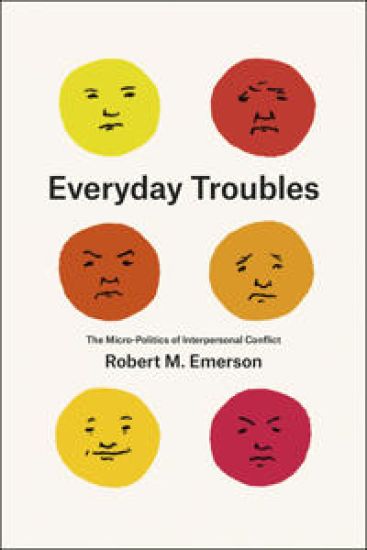
Everyday Troubles

Everyday Troubles

Robert M. Emerson

University of Chicago Press
2015
sidottu
From roommate disputes to family arguments, trouble is inevitable in interpersonal relationships. In Everyday Troubles, Robert M Emerson explores the beginnings and development of the conflicts that occur in our relationships with the people we regularly encounter-family members, intimate partners, coworkers, and others - and the common responses to such troubles. To examine these issues, Emerson draws on interviews with college roommates, diaries documenting a wide range of irritation with others, conversations with people caring for family members suffering from Alzheimer's, studies of family interactions, neighborly disputes, and other personal accounts. He considers how people respond to everyday troubles: in non-confrontational fashion, by making low-visibility, often secretive, changes in the relationship; more openly by directly complaining to the other person; or by involving a third party, such as friends or family. He then examines how some relational troubles escalate toward extreme and even violent responses, in some cases leading to the involvement of outside authorities like the police or mental health specialists. By calling attention to the range of possible reactions to conflicts in interpersonal relationships, Emerson also reminds us that extreme, even criminal actions often result when people fail to find ways to deal with trouble in moderate, non-confrontational ways. Innovative and insightful, Everyday Troubles is an illuminating look at how we deal with discord in our relationships.
Everyday Troubles

Everyday Troubles

Robert M. Emerson

University of Chicago Press
2015
nidottu
From roommate disputes to family arguments, trouble is inevitable in interpersonal relationships. In Everyday Troubles, Robert M Emerson explores the beginnings and development of the conflicts that occur in our relationships with the people we regularly encounter-family members, intimate partners, coworkers, and others-and the common responses to such troubles. To examine these issues, Emerson draws on interviews with college roommates, diaries documenting a wide range of irritation with others, conversations with people caring for family members suffering from Alzheimer's, studies of family interactions, neighborly disputes, and other personal accounts. He considers how people respond to everyday troubles: in non-confrontational fashion, by making low-visibility, often secretive, changes in the relationship; more openly by directly complaining to the other person; or by involving a third party, such as friends or family. He then examines how some relational troubles escalate toward extreme and even violent responses, in some cases leading to the involvement of outside authorities like the police or mental health specialists. By calling attention to the range of possible reactions to conflicts in interpersonal relationships, Emerson also reminds us that extreme, even criminal actions often result when people fail to find ways to deal with trouble in moderate, non-confrontational ways. Innovative and insightful, Everyday Troubles is an illuminating look at how we deal with discord in our relationships.
Comic Faith

Comic Faith

Robert M. Polhemus

University of Chicago Press
1982
nidottu
"Polhemus sketches several distinctions between nineteenth- and twentieth-century novelists and concludes that what most characterizes the nineteenth century, from the perspective of the twentieth, is the tendency in its comic fiction to criticize and to undermine the dogma and institutions of religion and to put faith instead of the existence of the comic perspective. Comic Faith is a virtuoso performance of impressive stature; I suspect the book will be influential for many years to come."—John Halperin, Modern Fiction Studies
Patents for Power

Patents for Power

Robert M. Farley; Davida H. Isaacs

University of Chicago Press
2020
sidottu
In an era when knowledge can travel with astonishing speed, the need for analysis of intellectual property (IP) law—and its focus on patents, trade secrets, trademarks, and issues of copyright—has never been greater. But as Robert M. Farley and Davida H. Isaacs stress in Patents for Power, we have long overlooked critical ties between IP law and one area of worldwide concern: military technology. This deft blend of case studies, theoretical analyses, and policy advice reveals the fundamental role of IP law in shaping how states create and transmit defense equipment and weaponry. The book probes two major issues: the effect of IP law on innovation itself and the effect of IP law on the international diffusion, or sharing, of technology. Discussing a range of inventions, from the AK-47 rifle to the B-29 Superfortress bomber to the MQ-1 Predator drone, the authors show how IP systems (or their lack) have impacted domestic and international relations across a number of countries, including the United States, Russia, China, and South Korea. The study finds, among other results, that while the open nature of the IP system may encourage industrial espionage like cyberwarfare, increased state uptake of IP law is helping to establish international standards for IP protection. This clear-eyed approach to law and national security is thus essential for anyone interested in history, political science, and legal studies.
Quantum Field Theory in Curved Spacetime and Black Hole Thermodynamics
In this book, Robert Wald provides a pedagogical introduction to the formulation of quantum field theory in curved spacetime. He begins with a treatment of the ordinary one-dimensional quantum harmonic oscillator, progresses through the construction of quantum field theory in flat spacetime to possible constructions of quantum field theory in curved spacetime, and, ultimately, to an algebraic formulation of the theory. In his presentation, Wald disentangles essential features of the theory from inessential ones (such as a particle interpretation) and clarifies relationships between various approaches to the formulation of the theory. He also provides a comprehensive, up-to-date account of the Unruh effect, the Hawking effect, and some of its ramifications. In particular, the subject of black hole thermodynamics, which remains an active area of research, is treated in depth. This book is intended for students and researchers who have had introductory courses in general relativity and quantum field theory, and should be of interest to scientists in general relativity and related fields.
Space, Time, and Gravity

Space, Time, and Gravity

Robert M. Wald

University of Chicago Press
1992
sidottu
Writing for the general reader or student, Wald has completely revised and updated this highly regarded work to include recent developments in black hole physics and cosmology. Nature called the first edition "a very readable and accurate account of modern relativity physics for the layman within the unavoidable constraint of almost no mathematics...A well written, entertaining and authoritative book."
Space, Time, and Gravity

Space, Time, and Gravity

Robert M. Wald

University of Chicago Press
1992
nidottu
Writing for the general reader or student, Wald has completely revised and updated this highly regarded work to include recent developments in black hole physics and cosmology. Nature called the first edition "a very readable and accurate account of modern relativity physics for the layman within the unavoidable constraint of almost no mathematics. . . . A well written, entertaining and authoritative book."
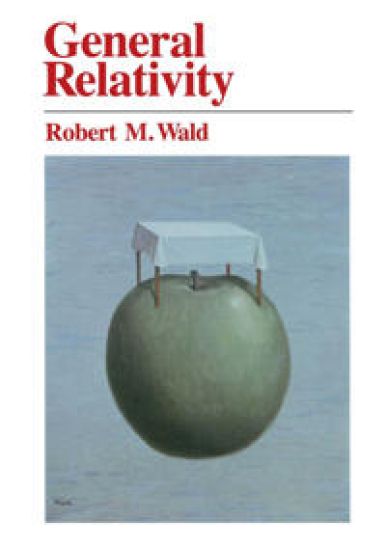
General Relativity

General Relativity

Robert M. Wald

University of Chicago Press
1984
nidottu
"Wald's book is clearly the first textbook on general relativity with a totally modern point of view; and it succeeds very well where others are only partially successful. The book includes full discussions of many problems of current interest which are not treated in any extant book, and all these matters are considered with perception and understanding."—S. Chandrasekhar "A tour de force: lucid, straightforward, mathematically rigorous, exacting in the analysis of the theory in its physical aspect."—L. P. Hughston, Times Higher Education Supplement"Truly excellent. . . . A sophisticated text of manageable size that will probably be read by every student of relativity, astrophysics, and field theory for years to come."—James W. York, Physics Today
Black Holes and Relativistic Stars

Black Holes and Relativistic Stars

Robert M. Wald

University of Chicago Press
1998
sidottu
The inevitability of gravitational collapse for stellar bodies of sufficient mass was convincingly demonstarted by S. Chandrasekhar in the 1930s, black holes and neutron stars played a minor role in serious analyses of physical or astrophysical phenomena until the discovery of quasars and pulsars in the 1960s. Black holes and neutron stars are now generally recognized as key components of many astrophysical systems, and play a central role in the understanding of gravitational phenomena at both the classical and quantum levels. Based on a symposium held in honour of S. Chandrasekhar, these papers provide a comprehensive summary of progress made in the 1990s on the theory of black holes and relativistic stars.
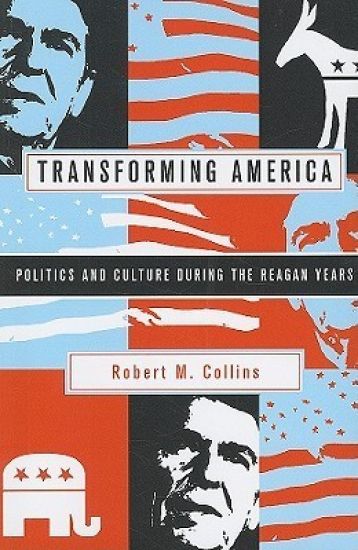
Transforming America

Transforming America

Robert M. Collins

Columbia University Press
2006
sidottu
By the end of the 1980s, the "malaise" that had once pervaded American society was replaced by a renewed sense of confidence and national purpose. However, beneath this veneer of optimism was a nation confronting the effects of massive federal deficits, a reckless foreign policy, AIDS, homelessness, and a growing "cultural war." In Transforming America, renowned historian Robert Collins examines the decade's critical and controversial developments and the unmistakable influence of Ronald Reagan. Moving beyond conventional depictions that either demonize or sanctify Reagan, Collins offers fresh insights into his thought and influence. He portrays Reagan as a complex political figure who combined ideological conservatism with political pragmatism to achieve many of his policy aims. Collins demonstrates how Reagan's policies helped to limit the scope of government, control inflation, reduce the threat of nuclear war, and defeat communism. Collins also shows how the simultaneous ascendancy of the right in politics and the left in culture created a divisive legacy. The 1980s witnessed other changes, including the advent of the personal computer, a revolution in information technology, a more globalized national economy, and a restructuring of the American corporation. In the realm of culture, the creation of MTV, the popularity of self-help gurus, and the rise of postmodernism in American universities were the realization of the cultural shifts of the postwar era. These developments, Collins suggests, created a conflict in American society that continues today, pitting cultural conservatism against a secular and multicultural view of the world. Entertaining and erudite, Transforming America explores the events, movements, and ideas that defined a turbulent decade and profoundly changed the shape and direction of American culture and politics.
Transforming America

Transforming America

Robert M. Collins

Columbia University Press
2009
pokkari
By the end of the 1980s, the "malaise" that had once pervaded American society was replaced by a renewed sense of confidence and national purpose. However, beneath this veneer of optimism was a nation confronting the effects of massive federal deficits, a reckless foreign policy, AIDS, homelessness, and a growing "cultural war." In Transforming America, renowned historian Robert Collins examines the decade's critical and controversial developments and the unmistakable influence of Ronald Reagan. Moving beyond conventional depictions that either demonize or sanctify Reagan, Collins offers fresh insights into his thought and influence. He portrays Reagan as a complex political figure who combined ideological conservatism with political pragmatism to achieve many of his policy aims. Collins demonstrates how Reagan's policies helped to limit the scope of government, control inflation, reduce the threat of nuclear war, and defeat communism. Collins also shows how the simultaneous ascendancy of the right in politics and the left in culture created a divisive legacy. The 1980s witnessed other changes, including the advent of the personal computer, a revolution in information technology, a more globalized national economy, and a restructuring of the American corporation. In the realm of culture, the creation of MTV, the popularity of self-help gurus, and the rise of postmodernism in American universities were the realization of the cultural shifts of the postwar era. These developments, Collins suggests, created a conflict in American society that continues today, pitting cultural conservatism against a secular and multicultural view of the world. Entertaining and erudite, Transforming America explores the events, movements, and ideas that defined a turbulent decade and profoundly changed the shape and direction of American culture and politics.