

Kirjahaku
Etsi kirjoja tekijän nimen, kirjan nimen tai ISBN:n perusteella.
1000 tulosta hakusanalla Rodney a. Robertson

In this unique text, Stark and Bainbridge begin with basic statements about human nature and, employing the principles of logic and philosophy, build toward increasingly complex propositions about societies and their religious institutions. They provide a rigorous yet flexible sociological theory of religion as well as a general sociological model for deriving macrolevel theory from microlevel evidence.

Christians feel increasingly useless, argues Rodney Clapp, not because they have nothing to offer a post-Christian society, but because they are trying to serve as "sponsoring chaplins" to a civilization that no longer sees Christianity as necessary to its existence. In the individualistic, technologically oriented, consumer-based culture, Christianity has become largely irrelevant. Writing inclusively with considerable verve, Clapp offer a keen analysis of the church and its ministry as we face a new miillennium.

A Descriptive Catalogue of the Medieval Manuscripts in Worcester Cathedral Library
Rodney M Thomson; Michael Gullick
D.S. Brewer
2001
sidottu
Collection of 277 litle-known medieval manuscripts, second only in number to Durham; special strengths are scholastic theology, biblical studies and sermons 13c-15c, and early music. Worcester Cathedral Library contains 277 medieval manuscripts, the largest number of any English cathedral except Durham. Most of them belonged to the pre-Reformation Cathedral Priory and date between the eleventh and late fifteenth centuries. The collection has never been adequately catalogued before, and is consequently little known; much of the contents of the books, their physical features and history, is here described for the first time. The libraryis rich in late medieval theology and sermon-literature. Many of the books are important because of their connections with Oxford University, and constitute a valuable source for the history of studies there after c.1300. The Worcester monks tended to annotate and write their names in their books, and some seventy of them are identified. Great treasures are the Worcester Antiphoner, and the fragments of early polyphonic music, some newly-discovered and described for the first time. About half the books are in their medieval bindings, including the second-oldest intact Anglo-Saxon binding. These are described individually, and the history of binding at the Cathedral Priory traced, by Michael Gullick. The rest of the Introduction is devoted to the history of the books and library to the early 1600s. There are indexes of incipits and of manuscripts other than those catalogued, as well as a general index.R.M. THOMSON is Emeritus Professor of History, University of Tasmania; MICHAEL GULLICK..Other Cathedral library catalogues; Catalogue of the Manuscripts of Hereford Cathedral Library and Catalogue of the Manuscripts of Lincoln Cathedral Chapter Library.

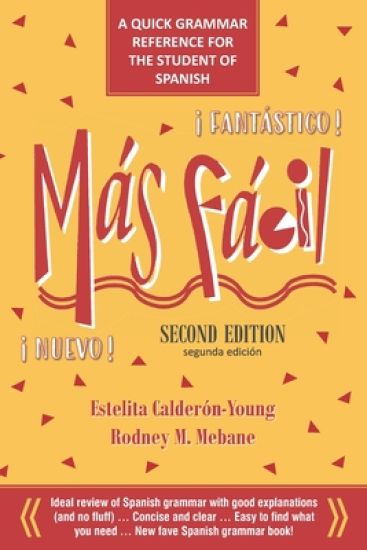
Más Fácil: A Quick Grammar Reference for the Student of Spanish
Rodney M. Mebane; Estelita Calderón-Young
Wordsmith Associates
2021
nidottu
SPANISH GRAMMAR MADE EASIER EASIER is exactly what M s F cil does to learning Spanish - makes it EASIER The book's ingenious design: 1) speeds access to needed information, 2) it enables learning, and 3) it enhances memory. One verified reader refers to M s F cil as "my go-to aide." Another calls it my "NEW FAVE Spanish book ... easily the best concise Spanish grammar, with good explanations ... and no fluff " M s F cil earns its rep by organizing and presenting all key Spanish grammar principles in a comprehensive, tightly organized, well-indexed, and highly cross-referenced guide. At less than 200 pages, it is a thin volume that travels well as a full-service, one-stop-shop reference tool. Topics in M s F cil cover: 1. Grammar rules, principles, and practices2. Parts of speech3. Verb forms4. Pronunciation and punctuation5. Common phrases6. Commonly confused and misused terms7. Days, dates, numbers, telling timeand MORE Creatively designed for ease of use, M s F cil is a first-rate, best-in-class look-up reference manual. By leveraging principles of organization and presentation to optimize the look-up time, M s F cil frees up capacity for accelerated language skill building. Complete with everyday explanations and illustrative examples, M s F cil is a valuable self-study companion, and it complements and extends other study programs (online or in-person).
A Student's Introduction to English Grammar
Rodney Huddleston; Geoffrey K. Pullum; Brett Reynolds
Cambridge University Press
2021
pokkari
A new edition of a successful undergraduate textbook on contemporary international Standard English grammar, based on Huddleston and Pullum's earlier award-winning work, The Cambridge Grammar of the English Language (2002). The analyses defended there are outlined here more briefly, in an engagingly accessible and informal style. Errors of the older tradition of English grammar are noted and corrected, and the excesses of prescriptive usage manuals are firmly rebutted in specially highlighted notes that explain what older authorities have called 'incorrect' and show why those authorities are mistaken. Intended for students in colleges or universities who have little or no background in grammar or linguistics, this teaching resource contains numerous exercises and online resources suitable for any course on the structure of English in either linguistics or English departments. A thoroughly modern undergraduate textbook, rewritten in an easy-to-read conversational style with a minimum of technical and theoretical terminology.
A Student's Introduction to English Grammar
Rodney Huddleston; Geoffrey K. Pullum; Brett Reynolds
Cambridge University Press
2021
sidottu
A new edition of a successful undergraduate textbook on contemporary international Standard English grammar, based on Huddleston and Pullum's earlier award-winning work, The Cambridge Grammar of the English Language (2002). The analyses defended there are outlined here more briefly, in an engagingly accessible and informal style. Errors of the older tradition of English grammar are noted and corrected, and the excesses of prescriptive usage manuals are firmly rebutted in specially highlighted notes that explain what older authorities have called 'incorrect' and show why those authorities are mistaken. Intended for students in colleges or universities who have little or no background in grammar or linguistics, this teaching resource contains numerous exercises and online resources suitable for any course on the structure of English in either linguistics or English departments. A thoroughly modern undergraduate textbook, rewritten in an easy-to-read conversational style with a minimum of technical and theoretical terminology.

Put. Vernon Eugene Chadwick was proud of his time served in the United States Army. Eugene was a good Christian Soldier who kept his faith and strengthened others during WWII. Eugene never complained, but encouraged others in his company. As you read this book, find yourself imagining every little detail of the war. Imagine your desk being a green duffel bag on the hard ground, imagine driving huge heavy trucks down to the winding river. Hear the loud planes roar over your head. Feel his tied body resting in a foxhole wondering when the next shell is going to hit. Feel his loneliness of wanting to be home. Eugene is a soldier who had a wish that the war would soon be over so he could return home to the family farm.


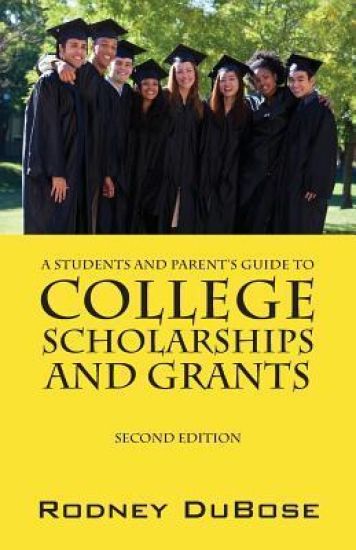
A Students and Parent's Guide to College Scholarships and Grants
Rodney Dubose
Outskirts Press
2012
pokkari


A Practical Guide To SUCCESS in the United States Air Force
Rodney Q. Phillips
Createspace Independent Publishing Platform
2012
nidottu
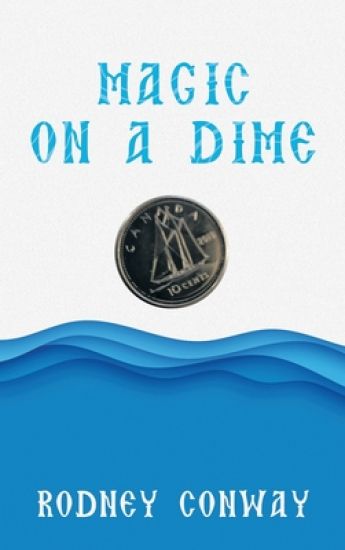
Cid is living a life of unfulfilled dreams. One day he wakes up to look out his window and see something that shakes up his life. He has to face it and when he does he begins to fulfill his dreams. He goes off in an adventure that changes everything for him.

Cid is living a life of unfulfilled dreams. One day he wakes up to look out his window and see something that shakes up his life. He has to face it and when he does he begins to fulfill his dreams. He goes off in an adventure that changes everything for him.
A History of English Poetry An Unpublished Continuation
Rodney M. Baine
Createspace Independent Publishing Platform
2014
nidottu
A Man Named Clarke 1831 Volume 2
Rodney Glass
Createspace Independent Publishing Platform
2014
nidottu

Caught In A Storm: What Would Sarah and The Girls Say?
Rodney Glynn Bankens
Createspace Independent Publishing Platform
2014
nidottu

Surviving PTSD: A Combat Marine's Story
Rodney R. Letchworth
Createspace Independent Publishing Platform
2015
nidottu