The Day's Work is a collection of stories by Rudyard Kipling. It was first published in 1898. There are no poems included between the different stories in The Day's Work, as there are in many other of Kipling's collections. The book contains 13 short stories, which were mainly written between 1893 and 1896 while Kipling was living in Vermont. Four of the stories contained in The Day's Work include anthropomorphic characters. "The Bridge-Builders" "A Walking Delegate" "The Ship that Found Herself" "The Tomb of His Ancestors" "The Devil and the Deep Sea" "William the Conqueror - part I" "William the Conqueror - part II" ".007" "The Maltese Cat" "Bread upon the Waters" "An Error in the Fourth Dimension" "My Sunday at Home" "The Brushwood Boy"
Just So Stories for Little Children is a 1902 collection of origin stories by the British author Rudyard Kipling. Considered a classic of children's literature, the book is among Kipling's best known works. Kipling began working on the book by telling the first three chapters as bedtime stories to his daughter Josephine. These had to be told "just so" (exactly in the words she was used to) or she would complain. The stories describe how one animal or another acquired its most distinctive features, such as how the Leopard got his spots. For the book, Kipling illustrated the stories himself. The stories have appeared in a variety of adaptations including a musical and animated films. Evolutionary biologists have noted that what Kipling did in fiction, they have done in reality, providing explanations for the evolutionary development of animal features.The stories, first published in 1902, are origin stories, fantastic accounts of how various features of animals came to be. A forerunner of these stories is Kipling's "How Fear Came", in The Second Jungle Book (1895). In it, Mowgli hears the story of how the tiger got his stripes.The Just So Stories each tell how a particular animal was modified from an original form to its current form by the acts of man, or some magical being. For example, the Whale has a tiny throat because he swallowed a mariner, who tied a raft inside to block the whale from swallowing other men. The Camel has a hump given to him by a djinn as punishment for the camel's refusing to work (the hump allows the camel to work longer between times of eating). The Leopard's spots were painted by an Ethiopian (after the Ethiopian painted himself black). The Kangaroo gets its powerful hind legs, long tail, and hopping gait after being chased all day by a dingo, sent by a minor god responding to the Kangaroo's request to be made different from all other animals. The Just So Stories began as bedtime stories told to his daughter "Effie" Josephine, Kipling's firstborn]; when the first three were published in a children's magazine, a year before her death, Kipling explained: "in the evening there were stories meant to put Effie to sleep, and you were not allowed to alter those by one single little word. They had to be told just so; or Effie would wake up and put back the missing sentence. So at last they came to be like charms, all three of them, -the whale tale, the camel tale, and the rhinoceros
The Seven Seas is a book of poetry by Rudyard Kipling published 1896.Poems include The Lost Legion. Joseph Rudyard Kipling ( 30 December 1865 - 18 January 1936) was an English journalist, short-story writer, poet, and novelist. Kipling's works of fiction include The Jungle Book (1894), Kim (1901), and many short stories, including "The Man Who Would Be King" (1888).His poems include "Mandalay" (1890), "Gunga Din" (1890), "The Gods of the Copybook Headings" (1919), "The White Man's Burden" (1899), and "If-" (1910). He is regarded as a major innovator in the art of the short story; his children's books are classics of children's literature; and one critic described his work as exhibiting "a versatile and luminous narrative gift". Kipling was one of the most popular writers in the United Kingdom, in both prose and verse, in the late 19th and early 20th centuries. Henry James said: "Kipling strikes me personally as the most complete man of genius, as distinct from fine intelligence, that I have ever known." In 1907, at the age of 42, he was awarded the Nobel Prize in Literature, making him the first English-language writer to receive the prize, and its youngest recipient to date.He was also sounded out for the British Poet Laureateship and on several occasions for a knighthood, both of which he declined. Kipling's subsequent reputation has changed according to the political and social climate of the age and the resulting contrasting views about him continued for much of the 20th century. George Orwell called him a "prophet of British imperialism". Literary critic Douglas Kerr wrote: " Kipling] is still an author who can inspire passionate disagreement and his place in literary and cultural history is far from settled. But as the age of the European empires recedes, he is recognised as an incomparable, if controversial, interpreter of how empire was experienced. That, and an increasing recognition of his extraordinary narrative gifts, make him a force to be reckoned with."
Joseph Rudyard Kipling ( 30 December 1865 - 18 January 1936) was an English journalist, short-story writer, poet, and novelist. Kipling's works of fiction include The Jungle Book (1894), Kim (1901), and many short stories, including "The Man Who Would Be King" (1888).His poems include "Mandalay" (1890), "Gunga Din" (1890), "The Gods of the Copybook Headings" (1919), "The White Man's Burden" (1899), and "If-" (1910). He is regarded as a major innovator in the art of the short story; his children's books are classics of children's literature; and one critic described his work as exhibiting "a versatile and luminous narrative gift". Kipling was one of the most popular writers in the United Kingdom, in both prose and verse, in the late 19th and early 20th centuries. Henry James said: "Kipling strikes me personally as the most complete man of genius, as distinct from fine intelligence, that I have ever known." In 1907, at the age of 42, he was awarded the Nobel Prize in Literature, making him the first English-language writer to receive the prize, and its youngest recipient to date.He was also sounded out for the British Poet Laureateship and on several occasions for a knighthood, both of which he declined. Kipling's subsequent reputation has changed according to the political and social climate of the age and the resulting contrasting views about him continued for much of the 20th century. George Orwell called him a "prophet of British imperialism". Literary critic Douglas Kerr wrote: " Kipling] is still an author who can inspire passionate disagreement and his place in literary and cultural history is far from settled. But as the age of the European empires recedes, he is recognised as an incomparable, if controversial, interpreter of how empire was experienced. That, and an increasing recognition of his extraordinary narrative gifts, make him a force to be reckoned with."
Plain Tales from the Hills (published 1888) is the first collection of short stories by Rudyard Kipling. Out of its 40 stories, "eight-and-twenty", according to Kipling's Preface, were initially published in the Civil and Military Gazette in Lahore, Punjab, British India, between November 1886 and June 1887. "The remaining tales are, more or less, new." (Kipling had worked as a journalist for the CMG-his first job-since 1882, when he was not quite 17.) The title refers, by way of a pun on "Plain" as the reverse of "Hills", to the deceptively simple narrative style; and to the fact that many of the stories are set in the Hill Station of Simla-the "summer capital of the British Raj" during the hot weather. Not all of the stories are, in fact, about life in "the Hills" Kipling gives sketches of many aspects of life in British India. The tales include the first appearances, in book form, of Mrs. Hauksbee, the policeman Strickland, and the Soldiers Three (Privates Mulvaney, Ortheris and Learoyd). The stories edit] "Lispeth" "Three and - an Extra" "Thrown Away" "Miss Youghal's Sais" "Yoked with an Unbeliever'" "False Dawn" "The Rescue of Pluffles" "Cupid's Arrows" "The Three Musketeers" "His Chance in Life" "Watches of the Night" "The Other Man" "Consequences" "The Conversion of Aurelian McGoggin" "The Taking of Lungtungpen" "A Germ-Destroyer" "Kidnapped" "The Arrest of Lieutenant Golightly" "In the House of Suddhoo" "His Wedded Wife" "The Broken Link Handicap" "Beyond the Pale" "In Error" "A Bank Fraud" "Tods' Amendment" "The Daughter of the Regiment" "In the Pride of his Youth" "Pig" "The Rout of the White Hussars" "The Bronckhorst Divorce-case" "Venus Annodomini" "The Bisara of Pooree" "A Friend's Friend" "The Gate of the Hundred Sorrows" "The Madness of Private Ortheris" "The Story of Muhammad Din" "On the Strength of a Likeness" "Wressley of the Foreign Office" "By Word of Mouth" "To be Filed for Reference"... Joseph Rudyard Kipling ( 30 December 1865 - 18 January 1936) was an English journalist, short-story writer, poet, and novelist. Kipling's works of fiction include The Jungle Book (1894), Kim (1901), and many short stories, including "The Man Who Would Be King" (1888).His poems include "Mandalay" (1890), "Gunga Din" (1890), "The Gods of the Copybook Headings" (1919), "The White Man's Burden" (1899), and "If-" (1910). He is regarded as a major innovator in the art of the short story; his children's books are classics of children's literature; and one critic described his work as exhibiting "a versatile and luminous narrative gift". Kipling was one of the most popular writers in the United Kingdom, in both prose and verse, in the late 19th and early 20th centuries. Henry James said: "Kipling strikes me personally as the most complete man of genius, as distinct from fine intelligence, that I have ever known." In 1907, at the age of 42, he was awarded the Nobel Prize in Literature, making him the first English-language writer to receive the prize, and its youngest recipient to date.He was also sounded out for the British Poet Laureateship and on several occasions for a knighthood, both of which he declined. Kipling's subsequent reputation has changed according to the political and social climate of the age and the resulting contrasting views about him continued for much of the 20th century. George Orwell called him a "prophet of British imperialism". Literary critic Douglas Kerr wrote: " Kipling] is still an author who can inspire passionate disagreement and his place in literary and cultural history is far from settled. But as the age of the European empires recedes, he is recognised as an incomparable, if controversial, interpreter of how empire was experienced. That, and an increasing recognition of his extraordinary narrative gifts, make him a force to be reckoned with."
The Day's Work is a collection of stories by Rudyard Kipling. It was first published in 1898. There are no poems included between the different stories in The Day's Work, as there are in many other of Kipling's collections. The book contains 13 short stories, which were mainly written between 1893 and 1896 while Kipling was living in Vermont. Four of the stories contained in The Day's Work include anthropomorphic characters. "The Bridge-Builders" "A Walking Delegate" "The Ship that Found Herself" "The Tomb of His Ancestors" "The Devil and the Deep Sea" "William the Conqueror - part I" "William the Conqueror - part II" ".007" "The Maltese Cat" "Bread upon the Waters" "An Error in the Fourth Dimension" "My Sunday at Home" "The Brushwood Boy"... Joseph Rudyard Kipling ( 30 December 1865 - 18 January 1936) was an English journalist, short-story writer, poet, and novelist. Kipling's works of fiction include The Jungle Book (1894), Kim (1901), and many short stories, including "The Man Who Would Be King" (1888).His poems include "Mandalay" (1890), "Gunga Din" (1890), "The Gods of the Copybook Headings" (1919), "The White Man's Burden" (1899), and "If-" (1910). He is regarded as a major innovator in the art of the short story; his children's books are classics of children's literature; and one critic described his work as exhibiting "a versatile and luminous narrative gift". Kipling was one of the most popular writers in the United Kingdom, in both prose and verse, in the late 19th and early 20th centuries. Henry James said: "Kipling strikes me personally as the most complete man of genius, as distinct from fine intelligence, that I have ever known." In 1907, at the age of 42, he was awarded the Nobel Prize in Literature, making him the first English-language writer to receive the prize, and its youngest recipient to date.He was also sounded out for the British Poet Laureateship and on several occasions for a knighthood, both of which he declined. Kipling's subsequent reputation has changed according to the political and social climate of the age and the resulting contrasting views about him continued for much of the 20th century. George Orwell called him a "prophet of British imperialism". Literary critic Douglas Kerr wrote: " Kipling] is still an author who can inspire passionate disagreement and his place in literary and cultural history is far from settled. But as the age of the European empires recedes, he is recognised as an incomparable, if controversial, interpreter of how empire was experienced. That, and an increasing recognition of his extraordinary narrative gifts, make him a force to be reckoned with.".....
Just So Stories for Little Children is a 1902 collection of origin stories by the British author Rudyard Kipling. Considered a classic of children's literature, the book is among Kipling's best known works. Kipling began working on the book by telling the first three chapters as bedtime stories to his daughter Josephine. These had to be told "just so" (exactly in the words she was used to) or she would complain. The stories describe how one animal or another acquired its most distinctive features, such as how the Leopard got his spots. For the book, Kipling illustrated the stories himself. The stories have appeared in a variety of adaptations including a musical and animated films. Evolutionary biologists have noted that what Kipling did in fiction, they have done in reality, providing explanations for the evolutionary development of animal features.The stories, first published in 1902, are origin stories, fantastic accounts of how various features of animals came to be. A forerunner of these stories is Kipling's "How Fear Came", in The Second Jungle Book (1895). In it, Mowgli hears the story of how the tiger got his stripes.The Just So Stories each tell how a particular animal was modified from an original form to its current form by the acts of man, or some magical being. For example, the Whale has a tiny throat because he swallowed a mariner, who tied a raft inside to block the whale from swallowing other men. The Camel has a hump given to him by a djinn as punishment for the camel's refusing to work (the hump allows the camel to work longer between times of eating). The Leopard's spots were painted by an Ethiopian (after the Ethiopian painted himself black). The Kangaroo gets its powerful hind legs, long tail, and hopping gait after being chased all day by a dingo, sent by a minor god responding to the Kangaroo's request to be made different from all other animals. The Just So Stories began as bedtime stories told to his daughter "Effie" Josephine, Kipling's firstborn]; when the first three were published in a children's magazine, a year before her death, Kipling explained: "in the evening there were stories meant to put Effie to sleep, and you were not allowed to alter those by one single little word. They had to be told just so; or Effie would wake up and put back the missing sentence. So at last they came to be like charms, all three of them, -the whale tale, the camel tale, and the rhinoceros tale."..... Joseph Rudyard Kipling ( 30 December 1865 - 18 January 1936) was an English journalist, short-story writer, poet, and novelist. Kipling's works of fiction include The Jungle Book (1894), Kim (1901), and many short stories, including "The Man Who Would Be King" (1888).His poems include "Mandalay" (1890), "Gunga Din" (1890), "The Gods of the Copybook Headings" (1919), "The White Man's Burden" (1899), and "If-" (1910). He is regarded as a major innovator in the art of the short story; his children's books are classics of children's literature; and one critic described his work as exhibiting "a versatile and luminous narrative gift". Kipling was one of the most popular writers in the United Kingdom, in both prose and verse, in the late 19th and early 20th centuries. Henry James said: "Kipling strikes me personally as the most complete man of genius, as distinct from fine intelligence, that I have ever known." In 1907, at the age of 42, he was awarded the Nobel Prize in Literature, making him the first English-language writer to receive the prize, and its youngest recipient to date.He was also sounded out for the British Poet Laureateship and on several occasions for a knighthood, both of which he declined. Kipling's subsequent reputation has changed according to the political and social climate of the age and the resulting contrasting views about him continued for much of the 20th century. ...
The Second Jungle Book is a sequel to The Jungle Book by Rudyard Kipling. First published in 1895, it features five stories about Mowgli and three unrelated stories, all but one set in India, most of which Kipling wrote while living in Vermont. All of the stories were previously published in magazines in 1894-5, often under different titles. The book is less well-known than the original.
The Light That Failed is a novel by Rudyard Kipling that was first published in 1890 in Lippincott's Monthly Magazine dated January 1891. Most of the novel is set in London, but many important events throughout the story occur in Sudan or India. The Light that Failed follows the life of Dick Heldar, a painter who goes blind. A play by George Fleming, starring Johnston Forbes-Robertson, his wife Gertrude Elliott, and Sydney Valentine, was first staged in the West End from February to April 1903 and moved on to Broadway in November, making the story more famous.It was made into a 1916 silent film by Path , with Robert Edeson and Jose Collins, a 1923 silent film by Famous Players-Lasky, and a 1939 film by Paramount, starring Ronald Colman as Heldar, with Muriel Angelus, Ida Lupino, and Walter Huston.... Joseph Rudyard Kipling ( 30 December 1865 - 18 January 1936) was an English journalist, short-story writer, poet, and novelist. Kipling's works of fiction include The Jungle Book (1894), Kim (1901), and many short stories, including "The Man Who Would Be King" (1888).His poems include "Mandalay" (1890), "Gunga Din" (1890), "The Gods of the Copybook Headings" (1919), "The White Man's Burden" (1899), and "If-" (1910). He is regarded as a major innovator in the art of the short story; his children's books are classics of children's literature; and one critic described his work as exhibiting "a versatile and luminous narrative gift". Kipling was one of the most popular writers in the United Kingdom, in both prose and verse, in the late 19th and early 20th centuries. Henry James said: "Kipling strikes me personally as the most complete man of genius, as distinct from fine intelligence, that I have ever known." In 1907, at the age of 42, he was awarded the Nobel Prize in Literature, making him the first English-language writer to receive the prize, and its youngest recipient to date.He was also sounded out for the British Poet Laureateship and on several occasions for a knighthood, both of which he declined. Kipling's subsequent reputation has changed according to the political and social climate of the age and the resulting contrasting views about him continued for much of the 20th century. George Orwell called him a "prophet of British imperialism". Literary critic Douglas Kerr wrote: " Kipling] is still an author who can inspire passionate disagreement and his place in literary and cultural history is far from settled. But as the age of the European empires recedes, he is recognised as an incomparable, if controversial, interpreter of how empire was experienced. That, and an increasing recognition of his extraordinary narrative gifts, make him a force to be reckoned with."
Captains Courageous is an 1897 novel, by Rudyard Kipling, that follows the adventures of fifteen-year-old Harvey Cheyne Jr., the spoiled son of a railroad tycoon, after he is saved from drowning by a Portuguese fisherman in the north Atlantic. The novel originally appeared as a serialisation in McClure's, beginning with the November 1896 edition. In 1900, in his essay "What We Can Expect of the American Boy," Teddy Roosevelt extolled the book and praised Kipling for describing "in the liveliest way just what a boy should be and do." The book's title comes from the ballad "Mary Ambree", which starts, "When captains courageous, whom death could not daunt". Kipling had previously used the same title for an article on businessmen as the new adventurers, published in The Times of 23 November 1892. Plot: Protagonist Harvey Cheyne, Jr., is the son of a wealthy railroad magnate and his wife, in San Diego, California. Washed overboard from a transatlantic steamship and rescued by fishermen off the Grand Banks of Newfoundland, Harvey can neither persuade them to take him quickly to port, nor convince them of his wealth. Disko Troop, captain of the schooner We're Here, offers him temporary membership in the crew until they return to port, and Harvey later accepts. Through a series of trials and adventures, Harvey, with the help of the captain's son Dan Troop, becomes acclimated to the fishing lifestyle, and even skillful. Eventually, the schooner returns to port and Harvey wires his parents, who immediately hasten to Boston, Massachusetts, and thence to the fishing town of Gloucester to recover him. There, Harvey's mother rewards the seaman Manuel, who initially rescued her son; Harvey's father hires Dan to work on his prestigious tea clipper fleet; and Harvey goes to Stanford to prepare for taking over his father's shipping lines.... Joseph Rudyard Kipling ( 30 December 1865 - 18 January 1936) was an English journalist, short-story writer, poet, and novelist. Kipling's works of fiction include The Jungle Book (1894), Kim (1901), and many short stories, including "The Man Who Would Be King" (1888).His poems include "Mandalay" (1890), "Gunga Din" (1890), "The Gods of the Copybook Headings" (1919), "The White Man's Burden" (1899), and "If-" (1910). He is regarded as a major innovator in the art of the short story; his children's books are classics of children's literature; and one critic described his work as exhibiting "a versatile and luminous narrative gift". Kipling was one of the most popular writers in the United Kingdom, in both prose and verse, in the late 19th and early 20th centuries. Henry James said: "Kipling strikes me personally as the most complete man of genius, as distinct from fine intelligence, that I have ever known." In 1907, at the age of 42, he was awarded the Nobel Prize in Literature, making him the first English-language writer to receive the prize, and its youngest recipient to date.He was also sounded out for the British Poet Laureateship and on several occasions for a knighthood, both of which he declined. Kipling's subsequent reputation has changed according to the political and social climate of the age and the resulting contrasting views about him continued for much of the 20th century. George Orwell called him a "prophet of British imperialism". Literary critic Douglas Kerr wrote: " Kipling] is still an author who can inspire passionate disagreement and his place in literary and cultural history is far from settled. But as the age of the European empires recedes, he is recognised as an incomparable, if controversial, interpreter of how empire was experienced. That, and an increasing recognition of his extraordinary narrative gifts, make him a force to be reckoned with."
Soldiers Three is a collection of short stories by Rudyard Kipling. The three soldiers of the title are Learoyd, Mulvaney and Ortheris, who had also appeared previously in the collection Plain Tales from the Hills. The current version, dating from 1899 and more fully titled Soldiers Three and other stories, consists of three sections which each had previously received separate publication in 1888; Learoyd, Mulvaney and Ortheris appear only in the first section, which is also titled Soldiers Three. The books reveal a side of the British Tommy in Afghanistan rarely seen in the Twilight of the British Empire. The soldiers comment on their betters, act the fool, but cut straight to the rawness of war in the mid-east as the British began to loosen their Imperial hold.. The Story of the Gadsbys is a story by Rudyard Kipling. 1] It was originally published as no. 2 of the Indian Railway Library in 1888. The Story of the Gadsbys is written in dramatic form, consisting of eight short scenes (listed below). This short pamphlet, of 100 pages, was later collected in book form as the second part of Soldiers Three. "Poor Dear Mamma" "The World Without" "The Tents of Kedar" "With any Amazement" "The Garden of Eden" "Fatima" "The Valley of the Shadow" "The Swelling of Jordan" "L'Envoi" (a poem)... In Black and White is a collection of eight short stories by Rudyard Kipling which was first published in a booklet of 108 pages as no. 3 of A H Wheeler & Co.'s Indian Railway Library in 1888. It was subsequently published in a book along with nos 1 and 2, Soldiers Three (1888) and The Story of the Gadsbys, as Soldiers Three (1899). The characters about whom the stories are concerned are native Indians, rather than the British for writing about whom Kipling may be better known; four of the stories are narrated by the Indians, and four by an observant wise English journalist (the persona that Kipling likes to adopt). The stories are: "Dray Wara Yow Dee" - told by an Afghan (Pathan) narrator "The Judgement of Dungara" - told by an English narrator "At Howli Thana" - told by an Indian narrator "Gemini" - told by an Indian narrator "At Twenty-Two" - told by an English narrator "In Flood Time" - told by an Indian narrator "The Sending of Dana Dee" - told by an English narrator "On the City Wall" - told by an English narrator... Joseph Rudyard Kipling ( 30 December 1865 - 18 January 1936) was an English journalist, short-story writer, poet, and novelist. Kipling's works of fiction include The Jungle Book (1894), Kim (1901), and many short stories, including "The Man Who Would Be King" (1888).His poems include "Mandalay" (1890), "Gunga Din" (1890), "The Gods of the Copybook Headings" (1919), "The White Man's Burden" (1899), and "If-" (1910). He is regarded as a major innovator in the art of the short story; his children's books are classics of children's literature; and one critic described his work as exhibiting "a versatile and luminous narrative gift". Kipling was one of the most popular writers in the United Kingdom, in both prose and verse, in the late 19th and early 20th centuries. Henry James said: "Kipling strikes me personally as the most complete man of genius, as distinct from fine intelligence, that I have ever known." In 1907, at the age of 42, he was awarded the Nobel Prize in Literature, making him the first English-language writer to receive the prize, and its youngest recipient to date.He was also sounded out for the British Poet Laureateship and on several occasions for a knighthood, both of which he declined....
Stalky & Co. is a novel by Rudyard Kipling, about adolescent boys at a British boarding school. It was first published in 1899 (following serialisation in the Windsor Magazine). Reflecting its origins, the novel is episodic in nature, with self-contained chapters. It is set at an unnamed school referred to as the College or the Coll., which is based on the United Services College in Devon, which Kipling attended. The character Beetle, one of the main trio, is partly based on Kipling himself, while the charismatic character Stalky is based on Lionel Dunsterville, M'Turk is based on George Charles Beresford and Mr King is based on William Carr Crofts. The stories have elements of revenge, the macabre, bullying and violence, and hints about sex, making them far from childish or idealised. For example, Beetle pokes fun at an earlier, more earnest, boys' book, Eric, or, Little by Little, thus flaunting his more worldly outlook. There is also some information about Stalky in later life. In his essay entitled "What We Can Expect of the American Boy," Teddy Roosevelt disdained this novel, calling it "a story which ought never to have been written, for there is hardly a single form of meanness which it does not seem to extol, or of school mismanagement which it does not seem to applaud."........ Joseph Rudyard Kipling ( 30 December 1865 - 18 January 1936) was an English journalist, short-story writer, poet, and novelist. Kipling's works of fiction include The Jungle Book (1894), Kim (1901), and many short stories, including "The Man Who Would Be King" (1888).His poems include "Mandalay" (1890), "Gunga Din" (1890), "The Gods of the Copybook Headings" (1919), "The White Man's Burden" (1899), and "If-" (1910). He is regarded as a major innovator in the art of the short story; his children's books are classics of children's literature; and one critic described his work as exhibiting "a versatile and luminous narrative gift". Kipling was one of the most popular writers in the United Kingdom, in both prose and verse, in the late 19th and early 20th centuries. Henry James said: "Kipling strikes me personally as the most complete man of genius, as distinct from fine intelligence, that I have ever known." In 1907, at the age of 42, he was awarded the Nobel Prize in Literature, making him the first English-language writer to receive the prize, and its youngest recipient to date.He was also sounded out for the British Poet Laureateship and on several occasions for a knighthood, both of which he declined. Kipling's subsequent reputation has changed according to the political and social climate of the age and the resulting contrasting views about him continued for much of the 20th century. George Orwell called him a "prophet of British imperialism". Literary critic Douglas Kerr wrote: " Kipling] is still an author who can inspire passionate disagreement and his place in literary and cultural history is far from settled. But as the age of the European empires recedes, he is recognised as an incomparable, if controversial, interpreter of how empire was experienced. That, and an increasing recognition of his extraordinary narrative gifts, make him a force to be reckoned with."
Joseph Rudyard Kipling 30 December 1865 - 18 January 1936) was an English journalist, short-story writer, poet, and novelist. Kipling's works of fiction include The Jungle Book (1894), Kim (1901), and many short stories, including "The Man Who Would Be King" (1888).His poems include "Mandalay" (1890), "Gunga Din" (1890), "The Gods of the Copybook Headings" (1919), "The White Man's Burden" (1899), and "If-" (1910). He is regarded as a major innovator in the art of the short story; his children's books are classics of children's literature; and one critic described his work as exhibiting "a versatile and luminous narrative gift".
Puck of Pook's Hill is a fantasy book by Rudyard Kipling, published in 1906, containing a series of short stories set in different periods of English history. It can count both as historical fantasy - since some of the stories told of the past have clear magical elements, and as contemporary fantasy - since it depicts a magical being active and practising his magic in the England of the early 1900s when the book was written. The stories are all narrated to two children living near Burwash, in the area of Kipling's own house Bateman's, by people magically plucked out of history by the elf Puck, or told by Puck himself. (Puck, who refers to himself as "the oldest Old Thing in England", is better known as a character in William Shakespeare's play A Midsummer Night's Dream.) The genres of particular stories range from authentic historical novella (A Centurion of the Thirtieth, On the Great Wall) to children's fantasy (Dymchurch Flit). Each story is bracketed by a poem which relates in some manner to the theme or subject of the story.
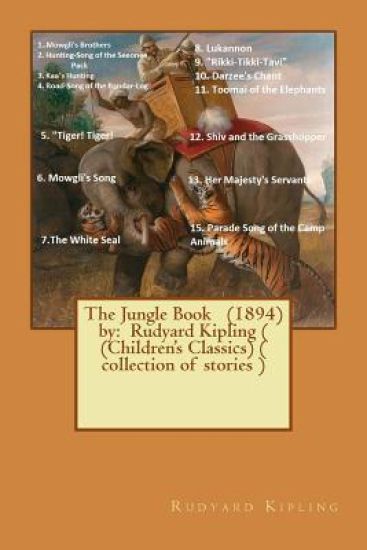
The Jungle Book (1894) is a collection of stories by English author Rudyard Kipling. The stories are fables, using animals in an anthropomorphic manner to give moral lessons. A principal character is the boy or "man-cub" Mowgli, who is raised in the jungle by wolves. Other characters include Shere Khan the tiger and Baloo the bear. The book has been adapted many times for film and other media.The stories were first published in magazines in 1893-94. The original publications contain illustrations, some by the author's father, John Lockwood Kipling. Rudyard Kipling was born in India and spent the first six years of his childhood there. After about ten years in England, he went back to India and worked there for about six-and-a-half years. These stories were written when Kipling lived in Naulakha, the home he built in Dummerston, Vermont, in the United States. 1] There is evidence that Kipling wrote the collection of stories for his daughter Josephine, who died from pneumonia in 1899, aged 6; a rare first edition of the book with a handwritten note by the author to his young daughter was discovered at the National Trust's Wimpole Hall in Cambridgeshire, England, in 2010
Kim, aka Kimball O'Hara, is the orphan son of a British soldier and a half-caste opium addict in India. While running free through the streets of Lahore as a child he befriends a British secret service agent. Later, attaching himself to a Tibetan Lama on a quest to be freed from the Wheel of Life, Kim becomes the Lama's disciple, but is also used by the British to carry messages to the British commander in Umballa. Kim's trip with the Lama along the Grand Trunk Road is only the first great adventure in the novel...