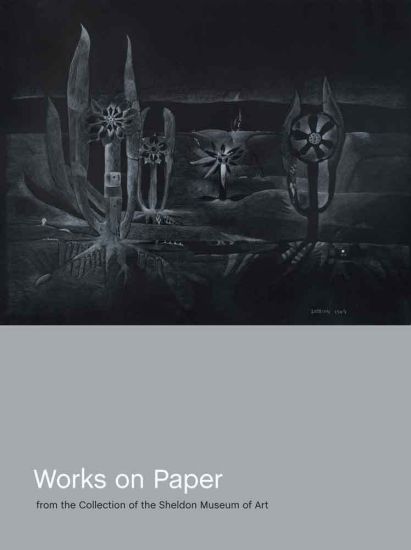
As the first serious study and presentation of the Sheldon Museum of Art’s collection of works on paper, this catalog introduces students and art lovers alike to the largest, most international area of the museum’s holdings, which includes prints and drawings from the European Renaissance to the present. Like the other collection catalogs in the American Transnationalism series, this publication draws together a team of distinguished scholars and features some of the museum’s most iconic works. These include rarely seen yet important objects such as medieval manuscript illuminations and Renaissance prints; nineteenth-century drawings and prints by such artists as Mary Cassatt, Winslow Homer, and James McNeill Whistler; twentieth-century works by Peggy Bacon, George Bellows, Charles Demuth, Marjorie Organ Henri, John Marin, Georgia O’Keeffe, Diego Rivera, and Charles White; and contemporary works by Robert Colescott, Vija Celmins, Roy Lichtenstein, Judy Pfaff, and Kara Walker.
Charles Monroe Sheldon (February 26, 1857 - February 24, 1946) was an American minister in the Congregational churches and leader of the Social Gospel movement. His novel, In His Steps, introduced the principle of "What Would Jesus Do?" which articulated an approach to Christian theology that became popular at the turn of the 20th Century and had a revival almost one hundred years later. The stretch of US-24 on the north side of Topeka, Kansas between US-75 and K-4 is named the Charles Sheldon Memorial Highway in his honor. Novel and theological influence: The theme of the sermons was later fictionalized into the novel In His Steps. The central ethos of the novel was not about personal redemption but about moral choices related to encountering circumstances of poverty and deprivation. Sheldon's theological motif reflected his socialist outlook. Sheldon's own parish work became identified with the Social Gospel. Walter Rauschenbusch, widely viewed as the chief architect of the Social Gospel, acknowledged the importance Sheldon placed on imitating Jesus. He saw the significance of Sheldon's work in bringing home the realization that it is hard to live a Christ-like life, given the temptations of modern society. While Rauschenbusch found this awareness valuable, he saw that it did not demand what he believed was a necessary transformation of social institutions.Sheldon was in touch with the concerns of middle-class America at the end of the century. He saw his role as one of communication-to introduce his congregation and the wider public to the ideas of Lyman Abbott, Richard Ely, George Herron, and Rauschenbusch. That was his intention in writing In His Steps. Of the social issues Sheldon espoused during his lifetime, the two he was most passionate about were equality and prohibition. He believed that all persons were equal and should be treated as such. He was a pioneer among Protestant ministers in welcoming blacks into a mainstream church. He was also committed to fair treatment for Jews and Catholics, and proclaimed the equality of men and women. A strong supporter of the feminist struggle for equal rights, he urged women to enter politics. He also pushed for full equality in the workplace. Sheldon was also a vegetarian who promoted compassion towards animal just as he did towards humans. He even criticized circuses for their treatment of animals. Newspaper "career" In March 1900 he became editor for a week of the Topeka Daily Capital applying the "What Would Jesus Do?" concept. In that short time, the newspaper's circulation exploded from just under 12,000 to 387,000, overwhelming the paper's Topeka printing plant causing it to print 120,000 copies each in Chicago, Illinois and New York City. Charles Monroe Sheldon (February 26, 1857 - February 24, 1946) was an American minister in the Congregational churches and leader of the Social Gospel movement...........
This work has been selected by scholars as being culturally important and is part of the knowledge base of civilization as we know it.This work is in the public domain in the United States of America, and possibly other nations. Within the United States, you may freely copy and distribute this work, as no entity (individual or corporate) has a copyright on the body of the work.Scholars believe, and we concur, that this work is important enough to be preserved, reproduced, and made generally available to the public. To ensure a quality reading experience, this work has been proofread and republished using a format that seamlessly blends the original graphical elements with text in an easy-to-read typeface.We appreciate your support of the preservation process, and thank you for being an important part of keeping this knowledge alive and relevant.
A heartwarming story about standing out, standing tall, and the courage it takes to be yourself.Sheldon the Turtle has never quite fit in. His shell isn't round like the others-it's square. And in the woods where "different" doesn't always feel safe, Sheldon faces teasing and loneliness every day. But when a group of woodland creatures rally around him, Sheldon discovers that kindness, courage, and true friendship can transform not just how others see you-but how you see yourself.Inspired by the classic tale The Ugly Duckling, this uplifting story teaches children the power of embracing differences, standing up to bullies, and staying true to who you are.Perfect for ages 4-9Includes thoughtful discussion questions about bullying, kindness, and acceptanceGreat for classrooms, libraries, or bedtime readingA wonderful conversation starter about empathy and inclusivitySheldon the Turtle is a touching modern fable that empowers young readers to celebrate what makes them unique-and reminds us all that different is beautiful.Get your copy today and help inspire courage, kindness, and confidence in every child.
Not long ago, Beaufort County, South Carolina was a quiet, sparsely populated corner of the Old South where the residents were just as likely to travel by tidal creek as they were so slog down the county s dusty, track-worn roads. Generations came and went like the tidal ebb and flow, and eventually Beaufort County like much of the Lowcountry was the site of much development, which brought changes to the face and pace of the area. Life in Beaufort County is different now, but many of the old ways have been kept alive in the county s oral histories stories that have been passed down over time, preserving the past through spoken word. Now, author and journalist Fran Marscher has captured these rich, vibrant stories for all to enjoy. Remembering the Way it Was at Beaufort, Sheldon and the Sea Islands is a collection of these priceless oral histories, which offer a glimpse of simpler times and unspoiled landscapes that cannot be found anywhere else. In their own words, the residents of old Beaufort County reveal a time when turnips and scrawny chickens substituted for legal fees among some of the clients of Grace White, the county s first female attorney; when Henry Chambers Aunt Henrietta rumored locally to be the richest woman in the world, and an Italian princess to boot stunned everyone when she brought her magnificent yacht right up the Beaufort River. And much, much more."
Daily audiences are subjected to a blizzard of information, some of which is deliberately incorrect. The best news organizations in the world are marshalling fact-checking teams to determine the accuracy of the news content. Computer wonks are working with the news industry to create computer programs that trace the information back to the source to determine the credibility of the information. Fact-checking is fashionable these days but among a little-known truth is that a clergyman-turned-journalist pioneered the passion for getting information right when he took over a general-circulation, mainstream newspaper in 1900 and tried to apply the adage, "Accuracy, accuracy, accuracy" to every news article and advertisement in the periodical. He used his faith-based sensibilities to edit the newspaper and his work came to be called "The Jesus Newspaper." Circulation soared with the experiment lasting only one week, yet it provoked the newspaper complex to reconsider some of its practices that are part of the fact-checking mania at work today.
In the vein of inspirational bestsellers "Calling In the One" and "The Soulmate Secret" Julia Storm takes us on her real-life journey from 40, frustrated, single and losing hope to manifesting the relationship she'd always dreamed of. Harnessing the Power of Intention and The Law of Attraction and with a little help from some inspiring women, world renowned hypnotherapist Marisa Peer, expert in the field of understanding the differences between the genders, Alison Armstrong, and energetic healer Christie Marie Sheldon. Marrying practicality with spirituality and a little magic, Julia takes us through the 5 step process that completely transformed not only her love life but her inner life and even her financial life, making this a book about dreams coming true, hers and yours. If you are longing to be with "the One" or "the One that got away" 5 Simple Steps to Manifesting Your Life Partner is a must read. Inspiring and honest in that uniquely Australian way, it is a book that you will read and then pass on to all your single friends so they too can find within it the yellow brick road to happily ever after.