The great scientific, astronomical and technological advances of the 20th century inspired the science fiction genre to imagine distant worlds and futures, far beyond the discoveries of the here and now. This book explores science fiction films, television series, novels and short stories--from Lost in Space (1965-1968) to Fringe (2008-2013) to the works of Isaac Asimov and Stephen Baxter--with a focus on their underlying concepts of physics and astronomy. Assessing accuracy and plausibility, the author considers the possibilities of solar system, interstellar and faster than light travel; intelligent planets, dark (anti-) matter, the multiverse and string theory, time travel, alternate universes, teleportation and replication, weaponry, force fields, extraterrestrial life, subatomic life, emotional robots, super-human and parapsychological powers, asteroid impacts, space colonies and many other topics.
This book examines Torah and its interpretation both as a recurring theme in the early rabbinic commentary and as the very practice of the commentary. It studies the phenomenon of ancient rabbinic scriptural commentary in relation to the perspectives of literary and historical criticisms and their complex intersection. The author discusses extensively the nature of ancient commentary, comparing and contrasting it with the antecedents in the pesharim of the Dead Sea Scrolls and the allegorical commentaries of Philo of Alexandria. He develops a model for a dynamic understanding of the literary structure and sociohistorical function of early rabbinic commentary, and then applies this model to the Sifre - to the oldest extant running commentary to Deuteronomy and one of the oldest rabbinic collections of exegesis. Fraade examines the commentary's representation of revelation and its reception at Mt. Sinai, with particular attention to its fractured refiguration and interrelation of Scripture, tradition, and history. He discusses the commentary's discursive empowering of the class of sages in their collective self-understanding as Israel's authorized teachers, leaders, legislators, and judges. The author also probes the tension between Torah and nature as witnesses to Israel's covenant with God.
It is difficult to overstate the importance of personal consumption both to individual consumers and to the economy. While consumer&, are recognized as valuing market goods and services for the activities they can construct from them in the frameworks of several disciplines, consequences of the characteristics of goods and services they use in these activities have not been well studied. In the discourse to follow, I will contrast knowledge-yielding and conventional goods and services as factors in the construction of activities that consumers engage in when they are not in the workplace. Consumers will be seen as deciding on non-work activities and the inputs to these activities according to their objectives, and the values and cumulated skills they hold. I will suggest that knowledge content in these activities can be efficient for consumer objectives and also have important externalities through its effect on productivity at work and economic growth. The exposition will seek to elaborate these points and contribute to multi disciplinal dialogue on consumption. It takes as its starting point the contention that consumption is simultaneously an economic and social psychological process and that integration of content can contribute to explanation.
What would happen if believers truly grasped how the resurrection of Jesus changes not just their own standing with God, but that it changes everything? In the spirit of John Piper's Fifty Reasons Why Christ Came to Die, Steven D. Mathewson unpacks the New Testament Scriptures that speak of the reasons Jesus was raised from the dead.In fifty brief chapters, he offers readers faith-filled meditations on the primary passages on the resurrection, taking these ancient truths and applying them to contemporary life. With compelling insight, he shows why Jesus not only had to die, but why his resurrection was necessary and how our lives change when we understand and embrace this essential truth of the Christian faith.
Traditionalist Christians who oppose same-sex marriage and other cultural developments in the US wonder why they are being forced to bracket their beliefs in order to participate in public life. This situation is not new, says Steven D. Smith: Christians two thousand years ago in the Roman Empire faced similar challenges and questions.Starting with T. S. Eliot's claim that the future of the West would be determined by a contest between Christianity and "modern paganism," Smith argues in Pagans and Christians in the City that today's culture wars can be seen as a contemporary reprise of the basic antagonism that pitted pagans against Christians in the late Roman Empire. He looks at that historical conflict and explores how the same competing orientations continue to clash today. Readers on both sides of the culture wars, Smith shows, have much to learn from seeing how patterns from ancient history are reemerging in today's most controversial issues.
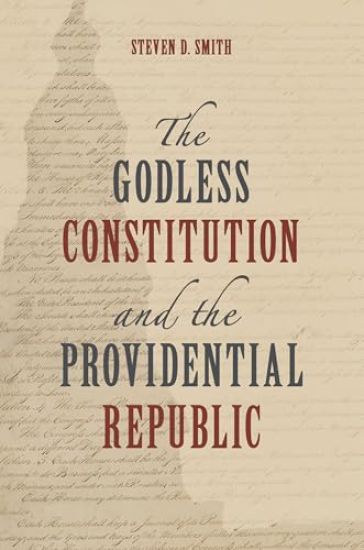
Were America's founding ideals religious or secular? In this timely and well-researched book, law scholar Steven D. Smith makes the case that the United States of America was founded on a providentialist view--the belief that God actively directs the destinies not only of individuals but of nations. Smith shows how this providentialist perspective was pervasively, officially, and unapologetically expressed in essential public documents like the Declaration of Independence and by presidents from Washington, Adams, Jefferson, Madison, and Lincoln to modern presidents including FDR, Eisenhower, Kennedy, and Obama. A crucial point in Smith's argument is that the Constitution neither prescribed nor forbade this providentialist understanding; it was like an agnostic parent who allowed their children the freedom to follow a religious or nonreligious path, as they wished. In modern times, by contrast, the courts and the legal and academic communities have frequently misinterpreted the Constitution as mandating governance that is completely secular. In so doing, they have effectively banished the providentialist perspective from American public philosophy. The consequences of this banishment have been deeply disruptive, contributing to dangerous polarization and lack of trust in government and other public institutions. Smith's compelling study is an essential resource for making sense of current debates about the place of religion in American public life. Readers will gain a deeper understanding of the extent to which secular neutrality is not mandated by the Constitution but rather is a modern invention with little grounding in the nation's history.
Using a life-course perspective, this study spans the social history of American women from preindustrial times to the present, with emphasis on the last five decades. The authors examine the timing, duration, and sequencing of events common to the life of American women over succeeding generations. The recent rise in the primacy of the individual woman provides the authors with a central theme for integrating the data on long-term marital, childbearing, educational, and employment patterns. Originally published in 1988. A UNC Press Enduring Edition -- UNC Press Enduring Editions use the latest in digital technology to make available again books from our distinguished backlist that were previously out of print. These editions are published unaltered from the original, and are presented in affordable paperback formats, bringing readers both historical and cultural value.
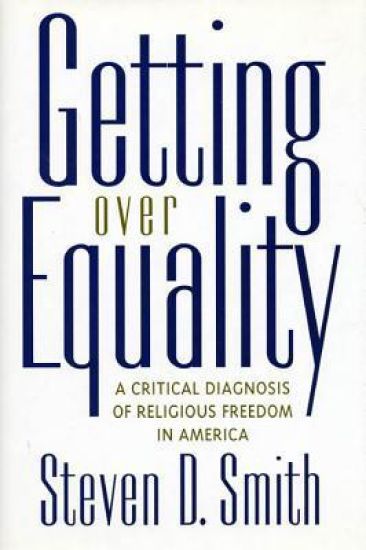
Questions of religious freedom continue to excite passionate public debate. Proposals involving school prayer and the posting of the Ten Commandments in schools and courtrooms perennially spur controversy. But there is also a sense that the prevailing discourse is exhausted, that no one seems to know how to think about religious freedom in a way that moves beyond our stale, counterproductive thinking on this issue. In Getting over Equality, Steven D. Smith, one of the most important voices now writing about religious liberty, provocatively contends that we must get over our presumption mistakenly believed to be rooted in the Constitution that all religions are equally true and virtuous and "authentically American." Smith puts forth an alternative view, that the courts should promote an ideal of tolerance rather than equality and neutrality. Examining such controversial examples as the animal sacrifice case, the peyote case, and the problem of aid to parochial schools, Smith delineates a way for us to tolerate and respect contrary creeds without sacrificing or diluting our own beliefs and without pretending to believe in a spurious "equality" among the variety of diverse faiths.
Tracing the development of international humanitarian law especially since World War II, this volume focuses on the role of the international community in crafting international and mixed war crimes tribunals. It examines the cases of the former Yugoslavia, Rwanda, Sierra Leone, Cambodia and East Timor. These tribunals are legal institutions embedded within a political environment in which the need for nation-state consensus can undermine their judicial effectiveness and ultimately the quest for justice. One of the principal themes examined is how the demands of state sovereignty and finance have contributed to the constant innovation of these tribunals. This is the only book available covering the breadth of cases and it places these institutions within the general development of international humanitarian law.
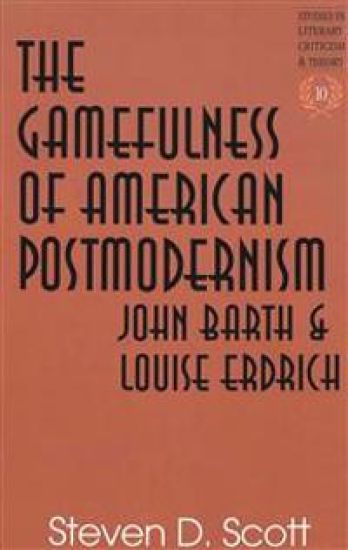
This book examines the twin problems of play and game in American literary postmodernism. There have been many studies of the function of play in postmodernism, but very few have discussed the role of game without conflating play and game. This study claims that play is an important consideration in any discussion of the postmodern (as it is in any discussion of literature), but game is also useful because of its structuring influence. Game provides limits, boundaries, and borders to play, thereby both limiting and, paradoxically, enabling meaningful play. This study does not claim that literature is a game in the strong sense, it chooses instead to concentrate on the gamelike shape - the gamefulness - that literary postmodernism assumes. After theoretical chapters that discuss postmodernism, play, and game, this study moves to critical discussions of the work of two prominent contemporary American authors, John Barth and Louise Erdrich.
In 1993, white American Fulbright scholar Amy Biehl was killed in a racially motivated attack near Cape Town, after spending months working to promote democracy and women's rights in South Africa. The ironic circumstances of her death generated enormous international publicity and yielded one of South Africa's most heralded stories of postapartheid reconciliation. Amy's parents not only established a humanitarian foundation to serve the black township where she was killed, but supported amnesty for her killers and hired two of the young men to work for the Amy Biehl Foundation. The Biehls were hailed as heroes by Nelson Mandela, Desmond Tutu, and many others in South Africa and the United States—but their path toward healing was neither quick nor easy. Granted unrestricted access to the Biehl family's papers, Steven Gish brings Amy and the Foundation to life in ways that have eluded previous authors. He is the first to place Biehl's story in its full historical context, while also presenting a gripping portrait of this remarkable young woman and the aftermath of her death across two continents.
In the early 1960s, whenever the Today Show discussed integration, wlbt-tv, the nbc affiliate in Jackson, Mississippi, cut away to local news after announcing that the Today Show content was “network news . . . represent[ing] the views of the northern press.” This was only one part of a larger effort by wlbt and other local stations to keep African Americans and integrationists off Jackson’s television screens. Watching Jim Crow presents the vivid story of the successful struggles of African Americans to achieve representation in the tv programming of Jackson, a city many considered one of the strongest bastions of Jim Crow segregation. Steven D. Classen provides a detailed social history of media activism and communications policy during the civil rights era. He focuses on the years between 1955-when Medgar Evers and the naacp began urging the two local stations, wlbt and wjtv, to stop censoring African Americans and discussions of integration-and 1969, when the U.S. Court of Appeals issued a landmark decision denying wlbt renewal of its operating license. During the 1990s, Classen conducted extensive interviews with more than two dozen African Americans living in Jackson, several of whom, decades earlier, had fought to integrate television programming. He draws on these interviews not only to illuminate their perceptions-of the civil rights movement, what they accomplished, and the present as compared with the past-but also to reveal the inadequate representation of their viewpoints in the legal proceedings surrounding wlbt’s licensing. The story told in Watching Jim Crow has significant implications today, not least because the Telecommunications Act of 1996 effectively undid many of the hard-won reforms achieved by activists-including those whose stories Classen relates here.
The story of the successful struggles of African Americans to achieve representation in the TV programming of Jackson, a city many considered one of the strongest bastions of Jim Crow segregation. The 1996 Federal Communications Act then effectively undid many of the reforms achieved by activists.
Dr. Steven D. Hsi, a family physician and father of two young sons, was diagnosed in 1995 with a rare coronary disease that caused his death five years later at the age of forty-four. Throughout his ordeals as a patient, including three open-heart surgeries, Dr. Hsi's outlook on the teaching and practice of medicine changed. In 1997 he began a journal intended for publication after his death. Written with the assistance of newspaper columnist Jim Belshaw and completed posthumously by Hsi's widow, Beth Corbin-Hsi, Dr. Hsi's writings urge his colleagues to become healers, to look at their patients as human beings with spiritual as well as physical lives."Every patient should read it, if only to be made aware that they are not alone with their thoughts. Every spouse of a patient should read it. . . . Every medical student and physician should read it to learn that the biology of the disease is really just a small part of the illness."--John Saiki, M.D., Medical Oncology, University of New Mexico"Dr. Steven Hsi asks his fellow doctors to be more than physicians. He asks them to be healers. He says that when he thinks of healers, he sees traditional medicine men, people who are integral parts of their communities. They are in touch physically and spiritually with the people they serve."--Tony Hillerman"Closing the Chart is built on the personal journals and experiences of Steven D. Hsi, M.D., as he travels on an intense 5-year journey from an assumption of health, professional success, and family stability to his progressive illness and eventual death. . . . Closing the Chart is both an engaging, page-turning read and a story told with so little artifice that you cannot close the cover unchanged."--Kenneth Jacobson, executive director, American Holistic Medical Association, Explore "There are lessons on every page, lessons to make us better caregivers, more discerning patients, and better advocates for family members and friends who are sick. . . . Every reader will take away different lessons from this book based on his or her role, age, and experience. This would be an ideal book for group study by medical and nursing students with some senior physicians, patients, and family members. What a great learning experience for all participants! . . . I exhort you to pick up and read this humble story. Nothing I have encountered in the medical narrative genre has been more worthy of my time." --David J. Elpern, M.D, Psychiatric Services
The second revised edition of this companion to the ponds and lakes of New Hampshire's White mountains celebrates their rich diversity: You can hike, ski, snowshoe, swim, paddle a canoe, watch birds or moose, or simply linger by a sunny shore. Expanded fishing information tells you where to cast a line for small-mouth bass, perch, native speckled trout, and more. The ponds that Smith describes range from a tree-lined roadside beauty perfect for a spontaneous swim to an isolated mountain tarn reached only after a day of serious hiking or snowshoeing. He weaves into the text anecdotes and quotations culled from old guidebooks and local history. Additional information includes a bibliography and the author's lists of everything from the best ponds for a family hike to the best rocks to sit on. Each of the 68 descriptions include: * A trail description * Directions to road or trailhead access, with a topographical map * A summary of hiking facts, pond and lake statistics, activities, and fishing opportunities * Descriptions of nearby overlooks that offer bird's-eye views * Notes on visiting in winter
In Work and the Evolving Self, Steven Axelrod begins to remedy this serious oversight by setting forth a comprehensive psychoanalytic perspective on work life. Consonant with his analytic perspective, Axelrod sets out to illuminate the workplace by examining the psychodynamic meaning of work throughout the life cycle. He begins by exploring the various dimensions of work satisfaction from a psychoanalytic perspective and then expands on the relationship between work life and the adult developmental process. This developmental perspective frames Axelrod's central task: an examination of the typical work-related problems encountered in clinical practice, beginning with a psychodynamic definition of a "work disturbance." Moving on to treatment issues, Axelrod elaborates on the manner in which assessment, supportive, and exploratory interventions all enter into the treatment of work disturbances. Axelrod concludes by considering issues of career development that emerge in individual psychotherapy and exploring the psychological implications of dramatic changes now taking place in the workplace. As such, Work and the Evolving Self is an impressive contribution to the task with which psychoanalytic therapists are increasingly engaged: that of broadening their identities and treatment approaches in a world that increasingly demands flexibility and innovation.
The book uses extensive illustrations to explain how to create extended sequence shots, elaborate moving camera choreography, and tracking shots with multiple story points.