" Depuis un an, on a fait le d nombrement de nos d fauts: il n'est si mince politique qui n'ait dit la France ses v rit s, et entrepris de lui prouver qu'elle m ritait ses d sastres. Sans doute il ne faut pas n gliger les avertissements ni les conseils, mais il faut voir le rem de c t du mal, et surtout distinguer, parmi les reproches qu'on nous adresse, ceux qui frappent la nation et ceux qui retombent sur l'humanit tout enti re. Par exemple, en politique, on condamne notre go t pour les conceptions ambitieuses et notre d dain pour les enseignements de l'histoire; cependant les intemp rances du raisonnement, qui enfantent l'esprit r volutionnaire, ne peuvent se s parer du raisonnement m me, et, si nous en avons souffert les premiers, peut- tre tous les peuples doivent-ils payer des m mes preuves la crise tardive de leur mancipation. On nous oppose ordinairement l'exemple de l'Angleterre, dont la prudence repousse les th ories rationnelles, et n'a jamais rompu la cha ne des traditions historiques. Voici pourtant un crivain populaire, M. John Stuart Mill, qui entreprend contre les institutions du pass une croisade sans merci. Est-ce que l'heure de l'audace philosophiques sonn ? Chaque nation a-t-elle une p riode o elle abandonne le principe d'autorit pour discuter librement le syst me qui lui convient le mieux ? ou bien M. Stuart Mill est-il un esprit sp culatif que la science a entra n loin des chemins battus, et qui construit dans l'isolement un syst me impraticable ?..."
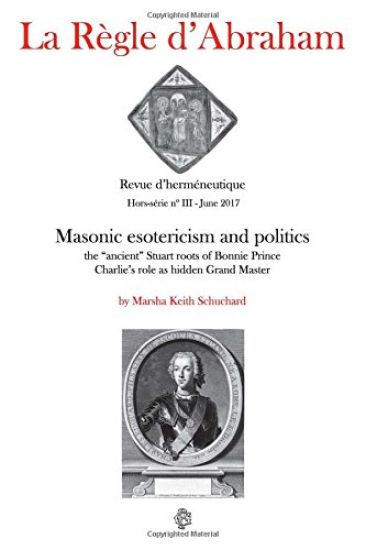
Mainly focused on the study of esoteric traditions within the three monotheist Revelations, La R gle d'Abraham is a periodical founded and directed by Patrick Geay since April 1996. This special edition in English, with 20 rare Masonic illustrations, is dedicated to an important article by Marsha Keith Schuchard on Masonic esotericism and politics: the "ancient" Stuart roots of Bonnie Prince Charlie's role as hidden Grand Master Research into Charles Edward Stuart's alleged affiliation with Jacobite or Ecossais Freemasonry has long been hampered by the misleading assumption, which became academic "conventional wisdom," that Freemasonry virtually began in England when the Grand Lodge of London was formed in 1717. Moreover, it was generally characterized as non-political and rationalistic, devoted to the Protestant succession, the Hanoverian government, Newtonian science, and latitudinarian religion. However, the recent international expansion of Masonic and Jacobite studies makes possible a more credible and documented study of the Stuart prince's political and Masonic activities, within a context of anti-Hanoverian, politically-active, diplomatically-diverse, and spiritually-oriented Masonry that draws upon the early Scots-Irish traditions maintained by the Stuart kings in Greater Britain and by the exiles in the Jacobite diaspora. Ranging from the 1590s in Scotland to the 1780s in Italy, the Stuart-Masonic themes of Jewish mysticism, Lullist illuminated knighthood, Solomonic architecture, and religious toleration sustained the military and political campaigns of James II, James III, and "Bonnie Prince Charlie" in their struggle to reclaim the thrones of their ancestors. Table of contents Introduction Swift, Lull, and the masonic Art of Memory Stuart freemasonry and solomonic architecture Jacobite versus Hanoverian rivalries Mar, Ramsay, and the restoration of Stuart freemasonry "Bonnie Prince Charlie" emerges on the masonic stage The Royal Order of Heredom and Kilwinning The ancient chivalry of the Temple of Jerusalem The fates of the Jacobite Grand Masters The hidden Grand Master and the cossais network Old world royalists and new world revolutionaries Restoring the Temple in the North Conclusion Fond e en 1996 La R gle d'Abraham est une revue annuelle fran aise d'herm neutique principalement consacr e l' tude des traditions sot riques issues des trois r v lations monoth istes: juda sme, christianisme, islam. Pour autant, elle est aussi vou e la connaissance approfondie de toutes les religions du monde. Son but est de favoriser une meilleure compr hension de celles-ci, mais galement d' tablir l'existence d'un v ritable fond commun universel partir de leur dimension int rieure, m taphysique, cosmologique et symbolique. Notre revue vise en ce sens le r tablissement d'une interpr tation spirituelle du sacr en g n ral, en opposition toutes les formes de r ductionnisme qu'elle critique. Elle fait appel des sp cialistes, universitaires le plus souvent ou ind pendants. Nous publions des recherches originales in dites ainsi que des traductions de textes anciens et contemporains. Certains articles parus dans La R gle d'Abraham ont eux-m mes t traduits et publi s en Espagne, en Italie et aux Etats-Unis.
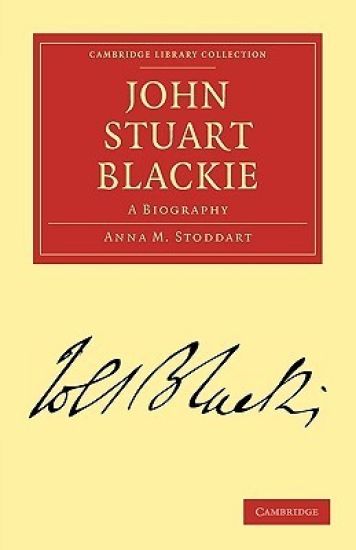
John Stuart Blackie (1805–1895) trained in law and studied divinity in Scotland and Germany before becoming a professor of Classics. Confident, well-travelled, vivacious, and outspoken, he delivered numerous public lectures, was instrumental in the founding of the Gaelic Chair at Edinburgh University, and published translations of many German and Classical works, as well as an impressive body of literary criticism. He was active in Radical politics, a strong opponent of the 1867 Reform Bill, and well-known for his eccentric dress. Anna M. Stoddart's detailed biography of Blackie, published in 1896, provides captivating insights into this extraordinary man's life and times by drawing on letters and papers provided by Blackie's widow and colleagues soon after his death. It remains a useful source for scholars interested in Scottish education or the experience of Scots abroad, as well as those studying nineteenth-century literature and literary criticism.
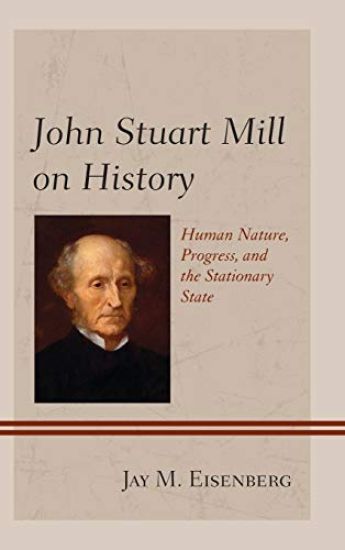
Though Mill has been the subject of an imposing volume of scholarship, his philosophy of history has received scant attention. This inquiry considers the role of history in Mill’s break from the Benthamite radicals, his effort to define a methodology for the study of society modelled on the natural sciences, and his speculations about the course and meaning of history. A dominant theme is Mill’s struggle to reconcile his ambition to develop a comprehensive science of society with his convictions that human nature is malleable and that history progresses as a consequence of intellectual achievement and diversity of beliefs. Mill’s compatibilist vision of the individual as driven by deterministic psychological laws and as also capable of freely choosing a life of autonomous “self-culture” was mirrored in his philosophy of history, as Mill retained the materialistic stadial theory of social development proposed during the Scottish Enlightenment, and an idealistic vision of history derived from the Saint-Simonians, Guizot and Comte. Though Mill claimed the primacy of the intellect in advancing material living conditions, he believed that the culmination of instrumental rationalism in his own Age of Commerce was undermining and marginalizing other forms of individual accomplishment—indeed, individuality itself—in the suffocating conformity of mass culture. Mindful of what he considered to be the culturally stationary states of Asia, Mill dreaded the prospect that a commercial culture with no higher ambition than the acquisition of ever-greater wealth would also become inert as the consequence of overbearing social conventions and intellectual stagnation. Like Smith and Ricardo, Mill anticipated the inevitability of the economically stationary state as the consequence of the fall in the rate of profits under free market capitalism, but rather than await its arrival, Mill seized on its possibilities. The stationary state became Mill’s vehicle for advocating an egalitarian supra-subsistence economy in the expectation that cultural priorities would shift to the pursuit of higher moral, intellectual and aesthetic aspirations, and the revitalization of individual autonomy.
Darren M. Pollock examines the 1611 Romans hexapla commentary by the prolific Church of England preacher and controversialist Andrew Willet. While some have considered Willets later biblical commentaries to have been a retreat from his earlier engagement in religious controversy, the author argues that his exegetical work maintained a significant element of anti-Catholic polemics, only expressed in a different genre. This polemical hermeneutic served as an organizing principle and as a means by which to clarify the presentation of traditional Reformed readings in relief against a body of Roman Catholic theology that Willet believed threatened the gospel of grace. Pauls letter provided ample opportunity for Willet to identify what is distinctive about Reformed theology or rather, as Willet would have it, the particular ways in which papist dogma had diverged from the true line of Christian belief running from the Fathers through to the (truly catholic) Reformed church of the seventeenth century.Willets exegesis highlights many of the polemical issues that had long been contended between Protestants and Catholics, including the authentic versions of the bible, Scriptures attributes, and principles of interpretation, as well as doctrines like justification, predestination, the assurance of salvation, and the place of good works. A close investigation into Willets exegetical method also helps to see how an identifiable hermeneutical lens is consistent with a disciplined reading that is faithful to the text. His polemical focus does not corrupt his exegesis or force upon it meanings that are alien to the text itself; rather, his polemical hermeneutic serves to focus his attention and frame positive doctrinal statements against the sharp contrast of alternate readings.
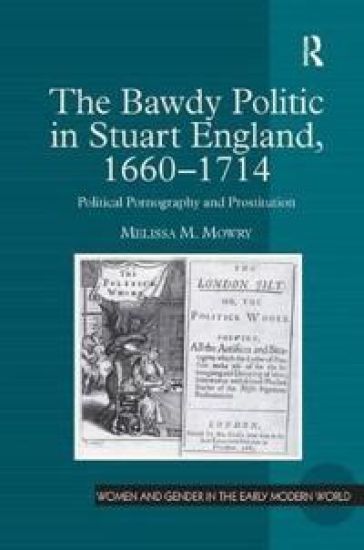
With this original study, Melissa Mowry makes a strong contribution to a provocative interdisciplinary conversation about an important and influential sub genre: seventeenth-century political pornography. This book further advances our understanding of pornography's importance in seventeenth-century England by extending its investigation beyond the realm of cultural rhetoric into the realm of cultural practice. In addition to the satires which previous scholars have discussed in this context, Mowry brings to light hitherto unexamined pornographies as well as archival texts that reveal the ways in which the satires helped shape the social policies endured by prostitutes and bawds. Her study includes substantial archival evidence of prostitution from the Middlesex Sessions and the Bridewell Courtbooks. Mowry argues that Stuart partisans cultivated representations of bawds and prostitutes because polemicists saw the public sale of sex as republicanism's ideological apotheosis. Sex work, partisans repeatedly asserted, inherently disrupted ancestral systems of property transfer and distribution in favour of personal ownership, while the republican belief that all men owned the labour of their body achieved a nightmarish incarnation in the prostitute's understanding that the sexual favours she performed were labour. The prostitute's body thus emerged in the loyalist imagination as the epitome of the democratic body politic. Carefully grounded in original research, The Bawdy Politic in Stuart England, 1660-1714 is a cultural study with broad implications for the way we understand the historical constructions and legal deployments of women's sexuality.
With this original study, Melissa Mowry makes a strong contribution to a provocative interdisciplinary conversation about an important and influential sub genre: seventeenth-century political pornography. This book further advances our understanding of pornography's importance in seventeenth-century England by extending its investigation beyond the realm of cultural rhetoric into the realm of cultural practice. In addition to the satires which previous scholars have discussed in this context, Mowry brings to light hitherto unexamined pornographies as well as archival texts that reveal the ways in which the satires helped shape the social policies endured by prostitutes and bawds. Her study includes substantial archival evidence of prostitution from the Middlesex Sessions and the Bridewell Courtbooks. Mowry argues that Stuart partisans cultivated representations of bawds and prostitutes because polemicists saw the public sale of sex as republicanism's ideological apotheosis. Sex work, partisans repeatedly asserted, inherently disrupted ancestral systems of property transfer and distribution in favour of personal ownership, while the republican belief that all men owned the labour of their body achieved a nightmarish incarnation in the prostitute's understanding that the sexual favours she performed were labour. The prostitute's body thus emerged in the loyalist imagination as the epitome of the democratic body politic. Carefully grounded in original research, The Bawdy Politic in Stuart England, 1660-1714 is a cultural study with broad implications for the way we understand the historical constructions and legal deployments of women's sexuality.