Kirjahaku
Etsi kirjoja tekijän nimen, kirjan nimen tai ISBN:n perusteella.
1000 tulosta hakusanalla Susan Atkinson
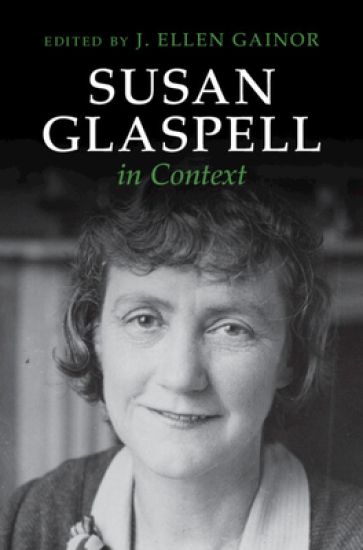
Susan Glaspell in Context
Cambridge University Press
2023
sidottu
Susan Glaspell in Context provides new, accessible, and informative essays by leading international scholars and artists on Pulitzer Prize winner Susan Glaspell's life, career development, writing, and ongoing global creative impact. The collection features wide-ranging discussions of Glaspell's fiction, plays, and non-fiction in both historical and contemporary critical contexts, and demonstrates the significance of Glaspell's writing and other professional activities to a range of academic disciplines and artistic engagements. The volume also includes the first analyses of six previously unknown Glaspell short stories, as well as interviews with contemporary stage and film artists who have produced Glaspell's works or adapted them for audiences worldwide. Organized around key locations, influences, and phases in Glaspell's career, as well as core methodological and pedagogical approaches to her work, the collection's thirty-one essays place Glaspell in historical, geographical, political, cultural, and creative contexts of value to students, scholars, teachers, and artists alike.



Susan, The Fisherman's Daughter Or Getting Along
Caroline Chesebro'
KESSINGER PUBLISHING, LLC
2009
pokkari


Originally published in 1969, this is the first biography of Susan Isaacs, the first attempt to estimate her incalculable contribution to the theory and practice of the education of young children. As a pioneer of new teaching methods, Susan Isaacs will be remembered mainly for her work at the Malting House School in Cambridge in the 1920s, and her contribution was such that in 1933 the Department of Child Development at the University of London, Institute of Education was specially created for her; she was Head of the Department until 1943. But Susan Isaacs was also a psychoanalyst, and D.W. Winnicott in his Foreword refers to the time when he was supplying cases for her child analysis training: ‘I watched with interest her sensitive management of the total family situation, a difficult thing when one is engaged in learning while carrying out a psycho-analytic treatment involving daily sessions over years.’D.E.M. Gardner, who was a close friend as well as student of Susan Isaacs, begins by describing Susan’s childhood in a Lancashire cotton town, and throughout the book she helps us to feel the force of Susan’s personality and intellect – ‘she was a truly great person, one who has had a tremendous influence for good on the attitude of parents and of teachers to the children in their care’.
Originally published in 1969, this is the first biography of Susan Isaacs, the first attempt to estimate her incalculable contribution to the theory and practice of the education of young children. As a pioneer of new teaching methods, Susan Isaacs will be remembered mainly for her work at the Malting House School in Cambridge in the 1920s, and her contribution was such that in 1933 the Department of Child Development at the University of London, Institute of Education was specially created for her; she was Head of the Department until 1943. But Susan Isaacs was also a psychoanalyst, and D.W. Winnicott in his Foreword refers to the time when he was supplying cases for her child analysis training: ‘I watched with interest her sensitive management of the total family situation, a difficult thing when one is engaged in learning while carrying out a psycho-analytic treatment involving daily sessions over years.’D.E.M. Gardner, who was a close friend as well as student of Susan Isaacs, begins by describing Susan’s childhood in a Lancashire cotton town, and throughout the book she helps us to feel the force of Susan’s personality and intellect – ‘she was a truly great person, one who has had a tremendous influence for good on the attitude of parents and of teachers to the children in their care’.

Susan Strange and the Future of Global Political Economy
Routledge
2016
sidottu
This edited volume addresses the 2007/2009 financial crisis as the occasion to engage critically with the corpus of Susan Strange’s work, in order to consider what changes (if any) this crisis portends for the structural organization of the global political economy. The contributors use Strange’s rich conceptual framework to explore the financial crisis and its aftermath, and reflect critically on the broader contributions which her work has made to the discipline of IPE.The volume makes three valuable contributions for scholars and students. First, it raises the profile of Susan Strange, a unique and powerful contributor to the field of IPE whose ideas matter to our current circumstance and can provide deep and enduring insights into important questions and issues. Secondly, each contributor to this volume combines her work and ideas with that of other traditions or individual theorists in ways that extend and/or deepen Strange’s own efforts. Finally, this volume leaves us with a judicious optimism about the future of both IPE and the world as it actually is, on the ground. This book will be of interest to scholars and students who are interested in the dynamics shaping contemporary and future developments in the global political economy, as well as those who are interested in the theoretical debates about how to study IPE.

First published in 1990, this is the first book-length study of Susan Sontag: essayist and analyst of culture, author of ‘Notes on Camp’ and Illness as Metaphor, novelist, reviewer, and filmmaker. It was modernism, and the excitement it created in her, that "rescued" Sontag from childhood in Southern California and sent her abroad in the 1950s. Sohnya Sayres looks into the foundations and directions of Sontag’s imposing work and in doing so discovers a unity of design and subject that Sontag has only recently acknowledged to have been an ambition all along. Sayres’s Sontag is the "elegiac modernist", committed to a modernism whose high noon has long since passed. And yet Sayres finds in Sontag’s lifelong indebtedness to modernism’s aesthetic an inherent conservatism. While guiding us through the work of a brilliant critic, Sayres questions whether Sontag is not herself caught in the paradoxes of the modernism she herself so much admires. A comprehensive analysis of the work of a remarkable intellectual, this title will be of value to any student of American modernism and literary life.

First published in 1990, this is the first book-length study of Susan Sontag: essayist and analyst if culture, author of ‘Notes on Camp’ and Illness as Metaphor, novelist, reviewer, and filmmaker. It was modernism, and the excitement it created in her, that "rescued" Sontag from childhood in Southern California and sent her abroad in the 1950s. Sohnya Sayres looks into the foundations and directions of Sontag’s imposing work and in doing so discovers a unity of design and subject that Sontag has only recently acknowledged to have been an ambition all along. Sayres’s Sontag is the "elegiac modernist", committed to a modernism whose high noon has long since passed. And yet Sayres finds in Sontag’s lifelong indebtedness to modernism’s aesthetic an inherent conservatism. While guiding us through the work of a brilliant critic, Sayres questions whether Sontag is not herself caught in the paradoxes of the modernism she herself so much admires. A comprehensive analysis of the work of a remarkable intellectual, this title will be of value to any student of American modernism and literary life.




Susan; Or the First Year in Service, Etc.
British Library, Historical Print Editions
2011
pokkari

The Last Poems of Susan K. Phillips.
Susan K Phillips
British Library, Historical Print Editions
2011
pokkari