Kirjojen hintavertailu. Mukana 11 244 527 kirjaa ja 12 kauppaa.

Kirjahaku

Etsi kirjoja tekijän nimen, kirjan nimen tai ISBN:n perusteella.

1000 tulosta hakusanalla Thomas Bateman

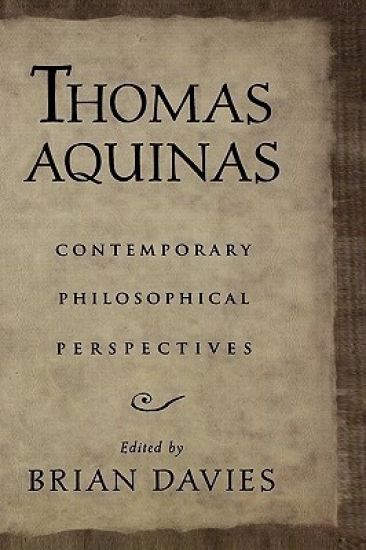
Thomas Aquinas

Thomas Aquinas

Oxford University Press Inc
2002
sidottu
Brian Davies offers a full-scale introduction to Aquinas's philosophy, collecting in one volume the best recent essays on Aquinas by some of the world's foremost scholars of medieval philosophy. Taken together they illuminate the entire spectrum of Aquinas's thought: philosophy of nature, logic, metaphysics, natural theology, philosophy of mind, philosophy of action and ethics. Philosophically rigorous, readable, informative, critical, and evaluative of the texts of Aquinas, the essays are framed by a detailed introduction providing an account of Aquinas's life, works, and his major philosophical conclusion.
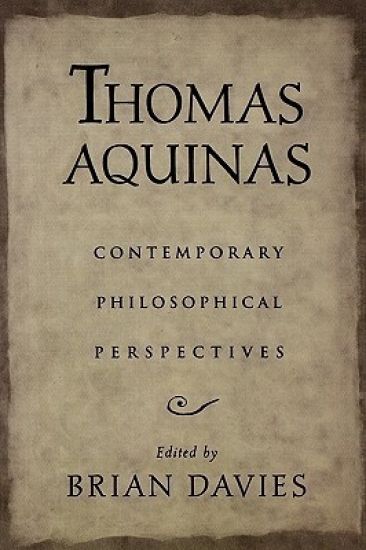
Thomas Aquinas

Thomas Aquinas

Oxford University Press Inc
2002
nidottu
Brian Davies offers a full-scale introduction to Aquinas's philosophy, collecting in one volume the best recent essays on Aquinas by some of the world's foremost scholars of medieval philosophy. Taken together they illuminate the entire spectrum of Aquinas's thought: philosophy of nature, logic, metaphysics, natural theology, philosophy of mind, philosophy of action and ethics. Philosophically rigorous, readable, informative, critical, and evaluative of the texts of Aquinas, the essays are framed by a detailed introduction providing an account of Aquinas's life, works, and his major philosophical conclusion.
Thomas Jefferson

Thomas Jefferson

Richard B. Bernstein

Oxford University Press Inc
2005
nidottu
A definitive short biography of Thomas Jefferson covers such topics as his luxurious but debt-burdened life as a Virginia gentleman, his passionate belief in democracy, his defense of slavery, his relationship with Sally Hemings, and his contributions to America as a writer, inventor, and party leader. Reprint.
Thomas Mann's The Magic Mountain

Thomas Mann's The Magic Mountain

Hans Rudolph Vaget

Oxford University Press Inc
2008
sidottu
This collection seeks to illustrate the ways in which Thomas Mann's 1924 novel, The Magic Mountain, has been newly construed by some of today's most astute readers in the field of Mann studies. The essays, many of which were written expressly for this volume, comment on some of the familiar and inescapable topics of Magic Mountain scholarship, including the questions of genre and ideology, the philosophy of time, and the ominous subjects of disease and medical practice. Moreover, this volume offers fresh approaches to the novel's underlying notions of masculinity, to its embodiment of the cultural code of anti-Semitism, and to its precarious relationship to the rival media of photography, cinema, and recorded sound.
Thomas Mann's The Magic Mountain

Thomas Mann's The Magic Mountain

Oxford University Press Inc
2008
nidottu
This collection seeks to illustrate the ways in which Thomas Mann's 1924 novel, The Magic Mountain, has been newly construed by some of today's most astute readers in the field of Mann studies. The essays, many of which were written expressly for this volume, comment on some of the familiar and inescapable topics of Magic Mountain scholarship, including the questions of genre and ideology, the philosophy of time, and the ominous subjects of disease and medical practice. Moreover, this volume offers fresh approaches to the novels underlying notions of masculinity, to its embodiment of the cultural code of anti-Semitism, and to its precarious relationship to the rival media of photography, cinema, and recorded sound.
Thomas Hoccleve's Complaint and Dialogue
Thomas Hoccleve's `Series', written c.1420 was edited for EETS in 1892. This is a new edition of the first two sections and glosses the poems more fully than before. The introduction presents new findings about Hoccleve, whose poems have attracted much attention in recent years.
Thomas Hoccleve: A Facsimile of the Autograph Verse Manuscripts
Thomas Hoccleve was a scribe in royal service from ca. 1386 to 1426, as well as a 'Chaucerian' poet who has attracted much interest, especially for his autobiographical poems. This facsimile reproduces three manuscripts containing all of his known poetry except his Regiment of Princes [of which no autograph copy survives]. It provides a rare opportunity to see how a medieval English poet presented his own work in copies which he made himself, meticulously spelled and metred. Although these manuscripts have attracted much scholarly attention, only a few pages have been previously reproduced in published studies. The Introduction includes the first full description of the contents and structure of the three volumes, with discussions of the author's handwriting, use of abbreviations and punctuations based on advances in palaeographical study and historical knowledge of Hoccleve's context. J. A. Burrow is Emeritus Professor and Senior Research Fellow at the University of Bristol. A. I. Doyle is Honorary Reader in Bibliography at the University of Durham.
Thomas Wylton

Thomas Wylton

Oxford University Press
2010
sidottu
Thomas Wylton's Quaestio de anima intellectiva is one of the most significant medieval treatments of the intellectual soul. This edition of the Latin text is accompanied by an en face English translation by Gail Trimble. The detailed introduction guides the reader through the intricacies of the transmission of the text as well as its philosophical contents. Wylton's Quaestio presents a strong and controversial defence of Averroes' interpretation of Aristotelian psychology. In his comparison of Averroes' view with the Catholic doctrine of the human soul, as defined by the Council of Vienne, Wylton highlights the rationality of the Arabic philosopher's stance and raises strong arguments against the commonly accepted opinion of Catholic thinkers, such as Thomas Aquinas and his followers. Wylton's Quaestio had a strong influence on his contemporaries and in particular on the most eminent exponent of Latin Averroism, John of Jandun, who included long passages from Wylton's treatise in his commentary on Aristotle's On the Soul. Wylton also addresses fundamental philosophical issues: the ontological status of a subsisting form, the existence of universal things as components of individuals, and the possibility of intellectual knowledge of universals as well as singulars. This combination of polemics and engaging philosophical reflection is one of the distinguishing features of Wylton's text and makes his work of significance to historians, philosophers, and theologians.
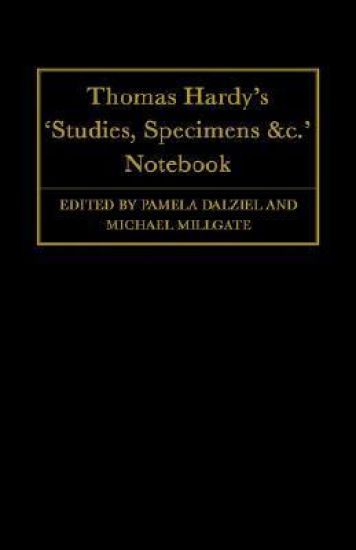
Thomas Hardy's 'Studies, Specimens &c.' Notebook
Thomas Hardy's Studies, Specimens &c. notebook stands almost alone as a witness to his exertions and aspirations of the 1860s, when he was already in his middle twenties but still working in London as an architectual assistant and only tentatively feeling his way towards as yet dimly glimpsed possibilities of literary expression and employment. Because so little documentation of any kind has survived for this early period of his life and work, the notebook is of extraordinary interest as containing detailed evidence of the untutored deliberateness with which Hardy was seeking to provide himself with a poetic background, educate himself in poetic techniques, and initiate a process from which he could perhaps emerge as a practising, even a publishing, poet. In private hands until very recently, and seen by only a very few scholars, Studies, Specimens &c.' dates from 1865-68, is entirely in Hardy's own hand, and consists of eighty-eight closely written pages of working memoranda, and quotations from other poets - mostly extracts a few words long in which underlining has been used to highlight individual images and word-usages. Although no drafts of actual poems are present, there are numerous instances of Hardy's seeking to generate a poetic, and sometimes erotic, language and imagery out of materials (e.g., an architectual textbook) apparently chosen precisley for their recalcitrance to such treatment. The edition itself seeks to reproduce typographically all essential features of the original document. The introductory material describes the notebook bibliographically, sets it in its biographical context, and discusses some of its more important technical features. Included in the extensive apparatus are textual notes, explications of Hardy's occasional quotations - indicating, in most instances, the editions or actual volumes he certainly or probably used. Explanatory notes are provided for - among other things - some erased but now partly recoved memoranda of Hardy's that appear to have significant biographical implications.