Kirjojen hintavertailu. Mukana 11 717 486 kirjaa ja 12 kauppaa.

Kirjahaku

Etsi kirjoja tekijän nimen, kirjan nimen tai ISBN:n perusteella.

1000 tulosta hakusanalla Timothy P. Banse

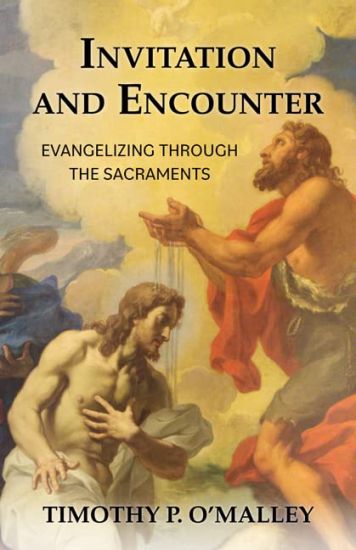
Invitation and Encounter: Evangelizing Through the Sacraments
"Sacramentalized, but not evangelized" is a phrase often used by those in the Church involved in pastoral outreach and evangelization efforts. While the phrase gets at a truth -- many Catholics who have received the sacraments are still in desperate need of evangelization -- it is theologically and spiritually imprecise. The problem is not that people have "only" received their sacraments, but that we do not fully understand the evangelizing work of the sacraments themselves. In Invitation and Encounter: Evangelizing Through the Sacraments, theologian, author, and speaker Timothy P. O'Malley shows how the sacraments, as efficacious signs, are Christ working in the Church by the power of the Holy Spirit. This book presents a pastoral introduction to sacramental theology from the standpoint of evangelization. How do sacraments evangelize? How do sacraments both heal and divinize those who receive them? Invitation and Encounter introduces the major terms and ideas of sacramental theology and helps the reader recognize how the sacramental life is integral to evangelization. By evangelizing through the sacraments, the goal of the New Evangelization is fulfilled, building up the Body of Christ with more Catholics who are sacramentalized and evangelized. About the Author Timothy P. O'Malley is director of McGrath Online and the academic director of the Notre Dame Center for Liturgy. He is a professor of theology at the University of Notre Dame, where he teaches and researches in the areas of liturgical-sacramental theology, catechesis, and spirituality.
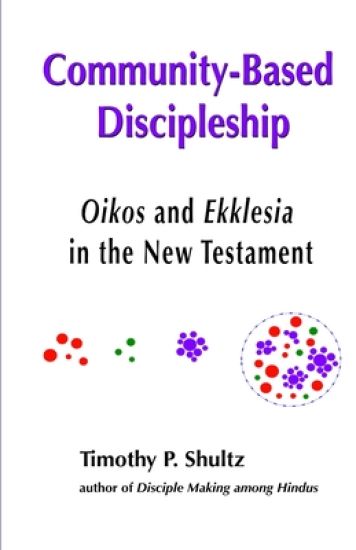
Community-Based Discipleship: Oikos and Ekklesia in the New Testament
Community-Based Discipleship is a book whose time has come. It is meant to both challenge and encourage "salt and light" disciples, people who have chosen to live within the realm of the Lordship of Jesus Christ in their own life as well as to represent his interests in the world. Ironically, these exemplary people often live with a hidden pain. They struggle to be faithful and fruitful disciples. They fear that they may ultimately be unable to fulfill the Lord's calling in their life. But he has left us with an illuminating, liberating pattern for discipleship At the core of the book is an integration of the four Gospels into a single Narrative. Reading this single, harmonized Gospel with special attention to the usage of oikos and ekklesia will reveal the discipleship philosophy of Jesus. We refer to this as O-2-O, oikos to oikos. Jesus formed an oikos of disciples who extended discipleship to the oikos communities that shaped their world. Jesus made disciples in community and for communities. Once salt and light disciples realize the extent to which human community informed how Jesus made disciples, they will clearly understand that the Lord has given them permission to create "new wineskins" that empower faithful and fruitful discipleship to Jesus in the world of tomorrow.Come join the adventure, as we explore together the unparalleled genius of Jesus' O-2-O oikklesia model...
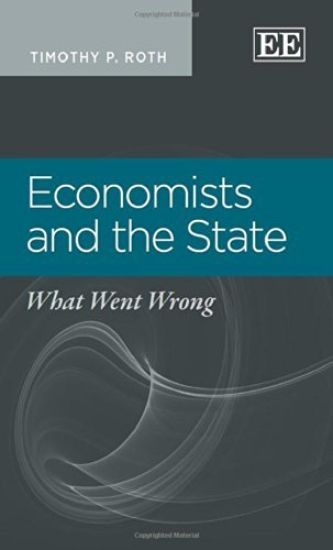
Economists and the State

Economists and the State

Timothy P. Roth

Edward Elgar Publishing Ltd
2014
sidottu
Economists and the State shows how modern economists have strayed far from Adam Smith's procedurally based, consequence-detached political economy. Timothy P. Roth argues that this wrong turn has left economists ill-equipped to address an expanding federal enterprise and new threats to our self-governing republic. He subsequently sets out to offer ways to redress this.Making the case for a return to the moral and political philosophy that informed Adam Smith's 'science of the statesman or legislator,' this book argues that economists must reject their relentlessly utilitarian, teleological theory of the state and embrace Nobel Laureate James M. Buchanan's constitutional political economy project. The author outlines the specific requirements of a non-teleological conception of the state - a conception that is vital to the continuing development of a theory of the state informed by a prior ethical commitment to the moral equivalence of persons.This book will appeal to scholars and students of political economy, political thought, public choice economics and Austrian economics as well as to practitioners and policy-makers interested in how economics should support those serving the public.
The Evolutioinite Chronicals book 3

The Evolutioinite Chronicals book 3

Timothy P Callahan

Independently Published
2019
pokkari
Damien Simen is a man on a mission: Steal 100 suits of armor transferred from a secret location. Once activated, the suits could finally give the terrorist group Infinity a chance against the cities high powered Evolutionites.Leonard Banks is the new leader of the Protectors, a group of elite Evolutionites formed to handle the unique challenges of Haven. He is determined to prove himself worthy of the mantle of leadership.Bryn Keefe is the most dangerous man alive. Leader of Infinity he wants to use the suits to take over the city, the country, and eventually the world. He's a man with a secret that will change everything.Infinity Rises is the third book in the Evolutionite Chronicles series which features heroes with immense power fighting for the rights of ordinary and extortionary people.
The Ethics and the Economics of Minimalist Government

The Ethics and the Economics of Minimalist Government

Timothy P. Roth

Edward Elgar Publishing Ltd
2002
sidottu
Because it is technically flawed and morally bankrupt, the author argues, the economist's consequence-based, procedurally detached theory of the state has contributed to the growth of government. As part of the Kantian-Rawlsian contractarian project, this book seeks to return economics to its foundations in moral philosophy. Given the moral equivalence of persons, the greatest possible equal participation must be promoted, persons must be impartially treated and, because it is grounded in consequentialist social welfare theory (SWT), the economist's theory of the state must be rejected. Ad hoc deployment of SWT has facilitated discriminatory rent seeking and contributed to larger government. In contrast, this book argues that equal political participation and a constitutional impartiality constraint minimize rent seeking, respect individual perceptions of the 'public good' and underwrite the legitimacy of government. Economists, moral philosophers and political scientists will find this book a unique contribution to the literature.
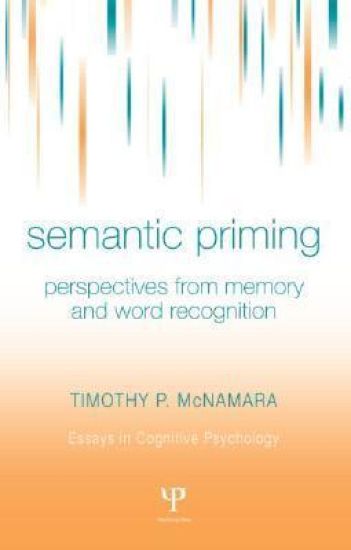
Semantic Priming

Semantic Priming

Timothy P. McNamara

Psychology Press Ltd
2005
sidottu
Semantic priming has been a focus of research in the cognitive sciences for more than thirty years and is commonly used as a tool for investigating other aspects of perception and cognition, such as word recognition, language comprehension, and knowledge representations. Semantic Priming: Perspectives from Memory and Word Recognition examines empirical and theoretical advancements in the understanding of semantic priming, providing a succinct, in-depth review of this important phenomenon, framed in terms of models of memory and models of word recognition.The first section examines models of semantic priming, including spreading activation models, the verification model, compound-cue models, distributed network models, and multistage activation models (e.g. interactive-activation model).The second section examines issues and findings that have played an especially important role in testing models of priming and includes chapters on the following topics: methodological issues (e.g. counterbalancing of materials, choice of priming baselines); automatic vs. strategic priming; associative vs. “pure” semantic priming; mediated priming; long-term semantic priming; backward priming; unconscious priming; the prime-task effect; list context effects; effects of word frequency, stimulus quality, and stimulus repetition; and the cognitive neuroscience of semantic priming.The book closes with a summary and a discussion of promising new research directions.The volume will be of interest to a wide range of researchers and students in the cognitive sciences and neurosciences.
Equality, Rights and the Autonomous Self

Equality, Rights and the Autonomous Self

Timothy P. Roth

Edward Elgar Publishing Ltd
2004
sidottu
Modern liberalism asserts the transcendental, autonomous self's 'natural rights' against others' moralistic and political preferences, and regards the economist's utilitarian social welfare theory as instrumental to the achievement of 'social justice'. Timothy Roth argues that the liberal enterprise ignores Kant's 'two points of view', confuses Kantian autonomy with moral and political license, mistakes utilitarian impersonality for impartiality, and takes no account of the indeterminacy of social welfare theory's fundamental theoretical constructs. In contrast, the author shows that Kant's 'two points of view' inform the conservative's constitutive political position and animate the consequence-detached, explicitly normative work of the conservative, constitutional political economist. He shows that, unlike modern liberalism, conservatism is grounded in Kant's 'two points of view', that utilitarian social welfare theory cannot be instrumental to the achievement of social justice, and that constitutional political economy is conservative economics. Economists interested in political economy, methodological issues, social welfare theory, public choice theory, or the moral foundations of economics will find much of interest in this thought-provoking volume. Political scientists interested in the philosophical foundations of modern liberalism and conservatism will also want to add this title to their library.
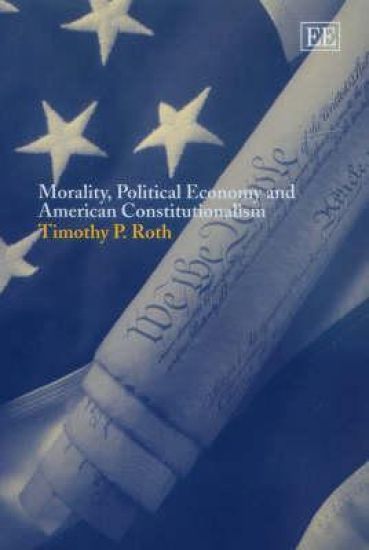
Morality, Political Economy and American Constitutionalism

Morality, Political Economy and American Constitutionalism

Timothy P. Roth

Edward Elgar Publishing Ltd
2007
sidottu
The Founders of the American Republic set up a remarkable experiment in self-government. Today, debates rage as to the philosophical legacy of this ongoing experiment. In this fascinating study, Timothy Roth offers a critical analysis of modern liberalism and the economic theory to which it is conjoined - social welfare theory. The author argues that social welfare theory cannot be reconciled with the American Founders' procedurally based, consequence-detached republican self-government project. The book goes on to explore and expound the Founders' desire to promote respect for the moral law, their appreciation of the reciprocal relationship between morality and law, and their commitment to the promotion of justice in the sense of impartial institutions; ideas which find expression in contractarian, constitutional political economy.Scholars and students in economics, political science, law and philosophy will find this marvelous treatise an engaging and thought-provoking read.
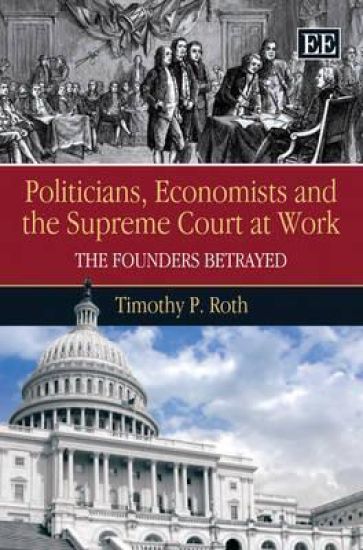
Politicians, Economists and the Supreme Court at Work

Politicians, Economists and the Supreme Court at Work

Timothy P. Roth

Edward Elgar Publishing Ltd
2010
sidottu
Thomas Jefferson wrote 'I wish - never to see all offices transferred to Washington, where, further withdrawn from the eyes of the people, they may more secretly be bought and sold at market'. What would Jefferson, Madison and the other Founders write today? Deploying their moral and political philosophy, their political economy and their understanding of the Constitution, Timothy P. Roth contends that the Founders would tell us that most of what the federal government does is either immoral, unconstitutional, or both. Presented as an engaging thought experiment, Politicians, Economists and the Supreme Court at Work examines the metastasizing federal role through two different means: first, as it relates to the increasing concerns of a contemporary nation, and second, the depth to which that nation's Founders would be appalled by the actions of their successors. Additionally, the book provides a critical appraisal of the burgeoning federal enterprise and the federal government's 'on-, off-, and off-off' budget activities - ultimately answering the question, 'What would the Founders do?' The nature and timeliness of this volume will appeal to moral and political philosophers, political scientists, historians, economists, scholars and students. In addition, the accessibility of the text provides for a compelling read that will pique the interest of the general public.
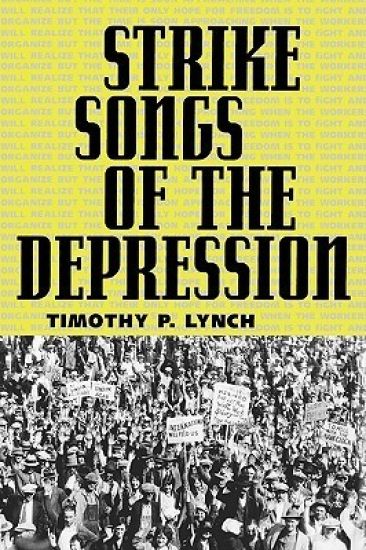
Strike Songs of the Depression

Strike Songs of the Depression

Timothy P. Lynch

University Press of Mississippi
2007
nidottu
The Depression brought unprecedented changes for American workers and organized labor. As the economy plummeted, employers cut wages and laid off workers, while simultaneously attempting to wrest more work from those who remained employed. In mills, mines, and factories workers organized and resisted, striking for higher wages, improved working conditions, and the right to bargain collectively. As workers walked the picket line or sat down on the shop floor, they could be heard singing. This book examines the songs they sang at three different strikes- the Gastonia, North Carolina, textile mill strike (1929), Harlan County, Kentucky, coal mining strike (1931-32), and Flint, Michigan, automobile sit-down strike (1936-37). Whether in the Carolina Piedmont, the Kentucky hills, or the streets of Michigan, the workers' songs were decidedly class-conscious. All show the workers' understanding of the necessity of solidarity and collective action. In Flint the strikers sang: The trouble in our homestead Was brought about this way When a dashing corporation Had the audacity to say You must all renounce your union And forswear your liberties, And we'll offer you a chance To live and die in slavery. As a shared experience, the singing of songs not only sent the message of collective action but also provided the very means by which the message was communicated and promoted. Singing was a communal experience, whether on picket lines, at union rallies, or on shop floors. By providing the psychological space for striking workers to speak their minds, singing nurtured a sense of community and class consciousness. When strikers retold the events of their strike, as they did in songs, they spread and preserved their common history and further strengthened the bonds among themselves. In the strike songs the roles of gender were pronounced and vivid. Wives and mothers sang out of their concerns for home, family, and children. Men sang in the name of worker loyalty and brotherhood, championing male solidarity and comaraderie. Informed by the new social history, this critical examination of strike songs from three different industries in three different regions gives voice to a group too often deemed as inarticulate. This study, the only book-length examination of this subject, tells history ""from the bottom up"" and furthers an understanding of worker culture during the tumultuous Depression years. Timothy P. Lynch is an associate professor of history at the College of Mount St. Joseph in Cincinnati, Ohio. He has been published in the Michigan Historical Review and the Encyclopedia of American Social History.
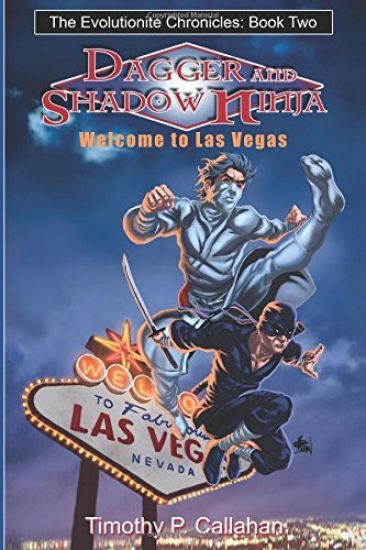
The Evolutionite Chronicles book 2

The Evolutionite Chronicles book 2

Timothy P Callahan

Independently Published
2018
pokkari
Tanaka and Daniel are more than just brothers; they are Evolutionites, former Protectors known as Dagger and Shadow Ninja, and now, they're business owners dedicated to maintaining peace and fighting crime wherever they're needed. When a distress call from Tanaka's ex-girlfriend, Nancy, lures them to the city of sin-Las Vegas, they find themselves in a high-stakes battle against an evil mastermind named Destructo.Destructo's sinister plan threatens to replace every human with lifelike robot doppelgangers. As the brothers race against time, they must confront their own past and the complexities of trust, especially when it comes to Nancy, whose actions once shattered Tanaka's heart.'Welcome to Vegas' is a thrilling superhero adventure that propels readers through the neon-lit streets, glitzy casinos, and enticing strip clubs of the most unique city on Earth. With the fate of humanity hanging in the balance, can Tanaka and Daniel save the world once again? Will they overcome personal grudges to forge a united front against Destructo's malevolent machinations? In a city where secrets are as common as poker chips, the stakes have never been higher
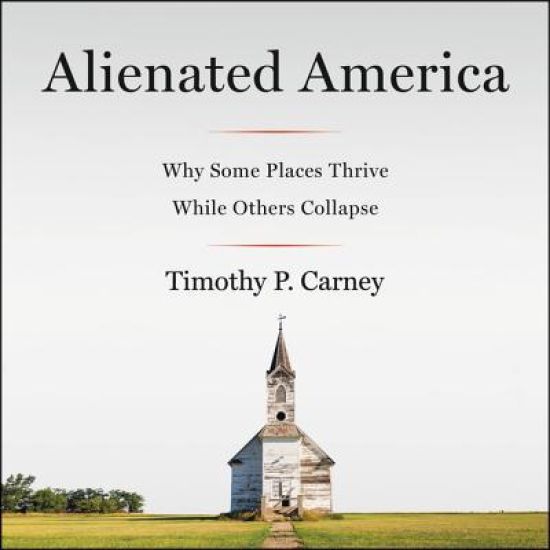
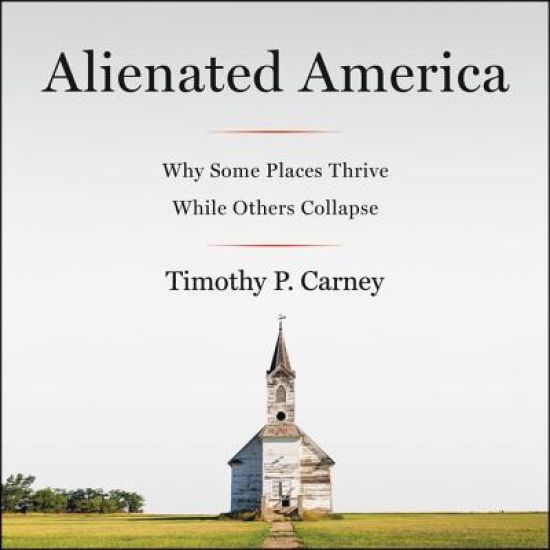
Alienated America Lib/E: Why Some Places Thrive While Others Collapse
Respected conservative journalist and commentator Timothy P. Carney continues the conversation begun with Hillbilly Elegy and the classic Bowling Alone in this hard-hitting analysis that identifies the true factor behind the decline of the American dream: it is not purely the result of economics as the left claims, but the collapse of the institutions that made us successful, including marriage, church, and civic life.During the 2016 presidential campaign, Donald J. Trump proclaimed, "the American dream is dead," and this message resonated across the country.Why do so many people believe that the American dream is no longer within reach? Growing inequality, stubborn pockets of immobility, rising rates of deadly addiction, the increasing and troubling fact that where you start determines where you end up, heightening political strife--these are the disturbing realities threatening ordinary American lives today.The standard accounts pointed to economic problems among the working class, but the root was a cultural collapse: While the educated and wealthy elites still enjoy strong communities, most blue-collar Americans lack strong communities and institutions that bind them to their neighbors. And outside of the elites, the central American institution has been religion.That is, it's not the factory closings that have torn us apart; it's the church closings. The dissolution of our most cherished institutions--nuclear families, places of worship, civic organizations--has not only divided us, but eroded our sense of worth, belief in opportunity, and connection to one another.In Alienated America, Carney visits all corners of America, from the dim country bars of Southwestern Pennsylvania., to the bustling Mormon wards of Salt Lake City, and explains the most important data and research to demonstrate how the social connection is the great divide in America. He shows that Trump's surprising victory was the most visible symptom of this deep-seated problem. In addition to his detailed exploration of how a range of societal changes have, in tandem, damaged us, Carney provides a framework that will lead us back out of a lonely, modern wilderness.
Alienated America: Why Some Places Thrive While Others Collapse
Respected conservative journalist and commentator Timothy P. Carney continues the conversation begun with Hillbilly Elegy and the classic Bowling Alone in this hard-hitting analysis that identifies the true factor behind the decline of the American dream: it is not purely the result of economics as the left claims, but the collapse of the institutions that made us successful, including marriage, church, and civic life.During the 2016 presidential campaign, Donald J. Trump proclaimed, "the American dream is dead," and this message resonated across the country.Why do so many people believe that the American dream is no longer within reach? Growing inequality, stubborn pockets of immobility, rising rates of deadly addiction, the increasing and troubling fact that where you start determines where you end up, heightening political strife--these are the disturbing realities threatening ordinary American lives today.The standard accounts pointed to economic problems among the working class, but the root was a cultural collapse: While the educated and wealthy elites still enjoy strong communities, most blue-collar Americans lack strong communities and institutions that bind them to their neighbors. And outside of the elites, the central American institution has been religion.That is, it's not the factory closings that have torn us apart; it's the church closings. The dissolution of our most cherished institutions--nuclear families, places of worship, civic organizations--has not only divided us, but eroded our sense of worth, belief in opportunity, and connection to one another.In Alienated America, Carney visits all corners of America, from the dim country bars of Southwestern Pennsylvania., to the bustling Mormon wards of Salt Lake City, and explains the most important data and research to demonstrate how the social connection is the great divide in America. He shows that Trump's surprising victory was the most visible symptom of this deep-seated problem. In addition to his detailed exploration of how a range of societal changes have, in tandem, damaged us, Carney provides a framework that will lead us back out of a lonely, modern wilderness.