Kirjojen hintavertailu. Mukana 12 390 323 kirjaa ja 12 kauppaa.

Kirjahaku

Etsi kirjoja tekijän nimen, kirjan nimen tai ISBN:n perusteella.

1000 tulosta hakusanalla Winfield Scott

A Dirty Hand

A Dirty Hand

Winfield Townley Scott

University of Texas Press
1969
nidottu
From "a dirty hand": Words are very powerful. You aren't sure of that? Think of all the things you won't say. Wonderful remark in a note I had this week from William Carlos Williams. He spoke of the "disease" of wanting to write poetry; said he had been "off" poetry for many months and-he said-"I feel clean and unhappy." One reason for keeping this kind of notebook: you can put on record the retort you couldn't think of at last night's party. Photographs of Henry James in his middle years should be commented upon. Gone is the shy aesthete of the youthful portrait (by LaFarge?) . This bearded man has a fierce look, even a bestial one. Here is perhaps-I don't know-James at his most generative. Again this man disappears in the shaven, bald, final James, the famous James-the Grand Lama. I noticed when Lindsay (thirteen) read aloud a passage from a hunting book the other day he pronounced "genital" as "genteel." I'd love to see a literary history titled "The Genital Tradition." Contrast "business ethics" and the ethics of art. Nobody writes a poem hoping it will wear out in four or five years. Between 1951 and 1966 the distinguished American poet Winfield Townley Scott kept a series of notebooks in which he set down his thoughts on poetry, literature, the literary scene, and life in general. Shortly before his untimely death in 1968 he made a selection of the entries he thought were best and gave it the title "a dirty hand." These perceptive notes, some tart, some gentle, some boisterous, some wistful, give us a remarkable insight into the workings of his creative mind. George P. Elliott has said of Scott: "In a very solid way, I think he was as rock-bottom American a poet as we have had since Frost." The introduction is by Scott's good friend Merle Armitage, who also designed the original edition of this book.
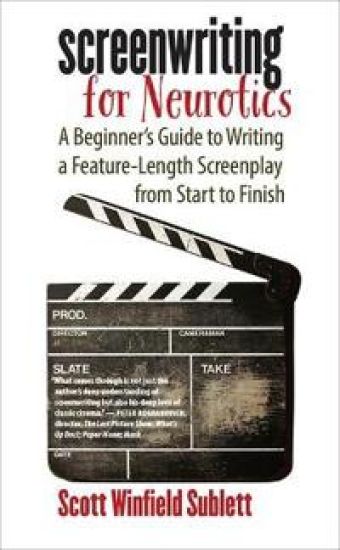
Screenwriting for Neurotics

Screenwriting for Neurotics

Scott Winfield Sublett

University of Iowa Press
2014
nidottu
Screenwriting for Neurotics is a quirky and accessible handbook for beginning screenwriters. Whether you are a student in a screenwriting class or just someone who wants to try their hand at writing for fi lm or television, this handy guidebook makes the entire process simple and unintimidating. Scott Winfield Sublett, a veteran screenwriter and screenwriting teacher, walks you step by step from start to finish and helps you navigate potential and unforeseen difficulties along the way, offering handy tips and suggestions to keep you from becoming blocked or stalled.Rather than throwing you into the writing process headfirst, Sublett guides you through the various decisions you need to make— about plot, character, structure, conflict—in the order you need to make them. He explains in straightforward terms the terminology and jargon, the theory and industry standards, and dispels common myths about screenwriting that can discourage or hold back a beginning writer.Balancing theory and practice and offering valuable and insightful examples from recognizable and well-known classic and contemporary films, ranging from Casablanca to A Christmas Story to Clerks, Sublett provides the new writer with the necessary tools to successfully write a feature-length screenplay and offers a roadmap of where to go next. With an emphasis on helping a writer not just to begin, but also to finish a script, Screenwriting for Neurotics is the screenwriting book to help you actually write one.
To Marry Strangers, a Book of Poems

To Marry Strangers, a Book of Poems

Winfield Townley 1910-1968 Scott

Hassell Street Press
2021
sidottu
This work has been selected by scholars as being culturally important and is part of the knowledge base of civilization as we know it.This work is in the public domain in the United States of America, and possibly other nations. Within the United States, you may freely copy and distribute this work, as no entity (individual or corporate) has a copyright on the body of the work.Scholars believe, and we concur, that this work is important enough to be preserved, reproduced, and made generally available to the public. To ensure a quality reading experience, this work has been proofread and republished using a format that seamlessly blends the original graphical elements with text in an easy-to-read typeface.We appreciate your support of the preservation process, and thank you for being an important part of keeping this knowledge alive and relevant.
The Dark Sister

The Dark Sister

Winfield Townley 1910-1968 Scott

Hassell Street Press
2021
sidottu
This work has been selected by scholars as being culturally important and is part of the knowledge base of civilization as we know it.This work is in the public domain in the United States of America, and possibly other nations. Within the United States, you may freely copy and distribute this work, as no entity (individual or corporate) has a copyright on the body of the work.Scholars believe, and we concur, that this work is important enough to be preserved, reproduced, and made generally available to the public. To ensure a quality reading experience, this work has been proofread and republished using a format that seamlessly blends the original graphical elements with text in an easy-to-read typeface.We appreciate your support of the preservation process, and thank you for being an important part of keeping this knowledge alive and relevant.
The Dark Sister

The Dark Sister

Winfield Townley 1910-1968 Scott

Hassell Street Press
2021
nidottu
This work has been selected by scholars as being culturally important and is part of the knowledge base of civilization as we know it.This work is in the public domain in the United States of America, and possibly other nations. Within the United States, you may freely copy and distribute this work, as no entity (individual or corporate) has a copyright on the body of the work.Scholars believe, and we concur, that this work is important enough to be preserved, reproduced, and made generally available to the public. To ensure a quality reading experience, this work has been proofread and republished using a format that seamlessly blends the original graphical elements with text in an easy-to-read typeface.We appreciate your support of the preservation process, and thank you for being an important part of keeping this knowledge alive and relevant.
The Trojan Legend in Medieval Scottish Literature
First full-length treatment of the Trojan legend in medieval Scottish literature, showing the various uses for, and the ways in, which it was deployed. The Trojan legend became hot property during the Anglo-Scots Wars of Independence. During the late thirteenth and early fourteenth centuries, the English traced their ancestry to Brutus and the Trojans and used this origin myth tobolster their claims to lordship and ownership of Scotland; while in a game of political one-upmanship, and in order to prove Scotland's independence and sovereignty, Scottish historians instead traced their nation's origins to aGreek prince, Gaythelos, and his Egyptian wife, Scota. Despite the wealth of scholarship on the Trojan legend in English and European literature, very little has been done on Scotland's literary response to the same legend,even though a mere glance at the canonical material of late medieval Scotland indicates that it remained equally current north of the Border, a gap which this book fills. Through a detailed analysis of a range of Older Scots textsfrom c. 1375 to c. 1513, notably The Scottish Troy Book, Henryson's Testament of Cresseid, and Douglas' Eneados, it provides the first comprehensive assessment of the Scottish response to the Trojan legend. It considers the way in which Scottish texts interact with English counterparts, such as Geoffrey of Monmouth's Historia, Chaucer's Troilus, Lydgate's Troy Book, and Caxton's Eneydos, and demonstrates how despite - or perhaps because of - its use in the Anglo-Scots Wars of Independence, the Trojan legend was for the most part neither neglected nor pejoratively treated in Older Scots literature. Rather, the Matter of Troy and related Matter of Greece were used not just as an origin myth, but also as a metaphor for Anglo-Scots political relations, guide to good governance, and locus through which poets might explore broader issues of literary tradition, authority, and the nature of poetic truth. Emily Wingfield is a lecturer in English at the University of Birmingham.
Winfield

Winfield

James R. McGuire

Arcadia Publishing Library Editions
2017
sidottu
Winfield's history traces back to the mid-19th century, well before its official incorporation in 1921. It began as the Gary's Mill settlement and nearly became Fredericksburg and Frederick Park due to the German heritage that its early people brought with them. It became Winfield when it was believed that Gen. Winfield Scott passed through the area during the Black Hawk War of the early 1830s. Winfield's history is attributed to people, businesses, and social activities. Its people included unique individuals such as Jacob Mueller and John Hamm, as well as the Higgins, Enders, and Besch families. Its businesses included longtime staples Higgins Store and Schmidt's Meat Market, as well as popular gathering locales like Hamm's tavern. Early social activities usually centered at Forester's Hall. Many residents attended mass at St. John the Baptist Church, which started in 1867, burned in 1906, and was rebuilt and rededicated one year later. While Central DuPage Hospital is a staple of today's Winfield, early Winfield had the Forsythe Rest Farm and the Chicago-Winfield Tuberculosis Sanitarium.