Kirjojen hintavertailu. Mukana 12 390 323 kirjaa ja 12 kauppaa.

Kirjahaku

Etsi kirjoja tekijän nimen, kirjan nimen tai ISBN:n perusteella.

285 tulosta hakusanalla "Jacques Derrida"

Given Time II

Given Time II

Jacques Derrida

THE UNIVERSITY OF CHICAGO PRESS
2026
sidottu
The long-awaited conclusion to Derrida’s seminar on the gift and time. In 1991, Jacques Derrida published the first half of a seminar delivered from 1978 to 1979 on gifts and time, but the second installment (though expected) was not completed in his lifetime. Given Time II completes the seminar with eight sessions that showcase Derrida’s most advanced work on the problematic of the gift in Heidegger, with deep dives into some of the most difficult texts in the Heideggerian corpus, including “The Origin of the Work of Art,” “The Thing,” and “On Time and Being.” Beyond Heidegger, Derrida engages Claude Lévi-Strauss, Marcel Mauss, Maurice Blanchot, Jacques Lacan, and others on the act of giving and receiving, the sacrificial gift, and more. Throughout, Derrida identifies a paradox of gift giving: for the gift to be received as a gift, it must not appear as such, since gifts often involve a cycle of debt and repayment. Given Time II is a uniquely Derridean treatment of an important subject in the work of Heidegger and beyond.

Perjury and Pardon, Volume II

Perjury and Pardon, Volume II

Jacques Derrida

THE UNIVERSITY OF CHICAGO PRESS
2023
sidottu
An exploration of the political dimensions of forgiveness and repentance from Jacques Derrida. Perjury and Pardon is a two-year seminar series given by Jacques Derrida at the École des hautes études en sciences sociales in Paris during the late 1990s. In these sessions, Derrida focuses on the philosophical, ethical, juridical, and political stakes of the concept of responsibility. His primary goal is to develop what he calls a “problematic of lying” by studying diverse forms of betrayal: infidelity, denial, false testimony, perjury, unkept promises, desecration, sacrilege, and blasphemy. This volume covers the seminar’s second year when Derrida explores the political dimensions of forgiveness and repentance. Over eight sessions, he discusses Hegel, Augustine, Levinas, Arendt, and Benjamin as well as Bill Clinton’s impeachment and Nelson Mandela and Desmond Tutu’s testimonies before the Truth and Reconciliation Commission. The seminars conclude with an extended reading of Henri Thomas’s 1964 novel Le Parjure.
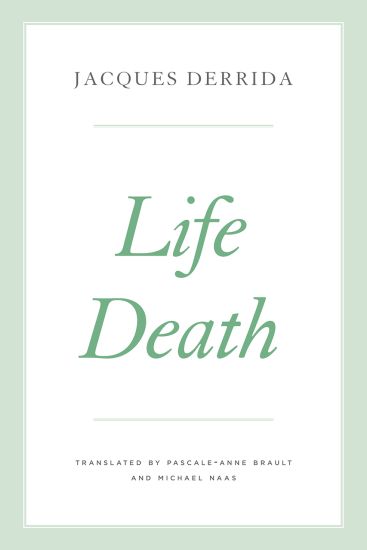
Life Death

Life Death

Jacques Derrida

THE UNIVERSITY OF CHICAGO PRESS
2023
nidottu
The seventh in our series of Derrida's seminars, Life Death provides interdisciplinary reflections on the relationship of life and death—now in paperback. One of Jacques Derrida’s most provocative works, Life Death deconstructs a deeply rooted dichotomy of Western thought: life and death. In rethinking the relationship between life and death, Derrida undertakes a multi-disciplinary analysis of a range of topics across philosophy, linguistics, and the life sciences. Derrida gave this seminar over fourteen sessions between 1975 and 1976 at the École normale supérieure in Paris to prepare students for the agrégation, a notoriously competitive exam. The theme for the exam that year was “Life and Death,” but Derrida made a critical modification to the title by dropping the coordinating conjunction. The resulting title of Life Death poses a philosophical question about the close relationship between life and death. Through close readings of Freudian psychoanalysis, the philosophy of Nietzsche and Heidegger, French geneticist François Jacob, and epistemologist Georges Canguilhem, Derrida argues that death must be considered neither as the opposite of life nor as the truth or fulfillment of it, but rather as that which both limits life and makes it possible. Derrida thus not only questions traditional understandings of the relationship between life and death but also ultimately develops a new way of thinking about what he calls “life death.”
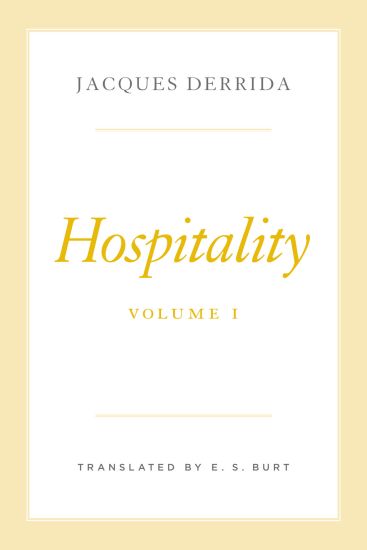
Hospitality, Volume I

Hospitality, Volume I

Jacques Derrida

THE UNIVERSITY OF CHICAGO PRESS
2023
sidottu
Jacques Derrida explores the ramifications of what we owe to others.Hospitality reproduces a two-year seminar series delivered by Jacques Derrida at the École des hautes études en sciences sociales in Paris between 1995 and 1997. In these lectures, Derrida asks a series of related questions about responsibility and “the foreigner”: How do we welcome or turn away the foreigner? What does the idea of the foreigner reveal about kinship and the state, particularly in relation to friendship, citizenship, migration, asylum, assimilation, and xenophobia? Derrida approaches these questions through readings of several classical texts as well as modern texts by Heidegger, Arendt, Camus, and others. Central to his project is a rigorous distinction between conventional, finite hospitality, with its many conditions, and the aspirational idea of hospitality as something offered unconditionally to the stranger. This volume collects the first year of the seminar.
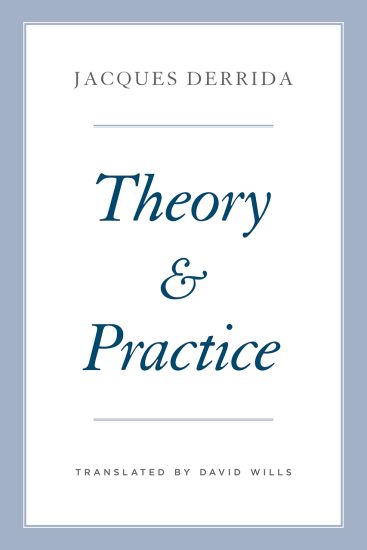
Theory and Practice

Theory and Practice

Jacques Derrida

THE UNIVERSITY OF CHICAGO PRESS
2024
nidottu
Now in paperback, nine lectures from Jacques Derrida that challenge the influential Marxist distinction between thinking and acting.Theory and Practice is a series of nine lectures that Jacques Derrida delivered at the École Normale Supérieure in 1976 and 1977. The topic of “theory and practice” was associated above all with Marxist discourse and particularly the influential interpretation of Marx by Louis Althusser. Derrida’s many questions to Althusser and other thinkers aim at unsettling the distinction between thinking and acting. Derrida’s investigations set out from Marx’s “Theses on Feuerbach,” in particular the eleventh thesis, which has often been taken as a mantra for the “end of philosophy,” to be brought about by Marxist practice. Derrida argues, however, that Althusser has no such end in view and that his discourse remains resolutely philosophical, even as it promotes the theory/practice pair as primary values. This seminar also draws fascinating connections between Marxist thought and Heidegger and features Derrida’s signature reconsideration of the dichotomy between doing and thinking. This text, available for the first time in English, shows that Derrida was doing important work on Marx long before Specters of Marx. As with the other volumes in this series, it gives readers an unparalleled glimpse into Derrida’s thinking at its best—spontaneous, unpredictable, and groundbreaking.
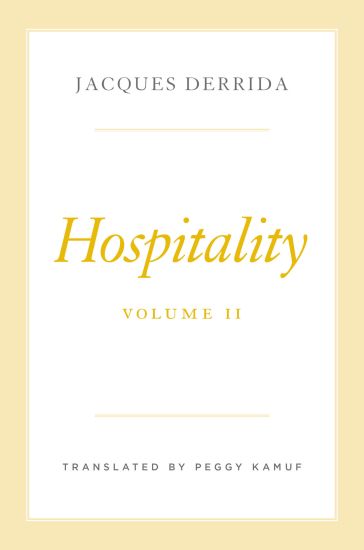
Hospitality, Volume II

Hospitality, Volume II

Jacques Derrida

THE UNIVERSITY OF CHICAGO PRESS
2024
sidottu
Jacques Derrida explores the ramifications of what we owe to others.Hospitality reproduces a two-year seminar series delivered by Jacques Derrida at the École des hautes études en sciences sociales in Paris between 1995 and 1997. In these lectures, Derrida asks a series of related questions about responsibility and “the foreigner”: How do we welcome or turn away the foreigner? What does the idea of the foreigner reveal about kinship and the state, particularly in relation to friendship, citizenship, migration, asylum, assimilation, and xenophobia? Central to his project is a rigorous distinction between conventional, finite hospitality, with its many conditions, and the aspirational idea of hospitality as something offered unconditionally to the stranger. This volume collects the second year of the seminar, which considers an Islamic problematic of hospitality, the relevance of forgiveness, and the work of Emmanuel Levinas.
Signature Derrida

Signature Derrida

Jacques Derrida

University of Chicago Press
2013
sidottu
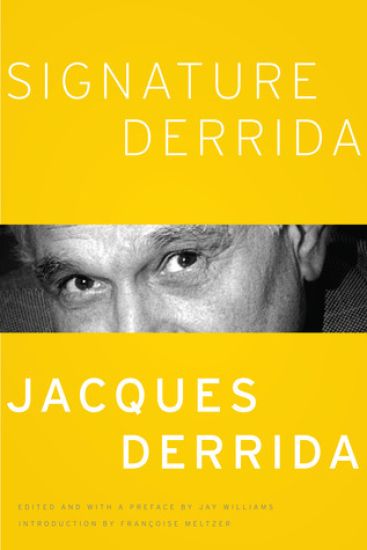
Throughout his long career, Jacques Derrida had a close, collaborative relationship with "Critical Inquiry" and its editors. He saved some of his most important essays for the journal, and he relished the ensuing arguments and polemics that stemmed from the responses to his writing that "Critical Inquiry" encouraged. Collecting the best of Derrida's work that was published in the journal between 1980 and 2002, "Signature Derrida" provides a remarkable introduction to the philosopher and the evolution of his thought. These essays define three significant "periods" in Derrida's writing: his early, seemingly revolutionary phase; a middle stage, often autobiographical, that included spirited defense of his work; and his late period, when his persona as a public intellectual was prominent, and he wrote on topics such as animals and religion. The first period is represented by essays like "The Law of Genre," in which Derrida produces a kind of phenomenological narratology. Another essay, "The Linguistic Circle of Geneva," embodies the second, presenting deconstructionism at its best: Derrida shows that what was imagined to be an epistemological break in the study of linguistics was actually a repetition of earlier concepts. The final period of Derrida's writing includes the essays "Of Spirit" and "The Animal That Therefore I Am (More to Follow)" and eulogies for Michel Foucault, Louis Marin, and Emmanuel Levinas, in which Derrida uses the ideas of each thinker to push forward the implications of their theories. Gathering a small but crucial portion of the oeuvre of this singular philosopher, "Signature Derrida" is the most wide-ranging, and thus most representative, anthology of Derrida's work to date.
Signature Derrida

Signature Derrida

Jacques Derrida

University of Chicago Press
2013
nidottu
Throughout his long career, Jacques Derrida had a close, collaborative relationship with "Critical Inquiry" and its editors. He saved some of his most important essays for the journal, and he relished the ensuing arguments and polemics that stemmed from the responses to his writing that "Critical Inquiry" encouraged. Collecting the best of Derrida's work that was published in the journal between 1980 and 2002, "Signature Derrida" provides a remarkable introduction to the philosopher and the evolution of his thought. These essays define three significant "periods" in Derrida's writing: his early, seemingly revolutionary phase; a middle stage, often autobiographical, that included spirited defense of his work; and his late period, when his persona as a public intellectual was prominent, and he wrote on topics such as animals and religion. The first period is represented by essays like "The Law of Genre," in which Derrida produces a kind of phenomenological narratology. Another essay, "The Linguistic Circle of Geneva," embodies the second, presenting deconstructionism at its best: Derrida shows that what was imagined to be an epistemological break in the study of linguistics was actually a repetition of earlier concepts. The final period of Derrida's writing includes the essays "Of Spirit" and "The Animal That Therefore I Am (More to Follow)" and eulogies for Michel Foucault, Louis Marin, and Emmanuel Levinas, in which Derrida uses the ideas of each thinker to push forward the implications of their theories. Gathering a small but crucial portion of the oeuvre of this singular philosopher, "Signature Derrida" is the most wide-ranging, and thus most representative, anthology of Derrida's work to date.
A Derrida Reader

A Derrida Reader

Jacques Derrida

Columbia University Press
1991
pokkari
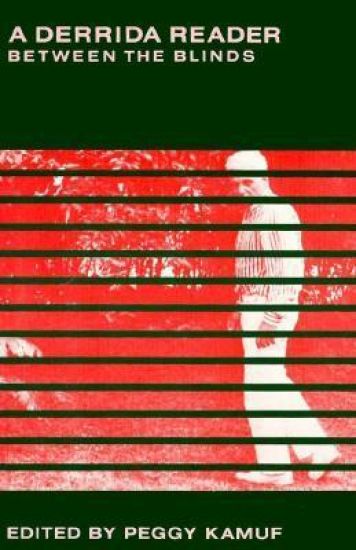
Jacques Derrida is one of the most prolific and influential contemporary French intellectuals. Twenty-two essays and excerpts from Derrida's writings over the last twenty-five years are gathered in this accessible introduction, A Derrida Reader. The book's five sections are carefully introduced by the editor, and each selection of Derrida's work is presented succinctly in context. A general introduction to the volume by Peggy Kamuf provides an original interpretation and overview of Derrida's work and philosophy.
Geneses, Genealogies, Genres, and Genius

Geneses, Genealogies, Genres, and Genius

Jacques Derrida

Columbia University Press
2008
pokkari
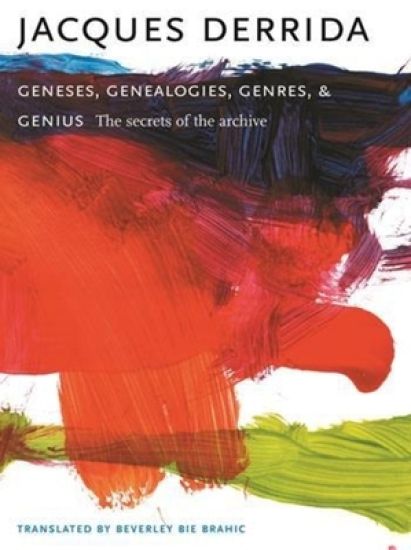
Jacques Derrida argues that the feminist and intellectual Helene Cixous is the most important writer working within the French idiom today. To prove this, he elucidates the epistemological and historical interconnectedness of four terms: genesis, genealogy, genre, and genius, and how they pertain to or are implicated in Cixous's work. Derrida explores Cixous's genius (a masculine term in French, he is quick to point out) and the inspiration that guides and informs her writing. He marvels at her skillful working within multiple genres. He focuses on a number of her works, including her extraordinary novel Manhattan and her lyrical and evocative Dream I Tell You, a book addressed to Derrida himself and one in which Cixous presents a series of her dreams. Derrida also delves into the nature of the literary archive, the production of literature, and the importance of the poetic and sexual difference to the entirety of his own work. For forty years, Derrida had a close personal and intellectual relationship with Helene Cixous. Clever, playful, and eloquent, Geneses, Genealogies, Genres, and Genius charts the influence these two critical giants had on each other and is the most vital work to address Cixous's contribution to French thought.
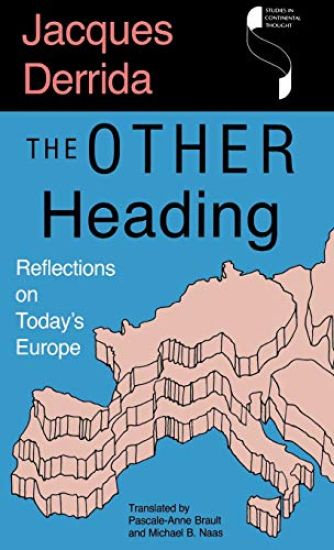
The Other Heading

The Other Heading

Jacques Derrida

Indiana University Press
1992
sidottu
Prompted by the unification of Europe in 1992 and by recent events in Eastern Europe and the Soviet Union, Jacques Derrida begins this compelling essay on contemporary world politics with the issue of European identity. What, he asks, is Europe? How has Europe traditionally been defined and how is the current world situation changing that definition? Might the prospects of a New Europe demand not only a new definition of European identity but also a new way of thinking identity itself? Navigating in and through texts of Marx, Husserl, and especially Valéry, Derrida seeks a redefinition of European identity that includes respect both for difference and for universal values. The Other Heading appeals eloquently for a sustained effort at thinking through the complexity and the multiple dangers and opportunities of the contemporary world situation without resorting to easy or hasty solutions.
On Cosmopolitanism and Forgiveness

On Cosmopolitanism and Forgiveness

Jacques Derrida

Routledge
2001
sidottu
One of the world's most famous philosophers, Jacques Derrida, explores difficult questions in this important and engaging book. Is it still possible to uphold international hospitality and justice in the face of increasing nationalism and civil strife in so many countries? Drawing on examples of treatment of minority groups in Europe, he skilfully and accessibly probes the thinking that underlies much of the practice, and rhetoric, that informs cosmopolitanism. What have duties and rights to do with hospitality? Should hospitality be grounded on a private or public ethic, or even a religious one? This fascinating book will be illuminating reading for all.
On Cosmopolitanism and Forgiveness

On Cosmopolitanism and Forgiveness

Jacques Derrida

Routledge
2001
nidottu
One of the world's most famous philosophers, Jacques Derrida, explores difficult questions in this important and engaging book. Is it still possible to uphold international hospitality and justice in the face of increasing nationalism and civil strife in so many countries? Drawing on examples of treatment of minority groups in Europe, he skilfully and accessibly probes the thinking that underlies much of the practice, and rhetoric, that informs cosmopolitanism. What have duties and rights to do with hospitality? Should hospitality be grounded on a private or public ethic, or even a religious one? This fascinating book will be illuminating reading for all.
Specters of Marx

Specters of Marx

Jacques Derrida

Routledge
2006
nidottu
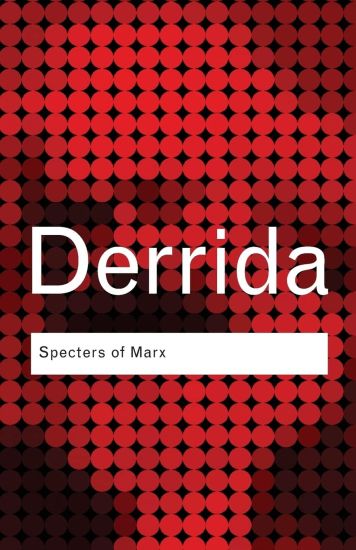
Prodigiously influential, Jacques Derrida gave rise to a comprehensive rethinking of the basic concepts and categories of Western philosophy in the latter part of the twentieth century, with writings central to our understanding of language, meaning, identity, ethics and values.In 1993, a conference was organized around the question, 'Whither Marxism?’, and Derrida was invited to open the proceedings. His plenary address, 'Specters of Marx', delivered in two parts, forms the basis of this book. Hotly debated when it was first published, a rapidly changing world and world politics have scarcely dented the relevance of this book.
Acts of Literature

Acts of Literature

Jacques Derrida

Routledge
1991
nidottu
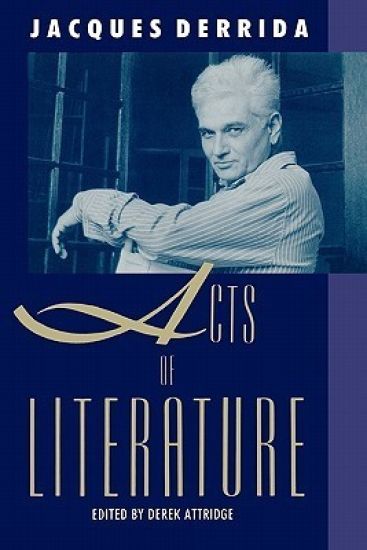
First published in 1992. "Acts of Literature", compiled in close association with Derrida, brings together for the first time a number of Derrida's writings on literary texts on the question of literature. The essays discuss literary figures such as Rousseau, Mallarme, Joyce, Shakespeare and Kafka. Comprising pieces spanning Derrida's career, the collection includes a substantial new interview with him on questions of literature, deconstruction, politics, feminism and history. Derek Attridge provides an introductory essay on deconstruction and the question of literature, and offers suggestions for further reading. These essays examine the place and function of literature in Western culture. They highlight Derrida's interest in literature as a significant cultural institution and as a peculiarly challenging form of writing, with inescapable consequences for our thinking about philosophy, politics and ethics. This book should be of interest to undergraduates and academics in the field of literary theory and criticism and continental philosophy.
Acts of Religion

Acts of Religion

Jacques Derrida

Routledge
2001
sidottu
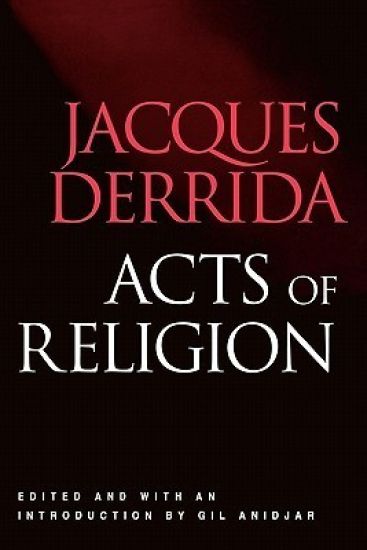
Acts of Religion, compiled in close association with Jacques Derrida, brings together for the first time a number of Derrida's writings on religion and questions of faith and their relation to philosophy and political culture. The essays discuss religious texts from Jewish, Christian, and Muslim traditions, as well as religious thinkers such as Kant, Levinas, and Gershom Scholem, and comprise pieces spanning Derrida's career. The collection includes two new essays by Derrida that appear here for the first time in any language, as well as a substantial introduction by Gil Anidjar that explores Derrida's return to his own "religious" origins and his attempts to bring to light hidden religious dimensions of the social, cultural, historical, and political.
Acts of Religion

Acts of Religion

Jacques Derrida

Routledge
2001
nidottu
Acts of Religion, compiled in close association with Jacques Derrida, brings together for the first time a number of Derrida's writings on religion and questions of faith and their relation to philosophy and political culture. The essays discuss religious texts from Jewish, Christian, and Muslim traditions, as well as religious thinkers such as Kant, Levinas, and Gershom Scholem, and comprise pieces spanning Derrida's career. The collection includes two new essays by Derrida that appear here for the first time in any language, as well as a substantial introduction by Gil Anidjar that explores Derrida's return to his own "religious" origins and his attempts to bring to light hidden religious dimensions of the social, cultural, historical, and political.