Kirjojen hintavertailu. Mukana 12 390 323 kirjaa ja 12 kauppaa.

Kirjahaku

Etsi kirjoja tekijän nimen, kirjan nimen tai ISBN:n perusteella.

1000 tulosta hakusanalla Alexandra Müller

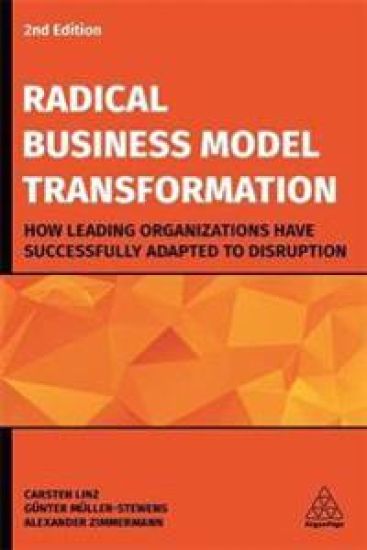
Radical Business Model Transformation

Radical Business Model Transformation

Carsten Linz; Günter Müller-Stewens; Alexander Zimmermann

Kogan Page Ltd
2020
sidottu
How can organizations complete a major business model transformation and how can leaders successfully guide their business through this radical shift? As markets are constantly transformed by new technologies and disruptor competitors, once successful business models designed to function in a different time now struggle as the mainstream changes. This book is the guide for organizations looking to turn downward trends into upward momentum and gain an edge on the competition. Now in its second edition, this book offers practical advice on how to understand the fit of an existing business model and reconstruct it with a forward-thinking approach. New illustrative case studies of global organizations which have boldly transformed offer examples for change, including SAP, Netflix and Daimler. Business transformation is presented as a leadership challenge and methods to realize and implement opportunities for innovation company-wide are discussed in detail. Radical Business Model Transformation is essential reading for business leaders, transformation experts and MBA students interested in ensuring that their business model is future-proof and can withstand the new proliferation of innovations set to transform the business landscape.
Entrepreneurship

Entrepreneurship

Urs Fueglistaller; Alexander Fust; Christoph Müller; Susan Müller; Thomas Zellweger

Springer Gabler
2020
nidottu
Anerkannte wissenschaftliche Experten erläutern in diesem umfassenden Lehrbuch die Grundkonzepte des Entrepreneurship sowie die wesentlichen Aspekte für ein erfolgreiches unternehmerisches Engagement. In jedem Kapitel sorgen ein Unternehmerportrait und eine auf realen Unternehmenssituationen basierende Fallstudie aus Deutschland, Österreich oder der Schweiz für einen gelungenen Theorie-Praxis-Transfer. Für die 5. Auflage wurden alle Kapitel überarbeitet. Neue wissenschaftliche Erkenntnisse wurden berücksichtigt.
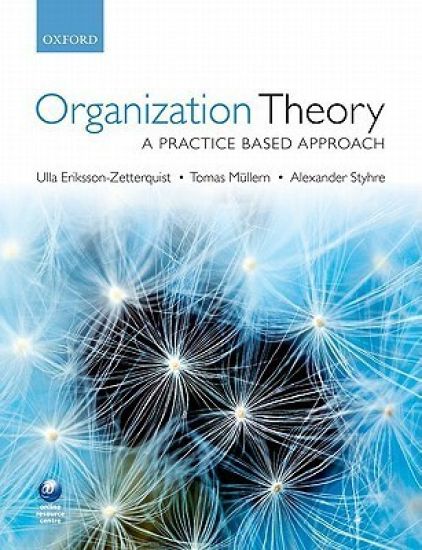
Organization Theory

Organization Theory

Ulla Eriksson-Zetterquist; Tomas Müllern; Alexander Styhre

Oxford University Press
2011
nidottu
This textbook presents organization theory in an exciting new way, moving away from a traditional linear historical narrative approach, to present students with an approach that offers both relevancy and appeal. The authors take a practice-based approach, identifying questions, problems and issues that are perceived as pertinent by practitioners, and using these as the starting point to identify the relevant theories. This means that students will find it easier to engage with the material and more attention is paid to issues such as boundary spanning, leadership, quality management, strategic change, and development psychology/organizational learning; areas that are not always covered in other textbooks. Online Resource Centre: For students: Multiple choice questions Further Reading and Research: Comprising of web links and web link updates linking to organization and company websites, plus additional readings and articles. "What happened next": as appropriate, cases from within the textbook will continue to be updated on the Online Resource Centre. For lecturers: Test bank PowerPoint slides Seminar exercises
Grenzen der Toleranz

Grenzen der Toleranz

Detlef Pollack; Olaf Müller; Gergely Rosta; Nils Friedrichs; Alexander Yendell

Springer vs
2013
nidottu
Wie begegnen die Menschen in Europa nichtchristlichen Religionen und Religionsgemeinschaften? Unter welchen Bedingungen werden religiöser Pluralismus sowie die Angehörigen religiöser Gruppen akzeptiert bzw. abgelehnt? Welche individuellen und kontextuellen Faktoren beeinflussen die Bereitschaft zu religiöser Toleranz und Wertschätzung? Dies sind einige der Fragestellungen, denen der vorliegende Band anhand von vergleichenden Analysen von fünf europäischen Ländern nachzugehen versucht.
Kongenitale Syphilis

Kongenitale Syphilis

G. Alexander; H. Boas; C. Hochsinger; J. Igersheimer; P. Kran?; R. Ledermann; F. Lesser; Erich Müller; H. Rietschel; L. v. ?umbusch

Springer-Verlag Berlin and Heidelberg GmbH Co. K
1927
nidottu
Dieser Buchtitel ist Teil des Digitalisierungsprojekts Springer Book Archives mit Publikationen, die seit den Anfängen des Verlags von 1842 erschienen sind. Der Verlag stellt mit diesem Archiv Quellen für die historische wie auch die disziplingeschichtliche Forschung zur Verfügung, die jeweils im historischen Kontext betrachtet werden müssen. Dieser Titel erschien in der Zeit vor 1945 und wird daher in seiner zeittypischen politisch-ideologischen Ausrichtung vom Verlag nicht beworben.
Complete PCB Design Using OrCAD Capture and PCB Editor

Complete PCB Design Using OrCAD Capture and PCB Editor

Kraig Mitzner; Bob Doe; Alexander Akulin; Anton Suponin; Dirk Müller

Academic Press Inc
2019
nidottu
Complete PCB Design Using OrCAD Capture and PCB Editor, Second Edition, provides practical instruction on how to use the OrCAD design suite to design and manufacture printed circuit boards. Chapters cover how to Design a PCB using OrCAD Capture and OrCAD PCB Editor, adding PSpice simulation capabilities to a design, how to develop custom schematic parts, how to create footprints and PSpice models, and how to perform documentation, simulation and board fabrication from the same schematic design. This book is suitable for both beginners and experienced designers, providing basic principles and the program's full capabilities for optimizing designs. Companion sitehttps://www.elsevier.com/books-and-journals/book-companion/9780128176849
Deliberate Practice in Systemic Family Therapy

Deliberate Practice in Systemic Family Therapy

Adrian Blow; Ryan Seedall; Deb Miller; Tony Rousmaniere; Alexandre Vaz

AMERICAN PSYCHOLOGICAL ASSOCIATION
2022
pokkari
Deliberate practice exercises allow students and trainees to rehearse systemic family therapy (SFT) skills to develop basic competence and hone their own personal therapeutic style.In these exercises, two or more trainees role-play couples or family therapy sessions with one trainee acting as the therapist and the others acting as clients, rotating through these roles under a supervisor amp rsquo s guidance. The trainee playing the therapist improvises appropriate and authentic responses to client statements organized into three difficulty levels-beginner, intermediate, and advanced-that reflect common problems and concerns encountered by SFT practitioners. The first 2 exercises each focus on a single skill, such as building a therapeutic alliance, deescalating conflicts, establishing rules and boundaries, and addressing diversity issues. These are followed by two comprehensive exercises-an annotated transcript and free-form mock therapy sessions-in which trainees integrate these essential skills into a single SFT session. Step-by-step instructions guide participants through the exercises, identify criteria for mastering each skill, and explain how to monitor and adjust difficulty. Guidelines to help trainers and trainees get the most out of training are also provided.
Wittgenstein and the Possibility of Meaning

Wittgenstein and the Possibility of Meaning

Alexander Miller

Oxford University Press
2024
sidottu
Wittgenstein and the Possibility of Meaning develops a new, non-reductionist, response to the sceptical argument about meaning famously developed in Saul Kripke's book Wittgenstein on Rules and Private Language. Inspired by Ludwig Wittgenstein's later philosophy, it begins by outlining an intuitive notion of following a rule, explaining its relationship to the notions of linguistic meaning and intentional content. It then gives an outline and development of Kripke's Wittgenstein's sceptical argument, going into detail on the arguments against reductive dispositional accounts of meaning. It also explains Kripke's Wittgenstein's objections to non-reductionist views which take semantic and intentional facts to be primitive and sui generis and argues against views (such as error theories and forms of non-factualism) which attempt to respond to the argument by conceding that there are no meaning facts. The position advocated in the book emerges from a response to recent arguments developed by Paul Boghossian ("The Inference Problem") and Crispin Wright ("The Minor Premise Problem") which appear to imply that rule-following and competent language use are impossible. The arguments of Boghossian and Wright are then blocked via a new account of Wittgenstein's remarks on the notion of "following a rule blindly" or "blind rule-following" that connects it to the Wittgensteinian idea that there is a way of following a rule that does not involve interpretation. In turn, this is used to generate a response to Kripke: understanding an expression is a matter of having an intention to exercise one's ability to use it in accord with its meaning or correctness condition.
Philosophy of Language

Philosophy of Language

Alexander Miller

Routledge
2018
sidottu
Philosophy of Language provides a comprehensive, meticulous survey of twentieth-century and contemporary philosophical theories of meaning. Interweaving the historical development of the subject with a thematic overview of the different approaches to meaning, the book provides students with the tools necessary to understand contemporary analytic philosophy. Beginning with a systematic look at Frege’s foundational theories on sense and reference, Alexander Miller goes on to offer a clear exposition of the development of subsequent arguments in the philosophy of language. Communicating a sense of active philosophical debate, the author confronts the views of the early theorists, taking in Frege, Russell, and logical positivism and going on to discuss the scepticism of Quine, Kripke, and Wittgenstein. The work of philosophers such as Davidson, Dummett, Searle, Fodor, McGinn, Wright, Grice, and Tarski is also examined in depth.The third edition has been fully revised for enhanced clarity and includes:· a short introduction for students, outlining the importance of the philosophy of language and the aims of the book;· two substantial new sections on Philip Pettit’s "ethocentric" account of rule-following and on Hannah Ginsborg’s "partial reductionism" about rule-following and meaning;· the addition of chapter summaries and study questions throughout, designed to promote greater understanding and engagement;· updated guides to further reading at the end of every chapter.This well-established and sophisticated introduction to the philosophy of language is an unrivalled guide to one of the liveliest and most challenging areas of philosophy and is suitable for use on undergraduate degrees and in postgraduate study.
Philosophy of Language

Philosophy of Language

Alexander Miller

Routledge
2018
nidottu
Philosophy of Language provides a comprehensive, meticulous survey of twentieth-century and contemporary philosophical theories of meaning. Interweaving the historical development of the subject with a thematic overview of the different approaches to meaning, the book provides students with the tools necessary to understand contemporary analytic philosophy. Beginning with a systematic look at Frege’s foundational theories on sense and reference, Alexander Miller goes on to offer a clear exposition of the development of subsequent arguments in the philosophy of language. Communicating a sense of active philosophical debate, the author confronts the views of the early theorists, taking in Frege, Russell, and logical positivism and going on to discuss the scepticism of Quine, Kripke, and Wittgenstein. The work of philosophers such as Davidson, Dummett, Searle, Fodor, McGinn, Wright, Grice, and Tarski is also examined in depth.The third edition has been fully revised for enhanced clarity and includes:· a short introduction for students, outlining the importance of the philosophy of language and the aims of the book;· two substantial new sections on Philip Pettit’s "ethocentric" account of rule-following and on Hannah Ginsborg’s "partial reductionism" about rule-following and meaning;· the addition of chapter summaries and study questions throughout, designed to promote greater understanding and engagement;· updated guides to further reading at the end of every chapter.This well-established and sophisticated introduction to the philosophy of language is an unrivalled guide to one of the liveliest and most challenging areas of philosophy and is suitable for use on undergraduate degrees and in postgraduate study.
Contemporary Metaethics

Contemporary Metaethics

Alexander Miller

Polity Press
2013
sidottu
This new edition of Alexander Miller’s highly readable introduction to contemporary metaethics provides a critical overview of the main arguments and themes in twentieth- and twenty-first-century contemporary metaethics. Miller traces the development of contemporary debates in metaethics from their beginnings in the work of G. E. Moore up to the most recent arguments between naturalism and non-naturalism, cognitivism and non-cognitivism. From Moore’s attack on ethical naturalism, A. J. Ayer’s emotivism and Simon Blackburn’s quasi-realism to anti-realist and best opinion accounts of moral truth and the non-reductionist naturalism of the ‘Cornell realists’, this book addresses all the key theories and ideas in this field. As well as revisiting the whole terrain with revised and updated guides to further reading, Miller also introduces major new sections on the revolutionary fictionalism of Richard Joyce and the hermeneutic fictionalism of Mark Kalderon. The new edition will continue to be essential reading for students, teachers and professional philosophers with an interest in contemporary metaethics.
Contemporary Metaethics

Contemporary Metaethics

Alexander Miller

Polity Press
2013
nidottu
This new edition of Alexander Miller’s highly readable introduction to contemporary metaethics provides a critical overview of the main arguments and themes in twentieth- and twenty-first-century contemporary metaethics. Miller traces the development of contemporary debates in metaethics from their beginnings in the work of G. E. Moore up to the most recent arguments between naturalism and non-naturalism, cognitivism and non-cognitivism. From Moore’s attack on ethical naturalism, A. J. Ayer’s emotivism and Simon Blackburn’s quasi-realism to anti-realist and best opinion accounts of moral truth and the non-reductionist naturalism of the ‘Cornell realists’, this book addresses all the key theories and ideas in this field. As well as revisiting the whole terrain with revised and updated guides to further reading, Miller also introduces major new sections on the revolutionary fictionalism of Richard Joyce and the hermeneutic fictionalism of Mark Kalderon. The new edition will continue to be essential reading for students, teachers and professional philosophers with an interest in contemporary metaethics.