Kirjojen hintavertailu. Mukana 12 460 772 kirjaa ja 12 kauppaa.

Kirjahaku

Etsi kirjoja tekijän nimen, kirjan nimen tai ISBN:n perusteella.

1000 tulosta hakusanalla Alexei V. Finkelstein

Judging Russia

Judging Russia

Alexei Trochev

Cambridge University Press
2011
pokkari
This is a study of the actual role that the Russian Constitutional Court played in protecting fundamental rights and resolving legislative-executive struggles and federalism disputes in both Yeltsin's and Putin's Russia. Trochev argues that judicial empowerment is a non-linear process with unintended consequences and that courts that depend on their reputation flourish only if an effective and capable state is there to support them. This is because judges can rely only on the authoritativeness of their judgments, unlike politicians and bureaucrats, who have the material resources necessary to respond to judicial decisions. Drawing upon systematic analysis of all decisions of the Russian Court (published and unpublished) and previously unavailable materials on their (non-)implementation, and resting on a combination of the approaches from comparative politics, law, and public administration, this book shows how and why judges attempted to reform Russia's governance and fought to ensure compliance with their judgments.
Quantum Field Theory in Condensed Matter Physics

Quantum Field Theory in Condensed Matter Physics

Alexei M. Tsvelik

Cambridge University Press
2007
pokkari
This book is a course in modern quantum field theory as seen through the eyes of a theorist working in condensed matter physics. It contains a gentle introduction to the subject and therefore can be used even by graduate students. The introductory parts include a derivation of the path integral representation, Feynman diagrams and elements of the theory of metals including a discussion of Landau–Fermi liquid theory. In later chapters the discussion gradually turns to more advanced methods used in the theory of strongly correlated systems. The book contains a thorough exposition of such non-perturbative techniques as 1/N-expansion, bosonization (Abelian and non-Abelian), conformal field theory and theory of integrable systems. The book is intended for graduate students, postdoctoral associates and independent researchers working in condensed matter physics.
Torsors and Rational Points

Torsors and Rational Points

Alexei Skorobogatov

Cambridge University Press
2001
sidottu
The classical descent on curves of genus one can be interpreted as providing conditions on the set of rational points of an algebraic variety X defined over a number field, viewed as a subset of its adelic points. This is the natural set-up of the Hasse principle and various approximation properties of rational points. The most famous among such conditions is the Manin obstruction exploiting the Brauer-Grothendieck group of X. It emerged recently that a non-abelian generalization of descent sometimes provides stronger conditions on rational points. An all-encompassing 'obstruction' is related to the X-torsors (families of principal homogenous spaces with base X) under algebraic groups. This book, first published in 2001, is a detailed exposition of the general theory of torsors with key examples, the relation of descent to the Manin obstruction, and applications of descent: to conic bundles, to bielliptic surfaces, and to homogenous spaces of algebraic groups.
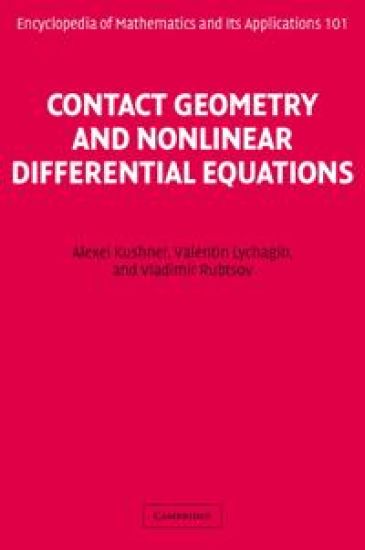
Contact Geometry and Nonlinear Differential Equations

Contact Geometry and Nonlinear Differential Equations

Alexei Kushner; Valentin Lychagin; Vladimir Rubtsov

Cambridge University Press
2006
sidottu
With the growing interest in the use of symmetry methods in applied mathematics, this book presents a comprehensive overview of the differential geometric view of the subject. The authors begin with a background chapter on calculus on manifolds, and then proceed to more advanced topics and applications, especially concerning singularities of the Monge-Ampere equations that describe many phenomena in geophysical fluid dynamics, for example. The authors describe many application areas and include computer code for implementing some of the techniques they describe. The book is richly illustrated.
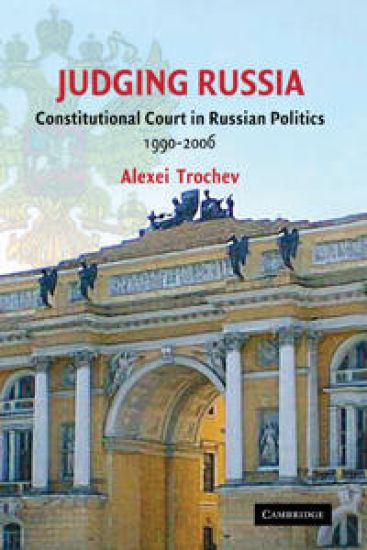
Judging Russia

Judging Russia

Alexei Trochev

Cambridge University Press
2008
sidottu
This is a study of the actual role that the Russian Constitutional Court played in protecting fundamental rights and resolving legislative-executive struggles and federalism disputes in both Yeltsin's and Putin's Russia. Trochev argues that judicial empowerment is a non-linear process with unintended consequences and that courts that depend on their reputation flourish only if an effective and capable state is there to support them. This is because judges can rely only on the authoritativeness of their judgments, unlike politicians and bureaucrats, who have the material resources necessary to respond to judicial decisions. Drawing upon systematic analysis of all decisions of the Russian Court (published and unpublished) and previously unavailable materials on their (non-)implementation, and resting on a combination of the approaches from comparative politics, law, and public administration, this book shows how and why judges attempted to reform Russia's governance and fought to ensure compliance with their judgments.
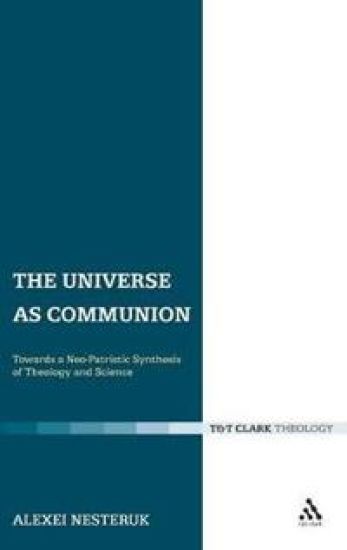
The Universe as Communion

The Universe as Communion

Alexei Nesteruk

T. T.Clark Ltd
2008
sidottu
In this book a new and distinctive approach to the science-religion debate emerges from a synthesis of the Eastern Orthodox Christian tradition with phenomenological thought. Developing ideas of Greek Patristics the author treats faith, with its sense of the Divine presence, and knowledge of the universe, as two modes of communion which constitute the human condition. The modern opposition between science and theology (which is historically paralleled with the Church's split between East and West, and monasticism and Christianity in the world), is treated as the split between two intentionalities of the overall human subjectivity. The human person, as a centre of their reconciliation, becomes the major theme of the dialogue between science and theology. It is argued that the reconciliation of science and theology is not simply an academic exercise; it requires an existential change, a change of mind (metanoia), which cannot be effected without ecclesial involvement. Then the person who effectuates the mediation between science and theology is raised to the level of "cosmic priesthood" while the mediation acquires the features of a "cosmic Eucharist" in which all divisions and tensions in creation and humanity are removed. It is through this existential change accompanied by phenomenological analysis that scientific theories can be subjected to a certain "vision" through which the hidden ultimate goal (telos) of scientific research (as the explication of the human condition) shows its kinship to the saving telos advocated by Christian faith. The opposition between theology and science is thus being para-eucharistically overcome.
The Universe as Communion

The Universe as Communion

Alexei Nesteruk

T. T.Clark Ltd
2011
nidottu
In this book a new and distinctive approach to the science-religion debate emerges from a synthesis of the Eastern Orthodox Christian tradition with phenomenological thought. Developing ideas of Greek Patristics the author treats faith, with its sense of the Divine presence, and knowledge of the universe, as two modes of communion which constitute the human condition. The modern opposition between science and theology (which is historically paralleled with the Church's split between East and West, and monasticism and Christianity in the world), is treated as the split between two intentionalities of the overall human subjectivity. The human person, as a centre of their reconciliation, becomes the major theme of the dialogue between science and theology. It is argued that the reconciliation of science and theology is not simply an academic exercise; it requires an existential change, a change of mind (metanoia), which cannot be effected without ecclesial involvement. Then the person who effectuates the mediation between science and theology is raised to the level of "cosmic priesthood" while the mediation acquires the features of a "cosmic Eucharist" in which all divisions and tensions in creation and humanity are removed. It is through this existential change accompanied by phenomenological analysis that scientific theories can be subjected to a certain "vision" through which the hidden ultimate goal (telos) of scientific research (as the explication of the human condition) shows its kinship to the saving telos advocated by Christian faith. The opposition between theology and science is thus being para-eucharistically overcome.
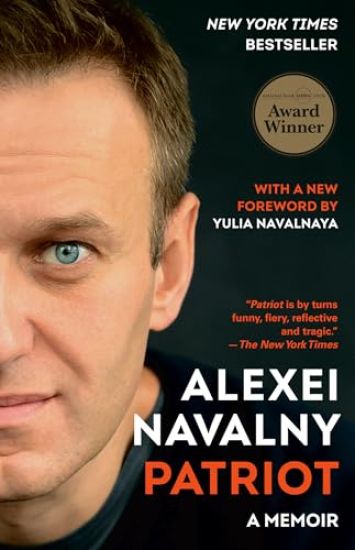
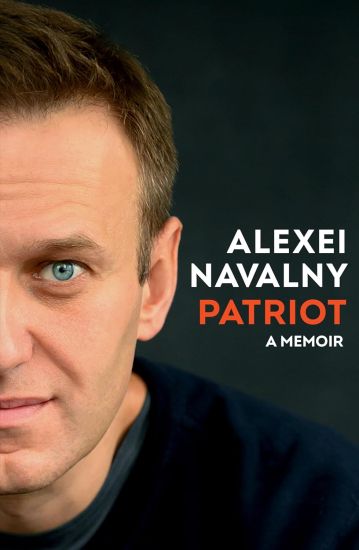
Patriot: A Memoir

Patriot: A Memoir

Alexei Navalny

VINTAGE
2026
nidottu
NEW YORK TIMES BESTSELLER - A NATIONAL BOOK CRITICS CIRCLE AWARD WINNER - BEST BOOK OF THE YEAR: THE NEW YORKER, THE ATLANTIC, NPR - The powerful and moving memoir of a fearless political opposition leader who paid the ultimate price for his beliefs. "Patriot is by turns funny, fiery, reflective and tragic, laced with Navalny's trademark wry humor and idealism....a gutting personal account from a husband and father facing the reality that he will never be with his family again."--The New York Times "Honest"--The Washington Post - "Shocking"--The Atlantic - "Uplifting." --Vanity Fair "A testament to resilience" --Associated Press - "Will be seen as a historic text."--The Economist Alexei Navalny began writing Patriot shortly after his near-fatal poisoning in 2020. It is the full story of his life: his youth, his call to activism, his marriage and family, his commitment to challenging a world super-power determined to silence him, and his total conviction that change cannot be resisted--and will come. In vivid, page-turning detail, including never-before-seen correspondence from prison, Navalny recounts, among other things, his political career, the many attempts on his life, and the lives of the people closest to him, and the relentless campaign he and his team waged against an increasingly dictatorial regime. Written with the passion, wit, candor, and bravery for which he was justly acclaimed, Patriot is Navalny's final letter to the world: a moving account of his last years spent in the most brutal prison on earth; a reminder of why the principles of individual freedom matter so deeply; and a rousing call to continue the work for which he sacrificed his life. "This book is a testament not only to Alexei's life, but to his unwavering commitment to the fight against dictatorship--a fight he gave everything for, including his life. Through its pages, readers will come to know the man I loved deeply--a man of profound integrity and unyielding courage. Sharing his story will not only honor his memory but also inspire others to stand up for what is right and to never lose sight of the values that truly matter." --Yulia Navalnaya
Patriot: A Memoir

Patriot: A Memoir

Alexei Navalny

Knopf Publishing Group
2024
sidottu
NEW YORK TIMES BESTSELLER - A NATIONAL BOOK CRITICS CIRCLE AWARD WINNER - BEST BOOK OF THE YEAR: THE NEW YORKER, THE ATLANTIC, NPR - The powerful and moving memoir of a fearless political opposition leader who paid the ultimate price for his beliefs. "Patriot is by turns funny, fiery, reflective and tragic, laced with Navalny's trademark wry humor and idealism....a gutting personal account from a husband and father facing the reality that he will never be with his family again."--The New York Times"Honest"--The Washington Post - "Shocking"--The Atlantic - "Uplifting." --Vanity Fair"A testament to resilience" --Associated Press - "Will be seen as a historic text."--The Economist Alexei Navalny began writing Patriot shortly after his near-fatal poisoning in 2020. It is the full story of his life: his youth, his call to activism, his marriage and family, his commitment to challenging a world super-power determined to silence him, and his total conviction that change cannot be resisted--and will come. In vivid, page-turning detail, including never-before-seen correspondence from prison, Navalny recounts, among other things, his political career, the many attempts on his life, and the lives of the people closest to him, and the relentless campaign he and his team waged against an increasingly dictatorial regime. Written with the passion, wit, candor, and bravery for which he was justly acclaimed, Patriot is Navalny's final letter to the world: a moving account of his last years spent in the most brutal prison on earth; a reminder of why the principles of individual freedom matter so deeply; and a rousing call to continue the work for which he sacrificed his life. "This book is a testament not only to Alexei's life, but to his unwavering commitment to the fight against dictatorship--a fight he gave everything for, including his life. Through its pages, readers will come to know the man I loved deeply--a man of profound integrity and unyielding courage. Sharing his story will not only honor his memory but also inspire others to stand up for what is right and to never lose sight of the values that truly matter." --Yulia Navalnaya
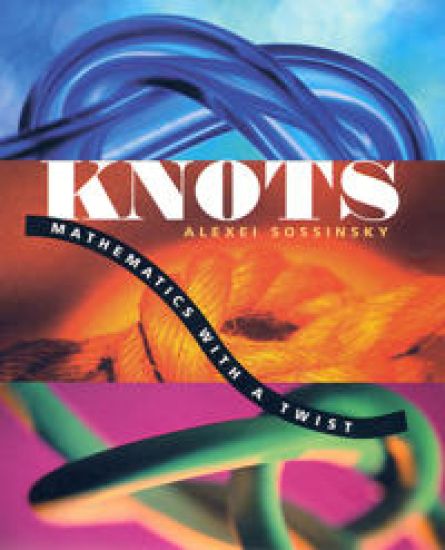
Knots

Knots

Alexei Sossinsky

Harvard University Press
2004
nidottu
Ornaments and icons, symbols of complexity or evil, aesthetically appealing and endlessly useful in everyday ways, knots are also the object of mathematical theory, used to unravel ideas about the topological nature of space. In recent years knot theory has been brought to bear on the study of equations describing weather systems, mathematical models used in physics, and even, with the realization that DNA sometimes is knotted, molecular biology.This book, written by a mathematician known for his own work on knot theory, is a clear, concise, and engaging introduction to this complicated subject. A guide to the basic ideas and applications of knot theory, Knots takes us from Lord Kelvin’s early—and mistaken—idea of using the knot to model the atom, almost a century and a half ago, to the central problem confronting knot theorists today: distinguishing among various knots, classifying them, and finding a straightforward and general way of determining whether two knots—treated as mathematical objects—are equal.Communicating the excitement of recent ferment in the field, as well as the joys and frustrations of his own work, Alexei Sossinsky reveals how analogy, speculation, coincidence, mistakes, hard work, aesthetics, and intuition figure far more than plain logic or magical inspiration in the process of discovery. His spirited, timely, and lavishly illustrated work shows us the pleasure of mathematics for its own sake as well as the surprising usefulness of its connections to real-world problems in the sciences. It will instruct and delight the expert, the amateur, and the curious alike.
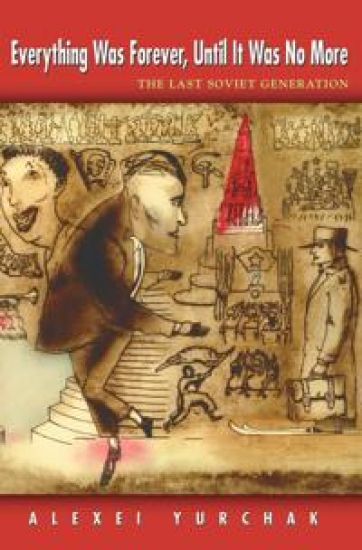
Everything Was Forever, Until It Was No More

Everything Was Forever, Until It Was No More

Alexei Yurchak

Princeton University Press
2005
pokkari
Soviet socialism was based on paradoxes that were revealed by the peculiar experience of its collapse. To the people who lived in that system the collapse seemed both completely unexpected and completely unsurprising. At the moment of collapse it suddenly became obvious that Soviet life had always seemed simultaneously eternal and stagnating, vigorous and ailing, bleak and full of promise. Although these characteristics may appear mutually exclusive, in fact they were mutually constitutive. This book explores the paradoxes of Soviet life during the period of "late socialism" (1960s-1980s) through the eyes of the last Soviet generation. Focusing on the major transformation of the 1950s at the level of discourse, ideology, language, and ritual, Alexei Yurchak traces the emergence of multiple unanticipated meanings, communities, relations, ideals, and pursuits that this transformation subsequently enabled. His historical, anthropological, and linguistic analysis draws on rich ethnographic material from Late Socialism and the post-Soviet period. The model of Soviet socialism that emerges provides an alternative to binary accounts that describe that system as a dichotomy of official culture and unofficial culture, the state and the people, public self and private self, truth and lie--and ignore the crucial fact that, for many Soviet citizens, the fundamental values, ideals, and realities of socialism were genuinely important, although they routinely transgressed and reinterpreted the norms and rules of the socialist state.
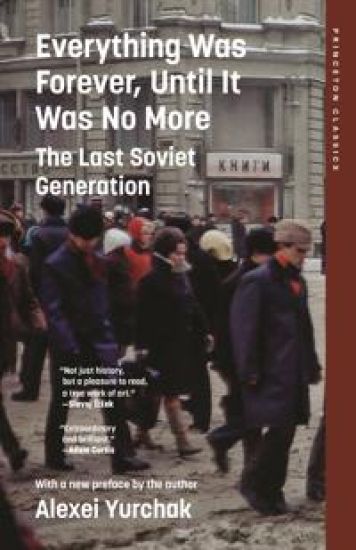
Everything Was Forever, Until It Was No More

Everything Was Forever, Until It Was No More

Alexei Yurchak

PRINCETON UNIVERSITY PRESS
2026
pokkari
“[An] extraordinary book.”—Brian Eno • “One of the best books about the U.S.S.R. in its late stage.”—Alexei Navalny, from Patriot: A Memoir • “Not just history, but a pleasure to read, a true work of art.”—Slavoj Žižek • “Extraordinary and brilliant.”—Adam Curtis, director of HyperNormalisation A fascinating exploration of “hypernormalization” in a political system that seemed powerful and eternal—even when it was on the verge of collapse Soviet socialism was based on paradoxes that were revealed by the peculiar experience of its collapse. To the people who lived in that system the collapse seemed both completely unexpected and completely unsurprising. At the moment of collapse it suddenly became obvious that Soviet life had always seemed simultaneously eternal and stagnating, vigorous and ailing, bleak and full of promise. Although these characteristics may appear mutually exclusive, in fact they were mutually constitutive. This book explores the paradoxes of Soviet life during the period of "late socialism" (1960s-1980s) through the eyes of the last Soviet generation. Focusing on the major transformation of the 1950s at the level of discourse, ideology, language, and ritual, Alexei Yurchak traces the emergence of multiple unanticipated meanings, communities, relations, ideals, and pursuits that this transformation subsequently enabled. His historical, anthropological, and linguistic analysis draws on rich ethnographic material from Late Socialism and the post-Soviet period. The model of Soviet socialism that emerges provides an alternative to binary accounts that describe that system as a dichotomy of official culture and unofficial culture, the state and the people, public self and private self, truth and lie—and ignore the crucial fact that, for many Soviet citizens, the fundamental values, ideals, and realities of socialism were genuinely important, although they routinely transgressed and reinterpreted the norms and rules of the socialist state.
Chumped: Beating in Progress

Chumped: Beating in Progress

Alexei Auld

Temrose Publishing
2014
nidottu
WARNING: Before you go any further, please don't read BEATINGS IN PROGRESS unless you've finished THE JERKED LAW CLERK. There are spoilers and I don't want to ruin the exciting conclusion of the first book for you.Percy Winkler's 24/7 law firm job requires him to pass the bar exam without any time to study. To make time, he accepts his friend's cockamamie scheme: fake an injury which requires a face mask and let a masked body double take his place at work. If he fails to trick boss Dick Bacon, Percy will lose his job and will receive a lifetime ban from practicing law. Unfortunately for Percy, the body double is a bruising goon who seeks and wreaks havoc on his law firm. Mind the carnage, BEATING IN PROGRESS. This is the second part of the CHUMPED trilogy.
Chumped: Cease to Persist

Chumped: Cease to Persist

Alexei Auld

Temrose Publishing
2014
nidottu
WARNING: Before you go any further, please don't read CEASE TO PERSIST unless you've finished THE JERKED LAW CLERK and BEATINGS IN PROGRESS. There are spoilers and I don't want to ruin the exciting conclusions of the previous books for you.Exasperated by Percy Winkler's inability to pass the bar exam, best friend Rufus Wang enlists him in a crash study course run by criminals. Percy is kidnapped and partnered with other dimwits who are forced to learn the law by breaking it. This is Percy's last chance to realize his dream for legal gloriousness. Should he fail this final time, he must CEASE TO PERSIST.This is the third part of the CHUMPED trilogy.
Chumped Collection

Chumped Collection

Alexei Auld

Temrose Publishing
2014
nidottu
"Every hour, you get a bag. In the bag, you find a job you gotta do and the tools you need to do it. You don't do the job? You die. You snitch? You die. You get locked up? You die. Capisce?"What did Percy Winkler do to deserve this? He graduated from law school. Percy wants to be a lawyer. He just needs to pass the bar exam. Neither his bullying boss nor his extortionist mama will give him the time and tools he needs to pass. As a result, he fails the exam every time he takes it. Exasperated by Percy's repeated failures, his best friend secretly enlists Percy in a crash study course run by criminals. Percy is kidnapped and partnered with other dimwits who are forced to learn the law by breaking it. Forget about Percy's dream for legal gloriousness. If he fails this time, he will cease to persist. The Chumped Collection includes all three volumes of the Chumped series: The Jerked Law Clerk, Beatings in Progress, and Cease to Persist.
Luscious Melchus 3: Picture Show Wendigo

Luscious Melchus 3: Picture Show Wendigo

Alexei Auld

Temrose Publishing
2015
nidottu
WARNING: Before you go any further, please finish the first two LUSCIOUS MELCHUS books and TONTO CANTO POCAHONTAS before you proceed with this one. There are spoilers and I don't want to ruin the exciting conclusions of the earlier books for you.Melchus hasn't been able to enjoy life since his god-like powers of lusciousness emerged. He unwittingly ends up in redface as a Hollywood Indian in a movie production so hostile to Native American actors, even Adam Sandler would walk off in protest. Although it's not apropos, how else could Melchus romance a Wendigo from a picture show?Have at thee, mortals. The adventures of LUSCIOUS MELCHUS continue