Kirjojen hintavertailu. Mukana 11 632 978 kirjaa ja 12 kauppaa.

Kirjahaku

Etsi kirjoja tekijän nimen, kirjan nimen tai ISBN:n perusteella.

1000 tulosta hakusanalla Augur

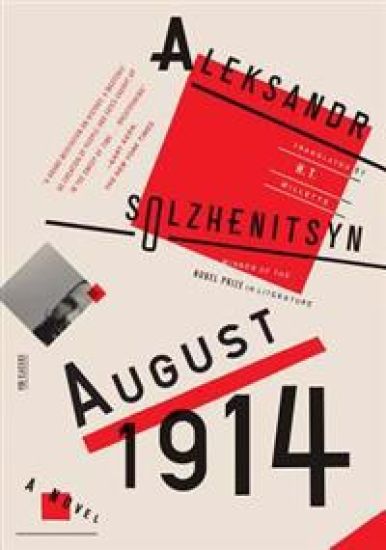
August 1914: A Novel: The Red Wheel I

August 1914: A Novel: The Red Wheel I

Aleksandr Solzhenitsyn

Farrar, Straus and Giroux
2014
nidottu
The Russian Nobelist's major work, back in print for the centenary of World War I and the Russian Revolution In his monumental narrative of the outbreak of the First World War and the ill-fated Russian offensive into East Prussia, Aleksandr Solzhenitsyn has written "a dramatically new interpretation of Russian history" (Nina Krushcheva, The Nation). The assassination of the tsarist prime minister Pyotr Stolypin, a crucial event in the years leading up to the Revolution of 1917, is reconstructed from the alienating viewpoints of historical witnesses. The sole voice of reason among the advisers to Tsar Nikolai II, Stolypin died at the hands of the anarchist Mordko Bogrov, and with him Russia's last hope for reform perished. August 1914 is the first volume of Solzhenitsyn's epic, The Red Wheel; the second is November 1916. Each volume concentrates on a critical moment or "knot" in the history of the Russian Revolution.

August Blue

August Blue

Deborah Levy

Farrar, Straus and Giroux
2023
sidottu
Named a Best Book of the Year by TIME, Vulture, The Guardian, BBC, The Week, and Publisher's Weekly A new novel from the Booker Prize finalist Deborah Levy, the celebrated author of The Man Who Saw Everything and The Cost of Living. At the height of her career, the piano virtuoso Elsa M. Anderson--former child prodigy, now in her thirties--walks off the stage in Vienna, midperformance. Now she is in Athens, watching an uncannily familiar woman purchase a pair of mechanical dancing horses at a flea market. Elsa wants the horses too, but there are no more for sale. She drifts to the ferry port, on the run from her talent and her history. So begins her journey across Europe, shadowed by the elusive woman who seems to be her double. A dazzling portrait of melancholy and metamorphosis, Deborah Levy's August Blue uncovers the ways in which we attempt to revise our oldest stories and make ourselves anew.
August and Then Some
In the heat of August, Jake Terri Savage ( JT ), his little sister Danielle, and his bone-headed best friend, Nokey (nicknamed after gnocchi ), try to steal JT s father s beloved 1965 Shelby Cobra. Their reasons are noble; the consequences, devastating. JT s abusive dad s idea of a twelfth birthday gift is getting his son involved in a barroom brawl. Nokey s dad thinks he has potatoes for brains. Both sons live out their fathers stunted visions in a way that brings down a terrible judgment on them all leaving JT hauling rocks for punishment while he staves off panic attacks and nightmares about his sister and her terrible half-known secret. A Dominican teenage girl with little hope for her own future gives JT a second chance to save someone, including himself. Throughout, David Prete s vivid sense of atmosphere, tight plotting, and crackling dialogue give the dysfunctional family story a new lease on life."
August

August

Gerard Woodward

WW Norton Co
2008
pokkari
Little did Aldous Jones know when he careened over his bicycle handlebars back in 1955, landing next to farmer Evans s field, that it would turn into the idyllic start to a series of camping holidays in that same field. With Gerard Woodward s deadpan wit and poignant evocation, August encapsulates the portrait of the Joneses and their growing family. Strangely enough, the rural site seems to change in conjunction with their city life, creating a parallel universe instead of a getaway. The Jones family also is featured in I ll Go to Bed at Noon and A Curious Earth."
Auguste Comte

Auguste Comte

Mike Gane

Routledge
2006
nidottu
Auguste Comte is widely acknowledged as the founder of the science of sociology and the 'Religion of Humanity'. In this fascinating study, the first major reassessment of Comte’s sociology for many years, Mike Gane draws on recent scholarship and presents a new reading of this remarkable figure. Comte’s contributions to the history and philosophy of science have decisively influenced positive methodologies. He coined the term ‘sociology’ and gave it its first content, and he is renowned for having introduced the sociology of gender and emotion into sociology. What is less well known however, is that Comte contributed to ethics, and indeed coined the word ‘altruism’. In this important work Gane examines Comte's sociological vision and shows that, because he thought sociology could and should be reflexive, encyclopaedic and utopian, he considered topics such as fetishism, polytheism, fate, love, and the relations between sociology, science, theology and culture.This fascinating account of the birth of sociology is an unprecedented introductory text on Comte. Gane’s work is an essential read for all sociologists and students of the discipline.
Auguste Comte

Auguste Comte

Mike Gane

Routledge
2006
sidottu
Auguste Comte is widely acknowledged as the founder of the science of sociology and the 'Religion of Humanity'. In this fascinating study, the first major reassessment of Comte’s sociology for many years, Mike Gane draws on recent scholarship and presents a new reading of this remarkable figure. Comte’s contributions to the history and philosophy of science have decisively influenced positive methodologies. He coined the term ‘sociology’ and gave it its first content, and he is renowned for having introduced the sociology of gender and emotion into sociology. What is less well known however, is that Comte contributed to ethics, and indeed coined the word ‘altruism’. In this important work Gane examines Comte's sociological vision and shows that, because he thought sociology could and should be reflexive, encyclopaedic and utopian, he considered topics such as fetishism, polytheism, fate, love, and the relations between sociology, science, theology and culture.This fascinating account of the birth of sociology is an unprecedented introductory text on Comte. Gane’s work is an essential read for all sociologists and students of the discipline.
August Strindberg

August Strindberg

Eszter Szalczer

Routledge
2010
sidottu
Dramatist, theatre practitioner, novelist, and painter, August Strindberg’s diverse dramatic output embodied the modernist sensibility. He was above all one of the most radical innovators of Western theatre.This book provides an insightful assessment of Strindberg’s vital contribution to the dramatic arts, while placing his creative process and experimental approach within a wider cultural context. Eszter Szalczer explores Strindberg’s re-definition of drama as a fluid, constantly evolving form that profoundly influenced playwriting and theatrical production from the German Expressionists to the Theatre of the Absurd. Key productions of Strindberg’s plays are analysed, examining his theatre as a living voice that continues to challenge audiences, critics, and even the most innovative directors.August Strindberg provides an essential and accessible guide to the playwright’s work and illustrates the influence of his drama on our understanding of contemporary theatre.
August Strindberg

August Strindberg

Eszter Szalczer

Routledge
2010
nidottu
Dramatist, theatre practitioner, novelist, and painter, August Strindberg’s diverse dramatic output embodied the modernist sensibility. He was above all one of the most radical innovators of Western theatre.This book provides an insightful assessment of Strindberg’s vital contribution to the dramatic arts, while placing his creative process and experimental approach within a wider cultural context. Eszter Szalczer explores Strindberg’s re-definition of drama as a fluid, constantly evolving form that profoundly influenced playwriting and theatrical production from the German Expressionists to the Theatre of the Absurd. Key productions of Strindberg’s plays are analysed, examining his theatre as a living voice that continues to challenge audiences, critics, and even the most innovative directors.August Strindberg provides an essential and accessible guide to the playwright’s work and illustrates the influence of his drama on our understanding of contemporary theatre.
Augustan Egypt

Augustan Egypt

Livia Capponi

Routledge
2014
nidottu
With updated documents including papyri, inscriptions and ostraka, this book casts fresh and original light on the administration and economy issues faced with the transition of Egypt from an allied kingdom of Rome to a province of the Roman Empire
Augustan Egypt

Augustan Egypt

Livia Capponi

Routledge
2005
sidottu
First published in 2005. With updated documents including papyri, inscriptions and ostraka, this book casts fresh and original light on the administration and economy issues faced with the transition of Egypt from an allied kingdom of Rome to a province of the Roman Empire.
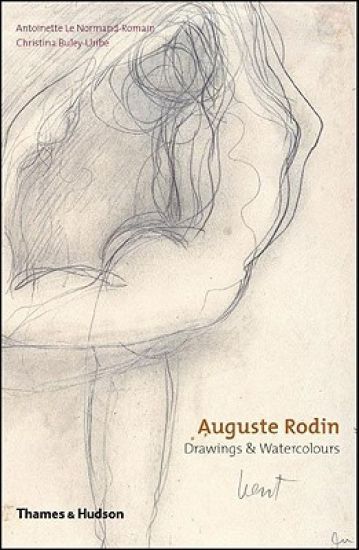
Auguste Rodin

Auguste Rodin

Le Normand-Romain Antoinette; Buley-Uribe Christina

Thames Hudson Ltd
2006
sidottu
Auguste Rodin: Drawings & Watercolours reveals what has until now been a little-known aspect of the great sculptor’s work, presenting an extensive panorama of his graphic output. It reproduces 350 of the most beautiful pieces from the collection at the Musée Rodin and the most important foreign collections, including a considerable number of never-beforereproduced works, to give as complete a picture as possible of a rich, often sumptous graphic oeuvre.
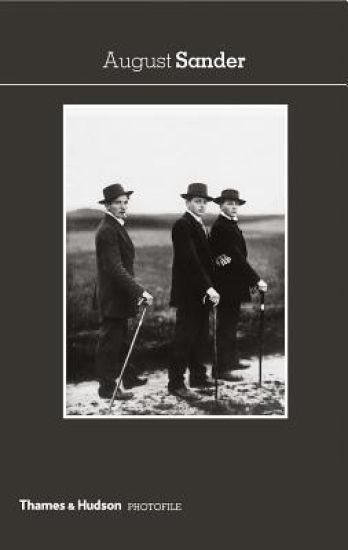
August Sander

August Sander

Thames Hudson Ltd
2019
nidottu
August Sander (1876–1964) was a documentary photographer whose greatest project lasted his entire working life. His series of portrait studies of the German people spanned three eras – the German Empire, the Weimar Republic and Nazi Germany – and every social class, combining to form a fascinating social mirror of the country over a tumultuous period in its history. Working with calm determination, Sander cast the same lucid eye on bankers and boxers, soldiers and circus performers, creating strikingly honest images that fulfil his sole ambition: to tell the truth about humanity.
Auguste Comte and the Religion of Humanity

Auguste Comte and the Religion of Humanity

Andrew Wernick

Cambridge University Press
2005
pokkari
This 2001 book offers an exciting reinterpretation of Auguste Comte, the founder of French sociology. Following the development of his philosophy of positivism, Comte later focused on the importance of the emotions in his philosophy resulting in the creation of a new religious system, the Religion of Humanity. Andrew Wernick provides the first in-depth critique of Comte's concept of religion and its place in his thinking on politics, sociology and philosophy of science. He places Comte's ideas in the context of post-1789 French political and intellectual history, and of modern philosophy, especially postmodernism. Wernick relates Comte to Marx and Nietzsche as seminal figures of modernity and examines key features of modern and postmodern French social theory, tracing the inherent flaws and disintegration of Comte's system. Wernick offers original and fascinating insights in this rich study which will attract a wide audience from sociologists and philosophers to cultural theorists and historians.
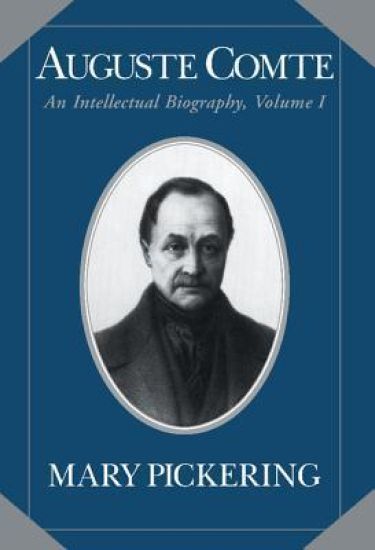
Auguste Comte: Volume 1

Auguste Comte: Volume 1

Mary Pickering

Cambridge University Press
2006
pokkari
This book constitutes the first volume of a two-volume intellectual biography of Auguste Comte, the founder of modern sociology and a philosophical movement called positivism. Volume One offers a reinterpretation of Comte's 'first career' (1798–1842), when he completed the scientific foundation of his philosophy. It describes the interplay between Comte's ideas and the historical context of post-revolutionary France, his struggles with poverty and mental illness, and his volatile relationships with friends, family and colleagues, including such famous contemporaries as Saint-Simon, the Saint-Simonians, Guizot and John Stuart Mill. Pickering shows that the man who called for a new social philosophy based on the sciences was not only ill at ease in the most basic human relationships, but also profoundly questioned the ability of the purely scientific spirit to regenerate the political and social world.
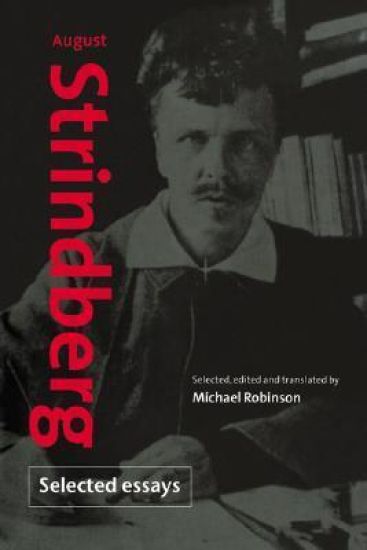
August Strindberg: Selected Essays

August Strindberg: Selected Essays

August Strindberg

Cambridge University Press
2006
pokkari
This is a fully edited translation of a series of essays by the great Swedish dramatist August Strindberg. The essays, edited and translated by Michael Robinson, have been selected for the light they shed, both directly and indirectly, on Strindberg's contribution to the European theatre, firstly in such masterpieces of psychological realism as The Father and Miss Julie, and subsequently in those works, including A Dream Play and The Ghost Sonata, with which he largely established a basis for theatrical modernism. Together with the accompanying notes and commentary, these essays on psychology, history, painting, natural history and alchemy as well as the theatre, help to clarify the multifaceted nature of Strindberg's project. Idiosyncratic and lively, they offer crucial insights into the intellectual history of the late nineteenth century, while their personal nature draws the reader into an intimate relationship with the writer and his wide range of interests.
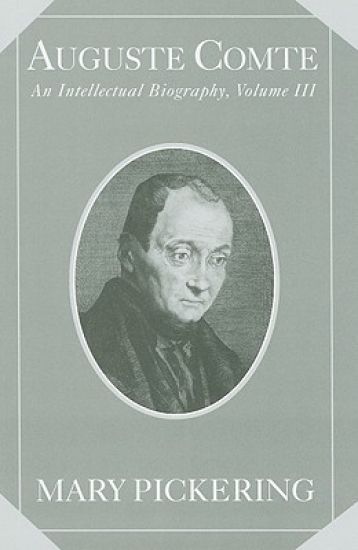
Auguste Comte: Volume 3

Auguste Comte: Volume 3

Mary Pickering

Cambridge University Press
2009
sidottu
This volume continues to explore the life and works of Auguste Comte during his so-called second career. It covers the period from the coup d'état of Louis Napoleon in late 1851 to Comte's death in 1857. During these early years of the Second Empire, Comte became increasingly conservative and anxious to control his disciples. This study offers the first study of the tensions within his movement. Focusing on his second masterpiece, the Système de politique positive, and other important books, such as the Synthèse subjective, Mary Pickering not only sheds light on Comte's intellectual development but also traces the dissemination of positivism and the Religion of Humanity throughout many parts of the world.
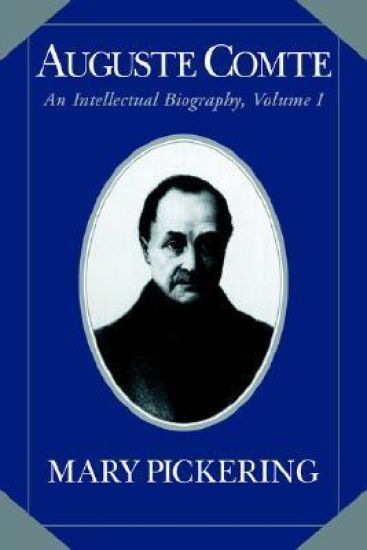
Auguste Comte: Volume 1

Auguste Comte: Volume 1

Mary Pickering

Cambridge University Press
1993
sidottu
This book constitutes the first volume of a two-volume intellectual biography of Auguste Comte, the founder of modern sociology and a philosophical movement called positivism. Volume One offers a reinterpretation of Comte’s ‘first career’, (1798–1842), when he completed the scientific foundation of his philosophy. It describes the interplay between Comte’s ideas and the historical context of post revolutionary France, his struggles with poverty and mental illness, and his volatile relationships with friends, family, and colleagues, including such famous contemporaries as Saint-Simon, the Saint-Simonians, Guizot, and John Stuart Mill. Pickering shows that the man who called for a new social philosophy based on the sciences was not only ill at ease in the most basic human relationships, but also profoundly questioned the ability of the purely scientific spirit to regenerate the political and social world.
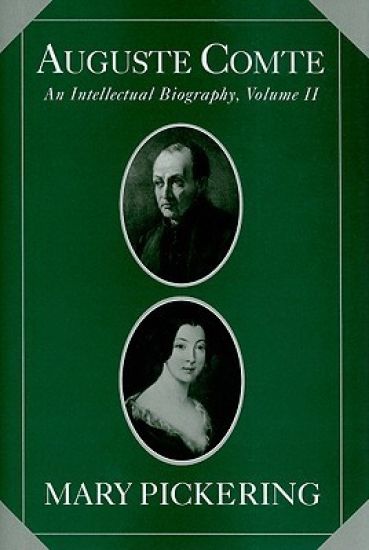
Auguste Comte: Volume 2

Auguste Comte: Volume 2

Mary Pickering

Cambridge University Press
2009
sidottu
This volume begins to explore the life and works of Auguste Comte during his so-called second career, the controversial period that began in 1842 and lasted until his death. This volume covers the years from 1842 to 1852, when Comte transformed his positive philosophy into a political and religious movement. It represents the first in-depth study of that movement. Focusing on key books, such as the Discours sur l'ensemble du positivisme, Mary Pickering connects Comte's intellectual development to the tumultuous historical context and to episodes in his personal life, especially his famous relationship with Clotilde de Vaux. The book examines for the first time why workers, doctors, women, and famous writers, such as John Stuart Mill, George Henry Lewes, and Emile Littré, were drawn to his thought.
August Strindberg: Selected Essays

August Strindberg: Selected Essays

August Strindberg

Cambridge University Press
1996
sidottu
This is the first fully-edited translation of a series of essays by the great Swedish dramatist August Strindberg. The essays, edited and translated by Michael Robinson, have been selected for the light they shed, both directly and indirectly, on Strindberg’s contribution to the European theatre, firstly in such masterpieces of psychological realism as The Father and Miss Julie, and subsequently in those works, including A Dream Play and The Ghost Sonata with which he largely established a basis for theatrical modernism. Together with the accompanying notes and commentary, these essays on psychology, history, painting, natural history and alchemy as well as the theatre, help to clarify the multifaceted nature of Strindberg’s project. Idiosyncratic and lively, they offer crucial insights into the intellectual history of the late nineteenth century.