Kirjojen hintavertailu. Mukana 12 465 084 kirjaa ja 12 kauppaa.

Kirjahaku

Etsi kirjoja tekijän nimen, kirjan nimen tai ISBN:n perusteella.

1000 tulosta hakusanalla Augustin

Augustine and the Disciplines

Augustine and the Disciplines

Oxford University Press
2005
sidottu
Augustine and the Disciplines takes its cue from Augustine's theory of the liberal arts to explore the larger question of how the Bible became the focus of medieval culture in the West. Augustine himself became increasingly aware that an ambivalent attitude towards knowledge and learning was inherent in Christianity. By facing the intellectual challenge posed by this tension he arrived at a new theory of how to interpret the Bible correctly. The topics investigated here include: Augustine's changing relationship with the 'disciplines', as he moved from an attempt at their Christianization (in the philosophical dialogues of Cassiciacum) to a radical reshaping of them within a Christian world-view (in the De Doctrina Christiana and Confessiones); the factors that prompted and facilitated his change of perspective; and the ways in which Augustine's evolving theory reflected contemporary trends in Christian pedagogy.
Augustine's Commentary on Galatians

Augustine's Commentary on Galatians

Eric Plumer

Oxford University Press
2006
nidottu
Now available in English for the first time, Augustine's Commentary on Galatians is his only complete, formal commentary on any book of the Bible and offers unique insights into his understanding of Paul and of his own task as a biblical interpreter. Yet it is one of his least known works today - and this despite its importance in the past for such major figures as Aquinas, Luther, Erasmus, and Newman. The present volume seeks to remedy this situation by providing not only an English translation with facing Latin text, but also a comprehensive introduction and copious notes. Since Galatians happens to be the only biblical book commented upon by all the ancient Latin commentators - including Jerome, Pelagius, Ambrosiaster, and Marius Victorinus, as well as Augustine - it provides a basis for comparing them and for identifying Augustine's special concerns and emphases. Augustine's Commentary also has crucial links to other works he wrote at the time, especially his monastic rule and De Doctrina Christiana. Augustine's emphasis on Galatians as a pastoral letter designed to preserve and strengthen Christian unity links the commentary to his monastic rule, while his method and sources link it to, and indeed pave the way for, the theory of biblical interpretation set forth in the De Doctrina Christiana.
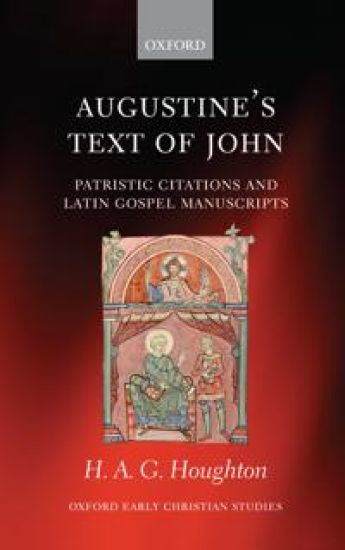
Augustine's Text of John

Augustine's Text of John

H. A. G. Houghton

Oxford University Press
2008
sidottu
What sort of Bible did Augustine have? How did he quote from it - and was he accurate? Do Augustine's biblical citations transmit readings not found in any surviving manuscripts? This book is part of a major project on the Old Latin versions of the Gospel according to John, and uses Augustine as a test-case to examine the importance of the evidence provided by the Church Fathers for the text of the Gospels. The early history of the Latin Bible is reconstructed from Augustine's comments in his treatise De doctrina christiana (On Christian teaching). Details are assembled from sermons, letters, and other writings to show how Augustine and his contemporaries used the Bible in the liturgy of the Church, public debates, and in composing their own works. Augustine's own methods of citing the Bible are analysed, and features are identified which are characteristic of citations produced from memory rather than read from a gospel codex. The second part of the book is a chronological survey of the biblical text in Augustine's works, showing how he switched from using the older versions of the Gospel to the revised text of Jerome, which later became known as the Vulgate. Finally, a verse by verse commentary is provided on all the significant readings in Augustine's text of John, assessing their significance for the history of the Latin Bible, and in some cases the Greek tradition as well. Details are also given of Augustine's exegesis of particular verses of the Gospel, making this an indispensable handbook for biblical scholars and church historians alike.
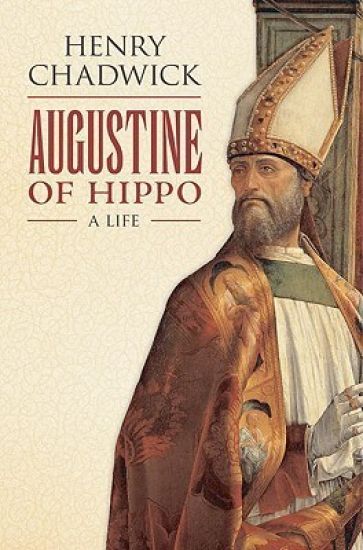
Augustine of Hippo

Augustine of Hippo

Henry Chadwick

Oxford University Press
2009
sidottu
The life and works of Augustine of Hippo (354-430) have shaped the development of the Christian Church, sparking controversy and influencing the ideas of theologians through subsequent centuries. His words are still frequently quoted in devotions throughout the global Church today. His key themes retain a striking contemporary relevance - what is the place of the Church in the world? What is the relation between nature and grace? Augustine's intellectual development is recounted with clarity and warmth in this newly rediscovered biography of Augustine, as interpreted by the acclaimed church historian, the late Professor Henry Chadwick. Augustine's intellectual journey from schoolboy and student to Bishop and champion of Western Christendom in a period of intense political upheaval, is narrated in Chadwick's characteristically rigorous yet sympathetic style. With a foreword reflecting on Professor Chadwick's distinctive approach to Augustine by Professor Peter Brown.
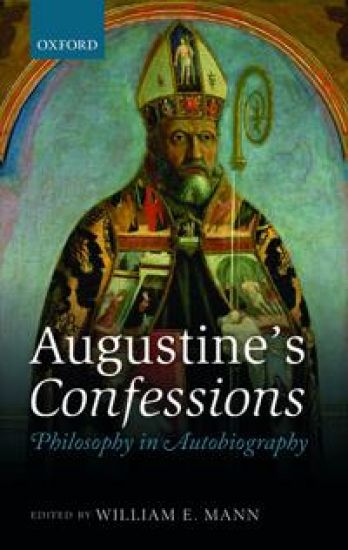
Augustine's Confessions

Augustine's Confessions

Oxford University Press
2014
sidottu
Augustine's Confessions is a masterpiece of world literature. Written by Augustine in his forties, at the height of his philosophical and rhetorical skills, the Confessions is at once autobiographical, philosophical, theological, and psychological. The aim of the eight essays commissioned for the present volume is to provide an examination and discussion of some of the philosophical issues raised by Augustine. What constitutes the happy or blessed life and what is required to achieve it? The essays question the role that philosophical perplexity plays in the search for truth, and the mental discipline that is required for conducting the search; in addition to asking how Augustine depicts the acquisition of truth as a vision of God. Furthermore, they discuss the problems that arise in the attempt to understand minds, both our own and others, and ask about the interplay between what reason tells us is right and what we will to do. What are the impediments to an individual's moral progress, and how far are these impediments created by the temptations to indulge in such fictions as dramas and dreams? What is the nature of eternity, and how does eternity differ from time? How should scripture be interpreted, especially the account of creation of the material world in Genesis? Readers with a basic knowledge of Augustine may perceive him to be simply a powerful definer and defender of religious orthodoxy, a figure who ranks behind only Jesus and Paul in the development of a distinctively Christian world-view. For such readers the intellectual honesty and psychological candour of the Confessions should come as a pleasant surprise.
Augustine of Hippo

Augustine of Hippo

Henry Chadwick

Oxford University Press
2010
nidottu
The life and works of Augustine of Hippo (354-430) have shaped the development of the Christian Church, sparking controversy and influencing the ideas of theologians through subsequent centuries. His words are still frequently quoted in devotions throughout the global Church today. His key themes retain a striking contemporary relevance - what is the place of the Church in the world? What is the relation between nature and grace? Augustine's intellectual development is recounted with clarity and warmth in this newly rediscovered biography of Augustine, as interpreted by the acclaimed church historian, the late Professor Henry Chadwick. Augustine's intellectual journey from schoolboy and student to Bishop and champion of Western Christendom in a period of intense political upheaval, is narrated in Chadwick's characteristically rigorous yet sympathetic style. With a foreword by Peter Brown reflecting on Chadwick's distinctive approach to Augustine.
Augustine Confessions: Augustine Confessions

Augustine Confessions: Augustine Confessions

James J. O'Donnell

Oxford University Press
2012
nidottu
The Confessions of Augustine have long both demanded and eluded the sustained and serious attention to detail that a scholarly commentary can provide. The present work, which is in three volumes, seeks to supplement that lack. A revised Latin text of the Confessions in Volume I forms the basis for a detailed line-by-line commentary (Volumes II-III) designed to elucidate the many layers of meaning in the work. Placing the emphasis primarily on exegesis, Professor O'Donnell opens up new lines of interpretation, as well as giving an abundance of fresh detail to some more familiar themes. At the same time, he clears the way for further scholarly work by furnishing the materials for others to draw on and press the task of interpretation further. A particular feature of the commentary is its attention to the influences in the Confessions of other texts of the Greek and Latin traditions - biblical, ecclesiastical, philosophical, and literary; whilst the place of the Confessions in Augustine's own life and in the history of Christian literature is also illuminated with greater precision.
Augustine Confessions: Augustine Confessions

Augustine Confessions: Augustine Confessions

James J. O'Donnell

Oxford University Press
2012
nidottu
The Confessions of Augustine have long both demanded and eluded the sustained and serious attention to detail that a scholarly commentary can provide. The present work, which is in three volumes, seeks to supplement that lack. A revised Latin text of the Confessions in Volume I forms the basis for a detailed line-by-line commentary (Volumes II-III) designed to elucidate the many layers of meaning in the work. Placing the emphasis primarily on exegesis, Professor O'Donnell opens up new lines of interpretation, as well as giving an abundance of fresh detail to some more familiar themes. At the same time, he clears the way for further scholarly work by furnishing the materials for others to draw on and press the task of interpretation further. A particular feature of the commentary is its attention to the influences in the Confessions of other texts of the Greek and Latin traditions - biblical, ecclesiastical, philosophical, and literary; whilst the place of the Confessions in Augustine's own life and in the history of Christian literature is also illuminated with greater precision.
Augustine Confessions: Augustine Confessions

Augustine Confessions: Augustine Confessions

James J. O'Donnell

Oxford University Press
2012
nidottu
The Confessions of Augustine have long both demanded and eluded the sustained and serious attention to detail that a scholarly commentary can provide. The present work, which is in three volumes, seeks to supplement that lack. A revised Latin text of the Confessions in Volume I forms the basis for a detailed line-by-line commentary (Volumes II-III) designed to elucidate the many layers of meaning in the work. Placing the emphasis primarily on exegesis, Professor O'Donnell opens up new lines of interpretation, as well as giving an abundance of fresh detail to some more familiar themes. At the same time, he clears the way for further scholarly work by furnishing the materials for others to draw on and press the task of interpretation further. A particular feature of the commentary is its attention to the influences in the Confessions of other texts of the Greek and Latin traditions - biblical, ecclesiastical, philosophical, and literary; whilst the place of the Confessions in Augustine's own life and in the history of Christian literature is also illuminated with greater precision.
Augustine and Nicene Theology

Augustine and Nicene Theology

Michel René Barnes

JAMES CLARKE CO LTD
2024
nidottu
In this collection of essays, Michel René Barnes offers a new reading of the character and development of Latin Trinitarian theology in the fourth and fifth centuries. Although Augustine is the principal focus, he is treated here as an inheritor of an earlier Latin tradition. Antecedent theologians, most notably including Marius Victorinus, are given a revised interpretation, and Augustine himself is explored from multiple angles. At every turn, developments in Augustine's thought are shown to be a response to the anti-Nicene theologies of the period. Most significantly, this view decries the modern 'systematic' tendency to engage with Augustine only though a simplified version of late-nineteenth-century categories. This accusation invites the question of how far modern theology can actually engage with Patristic theology at all, but Barnes offers a way forward.
Augustine

Augustine

Robin Lane Fox

Penguin Books Ltd
2016
pokkari
A major new interpretation of how one of the great figures of Christian history came to write the greatest of all autobiographiesAugustine is the person from the ancient world about whom we know most. He is the author of an intimate masterpiece, the Confessions, which continues to delight its many admirers. In it he writes about his infancy and his schooling in the classics in late Roman North Africa, his remarkable mother, his sexual sins ('Give me chastity, but not yet,' he famously prayed), his time in an outlawed heretical sect, his worldly career and friendships and his gradual return to God. His account of his own eventual conversion is a classic study of anguish, hesitation and what he believes to be God's intervention. It has inspired philosophers, Christian thinkers and monastic followers, but it still leaves readers wondering why exactly Augustine chose to compose a work like none before it.Robin Lane Fox follows Augustine on a brilliantly described journey, combining the latest scholarship with recently found letters and sermons by Augustine himself to give a portrait of his subject which is subtly different from older biographies. Augustine's heretical years as a Manichaean, his relation to non-Christian philosophy, his mystical aspirations and the nature of his conversion are among the aspects of his life which stand out in a sharper light. For the first time Lane Fox compares him with two contemporaries, an older pagan and a younger Christian, each of whom also wrote about themselves and who illumine Augustine's life and writings by their different choices.More than a decade passed between Augustine's conversion and his beginning the Confessions. Lane Fox argues that the Confessions and their thinking were the results of a long gestation over these years, not a sudden change of perspective, but that they were then written as a single swift composition and that its final books are a coherent consummation of its scriptural meditation and personal biography. This exceptional study reminds us why we are so excited and so moved by Augustine's story.
Augustine and Postmodernism

Augustine and Postmodernism

Indiana University Press
2005
pokkari
At the heart of the current surge of interest in religion among contemporary Continental philosophers stands Augustine's Confessions. With Derrida's Circumfession constantly in the background, this volume takes up the provocative readings of Augustine by Heidegger, Lyotard, Arendt, and Ricoeur. Derrida himself presides over and comments on essays by major Continental philosophers and internationally recognized Augustine scholars. While studies on and about Augustine as a philosopher abound, none approach his work from such a uniquely postmodern point of view, showing both the continuing relevance of Augustine and the religious resonances within postmodernism. Posed at the intersection of philosophy, theology, and religious studies, this book will be of interest to scholars and students of Augustine as well as those interested in the invigorating discussion between philosophy, religion, and postmodernism. Contributors include Geoffrey Bennington, Philippe Capelle, John D. Caputo, Elizabeth A. Clark, Hent de Vries, Jacques Derrida, Jean Bethke Elshtain, Richard Kearney, Catherine Malabou, James O'Donnell, Michael J. Scanlon, and Mark Vessey. Indiana Series in the Philosophy of Religion—Merold Westphal, general editor
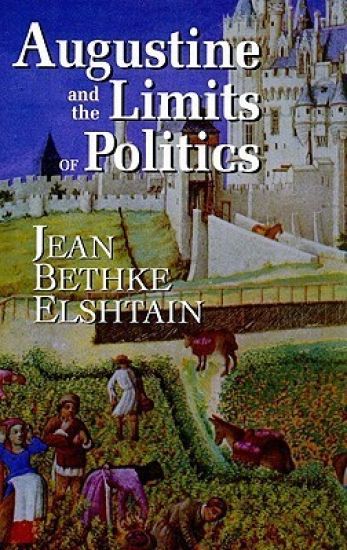
Augustine and the Limits of Politics

Augustine and the Limits of Politics

Elshtain Jean Bethke

UNIVERSITY OF NOTRE DAME PRESS
1996
sidottu
Now with a new foreword by Patrick J. Deneen. Jean Bethke Elshtain brings Augustine's thought into the contemporary political arena and presents an Augustine who created a complex moral map that offers space for loyalty, love, and care, as well as a chastened form of civic virtue. The result is a controversial book about one of the world's greatest and most complex thinkers whose thought continues to haunt all of Western political philosophy. What is our business "within this common mortal life?" Augustine asks and bids us to ask ourselves. What can Augustine possibly have to say about the conditions that characterize our contemporary society and appear to put democracy in crisis? Who is Augustine for us now and what do his words have to do with political theory? These are the underlying questions that animate Jean Bethke Elshtain's fascinating engagement with the thought and work of Augustine, the ancient thinker who gave no political theory per se and refused to offer up a positive utopia. In exploring the questions, Why Augustine, why now? Elshtain argues that Augustine's great works display a canny and scrupulous attunement to the here and now and the very real limits therein. She discusses other aspects of Augustine's thought as well, including his insistence that no human city can be modeled on the heavenly city, and further elaborates on Hannah Arendt's deep indebtedness to Augustine's understanding of evil. Elshtain also presents Augustine's arguments against the pridefulness of philosophy, thereby linking him to later currents in modern thought, including Wittgenstein and Freud.
Augustine and the Bible

Augustine and the Bible

University of Notre Dame Press
1999
sidottu
Based on the acclaimed French volume Saint Augustin et la Bible, this translation with additional selections honors the beautifully wrought monument to the scholarly research of Anne-Marie la Bonnardière and her colleagues. Editor Pamela Bright offers the first English-language edition of this volume in the highly regarded series Bible de Tous les Temps, published by Beauchesne Editeur in Paris. This volume presents the findings of eminent scholars on the Bible in Augustine's letters, in his preaching, in polemics, in the City of God, and as a source for Christian ethics, following the chronological order of Augustine's works from the mid-380s to just before his death in 430. Part I examines what can be known of the stages of Augustine's encounter with the biblical texts and which texts were formative for him before he assumed his ministry of the Word. Part II is devoted to a very different kind of encounter—Augustine's grappling with the hermeneutical method originating in the province of Africa. Part III describes Augustine's first foray into the field of biblical polemics when he opposes the Manichees, the very group who first introduced him to a study of the "obscurities" of the biblical text. And in Part IV, the reader encounters the most familiar voice of Augustine—that of the tireless preacher of the Word. Contributors include: Anne-Marie la Bonnardière, Mark Vessey, Michael Cameron, Pamela Bright, Robert A. Kugler, Charles Kannengiesser, Roland J. Teske, S.J., Gerald Bonner, Joseph Wolinski, Michel Albaric, O.P., Constance E. McLeese, and Albert Verwilghen.
Augustine and the Bible

Augustine and the Bible

University of Notre Dame Press
1999
nidottu
Based on the acclaimed French volume Saint Augustin et la Bible, this translation with additional selections honors the beautifully wrought monument to the scholarly research of Anne-Marie la Bonnardière and her colleagues. Editor Pamela Bright offers the first English-language edition of this volume in the highly regarded series Bible de Tous les Temps, published by Beauchesne Editeur in Paris. This volume presents the findings of eminent scholars on the Bible in Augustine's letters, in his preaching, in polemics, in the City of God, and as a source for Christian ethics, following the chronological order of Augustine's works from the mid-380s to just before his death in 430. Part I examines what can be known of the stages of Augustine's encounter with the biblical texts and which texts were formative for him before he assumed his ministry of the Word. Part II is devoted to a very different kind of encounter—Augustine's grappling with the hermeneutical method originating in the province of Africa. Part III describes Augustine's first foray into the field of biblical polemics when he opposes the Manichees, the very group who first introduced him to a study of the "obscurities" of the biblical text. And in Part IV, the reader encounters the most familiar voice of Augustine—that of the tireless preacher of the Word. Contributors include: Anne-Marie la Bonnardière, Mark Vessey, Michael Cameron, Pamela Bright, Robert A. Kugler, Charles Kannengiesser, Roland J. Teske, S.J., Gerald Bonner, Joseph Wolinski, Michel Albaric, O.P., Constance E. McLeese, and Albert Verwilghen.
Augustine and the Limits of Politics

Augustine and the Limits of Politics

Jean Bethke Elshtain; Patrick J. Deneen

University of Notre Dame Press
2018
nidottu
Now with a new foreword by Patrick J. Deneen. Jean Bethke Elshtain brings Augustine's thought into the contemporary political arena and presents an Augustine who created a complex moral map that offers space for loyalty, love, and care, as well as a chastened form of civic virtue. The result is a controversial book about one of the world's greatest and most complex thinkers whose thought continues to haunt all of Western political philosophy. What is our business "within this common mortal life?" Augustine asks and bids us to ask ourselves. What can Augustine possibly have to say about the conditions that characterize our contemporary society and appear to put democracy in crisis? Who is Augustine for us now and what do his words have to do with political theory? These are the underlying questions that animate Jean Bethke Elshtain's fascinating engagement with the thought and work of Augustine, the ancient thinker who gave no political theory per se and refused to offer up a positive utopia. In exploring the questions, Why Augustine, why now? Elshtain argues that Augustine's great works display a canny and scrupulous attunement to the here and now and the very real limits therein. She discusses other aspects of Augustine's thought as well, including his insistence that no human city can be modeled on the heavenly city, and further elaborates on Hannah Arendt's deep indebtedness to Augustine's understanding of evil. Elshtain also presents Augustine's arguments against the pridefulness of philosophy, thereby linking him to later currents in modern thought, including Wittgenstein and Freud.
Augustine and the Cure of Souls

Augustine and the Cure of Souls

Paul R. Kolbet

University of Notre Dame Press
2009
nidottu
Augustine and the Cure of Souls situates Augustine within the ancient philosophical tradition of using words to order emotions. Paul Kolbet uncovers a profound continuity in Augustine's thought, from his earliest pre-baptismal writings to his final acts as bishop, revealing a man deeply indebted to the Roman past and yet distinctly Christian. Rather than supplanting his classical learning, Augustine's Christianity reinvigorated precisely those elements of Roman wisdom that he believed were slipping into decadence. In particular, Kolbet addresses the manner in which Augustine not only used classical rhetorical theory to express his theological vision, but also infused it with theological content. This book offers a fresh reading of Augustine's writings—particularly his numerous, though often neglected, sermons—and provides an accessible point of entry into the great North African bishop's life and thought.
Augustine Our Contemporary

Augustine Our Contemporary

University of Notre Dame Press
2018
sidottu
In the massive literature on the idea of the self, the Augustinian influence has often played a central role. The volume Augustine Our Contemporary, starting from the compelling first essay by David W. Tracy, addresses this influence from the Middle Ages to modernity and from a rich variety of perspectives, including theology, philosophy, history, and literary studies. The collected essays in this volume all engage Augustine and the Augustinian legacy on notions of selfhood, interiority, and personal identity. Written by prominent scholars, the essays demonstrate a connecting thread: Augustine is a thinker who has proven his contemporaneity in Western thought time and time again. He has been "the contemporary" of thinkers ranging from Eriugena to Luther to Walter Benjamin and Jacques Derrida. His influence has been dominant in certain eras, and in others he has left traces and fragments that, when stitched together, create a unique impression of the "presentness" of Christian selfhood. As a whole, Augustine Our Contemporary sheds relevant new light on the continuity of the Western Christian tradition. This volume will interest academics and students of philosophy, political theory, and religion, as well as scholars of postmodernism and Augustine. Contributors: Susan E. Schreiner, David W. Tracy, Bernard McGinn, Vincent Carraud, Willemien Otten, Adriaan T. Peperzak, David C. Steinmetz, Jean-Luc Marion, W. Clark Gilpin, William Schweiker, Franklin I. Gamwell, Jean Bethke Elshtain, Fred Lawrence, and Françoise Meltzer.
Augustine and the Cure of Souls

Augustine and the Cure of Souls

Paul R. Kolbet

UNIVERSITY OF NOTRE DAME PRESS
2022
sidottu
Augustine and the Cure of Souls situates Augustine within the ancient philosophical tradition of using words to order emotions. Paul Kolbet uncovers a profound continuity in Augustine's thought, from his earliest pre-baptismal writings to his final acts as bishop, revealing a man deeply indebted to the Roman past and yet distinctly Christian. Rather than supplanting his classical learning, Augustine's Christianity reinvigorated precisely those elements of Roman wisdom that he believed were slipping into decadence. In particular, Kolbet addresses the manner in which Augustine not only used classical rhetorical theory to express his theological vision, but also infused it with theological content. This book offers a fresh reading of Augustine's writings—particularly his numerous, though often neglected, sermons—and provides an accessible point of entry into the great North African bishop's life and thought.
Augustine

Augustine

Pollmann Karla

SPCK Publishing
2020
nidottu
Part One: The History (What do we know?) This brief historical introduction to Augustine assesses his impact on the world as it was at the time and outlines the key ideas and values connected with him. It explores the social, political and religious factors that formed the context of his life and writings, and considers how those factors affected the way he was initially received. Part Two: The Legacy (Why does it matter?) This second part surveys the intellectual and cultural ‘afterlife’ of Augustine, exploring the ways in which his impact has lasted. Why does he continue to be so influential, and what aspects of his legacy are likely to endure beyond today and into the future? The book has a brief chronology at the front plus a glossary of key terms and a list of further reading at the back.