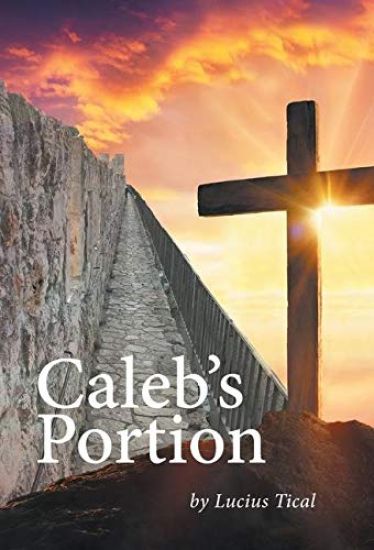
Caleb was born in Northern Virginia in the mid-18th century. He lost his innocence when he put his skills to work as a soldier in the Virginia Militia of the Revolutionary Army. He settled in Kentucky with his wife Alcy and family, working a farm as the partner of his old friend from the army, Captain Taliaferro. He finds himself in the middle of an allegiance between those who support Taliaferro and those who support the neighboring Harrison family. Kentucky was one of three counties that still belonged to Virginia. In Kentucky, most people are either backing the Harrisons or are remaining silent. But the danger from outside Taliaferro's camp is nothing compared to the threat within, as Caleb begins to suspect that Taliaferro's woman might not be everything she appears to be. Now Caleb is discovering that he must go to war again. But will it be with the Harrisons, or with his closest friend? Caleb is a descendant of the main character in the non-fiction books "Captain John Browning" that is available in both color and shades of grey. There is also another fictional account of John's private life with narratives in the short story "Captain John." This book, "Caleb", is the fifth volume of a series of short stories that helps to explain the evolution of the European Ancestors of many families that migrated to England and then America. There are a total of six short stories that are also consolidated into two books of three volumes each titled "Anatolia to Britain" and "America's Frontier." The next and last title, in Volume 6 of the series, is titled "Jeb: His Family and History."
Margaret Oliphant Wilson Oliphant (n e Margaret Oliphant Wilson) (4 April 1828 - 25 June 1897), was a Scottish novelist and historical writer, who usually wrote as Mrs. Oliphant. Her fictional works encompass "domestic realism, the historical novel and tales of the supernatural". The daughter of Francis W. Wilson (c.1788-1858), a clerk, and his wife, Margaret Oliphant (c.1789-1854), she was born at Wallyford, near Musselburgh, East Lothian, and spent her childhood at Lasswade (near Dalkeith), Glasgow and Liverpool. As a girl, she constantly experimented with writing. In 1849 she had her first novel published: Passages in the Life of Mrs. Margaret Maitland. This dealt with the Scottish Free Church movement, with which Mr. and Mrs. Wilson both sympathised, and met with some success. It was followed by Caleb Field in 1851, the year in which she met the publisher William Blackwood in Edinburgh and was invited to contribute to the famous Blackwood's Magazine. The connection was to last for her whole lifetime, during which she contributed well over 100 articles, including a critique of the character of Arthur Dimmesdale in Nathaniel Hawthorne's The Scarlet Letter. In May 1852, she married her cousin, Frank Wilson Oliphant, at Birkenhead, and settled at Harrington Square in London. An artist working mainly in stained glass, her husband had delicate health, and three of their six children died in infancy, while the father himself developed alarming symptoms of tuberculosis, then known as consumption. For the sake of his health they moved in January 1859 to Florence, and then to Rome, where Frank Oliphant died. His wife, left almost entirely without resources, returned to England and took up the burden of supporting her three remaining children by her own literary activity.She had now become a popular writer, and worked with amazing industry to sustain her position. Unfortunately, her home life was full of sorrow and disappointment. In January 1864 her only remaining daughter Maggie died in Rome, and was buried in her father's grave. Her brother, who had emigrated to Canada, was shortly afterwards involved in financial ruin, and Mrs. Oliphant offered a home to him and his children, and added their support to her already heavy responsibilities. In 1866 she settled at Windsor to be near her sons who were being educated at Eton. That year, her second cousin, Annie Louisa Walker, came to live with her as a companion-housekeeper. 3] This was her home for the rest of her life, and for more than thirty years she pursued a varied literary career with courage scarcely broken by a series of the gravest troubles. The ambitions she cherished for her sons were unfulfilled. Cyril Francis, the elder, died in 1890, leaving a Life of Alfred de Musset, incorporated in his mother's Foreign Classics for English Readers, The younger, Francis (whom she called "Cecco"), collaborated with her in the Victorian Age of English Literature and won a position at the British Museum, but was rejected by Sir Andrew Clark, a famous physician. Cecco died in 1894. With the last of her children lost to her, she had but little further interest in life. Her health steadily declined, and she died at Wimbledon, London, on 25 June 1897.In the 1880s she was the literary mentor of the Irish novelist Emily Lawless. During this time Oliphant wrote several works of supernatural fiction, including the long ghost story A Beleaguered City (1880) and several short tales, including "The Open Door" and "Old Lady Mary".
John Habberton (1842-1921) was an American author. He spent nearly twenty years as the literary and drama critic for the New York Herald, but he is best known for his stories about early California life, many of which were collected in his 1880 book Romance of California Life: Illustrated by Pacific Slope Stories, Thrilling, Pathetic and Humorous (New York: Baker, Pratt & Co., 1880). Habberton also wrote Helen's Babies, published in 1876 by Loring Publisher, Boston; and in the early 20th Century by George Routledge and Sons, London. In most of these copies, Habberton is not listed as the author. The novel is subtitled: "Helen's Babies with some account of their ways...innocent, crafty, angelic, impish, witching and repulsive by THEIR LATEST VICTIM." The book was one of the Ruby Books series for boys and girls. Habberton is acknowledged as the author of the book in an advertisement within the 1903 edition of Andersen's Fairy Tales published by Routledge. Habberton is acknowledged, also, in an inexpensive cardboard-back edition of "Helen's Babies" published by (and copyrighted by ) Whitman Publishing Company of Racine, Wisconsin in 1934. That edition is copiously illustrated by Pauline Adams. Helen's Babies was intended as just a piece of humour and aimed at an adult audience. But the hilarious novel almost instantly became a major juvenile literature success, highly estimated by the youngsters as well as authorities like Rudyard Kipling. It became a classic ranking on par with "Tom Sawyer", "Wind in the Willows", "Winnie-the Pooh" and the like. Popularity dwindled a bit after WW-II (although George Orwell mentions it very favourably in his 1946 essay on early American literature, Riding Down from Bangor), but started rising again in the 1980s. Translated into numerous foreign languages, it secured Habberton's modest share of immortality in literature. Curiously, as being one of the first pieces of an author, so insecure about his abilities, that he omitted his author name resp. wrote under pseudonym for many years. Habberton was also known under the pseudonym "Smelfungus." (Source: Initials and Pseudonyms: A Dictionary of Literary Disguises by Cushing, William).
I'm a boxer--fighting is my life, but nothing could've prepared me for the rounds I'd go through trying to woo my Raven-haired beauty into falling for me.It didn't help that she thought I was stalking her either, and maybe I was . . . a little. I just couldn't help myself She was my dream girl, an unattainable and infuriating one, but my dream girl nonetheless.To her, I would never be more than an unaccented pain in the ass. Sure, I didn't have an accent like she wanted, but there's more to love than the way a person talks. I was determined to show her that. Only, she didn't want my love, my help, or anything else from me, unless you counted my . . . yeah, she definitely wanted ALL of that.No matter how many times I tried to convince her, she just couldn't admit how good we really were for each other. It was like she purposely put up a fight just to torment me. I almost gave up, until one bad decision led her back to me, and now I'm the only thing keeping her from going to jail.