

Kirjahaku
Etsi kirjoja tekijän nimen, kirjan nimen tai ISBN:n perusteella.
657 tulosta hakusanalla Dissected Lives

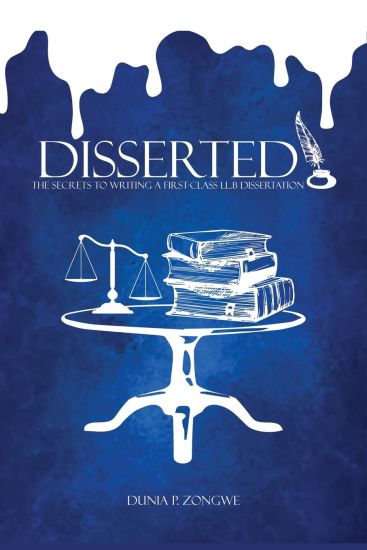
Disserted is a groundbreaking, comprehensive book that guides LL.B students on how to craft a first-class dissertation. It tackles head-on the triple crisis faced by law students in developing nations - a crisis of doubting, thinking, and writing This crisis manifests itself in the form of poorly written dissertations.This is the first book to show how to practically assemble a dissertation from the perspective of decoloniality. This makes Disserted uniquely suited to students from the Global South, considering that decoloniality empowers them to overcome the triple crisis. Indeed, its originality in presenting practical advice and decolonial theory sets this book apart from the handful of guides on LL.B dissertations. Existing resources and manuals are filled with generalities and lack in practicality.Written in student-friendly prose, its 23 chapters cover a wide range of topics. including research proposals, topic selection, purpose and problem statements. literature reviews, digital tools and models powered by artificial intelligence (AI), the basics of legal prompt engineering, plagiarism, grammar, and research methods. Each chapter offers secrets and deep insights, drawing from the author's extensive experience in supervising LL.B dissertations and research papers, notably in Southern Africa and India.Though primarily targeting LL.B students, Disserted also serves as an essential companion and indispensable resource for supervisors, law professors, jurists, and anyone interested in unraveling the complexities of writing dissertations. Overall, Disserted underscores the importance of structured dissertation writing coupled with a decolonized research approach that subverts dominant perspectives, exposes the role of Al and technology in entrenching the coloniality of knowledge, and fosters a broader understanding of law.

Directed Self-assembly of Block Co-polymers for Nano-manufacturing
Woodhead Publishing Ltd
2015
sidottu
The directed self-assembly (DSA) method of patterning for microelectronics uses polymer phase-separation to generate features of less than 20nm, with the positions of self-assembling materials externally guided into the desired pattern. Directed self-assembly of Block Co-polymers for Nano-manufacturing reviews the design, production, applications and future developments needed to facilitate the widescale adoption of this promising technology. Beginning with a solid overview of the physics and chemistry of block copolymer (BCP) materials, Part 1 covers the synthesis of new materials and new processing methods for DSA. Part 2 then goes on to outline the key modelling and characterization principles of DSA, reviewing templates and patterning using topographical and chemically modified surfaces, line edge roughness and dimensional control, x-ray scattering for characterization, and nanoscale driven assembly. Finally, Part 3 discusses application areas and related issues for DSA in nano-manufacturing, including for basic logic circuit design, the inverse DSA problem, design decomposition and the modelling and analysis of large scale, template self-assembly manufacturing techniques.
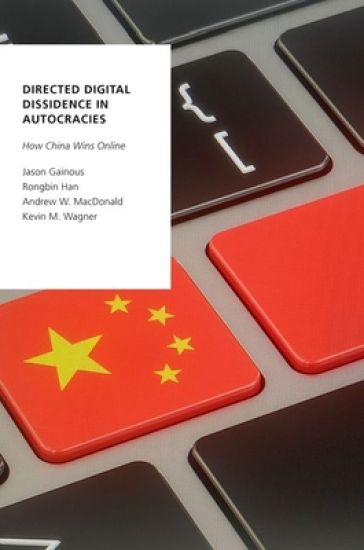
Directed Digital Dissidence in Autocracies
Jason Gainous; Rongbin Han; Andrew W. MacDonald; Kevin M. Wagner
OXFORD UNIVERSITY PRESS INC
2024
sidottu
Does the Internet fundamentally change the flow of politically relevant information, even in authoritarian regimes? If so, does it alter the attitudes and behavior of citizens? While there is a fair amount of research exploring how social media has empowered social actors to challenge authoritarian regimes, there is much less addressing whether and how the state can actively shape the flow of information to its advantage. In China, for instance, citizens often resort to "rightful resistance" to lodge complaints and defend rights. By using the rhetoric of the central government, powerless citizens may exploit the slim political opportunity structure and negotiate with the state for better governance. But this tactic also reinforces the legitimacy of authoritarian states; citizens engage rightful resistance precisely because they trust the state, at least the central government, to some degree. Drawing on original survey data and rich qualitative sources, Directed Digital Dissidence in Autocracies explores how authoritarian regimes employ the Internet in advantageous ways to direct the flow of online information. The authors argue that the central Chinese government successfully directs citizen dissent toward local government through critical information that the central government places online--a strategy that the authors call "directed digital dissidence". In this context, citizens engage in low-level protest toward the local government, and thereby feel empowered, while the central government avoids overthrow. Consequently, the Internet functions to discipline local state agents and to project a benevolent image of the central government and the regime as a whole. With an in-depth look at the COVID-19 and Xinjiang Cotton cases, the authors demonstrate how the Chinese state employs directed digital dissidence and discuss the impact and limitations of China's information strategy.
Directed Digital Dissidence in Autocracies
Jason Gainous; Rongbin Han; Andrew W. MacDonald; Kevin M. Wagner
OXFORD UNIVERSITY PRESS INC
2024
nidottu
Does the Internet fundamentally change the flow of politically relevant information, even in authoritarian regimes? If so, does it alter the attitudes and behavior of citizens? While there is a fair amount of research exploring how social media has empowered social actors to challenge authoritarian regimes, there is much less addressing whether and how the state can actively shape the flow of information to its advantage. In China, for instance, citizens often resort to "rightful resistance" to lodge complaints and defend rights. By using the rhetoric of the central government, powerless citizens may exploit the slim political opportunity structure and negotiate with the state for better governance. But this tactic also reinforces the legitimacy of authoritarian states; citizens engage rightful resistance precisely because they trust the state, at least the central government, to some degree. Drawing on original survey data and rich qualitative sources, Directed Digital Dissidence in Autocracies explores how authoritarian regimes employ the Internet in advantageous ways to direct the flow of online information. The authors argue that the central Chinese government successfully directs citizen dissent toward local government through critical information that the central government places online--a strategy that the authors call "directed digital dissidence". In this context, citizens engage in low-level protest toward the local government, and thereby feel empowered, while the central government avoids overthrow. Consequently, the Internet functions to discipline local state agents and to project a benevolent image of the central government and the regime as a whole. With an in-depth look at the COVID-19 and Xinjiang Cotton cases, the authors demonstrate how the Chinese state employs directed digital dissidence and discuss the impact and limitations of China's information strategy.

Dorothy Arzner was the exception in Hollywood film history—the one woman who succeeded as a director, in a career that spanned three decades. In Part One, Dorothy Arzner's film career—her work as a film editor to her directorial debut, to her departure from Hollywood in 1943—is documented, with particular attention to Arzner's roles as "star-maker" and "woman's director." In Part Two, Mayne analyzes a number of Arzner's films and discusses how feminist preoccupations shape them, from the women's communities central to Dance, Girl, Dance and The Wild Party to critiques of the heterosexual couple in Christopher Strong and Craig's Wife. Part Three treats Arzner's lesbianism and the role that desire between women played in her career, her life, and her films.

Dissenter on the Bench: Ruth Bader Ginsburg's Life and Work
Victoria Ortiz
Clarion Books
2022
nidottu
A 2020 Sydney Taylor Honor Book The life and career of the fiercely principled Supreme Court Justice, now a popular icon, with dramatic accounts of her landmark cases that moved the needle on legal protection of human rights, illustrated with b/w archival photographs. Dramatically narrated case histories from Justice Ginsburg's stellar career are interwoven with an account of RBG's life--childhood, family, beliefs, education, marriage, legal and judicial career, children, and achievements--and her many-faceted personality is captured. The cases described, many involving young people, demonstrate her passionate concern for gender equality, fairness, and our constitutional rights. Notes, bibliography, index.

First published in 1983, Shiguéhiko Hasumi's Directed by Yasujiro Ozu has become one of the most influential books on cinema written in Japanese. This pioneering translation brings Hasumi's landmark work to an English-speaking public for the first time, inviting a new readership to engage with this astutely observed, deeply moving meditation on the oeuvre of one of the giants of world cinema. Complemented by a critical introduction from acclaimed film scholar Aaron Gerow and rendered fluidly in Ryan Cook's agile translation, this volume will grace the shelves of cinephiles for many years to come.

First published in 1983, Shiguéhiko Hasumi's Directed by Yasujiro Ozu has become one of the most influential books on cinema written in Japanese. This pioneering translation brings Hasumi's landmark work to an English-speaking public for the first time, inviting a new readership to engage with this astutely observed, deeply moving meditation on the oeuvre of one of the giants of world cinema. Complemented by a critical introduction from acclaimed film scholar Aaron Gerow and rendered fluidly in Ryan Cook's agile translation, this volume will grace the shelves of cinephiles for many years to come.

This is the first authored book to be dedicated to the new field of directed algebraic topology that arose in the 1990s, in homotopy theory and in the theory of concurrent processes. Its general aim can be stated as 'modelling non-reversible phenomena' and its domain should be distinguished from that of classical algebraic topology by the principle that directed spaces have privileged directions and directed paths therein need not be reversible. Its homotopical tools (corresponding in the classical case to ordinary homotopies, fundamental group and fundamental groupoid) should be similarly 'non-reversible': directed homotopies, fundamental monoid and fundamental category. Homotopy constructions occur here in a directed version, which gives rise to new 'shapes', like directed cones and directed spheres. Applications will deal with domains where privileged directions appear, including rewrite systems, traffic networks and biological systems. The most developed examples can be found in the area of concurrency.

Dramatically narrated case histories from Justice Ginsburg's stellar career are interwoven with an account of RBG’s life - childhood, family, beliefs, education, marriage, legal and judicial career, children, and achievements - and her many faceted personality is captured. The cases described, many involving young people, demonstrate her passionate concern for gender equality, fairness, and our constitutional rights. Notes, bibliography, index.

"Being directed by the Jimmy Burrows, while on Friends, was like hitting the jackpot. I'm delighted that everyone can now share in his incredible insight with this book."--JENNIFER ANISTON From the director of The Mary Tyler Moore Show, Taxi, Cheers, Frasier, and Will & Grace comes an insightful and nostalgic behind-the-scenes memoir that's "as difficult to put down as a Friends marathon is to turn off" (The Washington Post). Legendary sitcom director James Burrows has spent five decades making America laugh. Here readers will find never-revealed stories behind the casting of the dozens of great sitcoms he directed, as well as details as to how these memorable shows were created, how they got on the air, and how the cast and crew continued to develop and grow. Burrows also examines his own challenges, career victories, and defeats, and provides advice for aspiring directors, writers, and actors. All this from the man who helped launch the careers of Ted Danson, Kelsey Grammer, Woody Harrelson, Jennifer Aniston, Debra Messing, and Melissa McCarthy, to name a few. Burrows talks fondly about the inspiration he found during his childhood and young adult years, including his father, legendary playwright and Broadway director Abe Burrows. From there he goes on to explain his rigorous work ethic, forged in his early years in theater, where he did everything from stage managing to building sets to, finally, directing. Transitioning to television, Burrows locked into a coveted job with The Mary Tyler Moore Show, where he first observed and then started to apply his craft. Directing most of the episodes of Taxi came next, where he worked closely with writers/producers Glen and Les Charles. The three formed a remarkable creative partnership that helped Burrows achieve his much sought-after goal of ownership and agency over a project, which came with the creating and directing of the seminal and beloved hit Cheers. Burrows has directed more than seventy-five pilots that have gone to series and over a thousand episodes, more than any other director in history. Directed by James Burrows is a heart-and-soul master class in sitcom, revealing what it truly takes to get a laugh.


Dissenter in Zion
Harvard University Press
1982
sidottu
For nearly half a century, until his death in October 1948, Judah Magnes occupied a singular place in Jewish public life. Dissenter in Zion draws upon a rich corpus of private letters, personal journals, and diaries to offer a moving account of an eloquent and sensitive person grappling with the great questions of the day and of an activist striving to translate private moral feelings into public deeds through politics and diplomacy.


Arnold made some of the most enduring science fiction films of the 1950s--It Came from Outer Space, Creature from the Black Lagoon, and The Incredible Shrinking Man. But only recently has he been recognized as a distinguished genre director, 3-D pioneer, and artist of international repute. This is the first complete critical appreciation of his career and works. Extensive interview material, many rare and previously unpublished photographs, storyboards, and the first complete Arnold filmography are included.
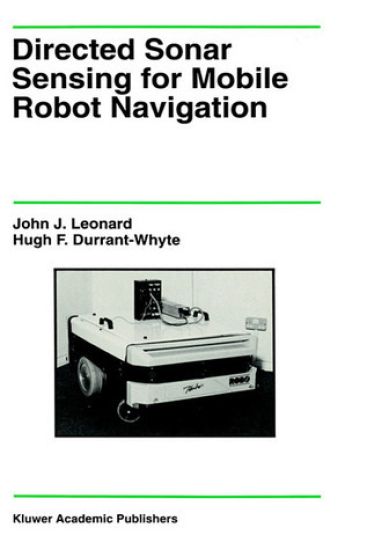
Directed Sonar Sensing for Mobile Robot Navigation
John J. Leonard; Hugh F. Durrant-Whyte
Springer
1992
sidottu
This monograph is a revised version of the D.Phil. thesis of the first author, submitted in October 1990 to the University of Oxford. This work investigates the problem of mobile robot navigation using sonar. We view model-based navigation as a process of tracking naturally occurring environment features, which we refer to as "targets". Targets that have been predicted from the environment map are tracked to provide that are observed, but not predicted, vehicle position estimates. Targets represent unknown environment features or obstacles, and cause new tracks to be initiated, classified, and ultimately integrated into the map. Chapter 1 presents a brief definition of the problem and a discussion of the basic research issues involved. No attempt is made to survey ex haustively the mobile robot navigation literature-the reader is strongly encouraged to consult other sources. The recent collection edited by Cox and Wilfong [34] is an excellent starting point, as it contains many of the standard works of the field. Also, we assume familiarity with the Kalman filter. There are many well-known texts on the subject; our notation derives from Bar-Shalom and Fortmann [7]. Chapter 2 provides a detailed sonar sensor model. A good sensor model of our approach to navigation, and is used both for is a crucial component predicting expected observations and classifying unexpected observations.

Allen Smithee specializes in the mediocre. He is versatile. He is prolific. And he doesn't exist. From 1969 until 1999, Allen Smithee was the pseudonym adopted by Hollywood directors when they wished not to be associated with films ostensibly of their making . Encompassing over fifty films of various stripes -- B movies, sequels, music videos, made-for-TV movies -- Smithee's three decades of work affords the authors of this volume a unique opportunity to reassess the claims of auteurism, both in its traditional guise and in the more commodified form it currently assumes.Sometimes treating Smithee as an auteur in much the same way critics and scholars have treated directors as diverse as Douglas Sirk, Abbas Kiarostami, and Quentin Tarantino, the contributors reclaim new possibilities for auteurist filmmaking and film studies, even as they show what an empty display it has recently become. In accounting for this change, the essays in this volume employ innovative theories of authorship to recapture the subversive effect that auteurism once enjoyed. Thus the Smithee name becomes part of a larger discussion of the economics and history of pseudonyms in filmmaking -- notably in the blacklist of the 1950s -- as well as an opportunity to employ Jacques Derrida's theory of the signature to recover obscured economic and historic contexts within Smithee's films. Unique in its focus, innovative in its approach, Directed by Allen Smithee argues that it is precisely through throwaway films such as Smithee's that recent Hollywood cinema can best be studied.