What has Emma Woodhouse, "handsome, clever, and rich, with a comfortable home and very little to distress or vex her" to say to a discipline like philosophy? How is a novel like Emma, inaccurately but not infrequently caricatured as a high-toned version of a pedestrian romance, to supply material for philosophical insight or speculation? Jane Austen's Emma is many things to many readers but it is as inaccurate as it is reductive to consider it just a romance. The minutia of daily living on which it concentrates permit not a rehearsal of platitudes, but a closer look at human emotions and motives, as well as the opportunity to hone our interpretive and empathetic skills. Emma flies in the face of conventional notions of femininity by presenting a heroine with hubris. It shows how friendships can affect one's ways of dealing with the world, how shame can reconfigure self-understanding, how gossip functions in sustaining a community. Emma rehabilitates conceptions of romance by rejecting melodrama in favor of naturalism. It explores the waywardness of the imagination and the myriad ways in which different people with different biases and agendas may evaluate the same evidence. It dwells on the limits of autonomy in that it explores the ease with which one may submit to the will of another. Emma is not itself a work of philosophy. Rather, it leads us to think philosophically. In this volume, a myriad group of scholars and philosophers explore the philosophical resonances of Emma.
What has Emma Woodhouse, "handsome, clever, and rich, with a comfortable home and very little to distress or vex her" to say to a discipline like philosophy? How is a novel like Emma, inaccurately but not infrequently caricatured as a high-toned version of a pedestrian romance, to supply material for philosophical insight or speculation? Jane Austen's Emma is many things to many readers but it is as inaccurate as it is reductive to consider it just a romance. The minutia of daily living on which it concentrates permit not a rehearsal of platitudes, but a closer look at human emotions and motives, as well as the opportunity to hone our interpretive and empathetic skills. Emma flies in the face of conventional notions of femininity by presenting a heroine with hubris. It shows how friendships can affect one's ways of dealing with the world, how shame can reconfigure self-understanding, how gossip functions in sustaining a community. Emma rehabilitates conceptions of romance by rejecting melodrama in favor of naturalism. It explores the waywardness of the imagination and the myriad ways in which different people with different biases and agendas may evaluate the same evidence. It dwells on the limits of autonomy in that it explores the ease with which one may submit to the will of another. Emma is not itself a work of philosophy. Rather, it leads us to think philosophically. In this volume, a myriad group of scholars and philosophers explore the philosophical resonances of Emma.
Although Jane Austen famously referred to Emma as a heroine "whom no one but myself will much like," the irony of her remark has been obvious since the first appearance of her novel in December 1815. The central character may have attracted diverse reactions, but there can be no doubt about the endless enjoyment afforded to generations of readers. The essays in this collection demonstrate the varied delights of reading Emma. Most have been written in the last twenty years, but each draws on the cumulative body of scholarship and critical analysis that has built up since the novel was first published. The purpose of the collection is to introduce readers of Austen to new ways of interpreting her most substantial and rewarding novel. Each essay engages with Emma, but there is considerable dialogue taking place between the different approaches, which collectively contributes to the enriched readings of Austen's work. The collection opens with an introduction encouraging readers to re-read Emma, and to find its pleasures magnified by the critical interpretations and scholarship represented in this casebook.
Emma is widely regarded as Jane Austen's most perfectly constructed novel. At once a comedy of misunderstanding, a razor-sharp analysis of the English class-system, a classic tale of moral growth, and a romance that combines sense with sensibility, it has appealed to readers of every generation and critics of every disposition.This sourcebook introduces readers not only to Jane Austen's text, but also to the literary and historical contexts within which the novel was written, and to the many different critical readings that it has generated, from the time of its publication to the twenty-first century. Each extract is fully introduced and analyzed, with a concluding section on recommended editions and further reading to prepare the reader for further study of this incomparable English novel.
Emma is widely regarded as Jane Austen's most perfectly constructed novel. At once a comedy of misunderstanding, a razor-sharp analysis of the English class-system, a classic tale of moral growth, and a romance that combines sense with sensibility, it has appealed to readers of every generation and critics of every disposition.This sourcebook introduces readers not only to Jane Austen's text, but also to the literary and historical contexts within which the novel was written, and to the many different critical readings that it has generated, from the time of its publication to the twenty-first century. Each extract is fully introduced and analyzed, with a concluding section on recommended editions and further reading to prepare the reader for further study of this incomparable English novel.
First published in 1968, Jane Austen’s Emma is a critical study of Miss Austen’s last completed novel. While often pausing to analyse and comment on major contemporary critics, Dr. Burrows provides a detailed insight into this outstanding novel. He has clarified certain of the book’s qualities, placing detail back into its proper context and perspective. Comic relief is contrasted with the serious and the sensitivity and capacity for change of her chief personages and the subtle use of such of Austen’s words as ‘sensible’ and ‘amiable’ are deftly treated. A select bibliography is included. This book will be of interest to students of literature, women’s studies, gender studies as well as to casual readers of Jane Austen’s novels.
First published in 1968, Jane Austen’s Emma is a critical study of Miss Austen’s last completed novel. While often pausing to analyse and comment on major contemporary critics, Dr. Burrows provides a detailed insight into this outstanding novel. He has clarified certain of the book’s qualities, placing detail back into its proper context and perspective. Comic relief is contrasted with the serious and the sensitivity and capacity for change of her chief personages and the subtle use of such of Austen’s words as ‘sensible’ and ‘amiable’ are deftly treated. A select bibliography is included. This book will be of interest to students of literature, women’s studies, gender studies as well as to casual readers of Jane Austen’s novels.
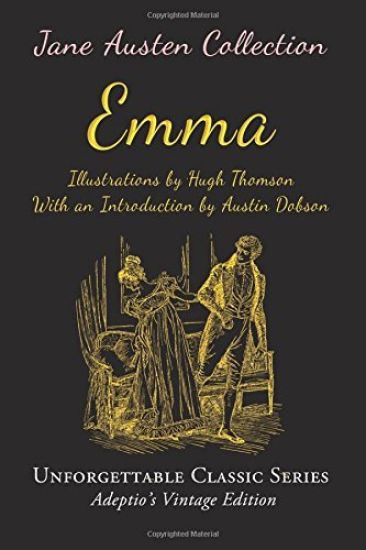
This is a new edition of "Emma," originally published in 1896 by Macmillan and Co., Ltd., of London, England, with an introduction by Austin Dobson and illustrations by Hugh Thomson. Part of the project Unforgettable Classic Series of classic literature, this is a new edition of Jane Austen's masterpiece published in 1896-not a facsimile reprint. Obvious typographical errors have been carefully corrected and the entire text has been reset and redesigned by Adeptio Editions to enhance readability, while respecting the original edition. "Emma" is considered by some as Jane Austen's greatest novels. It tells the story of Emma Woodhouse, an intelligent and wealthy young woman who lives with her father in the English village of Highbury. Emma is immature and meddles in the lives of the people around her, often to negative effect. She is proud of her matchmaking skills, and ends up turning her attention towards making a match for her new prot g , Harriet. Despite her obsession with romance, Emma is clueless about her own feelings for George Knightley, a true gentleman and her long-time friend-who enjoys correcting Emma on her well-intentioned but often mistaken perspectives. About the Author: Jane Austen (1775-1817) was an English novelist whose seminal works, inspired by her own upbringing as well as in the landed gentry, have influenced successive generations. She was the seventh child-out of eight-and second daughter of Cassandra (n e Leigh) and the Reverend George Austen. She was born on December 16, 1775, in Steventon, Hampshire, England. Her parents were well-respected middle-class community members. Her father was the local Anglican clergyman and supplemented the family income by taking private pupils in the family home and parsonage. Her mother, Cassandra Leigh Austen, came from an aristocratic family and influenced Jane's sense of social class and self-worth. When they were young, Jane and her six brothers and sister were encouraged to read from their father's extensive library. With a romantic vein, but nevertheless a realist-known for her style and ironic humor as well as for her fascinating depiction of women's domestic roles of the early nineteenth century-Austen wrote "Sense and Sensibility" (1811), "Pride and Prejudice" (1813), "Mansfield Park" (1814), "Emma" (1815), "Northanger Abbey" (1817), and "Persuasion" (1818), all of which replete with memorable protagonists-as are Emma Woodhouse and George Knightley in "Emma."
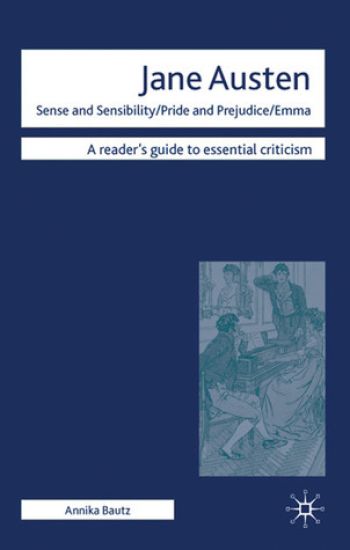
This Guide discusses the range of critical reactions to three of Jane Austen's most widely-studied and popular novels. Annika Bautz takes the reader chronologically through the profusion of criticism by selecting key approaches from the immense variety of responses these three Austen novels have provoked over the last two centuries.
This Guide discusses the range of critical reactions to three of Jane Austen's most widely-studied and popular novels. Annika Bautz takes the reader chronologically through the profusion of criticism by selecting key approaches from the immense variety of responses these three Austen novels have provoked over the last two centuries.