Kirjahaku
Etsi kirjoja tekijän nimen, kirjan nimen tai ISBN:n perusteella.
1000 tulosta hakusanalla Emma Bakster-Rajt
This is a new edition of "EMMA," originally published in 1896 by Macmillan and Co., Ltd., of London, England, with an introduction by Austin Dobson and illustrations by Hugh Thomson. Part of the project Immortal Literature Series of classic literature, this is a new edition of the classic work published in 1896-not a facsimile reprint. Obvious typographical errors have been carefully corrected and the entire text has been reset and redesigned by Pen House Editions to enhance readability, while respecting the original edition. Jane Austen's EMMA is-together with Pride and Prejudice-perhaps one of the finest and most popular novels ever written. It tells the story of the "Miss Dashwoods" sisters, the sensible Elinor and the passionate Marianne, whose chances at marriage seem doomed by their family's sudden loss of fortune. The reader will be delighted with this romantic suspense and with Austen's elegant narrative style, and with the story's fascinating characters and their social interactions. About the Author: Jane Austen (1775-1817) was an English novelist whose seminal works, inspired by her own upbringing as well as in the landed gentry, have influenced successive generations. She was the seventh child-out of eight-and second daughter of Cassandra (n e Leigh) and the Reverend George Austen. She was born on December 16, 1775, in Steventon, Hampshire, England. Her parents were well-respected middle-class community members. Her father was the local Anglican clergyman and supplemented the family income by taking private pupils in the family home and parsonage. Her mother, Cassandra Leigh Austen, came from an aristocratic family and influenced Jane's sense of social class and self-worth. When they were young, Jane and her six brothers and sister were encouraged to read from their father's extensive library. With a romantic vein, but nevertheless a realist-known for her style and ironic humor as well as for her fascinating depiction of women's domestic roles of the early nineteenth century-Austen wrote "Sense and Sensibility" (1811), "Pride and Prejudice" (1813), "Mansfield Park" (1814), "Emma" (1815), "Northanger Abbey" (1817), and "Persuasion" (1818), all of which replete with memorable protagonists.

Emma, by Jane Austen, is a novel about youthful hubris and the perils of misconstrued romance. As in her other novels, Austen explores the concerns and difficulties of genteel women living in Georgian

Emma, by Jane Austen, is a novel about youthful turmoil and the threats of misconstrued romance. As in her other novels, Austen explores the concerns and difficulties of genteel women living in Georgian
Emma is a novel by the Englishwoman Jane Austen, published anonymously (A Novel, December 1815, by the author of Sense and Sensibility and Pride) Mocking the attempts of the heroine to make meet the bachelors of his entourage the ideal spouse, painted with humor the life and problems of the provincial class wealthy under the Regency. Emma is considered by some Austrians to be her most accomplished work. Considered by Sir Walter Scott as a herald of a new kind of more realistic novel, Emma first disconcerts her contemporaries by the meticulous description of a small provincial town, where not much happens outside the events of The daily life of the community. Another essential aspect is that of the novel of learning, the learning of life by Emma herself, who, despite the vivacity of her mind, struggles so much to understand the feelings of others and her own. Other aspects of the novel, taken later, may also surprise us, such as its character of "crime novel without murder", which only a thorough re-reading allows to fully appreciate. Emma has been the subject of several translations in French, the first just one year after its publication in England. After a "forgetfulness" of a hundred years, the novel was serialized in the Journal des d bats in 1910; As is often the case in Jane Austen's French translations, the irony and the "second degree" proper to the author disappear in the adaptation that is made of it. The work has since been regularly published in French, in more or less faithful translations-adaptations.


Emma, by Jane Austen, is a novel about youthful hubris and the perils of misconstrued romance. As in her other novels, Austen explores the concerns and difficulties of genteel women living in Georgian-Regency England; she also creates a lively comedy of manners among her characters. Before she began the novel, Austen wrote, "I am going to take a heroine whom no one but myself will much like." In the first sentence, she introduces the title character as "Emma Woodhouse, handsome, clever, and rich." Emma is spoiled, headstrong, and self-satisfied; she greatly overestimates her own matchmaking abilities; she is blind to the dangers of meddling in other people's lives; and her imagination and perceptions often lead her astray.
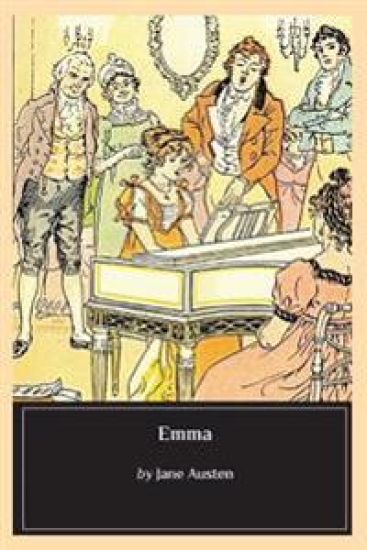
Emma Woodhouse, handsome, clever, and rich, with a comfortable home and happy disposition, seemed to unite some of the best blessings of existence; and had lived nearly twenty-one years in the world with very little to distress or vex her. She was the youngest of the two daughters of a most affectionate, indulgent father; and had, in consequence of her sister's marriage, been mistress of his house from a very early period. Her mother had died too long ago for her to have more than an indistinct remembrance of her caresses; and her place had been supplied by an excellent woman as governess, who had fallen little short of a mother in affection.


Emma, by Jane Austen, is a novel about youthful hubris and the perils of misconstrued romance. The novel was first published in December 1815. As in her other novels, Austen explores the concerns and difficulties of genteel women living in Georgian