Kirjojen hintavertailu. Mukana 11 699 587 kirjaa ja 12 kauppaa.

Kirjahaku

Etsi kirjoja tekijän nimen, kirjan nimen tai ISBN:n perusteella.

1000 tulosta hakusanalla F.J. Doherty

Identification and Control Using Volterra Models

Identification and Control Using Volterra Models

F.J.III Doyle; R.K. Pearson; B.A. Ogunnaike

Springer London Ltd
2013
nidottu
Much has been written about the general difficulty of developing the models required for model-based control of processes whose dynamics exhibit signif­ icant nonlinearity (for further discussion and references, see Chapter 1). In fact, the development ofthese models stands as a significant practical imped­ iment to widespread industrial application oftechniques like nonlinear model predictive control (NMPC), whoselinear counterpart has profoundly changed industrial practice. One ofthe reasons for this difficulty lies in the enormous variety of "nonlinear models," different classes of which can be less similar to each other than they are to the class of linear models. Consequently, it is a practical necessity to restrict consideration to one or a few specific nonlinear model classes if we are to succeed in developing, understanding, and using nonlinear models as a basis for practical control schemes. Because they repre­ sent a highly structured extension ofthe class oflinear finite impulse response (FIR) models on which industrially popular linear MPC implementations are based, this book is devoted to the class of discrete-time Volterra models and a fewother, closelyrelated, nonlinear model classes. The objective ofthis book is to provide a useful reference for researchers in the field of process control and closely related areas, collecting a reasonably wide variety of results that may be found in different parts of the large literature that exists on the gen­ eral topics of process control, nonlinear systems theory, statistical time-series models, biomedical engineering, and digital signal processing, among others.

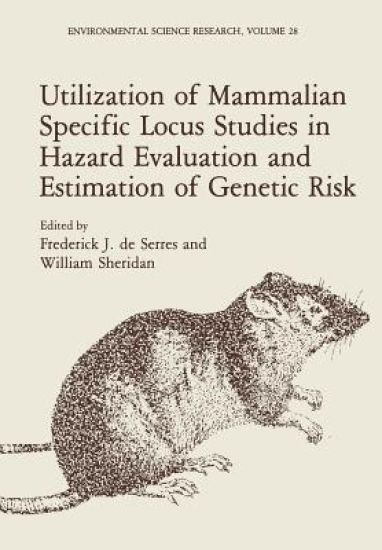
Utilization of Mammalian Specific Locus Studies in Hazard Evaluation and Estimation of Genetic Risk
The magnitude of the threat to the human genetic material posed by environmental agents has not as yet been fully determined. Never­ theless, the potential hazards of many chemicals have been identi­ fied by studies on lower organisms. However, too little is known regarding the comparability or lack of it between the metabolic pathways available in such organisms and those in man. Although at present there is great public concern for what is considered by some as the excessive use of laboratory animals in toxicological testing, it seems clear that the usage of mammalian systems may be deemed necessary. It has been proposed that cell culture systems might suffice to meet this need, however, such approaches cannot match the complexity of physiological occurances that are present in the intact animal. For studies of genetic effects, some non-invasive human test systems are presently available. These do not, however, meet the re­ quirements for extensive laboratory studies. In order to assess the risks to humans of environmental factors such laboratory investiga­ tions are essential. Therefore, for the forseeable future reliance on experiments using laboratory animals will be necessary. This Volume, which contains the proceedings of a workshop which was held at the National Institute of Environmental Health Sciences, March 29-31, 1982, explores the existing methodologies and their utility for risk estimations. It covers the most well developed human systems, as well as the most widely used animal tests.
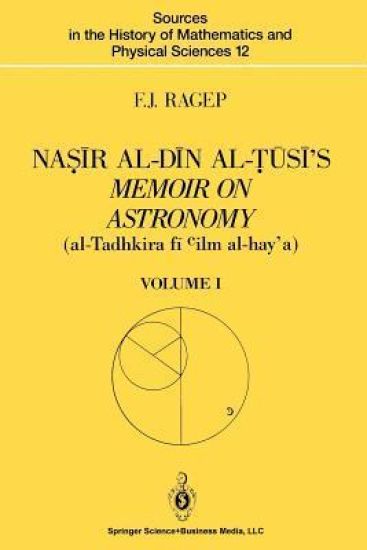
Na?ir al-Din al-?usi’s Memoir on Astronomy (al-Tadhkira fi cilm al-hay’a)
I was introduced to Tiisi: and his Tadhkira some 19 years ago. That first meeting was neither happy nor auspicious. My graduate student notes from the time indicate a certain level of confusion and frustration; I seem to have had trouble with such words as tadwlr (epicycle), which was not to be found in my standard dictionary, and with the concept of solid-sphere astronomy, which, when found, was pooh-poohed in the standard sources. I had another, even more decisive reaction: boredom. Only the end of the term brought relief, and I was grateful to be on to other, more exciting aspects of the history of science. A few years later, I found myself, thanks to fellowships from Fulbright-Hays and the American Research Center in Egypt, happily immersed in the manu­ script collections of Damascus, Aleppo, and Cairo. Though I had intended to work on a topic in the history of mathematics, I was drawn, perhaps inevitably, to a certain type of astronomical writing falling under the rubric of hay' a. At first this fascination was based on sheer numbers; that so many medieval scientists could have written on such a subject must mean something, I told myself. (I was in a sociological mode at the time.
Tunable Laser Optics

Tunable Laser Optics

F.J. Duarte

Apple Academic Press Inc.
2015
sidottu
Broadly tunable lasers have had, and continue to have, an enormous impact in many and diverse fields of science and technology. From a renaissance in spectroscopy to laser guide stars and laser cooling, the nexus is the tunable laser.Tunable Laser Optics offers a transparent and comprehensive treatment of the physics of tunable laser optics based on a detailed description of first principles. Authored by a leading expert in the field, the book covers the optics and optical principles needed to build lasers, the optics instrumentation necessary to characterize laser emission, and laser-based optical instrumentation, addressing key topics such as Dirac’s notation, the interferometric equation, the uncertainty principle, pulse compression, and tunable narrow-linewidth lasers.This revised, expanded, and improved Second Edition:Contains new and additional material on tunable lasers and quantum opticsExplains the first principles of tunable laser optics in a clear and concise mannerPresents an explicit exposition of the relevant theory, without the use of short cutsEmploys numerous examples, case studies, and figures to illustrate important conceptsIncludes carefully designed problems of direct practical significance to stimulate applicationEmphasizing the utilitarian aspects of the optics and theory, Tunable Laser Optics, Second Edition provides valuable insight into the optics and the trade-offs involved in the design and construction of tunable lasers and optical devices. It makes an ideal textbook for advanced undergraduate-level and graduate-level optics courses for physics and engineering students, as well as a handy reference for researchers and experimentalists.
Hans Christian Andersen and the Romantic Theatre

Hans Christian Andersen and the Romantic Theatre

F.J. Marker

UNIVERSITY OF TORONTO PRESS
1971
pokkari
The romantic theatre, with all its imaginative vigour and eagerness for experimentation, appeals to those who like total theatre – unabashed, unashamedly spectacular, unforgettably pathetic. Critics who take a purely literary approach the drama often neglect or malign the theatre of the nineteenth century. Yet even in terms of literary, influence it is a hazardous to ignore the debt the exponents of naturalism owed to the drama of the prenaturalistic period. Despite universal critical agreement about the significance of Ibsen and Strindberg as creators of modernism, no attempt has previously been made to describe and delineate the theatrical context from which these major Scandinavian playwrights emerged. Hans Christian Andersen stands squarely astride the romantic period in Scandinavia. His plays, appearing from 1829 to 1865, span the important transition from the actor-dominated theatre to the naturalist theatre controlled by the director. Although recognized as a great artist in the genre with which his name has become synonymous, his extensive work as a dramatist, constituting a microcosm if important nineteenth-century genres and styles, is virtually unknown today. This book, the first to deal with Andersen as a man of the theatre, dispels the myth that he was a frustrated closet dramatist; a glance at the chronology listing his twenty-five original plays and libretti, produced for more than 1000 performances, illustrates the serious emphasis which he himself placed on this aspect of his writing. His sense of the practical theatre was keen, and the production history of his plays affords an unparalleled stage picture. Equally fascinating are his frequently incisive comments and observations made about the theatre and drama as travelled restlessly through Europe and visited the leading playhouses of his day. The author has culled a unique body of theatrical sources from the archives of the Royal Theatre in Copenhagen and has collected a gallery of unpublished designs and ground plans to illustrate his story. This highly readable and fully documented account of nineteenth-century stage practices, as exemplified in Andersen’s plays, will stand as a lasting contribution to theatrical history.