Kirjojen hintavertailu. Mukana 11 244 527 kirjaa ja 12 kauppaa.

Kirjahaku

Etsi kirjoja tekijän nimen, kirjan nimen tai ISBN:n perusteella.

1000 tulosta hakusanalla French Hacking

French Caribbeans in Africa

French Caribbeans in Africa

V. Hélénon

Palgrave Macmillan
2011
sidottu
This is the first book-length study of the French Caribbean presence in Africa, and serves as a unique contribution to the field of African Diaspora and Colonial studies. By using administrative records, newspapers, and interviews, it explores the French Caribbean presence in the colonial administration in Africa before World War II.
French Presidential Elections

French Presidential Elections

M. Lewis-Beck; R. Nadeau; É. Bélanger

Palgrave Macmillan
2012
sidottu
An original and comprehensive study of the sociological and psychological forces driving individual choices in French Presidential elections. Based on a unique comparative analysis of four French presidential contests over the last two decades, this book presents a rigorous examination of long-term and short-term voter motivations.
French Comedy on Screen

French Comedy on Screen

R. Lanzoni

Palgrave Macmillan
2014
sidottu
French comedy films occupy a specific cultural space and are influenced by national traditions and shared cultural references, but at the same time they have always been difficult to classify. This book investigates the different methods in which these comedies textually inscribed and exemplified a variety of cultural and historical landmarks.
French and American Noir

French and American Noir

Alistair Rolls; Deborah Walker

Palgrave Macmillan
2009
sidottu
A longstanding misconception surrounding the term French noir suggests that the post-war French thriller and film noir were a development of, or response to, a pre-existing American tradition. This book challenges this misconception, examining the complexity of this trans-Atlantic exchange and refocusing debate to include a Franco-French lineage.
French Hospitality

French Hospitality

Tahar Ben Jelloun

Columbia University Press
1999
sidottu
The award-winning novelist and author of the international bestseller Racism Explained to My Daughter uses his own experience to illuminate the experience of the Other in his adopted land-and everywhere. A Moroccan who emigrated to France in 1971, Tahar Ben Jelloun draws upon his own encounters with racism along with his insights as a practicing psychologist and gifted novelist to elucidate the racial divisions that plague contemporary society. In a modern France where openly racist leaders such as National Front spokesman Jean-Marie Le Pen have made significant strides toward broad popular acceptance, Ben Jelloun's book is more topical now than ever. His profound and compelling appeal for tolerance-in both public discourse and the law-is a passionate yet reasoned argument that racism simply does not make sense in the multicultural world of today. French Hospitality confronts issues of international resonance: the relationship of a formerly colonized people to their onetime colonizers, the encounter between Islam and the modern Judeo-Christian West, and the status of the non-European minorities in Europe today. Underlying these issues is a heartfelt nostalgia for simple, traditional North African hospitality as practiced since time immemorial by a relatively poor and unsophisticated society. Ben Jelloun supplements this rather noble ideal of generosity and welcoming by borrowing the philosophical concept of hospitality-the opening of oneself to another-from the works of Emmanuel Levinas and Jacques Derrida in order to illustrate the moral conception of a nation's unconditional acceptance of foreigners. Isn't the belief in welcoming strangers a fundamental mark of civilization? In a political climate where increasingly repressive immigration laws are a national trend as well as an international phenomenon, he contends, it is not surprising that racism has gained a foothold. Most hurt by racist polemic and politics, he points out, are children of immigrants-born in France, their memories are those of the French people, and they deserve to be treated with the full respect afforded to any citizen. With his elegant and imaginative prose, Ben Jelloun shows us both racism's face and the immigrant's heartbreak; but he also evokes the wind of freedom and the ideal of hospitality, and with this gesture offers a kind of hope in extricating ourselves from racism's recidivist incoherencies.
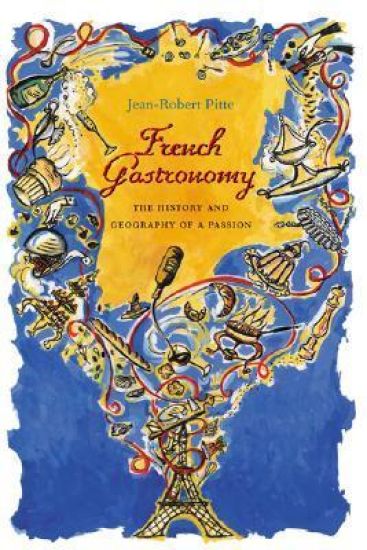
French Gastronomy

French Gastronomy

Jean-Robert Pitte

Columbia University Press
2002
sidottu
This we can be sure of: when a restaurant in the western world is famous for its cooking, it is the tricolor flag that hangs above the stove, opined one French magazine, and this is by no means an isolated example of such crowing. Indeed, both linguistically and conceptually, the restaurant itself is a French creation. Why are the French recognized by themselves and others the world over as the most enlightened of eaters, as the great gourmets? Why did the passion for food-gastronomy-originate in France? In French Gastronomy, geographer and food lover Jean-Robert Pitte uncovers a novel answer. The key, it turns out, is France herself. In her climate, diversity of soils, abundant resources, and varied topography lie the roots of France's food fame. Pitte masterfully reveals the ways in which cultural phenomena surrounding food and eating in France relate to space and place. He points out that France has some six hundred regions, or microclimates, that allow different agricultures, to flourish, and fully navigable river systems leading from peripheral farmlands directly to markets in the great gastronomic centers of Paris and Lyon. With an eye to this landscape, Pitte wonders: Would the great French burgundies enjoy such prestige if the coast they came from were not situated close to the ancient capital for the dukes and a major travel route for medieval Europe? Yet for all the shaping influence of earth and climate, Pitte demonstrates that haute cuisine, like so much that is great about France, can be traced back to the court of Louis XIV. It was the Sun King's regal gourmandise-he enacted a nightly theater of eating, dining alone but in full view of the court-that made food and fine dining a central affair of state. The Catholic Church figures prominently as well: gluttony was regarded as a "benign sin" in France, and eating well was associated with praising God, fraternal conviviality, and a respect for the body. These cultural ingredients, in combination with the bounties of the land, contributed to the full flowering of French foodways. This is a time of paradox for French gourmandism. Never has there been so much literature published on the subject of culinary creativity, never has there been so much talk about good food, and never has so little cooking been done at home. Each day new fast-food places open. Will French cuisine lose its charm and its soul? Will discourse become a substitute for reality? French Gastronomy is a delightful celebration of what makes France unique, and a call to everyone who loves French food to rediscover its full flavor.
French Global

French Global

Columbia University Press
2010
sidottu
Recasting French literary history in terms of the cultures and peoples that interacted within and outside of France's national boundaries, this volume offers a new way of looking at the history of a national literature, along with a truly global and contemporary understanding of language, literature, and culture. The relationship between France's national territory and other regions of the world where French is spoken and written (most of them former colonies) has long been central to discussions of "Francophonie." Boldly expanding such discussions to the whole range of French literature, the essays in this volume explore spaces, mobilities, and multiplicities from the Middle Ages to today. They rethink literary history not in terms of national boundaries, as traditional literary histories have done, but in terms of a global paradigm that emphasizes border crossings and encounters with "others." Contributors offer new ways of reading canonical texts and considering other texts that are not part of the traditional canon. By emphasizing diverse conceptions of language, text, space, and nation, these essays establish a model approach that remains sensitive to the specificities of time and place and to the theoretical concerns informing the study of national literatures in the twenty-first century.
French Global

French Global

Columbia University Press
2011
pokkari
Recasting French literary history in terms of the cultures and peoples that interacted within and outside of France's national boundaries, this volume offers a new way of looking at the history of a national literature, along with a truly global and contemporary understanding of language, literature, and culture. The relationship between France's national territory and other regions of the world where French is spoken and written (most of them former colonies) has long been central to discussions of "Francophonie." Boldly expanding such discussions to the whole range of French literature, the essays in this volume explore spaces, mobilities, and multiplicities from the Middle Ages to today. They rethink literary history not in terms of national boundaries, as traditional literary histories have done, but in terms of a global paradigm that emphasizes border crossings and encounters with "others." Contributors offer new ways of reading canonical texts and considering other texts that are not part of the traditional canon. By emphasizing diverse conceptions of language, text, space, and nation, these essays establish a model approach that remains sensitive to the specificities of time and place and to the theoretical concerns informing the study of national literatures in the twenty-first century.
French and Germans, Germans and French

French and Germans, Germans and French

Richard Cobb

Penguin Classics
2018
pokkari
An extraordinary history of French lives under occupation in the First and Second World Wars, this is an intimate, unforgettable meditation on the strange mixture of compromise and betrayal, collaboration and resistance that marks defeat, written by one of the greatest historians of France.'A splendid book for comprehending human kind ... Cobb has a strong sense of how ordinary life has to go on, even through disasters, and a sensitivity for what it was like at the time, matched by a gift for the telling phrase' Economist 'Prophet of the past, Richard Cobb is a visionary' New York Review of Books'His France - urban, northern, provincial, pedestrian, noisy, unpuritanical, festive - was in contrast to, and predicated upon, another France: bureaucratic, official, suburban, safe' Julian Barnes
French for Everyone Junior First Words Flash Cards
Learn 100 essential first words with this pack of beautifully illustrated flashcards, perfect for children learning to read and speak French.Make learning a new language fun with this pack of 100 beautifully illustrated flash cards. Young learners of French will be captivated and engaged by the dynamic, visual approach that sets French for Everyone Junior apart from other language materials for children.French for Everyone Junior: Flash Cards have been designed for children who are starting to read and speak French. Each beautifully illustrated card features an image plus an essential first word, introducing nouns, verbs, and adjectives. On the reverse of the card, just the image is shown so children can test their knowledge.Interactive and engaging, these flash cards for kids include: - A beautifully illustrated pack of 105 flash cards for young children who are learning French either as a first or second language.- An essential first word and an illustration on each card, to help young learners memorise new vocabulary.- Five bonus cards provide handy suggestions for fun, educational activities and games to play with the cards.- A sturdy, laminated cardboard design, so these flash cards are suitable for young hands to play with again and again.These first words flashcards are perfect and fun way to introduce children to French as a first or second language. They can be used at home with a parent or tutor, or by teachers looking to introduce new words, and are the perfect companion for children who have recently begun to learn or study French.At DK, we believe in the power of discovery. So why stop there?If you like French for Everyone Junior: Flash Cards, then why not try German for Everyone Junior: Flash Cards, Italian for Everyone Junior: Flash Cards and Spanish for Everyone Junior: Flash Cards as part of the series making learning new vocabulary fun.
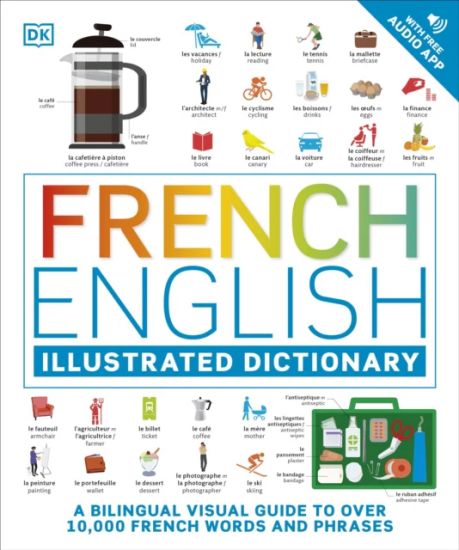
French English Illustrated Dictionary
Learn more than 10,000 of the most useful words and phrases in French with this beautifully illustrated dictionary for French-language students. Building on the success of the English for Everyone course books and the Bilingual Visual Dictionary series, the French English Illustrated Dictionary uses crystal-clear illustrations to show the meaning of over 10,000 words of French vocabulary. The words are shown in a visual context in themed sections covering practical or everyday topics (such as shopping, food, or study), providing learners with all the vocabulary they need for work, travel, and leisure. Fancy becoming an expert in the language? Then open the pages of this French dictionary to discover:- A comprehensive guide to a wide range of useful French words and expressions.- Structured in clear sections based around a theme (e.g. sports, food and drink, transport).- Clear, attractive illustrations make the vocabulary easy to understand and remember.- Includes a beautiful illustration at the start of the section that sets the theme in context.French English Illustrated Dictionary is incredibly easy to use and can be used for self-study or as a reference in the classroom, and is suitable for learners at all levels, from beginner to advanced.Learning French vocabulary has never been easier with this visually stunning dictionary!