Kirjojen hintavertailu. Mukana 12 390 323 kirjaa ja 12 kauppaa.

Kirjahaku

Etsi kirjoja tekijän nimen, kirjan nimen tai ISBN:n perusteella.

1000 tulosta hakusanalla Gadda

Gadamer in Conversation

Gadamer in Conversation

Hans-Georg Gadamer

Yale University Press
2012
pokkari
This volume presents six lively conversations with Hans-Georg Gadamer (born 1900), one of the twentieth century’s master philosophers. Looking back over his life and thought, Gadamer takes up key issues in his philosophy, addresses points of controversy, and replies to his critics, including those who accuse him of having been in complicity with the Nazis. A genial and direct conversationalist, Gadamer is here captured at his best and most accessible.The interviews took place between 1989 and 1996, and all but one appear in English for the first time in this volume. The first three conversations, conducted by Heidelberg philosopher Carsten Dutt, deal with hermeneutics, aesthetics, and practical philosophy and the question of ethics. In a fourth conversation, with University of Heidelberg classics professor Glenn W. Most, Gadamer argues for the vital importance of the Greeks for our contemporary thinking. In the next, the philosopher reaffirms his connection with phenomenology and clarifies his relation to Husserl and Heidegger in a conversation with London philosopher Alfons Grieder. In the final interview, with German Nazi expert Dörte von Westernhagen, Gadamer describes his life as a struggling young professor in Germany in the 1930s and refutes accusations of his complicity with the Nazis. These conversations are a lucid introduction for readers new to the philosopher’s thought, and for experts they present an invaluable commentary on Gadamer’s most important themes.
Gadamer for Architects

Gadamer for Architects

Paul Kidder

Routledge
2012
sidottu
Providing a concise and accessible introduction to the work of the celebrated twentieth century German philosopher, Hans-Georg Gadamer, this book focuses on the aspects of Gadamer’s philosophy that have been the most influential among architects, educators in architecture, and architectural theorists. Gadamer’s philosophy of art gives a special place to the activity of "play" as it occurs in artistic creation. His reflections on meaning and symbolism in art draw upon his teacher, Martin Heidegger, while moving Heidegger’s thought in new directions. His theory of interpretation, or "philosophical hermeneutics," offers profound ways to understand the influence of the past upon the present and to appropriate cultural history in ever new forms. For architects, architectural theorists, architectural historians, and students in these fields, Gadamer’s thought opens a world of possibilities for understanding how building today can be rich with human meaning, relating to architecture’s history in ways that do not merely repeat nor repudiate that history.In addition, Gadamer’s sensitivity to the importance of practical thinking – to the way that theory arises out of practice – gives his thought a remarkable usefulness in the everyday work of professional life.
Gadamer for Architects

Gadamer for Architects

Paul Kidder

Routledge
2012
nidottu
Providing a concise and accessible introduction to the work of the celebrated twentieth century German philosopher, Hans-Georg Gadamer, this book focuses on the aspects of Gadamer’s philosophy that have been the most influential among architects, educators in architecture, and architectural theorists. Gadamer’s philosophy of art gives a special place to the activity of "play" as it occurs in artistic creation. His reflections on meaning and symbolism in art draw upon his teacher, Martin Heidegger, while moving Heidegger’s thought in new directions. His theory of interpretation, or "philosophical hermeneutics," offers profound ways to understand the influence of the past upon the present and to appropriate cultural history in ever new forms. For architects, architectural theorists, architectural historians, and students in these fields, Gadamer’s thought opens a world of possibilities for understanding how building today can be rich with human meaning, relating to architecture’s history in ways that do not merely repeat nor repudiate that history.In addition, Gadamer’s sensitivity to the importance of practical thinking – to the way that theory arises out of practice – gives his thought a remarkable usefulness in the everyday work of professional life.
Gadamer’s Repercussions

Gadamer’s Repercussions

University of California Press
2003
sidottu
Certainly one of the key German philosophers of the twentieth century, Hans-Georg Gadamer also influenced the study of literature, art, music, sacred and legal texts, and medicine. Indeed, while much attention has been focused on Gadamer's writings about ancient Greek and modern German philosophy, the relevance of his work for other disciplines is only now beginning to be properly considered and understood. In an effort to address this slant, this volume brings together many prominent scholars to assess, re-evaluate, and question Hans-Georg Gadamer's works, as well as his place in intellectual history. The book includes a recent essay by Gadamer on 'the task of hermeneutics', as well as essays by distinguished contributors including Jurgen Habermas, Richard Rorty, Gerald Bruns, Georgia Warnke, and many others. The contributors situate Gadamer's views in surprising ways and show that his writings speak to a range of contemporary debates - from constitutional questions to issues of modern art. A controversial final section attempts to uncover and clarify Gadamer's history in relation to National Socialism. More an investigation and questioning than a celebration of this venerable and profoundly influential philosopher, this collection will become a catalyst for any future rethinking of philosophical hermeneutics, as well as a significant starting place for rereading and reviewing Hans-Georg Gadamer.
Gadamer and the Legacy of German Idealism

Gadamer and the Legacy of German Idealism

Kristin Gjesdal

Cambridge University Press
2009
sidottu
The philosophy of Hans-Georg Gadamer interests a wide audience that spans the traditional distinction between European (continental) and Anglo-American (analytic) philosophy. Yet one of the most important and complex aspects of his work - his engagement with German Idealism - has received comparatively little attention. In this book, Kristin Gjesdal uses a close analysis and critical investigation of Gadamer's Truth and Method (1960) to show that his engagement with Kant, Hegel, and Schleiermacher is integral to his conception of hermeneutics. She argues that a failure to engage with this aspect of Gadamer's philosophy leads to a misunderstanding of the most pressing problem of post-Heideggerian hermeneutics: the tension between the commitment to the self-criticism of reason, on the one hand, and the turn towards the meaning-constituting authority of tradition, on the other. Her study provides an illuminating assessment of both the merits and the limitations of Gadamer's thought.
Gadamer's Dialectical Hermeneutics

Gadamer's Dialectical Hermeneutics

Lauren Swayne Barthold

Lexington Books
2009
sidottu
Gadamer's Dialectical Hermeneutics contributes to the growing literature that takes seriously the significance of Plato for Gadamer's hermeneutics. What distinguishes this book is the way in which Lauren Swayne Barthold argues for a dialectic central to Gadamer's hermeneutics, one that recalls the Platonic chorismos, or separation, between the transcendent and sensory realms. Barthold demonstrates that Gadamer, too, insisted on the "in-between" nature of human understanding as characterized by Hermes: we are finite beings always striving for infinity—that which lies beyond being. Such a dialectical reading brings clarity to several themes crucial to, and contested within, Gadamer's hermeneutics. First, we are helped to see that Gadamer affirms the roles of both theory and practice for hermeneutics. Second, we are able to appreciate the nature of truth as the event of understanding—that into which we enter as opposed to that which stands apart from us as a criterion. Third, we gain insight into the significance of dialogue for understanding, including the necessary role of the other. And finally, we are able to substantiate the meaning of the good–beyond–being, as a key component to understanding. Gadamer's Dialectical Hermeneutics presents a reading of Gadamer that avoids the labels of realism or essentialism, and shows his primary motivation is to uncover the ethical, indeed dialectically ethical, and practical nature of philosophy.
Gadamer's Ethics of Play

Gadamer's Ethics of Play

Monica Vilhauer

Lexington Books
2010
sidottu
Gadamer's Ethics of Play: Hermeneutics and the Other examines the ethical dimensions of understanding by focusing on Gadamer's concept of "play" as it is developed in his magnum opus Truth and Method. Monica Vilhauer argues for the global relevance of play in Gadamer's philosophical hermeneutics by revealing play as the key concept that depicts the process of all understanding—that is, the dynamic, dialogical, and interpretive process by which interlocutors come to grasp a common subject matter together. Through the lens of dialogue-play, the book focuses on openness toward one's dialogue partner, respect for his differing point of view, and a willingness to learn from him in conversation as crucial ethical conditions of genuine understanding. The book aims to revive the ethical heart of philosophical hermeneutics and reveal the transforming power of the Other in Gadamer's hermeneutics. While Gadamer's Ethics of Play develops his philosophical hermeneutics as an ethical philosophy, in the style of the older tradition of Aristotelian practical philosophy, it is finally critical of the extent to which Gadamer's hermeneutics can be used as a guide to practice. The book points out our need for guidance when we face our most prevalent obstacle to understanding—a closedness to the Other, or unwillingness to engage in conversation—but finds no guidance from Gadamer in scenarios where ethical conditions are lacking. Inspired by Gadamer's discussion of play, the book searches for types of human interaction that might have the power to open or re-open the play of dialogue between those who have become closed to each other, so that true understanding between them can be developed. The book is accessible to an undergraduate audience, while also being relevant to ongoing debates among Gadamer scholars.
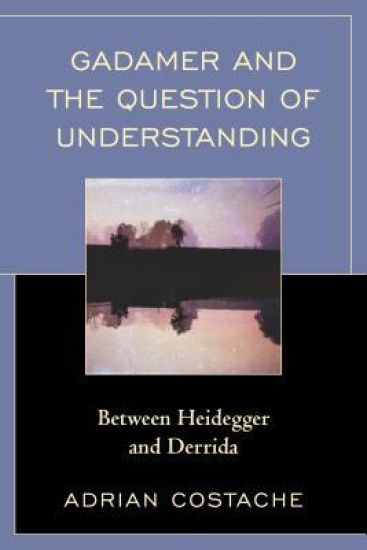
Gadamer and the Question of Understanding

Gadamer and the Question of Understanding

Adrian Costache

Lexington Books
2016
sidottu
Hans-Georg Gadamer is depicted as a paradoxical figure in the literature. When Gadamer’s work is approached by itself, outside the history of hermeneutics, he is generally presented as the disciple of Martin Heidegger, whose main theoretical contribution lies in having transposed his ontological hermeneutics into the sphere of the human sciences. Usually the master-student relation ends with a break between the two brought about by the student’s desire to become herself a master. In Gadamer and Heidegger’s case, scholarship has always excluded the possibility of such a symbolic parricide. However, when Gadamer’s work is approached from the history of hermeneutics, he, not Heidegger, is revered as the central figure of hermeneutic theory in the twentieth century, and scholars perceive the works of the latter—together with those of his immediate forerunners Friedrich Schleiermacher and Wilhelm Dilthey—as mere preambles to the great hermeneutic theory proposed by Truth and Method, and the works of those following him as footnotes to it. Gadamer and the Question of Understanding: Between Heidegger and Derrida dismantles this paradox by showing, on the one hand, that Gadamer’s translation of Heidegger involved, as he himself says, a series of “essential alterations” to the original which make philosophical hermeneutics a more coherent and better articulated hermeneutic theory, one offering a more faithful description of the phenomenon of understanding than Heidegger’s. And, on the other hand, by taking the dossier of the famous encounter between Gadamer and Derrida as its cue, Adrian Costache demonstrates that in light of Derrida’s deconstruction, every step Gadamer takes forward from Heidegger as well as from Schleiermacher and Dilthey—however necessary--is problematic in itself. The insights in this book will be valuable to students and scholars interested in modern and contemporary European philosophy, especially those focusing on philosophical hermeneutics and deconstruction, as well as those working in social sciences that have incorporated a hermeneutic approach to their investigations, such as pedagogy, sociology, psychotherapy, law, and nursing.
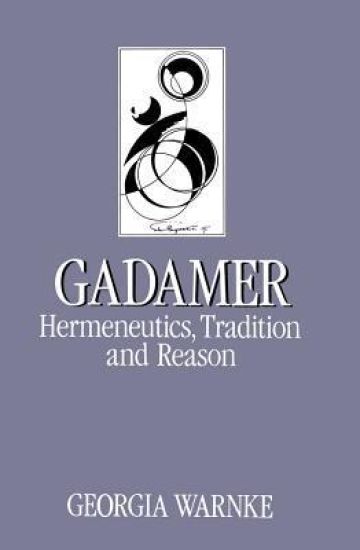
Gadamer

Gadamer

Georgia Warnke

Polity Press
1987
nidottu
Hans-Georg Gadamer is one of the leading philosophers in the world today. His philosophical hermeneutics has had a major impact in a wide range of disciplines, including the social sciences, literary criticism, theology and jurisprudence. Truth and Method, his major work, is widely recognised to be one of the great classics of twentieth-century thought. In this book Georgia Warnke provides a clear and systematic exposition of Gadamer's work, as well as a balanced and thoughtful assessment of his views. Warnke gives particular attention to the ways in which Gadamer's work has been taken up and criticised by literary critics, social theorists and philosophers, such as Hirsch, Habermas and Rorty. She thus provides an introduction to Gadamer which demonstrates the relevance of his work to current debates in a variety of disciplines. This book will be invaluable to students and specialists throughout the humanities and social sciences, as well as to anyone who is interested in the most important developments in contemporary thought.
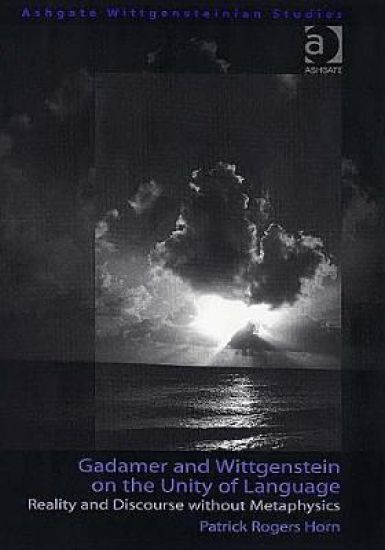
Gadamer and Wittgenstein on the Unity of Language

Gadamer and Wittgenstein on the Unity of Language

Patrick Rogers Horn

Ashgate Publishing Limited
2005
sidottu
In this innovative comparison of Gadamer and Wittgenstein, the author explores their common concern with the relation of language to reality. Patrick Horn's starting point is the widely accepted view that both philosophers rejected a certain metaphysical account of that relation in which reality determines the nature of language. Horn proceeds to argue that Gadamer never completely escaped metaphysical assumptions in his search for the unity of language. In this respect, argues Horn, Gadamer's work is nearer to the earlier rather than to the later Wittgenstein. The final chapter of the book highlights the work of Wittgenstein’s pupil Rush Rhees, who shows that Wittgenstein's own later emphasis on language games, while doing justice to the variety of language, does less than justice to the dialogical relation between speakers of a language, wherein the unity of language resides. Contrasting Rhees's account of the unity of language with those given by Gadamer and the early Wittgenstein brings out the importance of understanding reality in terms of the life that people share rather than in terms of what philosophers say about reality.
Gadamer and Law

Gadamer and Law

Francis J. Mootz Iii

Ashgate Publishing Limited
2007
sidottu
Hans-Georg Gadamer’s philosophical hermeneutics is especially relevant for law, which is grounded in the interpretation of authoritative texts from the past to resolve present-day disputes. In this collection, leading scholars consider the importance of Gadamer’s philosophy for ongoing disputes in legal theory. The work of prominent philosophers, including Fred Dallmayr, P. Christopher Smith and David Hoy, is joined with the work of leading legal theorists, such as William Eskridge, Lawrence Solum and Dennis Patterson, to provide an overview of the connections between law and Gadamer’s hermeneutical philosophy. Part I considers the relevance of Gadamer’s philosophy to longstanding disputes in legal theory such as the debate over originalism, the rule of law and proper modes of statutory and constitutional exegesis. Part II demonstrates Gadamer’s significance for legal theory by comparing his approach to the work of Nietzsche, Habermas and Dworkin.
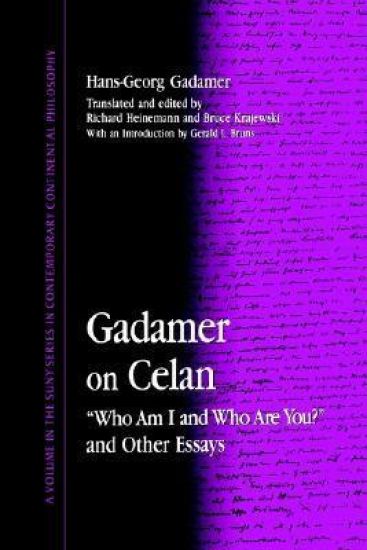
Gadamer on Celan

Gadamer on Celan

Hans-Georg Gadamer

State University of New York Press
1997
pokkari
Brings together all of Gadamer's published writings on Celan's poetry, and makes them available in English for the first time. This is accessible commentary on a notoriously difficult poet.Gadamer on Celan makes all of Hans-Georg Gadamer's published writings on Paul Celan's poetry available in English for the first time. Gadamer's commentaries on Celan's work are explicitly meant for a general audience, and they are further testimony to Celan's growing importance in world literature since the Second World War. Celan's poetry has attracted the attention of many well-known figures, including Maurice Blanchot, Jacques Derrida, Edmond Jabès, Otto Poggeler, and George Steiner. As Steiner has said, "It will take a long time for our sensibilities to apprehend poetry of these dimensions and this radicality." Gadamer's commentaries will help readers to listen to Celan's poetry, and to become acquainted with his only book-length commentary on a poet, using the best example of Gadamer's thinking on the relationship of philosophy and poetry.This book also contains a translation of Who Am I and Who Are You?, the centerpiece of Gadamer's most important philosophical project since the publication of Truth and Method (1960). Who Am I and Who Are You? demonstrates Gadamer's continual engagement with the key figures of twentieth-century thought, and his responsiveness to the challenges of modernist art and its various affronts to hermeneutics.
Gadamer

Gadamer

Georgia Warnke

Stanford University Press
1987
nidottu
Hans-Georg Gadamer is one of the leading philosophers in the world today. Since the publication in 1960 of his magnum opus Truth and Method, his philosophical hermeneutics has been the focus of a great deal of attention and controversy. His ideas have been applied to questions of interpretation in the study of art and literature, to issues of knowledge and objectivity in the social sciences, and even to reevaluations of philosophy itself.This book is a systematic introduction to Gadamer's work, presented with a clarity of exposition and argument that makes it rewarding to non-philosophers and philosophers alike. It is constructed around a series of debates on historicism, authorial intention, subjectivism, ideology, and the "New Pragmatism," and it pays particular attention to how Gadamer's work has been interpreted and criticized by such philosophers as Hirsch, Habermas, Apel, and Rorty. The dialogic form, which is in itself a central feature of hermeneutic theory, gives the book an immediacy that textual exegesis cannot achieve.This is the first book in the series, Key Contemporary Thinkers, which will make available the ideas of some of the most influential philosophers of our time. The series will cut across academic disciplines and will include books on European, British, and American thinkers.
Gadamer's Hermeneutics

Gadamer's Hermeneutics

Robert J. Dostal

Northwestern University Press
2022
nidottu
In Gadamer’s Hermeneutics Robert J. Dostal provides a comprehensive and critical account of Hans-Georg Gadamer’s hermeneutical philosophy, arguing that Gadamer’s enterprise is rooted in the thesis that “being that can be understood is language.” He defends Gadamer against charges of linguistic idealism and emphasizes language’s relationship to understanding, though he criticizes Gadamer for too often ignoring the role of the prelinguistic in our experience. Dostal goes on to explain the important role of the concept of “the inner word” for Gadamer’s account of language.The book situates Gadamer’s hermeneutics in three important ways: in relation to the contestability of the legacy of the Enlightenment project; in relation to the work of his mentor, Martin Heidegger; and in relation to Gadamer’s reading of Plato and Aristotle. Dostal explores both Gadamer’s claim on the Enlightenment and his ambivalence toward it. He considers Gadamer’s dependence on Heidegger’s accomplishment while pointing out the ways in which Gadamer charted his own course, rejecting his teacher’s reading of Plato and his antihumanism. Dostal points out notable differences in the philosophers’ politics as well. Finally, Dostal mediates between Gadamer’s hermeneutics and what might be called philological hermeneutics. His analysis defends the civic humanism that is the culmination of the philosopher’s hermeneutics, a humanism defined by moral education, common sense, judgment, and taste. Supporters and critics of Gadamer’s philosophy will learn much from this major achievement.
Gadamer's Hermeneutics

Gadamer's Hermeneutics

Robert J. Dostal

Northwestern University Press
2022
sidottu
In Gadamer’s Hermeneutics Robert J. Dostal provides a comprehensive and critical account of Hans-Georg Gadamer’s hermeneutical philosophy, arguing that Gadamer’s enterprise is rooted in the thesis that “being that can be understood is language.” He defends Gadamer against charges of linguistic idealism and emphasizes language’s relationship to understanding, though he criticizes Gadamer for too often ignoring the role of the prelinguistic in our experience. Dostal goes on to explain the important role of the concept of “the inner word” for Gadamer’s account of language.The book situates Gadamer’s hermeneutics in three important ways: in relation to the contestability of the legacy of the Enlightenment project; in relation to the work of his mentor, Martin Heidegger; and in relation to Gadamer’s reading of Plato and Aristotle. Dostal explores both Gadamer’s claim on the Enlightenment and his ambivalence toward it. He considers Gadamer’s dependence on Heidegger’s accomplishment while pointing out the ways in which Gadamer charted his own course, rejecting his teacher’s reading of Plato and his antihumanism. Dostal points out notable differences in the philosophers’ politics as well. Finally, Dostal mediates between Gadamer’s hermeneutics and what might be called philological hermeneutics. His analysis defends the civic humanism that is the culmination of the philosopher’s hermeneutics, a humanism defined by moral education, common sense, judgment, and taste. Supporters and critics of Gadamer’s philosophy will learn much from this major achievement.
Gadamer, History and the Classics

Gadamer, History and the Classics

Alison Forsyth

Peter Lang Publishing Inc
2002
sidottu
Should The Merchant of Venice be staged post-Holocaust? How was Antigone (an icon of noble suffering in the Western liberal humanist tradition) received in Apartheid-riven South Africa? These are some of the questions confronted in this examination of the potential of rewriting the classics to produce new or altered meanings by virtue and not in spite of such works' cultural cachet. Too often the space that exists between present realities and the interpretative stasis that typifies our reception of canonical texts is overlooked or used to bolster fruitless canon-busting polemics. This book persuasively advocates the productive potential of rewriting the canon whereby we are challenged to re-cognize that the often unsatisfactory absolutes with which we attempt to rationalize the world are inextricably bound up with, shaped and sustained by our hermeneutically dulled reception of high culture.
Gadamer: A Guide for the Perplexed

Gadamer: A Guide for the Perplexed

Chris Lawn

BLOOMSBURY PUBLISHING PLC
2006
sidottu
Continuum's Guides for the Perplexed are clear, concise and accessible introductions to thinkers, writers and subjects that students and readers can find especially challenging. Concentrating specifically on what it is that makes the subject difficult to fathom, these books explain and explore key themes and ideas, guiding the reader towards a thorough and confident understanding of demanding material. Hans-Georg Gadamer is one of the formeost European philosophers of recent times. His work on philosophical hermeneutics defined the whole subject, and Truth and Method, his magnum opus, is a landmark text in modern philosophy. However, Gadamer's ideas, the complex relationship between them, and the often opaque way they are expressed, undoubtedly pose a considerable challenge for the reader. Gadamer: A Guide for the Perplexed is the ideal text for anyone trying to get to grips with Gadamer's work. Providing a clear account of the central tenets of Gadamer's philosophy, the book does not shy away from the more complex material and provides an invaluably thorough and fully engaged account of Gadamer's hermeneutics. There is clear exposition and analysis of such key terms - often problematic for the reader - as 'fusion of horizons', 'effective historical consciousness' and 'the logic of question and answer', as well as Gadamer's redefinition of such concepts as 'prejudice', 'authority' and 'tradition'. The book also discusses Gadamer's influence in other areas of philosophy; the response of other philosophers to his work; and criticisms of his work on the grounds of relativism.
Gadamer: A Guide for the Perplexed

Gadamer: A Guide for the Perplexed

Chris Lawn

Continuum International Publishing Group Ltd.
2006
nidottu
Continuum's Guides for the Perplexed are clear, concise and accessible introductions to thinkers, writers and subjects that students and readers can find especially challenging. Concentrating specifically on what it is that makes the subject difficult to fathom, these books explain and explore key themes and ideas, guiding the reader towards a thorough and confident understanding of demanding material. Hans-Georg Gadamer is one of the formeost European philosophers of recent times. His work on philosophical hermeneutics defined the whole subject, and Truth and Method, his magnum opus, is a landmark text in modern philosophy. However, Gadamer's ideas, the complex relationship between them, and the often opaque way they are expressed, undoubtedly pose a considerable challenge for the reader. Gadamer: A Guide for the Perplexed is the ideal text for anyone trying to get to grips with Gadamer's work. Providing a clear account of the central tenets of Gadamer's philosophy, the book does not shy away from the more complex material and provides an invaluably thorough and fully engaged account of Gadamer's hermeneutics. There is clear exposition and analysis of such key terms - often problematic for the reader - as 'fusion of horizons', 'effective historical consciousness' and 'the logic of question and answer', as well as Gadamer's redefinition of such concepts as 'prejudice', 'authority' and 'tradition'. The book also discusses Gadamer's influence in other areas of philosophy; the response of other philosophers to his work; and criticisms of his work on the grounds of relativism.
Gadamer

Gadamer

Ingrid H. Scheibler

Rowman Littlefield
2000
nidottu
One of the first book-length studies to examine Gadamer's relation to Heidegger in depth, this important work looks at the ways in which Gadamer positively appropriates central elements of Heidegger's work as well as the way he extends Heidegger's critique of Western metaphysics, avoiding and tacitly challenging some of the most problematical aspects of Heidegger's work. By examining two of the central concepts in Gadamer's work, tradition and language, and by analyzing Gadamer's relation to his mentor, Martin Heidegger, Sheibler successfully shows that far from being the conservative both modernist and post-modernist critics have accused him of being, Gadamer anticipates a number of concerns central to post-modern or post-structuralist thought.