

Kirjahaku
Etsi kirjoja tekijän nimen, kirjan nimen tai ISBN:n perusteella.
1000 tulosta hakusanalla Gerry Feld


A former NPR correspondent takes you into his own ghost-filled life as he reports on a region in turmoil. Gerry Hadden was training to become a Buddhist monk when opportunity came knocking: the offer of a dream job as NPR's correspondent for Latin America. Arriving in Mexico in 2000 during the nation's first democratic transition of power, he witnesses both hope and uncertainty. But after 9/11, he finds himself documenting overlooked yet extraordinary events in a forgotten political landscape. As he reports on Colombia's drug wars, Guatemala's deleterious emigration, and Haiti's bloody rebellion, Hadden must also make a home for himself in Mexico City, coming to terms with its ghosts and chasing down the love of his life, in a riveting narrative that reveals the human heart at the center of international affairs.

The Naughty List meets Elf in Max Fernsby and the Infinite Toys, a charming, hilarious, illustrated middle grade Christmas tale about three friends who join forces with the two wayward elves to save the holidays Max Fernsby seems like your typical 10-year-old kid, but when a red bag- literally falls on his head from the sky, Max finds he suddenly has the power to produce any toy in the world But what Max doesn't realize is that the red bag only wound up in his hands because two of Santa's most troublesome elves decided to take Santa's sleigh for a joy ride. The bag fell out along the way, and if they don't get it back to the North Pole soon, Christmas itself may be in jeopardy. Not to mention a greedy businessman has eyes on the bag and wants to steal it for himself It's a race against time to save Christmas in this hilarious, illustrated, middle grade adventure from the acclaimed screenwriting duo of Peter Gaulke and Gerry Swallow.

"A scathing indictment of how law is taught, practiced, and administered in this country . . . One of the best books ever written on the law."--The Denver Post Renowned trial lawyer Gerry Spence takes an in-depth look at the American justice system and reveals a terrible truth: If you don't have power or money, then you likely won't receive justice either. The wealthy buy their way out of trouble, while the poor are punished. In an effort to combat this corruption, the author devises a number of reforms, tackling issues in every area of the system from law school to the courtroom. "Passionately eloquent and innovative, trial attorney Spence here argues the evils of the justice system itself and its abuse by monied interests such as corporations, 'the most cruel, calculating, and accomplished criminals of all time.'"--Publishers Weekly

An Anglican priest hands out brass knuckles to his congregation to guard his church from anti-Christmas fanatics. Fascists insist that the real Christmas is the Winter Solstice, while Communists stage atheist musicals outside of churches on Christmas Eve. Activists vandalize shops that set out holiday advertising in October and anti-consumerists sing parody carols in shopping malls. Is there such a thing as a War on Christmas? As Gerry Bowler demonstrates in this entertaining book, there is and always has been a War, or rather, several wars, on Christmas. Christmas, a global phenomenon adored by billions and a backbone of international trade, is the biggest single event on the planet. For Christians it is the second-most sacred date on the calendar. But whether one celebrates it or not, it engages billions of people who are caught up in its commercialism, music, sentiment, travel, and frenetic busyness. Since its controversial invention in the Roman Empire, Christmas has struggled with paganism, popular culture, fierce Christian opposition to its celebration, its abolition in Scotland and New England, and its neglect and near-death experience in the 1700s, only to be miraculously reinvented in the 1800s. The twentieth century saw it opposed by Bolsheviks, twisted by Hitler, and appropriated by every special interest group in the industrialized world. Lately it has been caught up in the cultural struggles between the left and the right in America, often misinterpreted as a war on Christmas, when the fight is really over whether religion in general will be allowed a public face. Gerry Bowler tells the fascinating story of the tug-of-war over Christmas, replete with cross-dressing priests, ranting Puritans, atheist witches, the League of the Militant Godless, aesthetic terrorists in Quebec and rap-singing Santa killers in Spain.

The Sentimental Life of International Law is about our age-old longing for a decent international society and the ways of seeing, being, and speaking that might help us achieve that aim. This book asks how international lawyers might engage in a professional practice that has become, to adapt a title of Janet Malcolm's, both difficult and impossible. It suggests that international lawyers are disabled by the governing idioms of international lawyering, and proposes that they may be re-enabled by speaking different sorts of international law, or by speaking international law in different sorts of ways. In this methodologically diverse and unusually personal account, Gerry Simpson brings to the surface international law's hidden literary prose and offers a critical and redemptive account of the field. He does so in a series of chapters on international law's bathetic underpinnings, its friendly relations, the neurotic foundations of its underlying social order, its screened-off comic dispositions, its anti-method, and the life-worlds of its practitioners. Finally, the book closes with a chapter in which international law is re-envisioned through the practice of gardening. All of this is put forward as a contribution to the project of making international law, again, a compelling language for our times.
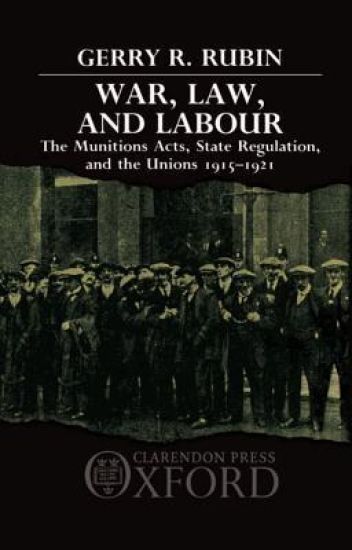
This book examines the working of the Munition of War Acts 1915-1917, during the First World War. The munitions code, parts of which remained in force until 1921, appeared at first to constitute a radical break with the pre-war voluntarist system of industrial relations. It aimed to prevent strikes by law, it imposed wage controls and tighter factory discipline and discouraged munitions workers from leaving their jobs. Munitions tribunals were established to enforce the law. Using, among other sources, the evidence offered by the tribunal proceedings under the Acts, the author suggests that a policy of strict enforcement of the law was transformed to one of sensitive conflict management, involving trade unionists, employers, and the tribunal judges. The identification of complex working-class attitudes to the wartime state accounts largely for the creation of this modus vivendi, despite the controversial nature of the legislation. This book, though dealing with events which arose during wartime in an atmosphere of militarism, radicalism as well as patriotism, inflation and full employment, may nevertheless offer glimpses of insight to analysts of modern industrial relations.

Language is one of the faculties that sets humans apart from animals, the crucial thing which makes our complex social interactions possible. The Ascent of Babel explores the ways in which the mind produces and understands language: the ways in which the sounds of language evoke meaning, and the ways in which the desire to communicate causes us to produce those sounds to begin with. The `ascent' symbolises different things: the progression from sound to meaning, the ascent that we each undergo, from birth onwards, as we learn our mother tongue, and the quest to understand the mental processes which underlie our use of language. Gerry Altmann leads the reader on this ascent - a fascinating tour which takes us from babies learning to say words to the production of spoken and written language, the effects of brain damage on language, and the ways in which computer simulations of interconnecting nerve cells can learn language. The Ascent of Babel is a journey of discovery, written in an engaging and witty style, at the end of which it becomes clear that Babel's summit - the secret of language - may actually lie at its foundations, where babies play and language is learned.

Geopolitics and Empire examines the relations between two phenomena that are central to modern conceptions of international relations. Geopolitics is the understanding of the inter-relations between empires, states, individuals, private companies, NGOs and multilateral agencies as these are expressed and shaped spatially. This view of the world achieved notoriety as the scientific basis claimed by Nazi ideologists of global conquest. However, under this or another name, similar sets of ideas were important on both sides of the Cold War and now have a renewed resonance in debates over the New World Order of the so-called Global War on Terror. Geopolitics is a way of describing the conflicts between states as constrained by both physical and economic space. It makes such conflicts seem inevitable. The argument of the book is that this view of the world continues to appear salient because it serves to make the projection of force overseas seem an inevitable aspect of the foreign policy of states. This quasi-Darwinian view of international relations makes the pursuit of Empire appear a responsibility of larger and more powerful states. Powerful states must become Empires or submit to others seeking something similar. In its associations with Empire, the study of Geopolitics returns continually to the ideas of a British geographer who never himself used the term. Halford Mackinder is the source of many of the ideas of Geopolitics and by examining his ideas both in their original context and as they have been repeatedly rediscovered and reinvented this book contributes to current discussions of the ideology and practices of the US Empire today.

In the summer of 2019, the Deh Cho created winds that were unprecedented and demonstrated once again the power of mother nature and the permanency of father time. Accompany the canoeist as he deals with winds, sandstorms, waves and cold. Partner with the canoeist as he embarks on a parallel journey of the mind as he explores his thoughts, observations and conclusions that help him make sense of it all. It is not a journey of inner conflicts, obstacles, struggles or battles, nor one of defeat; it's a journey into the world of inner solutions, adaptability, flexibility and creativity that become tools in dealing with situations that are not only applied to the canoe journey but also to life's journey.

In the summer of 2019, the Deh Cho created winds that were unprecedented and demonstrated once again the power of mother nature and the permanency of father time. Accompany the canoeist as he deals with winds, sandstorms, waves and cold. Partner with the canoeist as he embarks on a parallel journey of the mind as he explores his thoughts, observations and conclusions that help him make sense of it all. It is not a journey of inner conflicts, obstacles, struggles or battles, nor one of defeat; it's a journey into the world of inner solutions, adaptability, flexibility and creativity that become tools in dealing with situations that are not only applied to the canoe journey but also to life's journey.

The Relevance of Political Science
Gerry Stoker; B. Guy Peters; Jon Pierre
Red Globe Press
2015
sidottu
What does political science tell us about important real-world problems and issues? And to what extent does and can political analysis contribute to solutions? Debates about the funding, impact and relevance of political science in contemporary democracies have made this a vital and hotly contested topic of discussion, and in this original text authors from around the world respond to the challenge.A robust defence is offered of the achievements of political science research, but the book is not overly sanguine given its sustained recognition of the need for improvement in the way that political science is done. New insights are provided into the general issues raised by relevance, into blockages to relevance, and into the contributions that the different subfields of political science can and do make. The book concludes with a new manifesto for relevance that seeks to combine a commitment to rigour with a commitment to engagement.

The Relevance of Political Science
Gerry Stoker; B. Guy Peters; Jon Pierre
Red Globe Press
2015
nidottu
What does political science tell us about important real-world problems and issues? And to what extent does and can political analysis contribute to solutions? Debates about the funding, impact and relevance of political science in contemporary democracies have made this a vital and hotly contested topic of discussion, and in this original text authors from around the world respond to the challenge.A robust defence is offered of the achievements of political science research, but the book is not overly sanguine given its sustained recognition of the need for improvement in the way that political science is done. New insights are provided into the general issues raised by relevance, into blockages to relevance, and into the contributions that the different subfields of political science can and do make. The book concludes with a new manifesto for relevance that seeks to combine a commitment to rigour with a commitment to engagement.
Making Sense of Data and Statistics in Psychology
Gerry Mulhern; Brian Greer
Red Globe Press
2011
nidottu
Statistics is one of the most useful elements of any psychology degree. This popular textbook will equip you with the tools needed not only to make sense of your own data and research, but also to think critically about the research and statistics you will encounter in everyday life. Features include: - Logical, intuitive organization of key statistical concepts and tests with an emphasis on understanding which test to use and why - Innovative graphic illustrations and insightful dialogues that help you to get to grips with statistics - Concise, easy-to-follow guidelines for making sense of SPSS - COverage of more complex tests and concepts for when you need to dig deeper Making Sense of Data and Statistics in Psychology will help you design experiments, analyse data with confidence and establish a solid grounding in statistics; it will become a valuable resource throughout your studies. Companion Site: www.palgrave.com/psychology/mulhern2eAn innovative and easy-to-read introduction to understanding statistical concepts and data in Psychology, written with even the most maths-averse Psychology student in mind. Authored by the current president of the BPS (British Psychological Society), this second edition includes guidance for SPSS and extended statistical coverage to bridge the gap between conceptual understanding of data and how to run statistical tests.Confronts the challenge of teaching statistics The material is structured so that the reader revisits ideas at increasing levels of sophistication, building on their existing knowledge in order to develop their understanding of statistics. This book, grounded in the authors' research into the way students learn maths and statistics, provides a 'way in' to statistics for all Psychology undergraduates, from those who have studied Maths to A Level to those who find their statistics courses to be the most daunting of their university years. The authors emphasise the importance of developing a 'feel' for data, particularly through visual representation, before statistical tests are discussed in detail. Making extensive use of exploratory data analysis, the text emphasises conceptual understanding. Concepts are introduced and clearly explained, enabling the student to understand the foundations of data analysis in interpreting psychological research. There is an abundant use of examples from psychological research throughout, helping students to get to grips with different forms of data. Flexible approachCan easily be integrated into 'standard courses', but also used to support more mathematicallyorientated courses.Reinforces understandingAvoids the jargon that makes statistics so inaccessible to many Psychology students. Pedagogical features include Socratic dialogues between statisticsaverse students and their lecturers; 'Making Links' boxes to help students see the connections between basic and more complex tests; and innovative comprehension check boxes which encourage students to stop and think before reading on. A new feature, 'Making sense of SPSS', links this conceptual comprehension to the way students mostly carry out their statistical tests. Making Sense of Data and Statistics in Psychology ensures that students have a firm basis in the use of statistics that will serve them for life, not just for the duration of their statistics course.

Making Sense of Data and Statistics in Psychology
Gerry Mulhern; Brian Greer
Palgrave Macmillan
2011
sidottu
The second edition of this popular textbook is perfect for psychology students new to statistics or those who want to develop a better feel for handling data and the concepts behind data analysis, without the technical jargon. Using Socratic dialogues, diagrams and examples with SPSS, the emphasis is on clear explanations in everyday language.
Profound social changes have made governance and political leadership more challenging than ever. The result is that politics in the democratic world faces a crisis in the 21st century. The revised edition of this highly successful text reassesses the gap between citizen expectation and the realities of government in light of new developments.
Profound social changes have made governance and political leadership more challenging than ever. The result is that politics in the democratic world faces a crisis in the 21st century. The revised edition of this highly successful text reassesses the gap between citizen expectation and the realities of government in light of new developments.

Vietnam is a dramatic guide to the suffering, sacrifice, and heroism of the Vietnam War. It sees the highs and lows of the world's first televised war through the eyes of those who fought in it, both the generals commanding the war and the ordinary soldiers on the ground and in the air. Features memorabilia from key US archives and personal collections that go to the heart of the war, such as soldiers' letters, ID cards, and political memos.

This book is a comprehensive guide to buying and developing multimedia in the most cost-effective manner. Focusing on the human factors in producing multimedia, rather than just the software, Buying and Selling Multimedia Services is aimed at both buyers and sellers of multimedia services and draws on real-world anecdotes¦war stories¦from project diaries and first-hand experience, to provide examples of the key ideas delineated within the book. These are true stories culled from 25 years of working on both sides of the desk as a purchaser of creative services for a Fortune 500 company and as a producer and seller for one of the largest multimedia production shops in the country. This book helps the multimedia producer and buyer to recognize flaws in past performances and to anticipate situations in future projects in order to save money and eliminate boardroom confrontations. Accusations, altercations, and recriminations can be avoided and the bottom line enhanced with the production of an effective product targeted to a receptive audience. Souter examines the skills necessary to both the producer and the purchaser of multimedia, allowing each to see the others' problems and viewpoints. Viewing the multimedia project from both sides, as both buyer and seller, Souter highlights the issues which will allow for effective communication between parties, resulting in a better product and a more creative relationship among all involved. In the second part of the book, Souter provides a comprehensive guide to all the digital formats available, to help the buyer and the developer select the most appropriate for a given project.