Kirjojen hintavertailu. Mukana 11 627 064 kirjaa ja 12 kauppaa.

Kirjahaku

Etsi kirjoja tekijän nimen, kirjan nimen tai ISBN:n perusteella.

1000 tulosta hakusanalla Gillian Firth

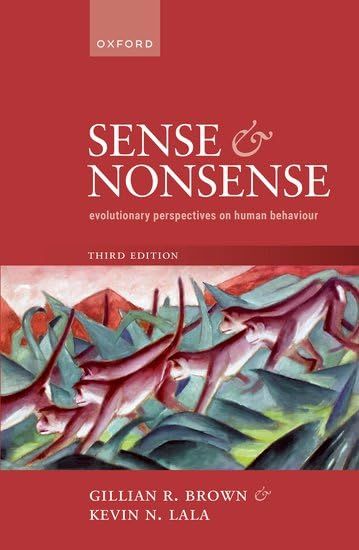
Sense and Nonsense

Sense and Nonsense

Gillian R. Brown; Kevin N. Lala

Oxford University Press
2024
nidottu
Evolutionary theory is one of the most wide-ranging and inspiring scientific ideas, and it offers a battery of methods that can be used to interpret human behaviour. However, researchers disagree about the best ways to use evolution to explore humanity, and a number of schools of thought have emerged. Sense and Nonsense, third edition, provides an introduction to the ideas, methods and findings of five such schools, namely sociobiology, human behavioural ecology, evolutionary psychology, cultural evolution and gene-culture coevolution. In this revised and updated edition of their successful monograph, Brown and Lala provide a balanced and rigorous analysis that scrutinises both the evolutionary arguments and the allegations of the critics, carefully guiding the reader through the mire of confusing terminology, claim, and counter-claim, and polemical statements. This readable and informative introductory book will be of use to undergraduate and postgraduate students (for example in psychology, anthropology and zoology), as well as experts on one approach who would like to know more about the other perspectives and lay-persons interested in evolutionary explanations of human behaviour. Having completed the book, the reader will feel better placed to assess the legitimacy of claims made about human behaviour under the name of evolution and to make judgements as to what is sense and what is nonsense.
Barriers to Entailment

Barriers to Entailment

Gillian K. Russell

Oxford University Press
2025
nidottu
A barrier to entailment exists if you can't get conclusions of a certain kind from premises of another. One of the most famous barriers in philosophy is Hume's Law, which says that you can't get normative conclusions from descriptive premises, or in slogan form: you can't get an ought from an is. This barrier is highly controversial, and many famous counterexamples were proposed in the last century. But there are other barriers which function almost as philosophical platitudes: no Universal conclusions from Particular premises, no Future conclusions from premises about the Past, and no claims that attribute Necessity from premises that merely tell us how things happen to be in the Actual world. Barriers to Entailment proposes a unified logical account of five barriers that have played important roles in philosophy, in the process showing how to diagnose proposed counterexamples and arguing that the case for Hume's Law is as strong as that for the platitudinous barriers. The first two parts of the book employ techniques from formal logic, but present them in an accessible way, suitable for any reader with some background in first-order model theory (of the kind that might be taught in a first class in logic). Gillian Russell introduces tense, modal, indexical, and deontic formal logics, but always avoids unneeded complexity. Each barrier is connected to broader philosophical topics: universality, time, necessity, context-sensitivity, and normativity. Russell brings out under-recognised connections between the domains and lays the groundwork for further work at the intersections. The last part of the book transposes the formal work to informal barrier theses in the philosophy of language, in the process doing new work on the concept of logical consequence, and providing new responses to proposed informal counterexamples to Hume's Law which employ hard-to-formalise tools from natural language, such as speech acts and thick normative expressions.
Financial Management: Turning Theory into Practice

Financial Management: Turning Theory into Practice

Gillian Bartlett; Greg Beech; Freddy de Hart; Phillip de Jager; Johann de Lange; Pierre Erasmus; Johan Hefer; Thabiso Madiba; Sanlie Middelberg; Gregory Plant; Jonathan Streng; Dave Thayser; Surika van Rooyen

Oxford University Press Southern Africa
2014
nidottu
Financial management: Turning theory into practice is an accessible and principles-based financial management textbook for undergraduate and Honours Accounting students. The book takes cognizance of changes in the economic environment and their implications for the role of financial management and the teaching of the subject. Financial management follows the SAICA syllabus for financial management but also takes the skills required by the CIMA syllabus into account. It acknowledges the intent behind the SAICA Competency Framework to develop problem-solving, critical thinking and ethical business leaders, but at the same time provides academic and financial literacy support to students. This guided approach serves to produce both technically competent students as well as students who will be capable financial leaders in the workplace. Financial management supports students in the following ways: - Opening case studies engage student interest and illustrate why the principles that will be dealt with in the chapter are important for the successful financial management of South African companies. - Critical thinking boxes encourage students to think deeply about the consequences of various actions in the business environment, such as implementing financial performance measures, thereby developing their reasoning skills. - Worked examples guide students through problems in a step-by-step manner and give them confidence to tackle questions on their own. -Self-assessment questions test understanding of the key concepts. - 'Finance in action' boxes provide real-life examples of the theory covered in the chapter. The book is aimed at undergraduate and Honours Financial Management students enrolled in BCom Accounting courses at universities, primarily those following a CA route.
Global Justice

Global Justice

Gillian Brock

Oxford University Press
2009
sidottu
Gillian Brock develops a viable cosmopolitan model of global justice that takes seriously the equal moral worth of persons, yet leaves scope for defensible forms of nationalism and for other legitimate identifications and affiliations people have. Brock addresses two prominent kinds of skeptic about global justice: those who doubt its feasibility and those who believe that cosmopolitanism interferes illegitimately with the defensible scope of nationalism by undermining goods of national importance, such as authentic democracy or national self-determination. The model addresses concerns about implementation in the world, showing how we can move from theory to public policy that makes progress toward global justice. It also makes clear how legitimate forms of nationalism are compatible with commitments to global justice. Global Justice is divided into three central parts. In the first, Brock defends a cosmopolitan model of global justice. In the second, which is largely concerned with public policy issues, she argues that there is much we can and should do toward achieving global justice. She addresses several pressing problems, discussing both theoretical and public policy issues involved with each. These include tackling global poverty, taxation reform, protection of basic liberties, humanitarian intervention, immigration, and problems associated with global economic arrangements. In the third part, she shows how the discussion of public policy issues can usefully inform our theorizing; in particular, it assists our thinking about the place of nationalism and equality in an account of global justice.
Global Justice

Global Justice

Gillian Brock

Oxford University Press
2009
nidottu
Gillian Brock develops a viable cosmopolitan model of global justice that takes seriously the equal moral worth of persons, yet leaves scope for defensible forms of nationalism and for other legitimate identifications and affiliations people have. Brock addresses two prominent kinds of skeptic about global justice: those who doubt its feasibility and those who believe that cosmopolitanism interferes illegitimately with the defensible scope of nationalism by undermining goods of national importance, such as authentic democracy or national self-determination. The model addresses concerns about implementation in the world, showing how we can move from theory to public policy that makes progress toward global justice. It also makes clear how legitimate forms of nationalism are compatible with commitments to global justice. Global Justice is divided into three central parts. In the first, Brock defends a cosmopolitan model of global justice. In the second, which is largely concerned with public policy issues, she argues that there is much we can and should do toward achieving global justice. She addresses several pressing problems, discussing both theoretical and public policy issues involved with each. These include tackling global poverty, taxation reform, protection of basic liberties, humanitarian intervention, immigration, and problems associated with global economic arrangements. In the third part, she shows how the discussion of public policy issues can usefully inform our theorizing; in particular, it assists our thinking about the place of nationalism and equality in an account of global justice.
Truth in Virtue of Meaning

Truth in Virtue of Meaning

Gillian Russell

Oxford University Press
2008
sidottu
The analytic/synthetic distinction looks simple. It is a distinction between two different kinds of sentence. Synthetic sentences are true in part because of the way the world is, and in part because of what they mean. Analytic sentences - like all bachelors are unmarried and triangles have three sides - are different. They are true in virtue of meaning, so no matter what the world is like, as long as the sentence means what it does, it will be true. This distinction seems powerful because analytic sentences seem to be knowable in a special way. One can know that all bachelors are unmarried, for example, just by thinking about what it means. But many twentieth-century philosophers, with Quine in the lead, argued that there were no analytic sentences, that the idea of analyticity didn't even make sense, and that the analytic/synthetic distinction was therefore an illusion. Others couldn't see how there could fail to be a distinction, however ingenious the arguments of Quine and his supporters. But since the heyday of the debate, things have changed in the philosophy of language. Tools have been refined, confusions cleared up, and most significantly, many philosophers now accept a view of language - semantic externalism - on which it is possible to see how the distinction could fail. One might be tempted to think that ultimately the distinction has fallen for reasons other than those proposed in the original debate. In Truth in Virtue of Meaning, Gillian Russell argues that it hasn't. Using the tools of contemporary philosophy of language, she outlines a view of analytic sentences which is compatible with semantic externalism and defends that view against the old Quinean arguments. She then goes on to draw out the surprising epistemological consequences of her approach.
An Introduction to Family Law

An Introduction to Family Law

Gillian Douglas

Oxford University Press
2004
nidottu
Gillian Douglas examines family law in England and Wales within a broad social context. The book explores how the law regulates family life, beginning with a discussion of the main social changes and influences on family law in modern society. It then examines which family relationships are legally recognised and the legal consequences that flow from recognition and non-recognition. Family Law provides a detailed account of how children's interests are viewed and protected in family law, and concludes with a consideration of how the law handles the ending of family relationships. Throughout, the book draws out the linkages between different aspects of the subject and its relationship with other areas of the law and with other disciplines. Gillian Douglas also takes full account of the influence of international law, particularly human rights law under the newly incorporated European Convention on Human Rights.
Debating Brain Drain

Debating Brain Drain

Gillian Brock; Michael Blake

Oxford University Press Inc
2015
sidottu
Many of the best and brightest citizens of developing countries choose to emigrate to wealthier societies, taking their skills and educations with them. What do these people owe to their societies of origin? May developing societies legitimately demand that their citizens use their skills to improve life for their fellow citizens? Are these societies ever permitted to prevent their own citizens from emigrating? These questions are increasingly important, as the gap between rich and poor societies widens, and as the global migration of skilled professionals intensifies. This volume addresses the ethical rights and responsibilities of such professionals, and of the societies in which they live. Gillian Brock and Michael Blake agree that the phenomenon of the brain drain is troubling, but offer distinct arguments about what might be permissibly done in response to this phenomenon.
Debating Brain Drain

Debating Brain Drain

Gillian Brock; Michael Blake

Oxford University Press Inc
2015
nidottu
Many of the best and brightest citizens of developing countries choose to emigrate to wealthier societies, taking their skills and educations with them. What do these people owe to their societies of origin? May developing societies legitimately demand that their citizens use their skills to improve life for their fellow citizens? Are these societies ever permitted to prevent their own citizens from emigrating? These questions are increasingly important, as the gap between rich and poor societies widens, and as the global migration of skilled professionals intensifies. This volume addresses the ethical rights and responsibilities of such professionals, and of the societies in which they live. Gillian Brock and Michael Blake agree that the phenomenon of the brain drain is troubling, but offer distinct arguments about what might be permissibly done in response to this phenomenon.
Late Antiquity

Late Antiquity

Gillian Clark

Oxford University Press
2011
nidottu
Late antiquity: decline or transformation, conflict or interaction? Late antiquity is the period (c.300 - c.800) in which barbarian invasions ended Roman Empire in Western Europe by the fifth century and Arab invasions ended Roman rule over the eastern and southern Mediterranean coasts by the seventh century. Asking 'what, where, and when' Gillian Clark presents an introduction to the concept of late antiquity and the events of its time. Not only a period of cultural clashes, political restructurings, and geographical controversies, Clark also demonstrates the sheer richness and diversity of religious life as well as the significant changes to trade, economy, archaeology, and towns. Encapsulating significant developments through vignettes, she reflects upon the period by asking the question 'How much can we recognise in the world of late antiquity?' ABOUT THE SERIES: The Very Short Introductions series from Oxford University Press contains hundreds of titles in almost every subject area. These pocket-sized books are the perfect way to get ahead in a new subject quickly. Our expert authors combine facts, analysis, perspective, new ideas, and enthusiasm to make interesting and challenging topics highly readable.
Postcolonial Life Narratives

Postcolonial Life Narratives

Gillian Whitlock

Oxford University Press
2015
nidottu
The Oxford Studies in Postcolonial Literatures series offers stimulating and accessible introductions to definitive topics and key genres and regions within the rapidly diversifying field of postcolonial literary studies in English. Postcolonial Life Narrative draws together two dynamic fields of contemporary literature and criticism, postcolonialism and life narrative, to create a new assemblage: postcolonial life narrative. Focusing in particular on testimonial narrative, from slave narrative in the late eighteenth century to contemporary Anglophone life narrative from Africa, Australia, the Caribbean, Palestine, North America, and India, this study follows texts on the move through adaptation, appropriation, and remediation. For postcolonial subjects life narrative offers extraordinary opportunities to present accounts of social injustice and oppression, of violence and social suffering. Testimonial narrative can reach across cultures to produce intimate attachments between those who testify and those who bear witness to legacies of apartheid, slavery, rape warfare, genocide, and dispossession. Thresholds of testimony are subject to change and for some, for example refugees and asylum seekers, opportunities to engage a witnessing public and inspire campaigns for social justice on their behalf are curtailed--these are the 'ends of testimony'. The production, circulation, and reception of testimonial life narrative connects directly to the most fundamental questions of who counts as human, what rights follow from this, and what makes for grievable life. Postcolonial life narrative is a dynamic field of literature and criticism, and this book presents a series of proximate readings that outline its distinctive imaginative geographies.
Postcolonial Life Narratives

Postcolonial Life Narratives

Gillian Whitlock

Oxford University Press
2015
sidottu
The Oxford Studies in Postcolonial Literatures series offers stimulating and accessible introductions to definitive topics and key genres and regions within the rapidly diversifying field of postcolonial literary studies in English. Postcolonial Life Narrative draws together two dynamic fields of contemporary literature and criticism, postcolonialism and life narrative, to create a new assemblage: postcolonial life narrative. Focusing in particular on testimonial narrative, from slave narrative in the late eighteenth century to contemporary Anglophone life narrative from Africa, Australia, the Caribbean, Palestine, North America, and India, this study follows texts on the move through adaptation, appropriation, and remediation. For postcolonial subjects life narrative offers extraordinary opportunities to present accounts of social injustice and oppression, of violence and social suffering. Testimonial narrative can reach across cultures to produce intimate attachments between those who testify and those who bear witness to legacies of apartheid, slavery, rape warfare, genocide, and dispossession. Thresholds of testimony are subject to change and for some, for example refugees and asylum seekers, opportunities to engage a witnessing public and inspire campaigns for social justice on their behalf are curtailed--these are the 'ends of testimony'. The production, circulation, and reception of testimonial life narrative connects directly to the most fundamental questions of who counts as human, what rights follow from this, and what makes for grievable life. Postcolonial life narrative is a dynamic field of literature and criticism, and this book presents a series of proximate readings that outline its distinctive imaginative geographies.
Psychology

Psychology

Gillian Butler; Freda McManus

Oxford University Press
2014
nidottu
Psychology is part of everyone's experience: it influences the way we think about everything from education and intelligence, to relationships and emotions, advertising and criminality. People readily behave as amateur psychologists, offering explanations for what people think, feel, and do. But what exactly are psychologists trying to do? What scientific grounding do they have for their approach? This Very Short Introduction explores some of psychology's leading ideas and their practical relevance. In this new edition, Gillian Butler and Freda McManus explore a variety of new topics and ways of studying the brain. Until recently it was not possible to study the living human brain directly, so psychologists studied our behaviour, and used their observations to derive hypotheses about what was going on inside. Now - through neuroscience - our knowledge of the workings of the brain has increased and improved technology provides us with a scientific basis on which to understand the structure and workings of the brain, and allows brain activity to be observed and measured. Exploring some of the most important advances and developments in psychology - from evolutionary psychology and issues surrounding adolescence and aggression to cognitive psychology - this is a stimulating introduction for anyone interested in understanding the human mind. ABOUT THE SERIES: The Very Short Introductions series from Oxford University Press contains hundreds of titles in almost every subject area. These pocket-sized books are the perfect way to get ahead in a new subject quickly. Our expert authors combine facts, analysis, perspective, new ideas, and enthusiasm to make interesting and challenging topics highly readable.
Shakespeare's Unreformed Fictions

Shakespeare's Unreformed Fictions

Gillian Woods

Oxford University Press
2013
sidottu
Why does Catholicism have such an imaginative hold on Shakespearean drama, even though the on-going Reformation outlawed its practice? Shakespeare's Unreformed Fictions contends that the answers to this question are theatrical rather than strictly theological. Avoiding biographical speculation, this book concentrates on dramatic impact, and thoroughly integrates new literary analysis with fresh historical research. In exploring the dramaturgical variety of the 'Catholic' content of Shakespeare's plays, Gillian Woods argues that habits, idioms, images, and ideas lose their denominational clarity when translated into dramatic fiction: they are awkwardly 'unreformed' rather than doctrinally Catholic. Providing nuanced readings of generically diverse plays, this book emphasises the creative function of such unreformed material, which Shakespeare uses to pose questions about the relationship between self and other. A wealth of contextual evidence is studied, including catechisms, homilies, religious polemics, news quartos, and non-Shakespearean drama, to highlight how early modern Catholicism variously provoked nostalgia, faith, conversion, humour, fear, and hatred. This book argues that Shakespeare exploits these contradictory attitudes to frame ethical problems, creating fictional plays that consciously engage audiences in the difficult leaps of faith required by both theatre and theology. By recognizing the playfulness of Shakespeare's unreformed fictions, this book offers a different perspective on the interactions between post-Reformation religion and the theatre, and an alternative angle on Shakespeare's interrogation of the scope of dramatic fiction.
Truth in Virtue of Meaning

Truth in Virtue of Meaning

Gillian Russell

Oxford University Press
2011
nidottu
The analytic/synthetic distinction looks simple. It is a distinction between two different kinds of sentence. Synthetic sentences are true in part because of the way the world is, and in part because of what they mean. Analytic sentences--like all bachelors are unmarried and triangles have three sides--are different. They are true in virtue of meaning, so no matter what the world is like, as long as the sentence means what it does, it will be true. This distinction seems powerful because analytic sentences seem to be knowable in a special way. One can know that all bachelors are unmarried, for example, just by thinking about what it means. But many twentieth-century philosophers, with Quine in the lead, argued that there were no analytic sentences, that the idea of analyticity didn't even make sense, and that the analytic/synthetic distinction was therefore an illusion. Others couldn't see how there could fail to be a distinction, however ingenious the arguments of Quine and his supporters. But since the heyday of the debate, things have changed in the philosophy of language. Tools have been refined, confusions cleared up, and most significantly, many philosophers now accept a view of language--semantic externalism--on which it is possible to see how the distinction could fail. One might be tempted to think that ultimately the distinction has fallen for reasons other than those proposed in the original debate. In Truth in Virtue of Meaning, Gillian Russell argues that it hasn't. Using the tools of contemporary philosophy of language, she outlines a view of analytic sentences which is compatible with semantic externalism and defends that view against the old Quinean arguments. She then goes on to draw out the surprising epistemological consequences of her approach.
Rules for a Flat World

Rules for a Flat World

Gillian Hadfield

Oxford University Press Inc
2016
sidottu
In this colorful and consistently engaging work, law and economics professor Gillian Hadfield picks up where New York Times columnist Thomas Friedman left off in his influential 2005 book, The World is Flat. Friedman was focused on the infrastructure of communications and technology-the new web-based platform that allows business to follow the hunt for lower costs, higher value and greater efficiency around the planet seemingly oblivious to the boundaries of nation states. Hadfield peels back this technological platform to look at the 'structure that lies beneath'--our legal infrastructure, the platform of rules about who can do what, when and how. Often taken for granted, economic growth throughout human history has depended at least as much on the evolution of new systems of rules to support ever-more complex modes of cooperation and trade as it has on technological innovation. When Google rolled out YouTube in over one hundred countries around the globe simultaneously, for example, it faced not only the challenges of technology but also the staggering problem of how to build success in the context of a bewildering and often conflicting patchwork of nation-state-based laws and legal systems affecting every aspect of the business-contract, copyright, encryption, censorship, advertising and more. Google is not alone. A study presented at the World Economic Forum in Davos in 2011 found that for global firms, the number one challenge of the modern economy is increasing complexity, and the number one source of complexity is law. Today, even our startups, the engines of economic growth, are global from Day One. Put simply, the law and legal methods on which we currently rely have failed to evolve along with technology. They are increasingly unable to cope with the speed, complexity, and constant border-crossing of our new globally inter-connected environment. Our current legal systems are still rooted in the politics-based nation state platform on which the industrial revolution was built. Hadfield argues that even though these systems supported fantastic growth over the past two centuries, today they are too slow, costly, cumbersome and localized to support the exponential rise in economic complexity they fostered. While everything else in the economy strives to become cheaper, sleeker and faster, our outdated approach to law hampers the invention of new products, the development of new business models, the structuring of global supply chains, the management of the risks posed by complex technologies, the evolution of financial, ecological, and other systems, as well as the protection of people and businesses as they and their products travel around the globe. They also fail to address looming challenges such as global warming and the reduction of poverty and oppression in the developing countries that are the backyard of global business. The answer to our troubles with law, however, is not the one critics usually reach for--to have less of it. Recognizing that law provides critical infrastructure for the cooperation and collaboration on which economic growth is built is the first step, Hadfield argues, to building a legal environment that does more of what we need it to do and less of what we don't. Through a sweeping review of first the invention and then the evolution of law over thousands of years of human development and the ways in which rule systems have consistently adapted to higher levels of complexity, Hadfield stresses that the state-based legal systems governing us today are not the only way to build the planks of a legal platform. Going back to fundamentals, she shows how historically, law's primary purpose has been to help societies to cope with the essential issues of trust, commitment, risk-allocation, and distribution that we face in coordinating cooperative ventures. While nation-state laws will never disappear, the time has come for us to supplement our legal infrastructure with rules developed on the same global platform as our economy. Hadfield offers a model for a more market- and globally-oriented legal system that fosters greater participation of end-users, market actors, and other non-governmental entities. Combining an impressive grasp of the empirical details of economic globalization with an ambitious re-envisioning of our global legal system, Rules for a Flat World promises to be a crucial and influential intervention into the debates surrounding how best to manage the evolving global economy.
Monica

Monica

Gillian Clark

Oxford University Press Inc
2015
sidottu
Rarely did ancient authors write about the lives of women; even more rarely did they write about the lives of ordinary women: not queens or heroines who influenced war or politics, not sensational examples of virtue or vice, not Christian martyrs or ascetics, but women of moderate status, who experienced everyday joys and sorrows and had everyday merits and failings. Such a woman was Monica--now Saint Monica because of her relationship with her son Augustine, who wrote about her in the Confessions and elsewhere. Despite her rather unremarkable life, Saint Monica has inspired a robust controversy in academia, the Church, and the Augustine-reading public alike: some agree with Ambrose, bishop of Milan, who knew Monica, that Augustine was exceptionally blessed in having such a mother, while others think that Monica is a classic example of the manipulative mother who lives through her son, using religion to repress his sexual life and to control him even when he seems to escape. In Monica: An Ordinary Saint, Gillian Clark reconciles these competing images of Monica's life and legacy, arriving at a woman who was shrewd and enterprising, but also meek and gentle. Weighing Augustine's discussion of his mother against other evidence of women's lives in late antiquity, Clark achieves portraits both of Monica individually, and of the many women like her. Augustine did not claim that his mother was a saint, but he did think that the challenges of everyday life required courage and commitment to Christian principle. Monica's ordinary life, as both he and Clark tell it, showed both. Monica: An Ordinary Saint illuminates Monica, wife and mother, in the context of the societal expectations and burdens that shaped her and all ordinary women.
Monica

Monica

Gillian Clark

Oxford University Press Inc
2015
nidottu
Rarely did ancient authors write about the lives of women; even more rarely did they write about the lives of ordinary women: not queens or heroines who influenced war or politics, not sensational examples of virtue or vice, not Christian martyrs or ascetics, but women of moderate status, who experienced everyday joys and sorrows and had everyday merits and failings. Such a woman was Monica--now Saint Monica because of her relationship with her son Augustine, who wrote about her in the Confessions and elsewhere. Despite her rather unremarkable life, Saint Monica has inspired a robust controversy in academia, the Church, and the Augustine-reading public alike: some agree with Ambrose, bishop of Milan, who knew Monica, that Augustine was exceptionally blessed in having such a mother, while others think that Monica is a classic example of the manipulative mother who lives through her son, using religion to repress his sexual life and to control him even when he seems to escape. In Monica: An Ordinary Saint, Gillian Clark reconciles these competing images of Monica's life and legacy, arriving at a woman who was shrewd and enterprising, but also meek and gentle. Weighing Augustine's discussion of his mother against other evidence of women's lives in late antiquity, Clark achieves portraits both of Monica individually, and of the many women like her. Augustine did not claim that his mother was a saint, but he did think that the challenges of everyday life required courage and commitment to Christian principle. Monica's ordinary life, as both he and Clark tell it, showed both. Monica: An Ordinary Saint illuminates Monica, wife and mother, in the context of the societal expectations and burdens that shaped her and all ordinary women.
Alice in Space

Alice in Space

Gillian Beer

University of Chicago Press
2016
sidottu
In Alice's Adventures in Wonderland and Through the Looking-Glass, Lewis Carroll created fantastic worlds that continue to delight and trouble readers of all ages today. What is often overlooked, however, is that Carroll conceived his Alice books during the 1860s, a moment of intense intellectual upheaval, as new scientific, linguistic, educational, and mathematical ideas flourished around him, in Oxford, and far beyond. Alice in Space reveals the contexts within which the Alice books first lived, bringing back the zest to jokes lost over time and poignancy to hidden references. Gillian Beer explores Carroll's work through the speculative gaze of Alice, for whom no authority is unquestioned and everything can speak. Parody and Punch, evolutionary debates, philosophical dialogues, educational works for children, math and logic, manners and rituals, dream theory and childhood studies all fueled the fireworks. While much has been written about Carroll's biography and his influence on children's literature, Beer convincingly shows him at play in the spaces of Victorian cultural and intellectual life, drawing on then-current controversies, reading prodigiously across many fields, and writing on multiple levels to please both children and adults in different ways. With a welcome combination of learning and lightness, Beer reminds us that Carroll's books are essentially about curiosity, its risks and pleasures. Along the way, Alice in Space shares Alice's exceptional ability to spark curiosity in us, too.
Blood Runs Green

Blood Runs Green

Gillian O'Brien

University of Chicago Press
2015
sidottu
It was the biggest funeral Chicago had seen since Lincoln's. On May 26, 1889, four thousand mourners proceeded down Michigan Avenue, followed by a crowd forty thousand strong, in a howl of protest at what commentators called one of the ghastliest and most curious crimes in civilized history. The dead man, Dr P H Cronin, was a respected Irish physician, but his brutal murder uncovered a web of intrigue, secrecy, and corruption that stretched across the United States and far beyond. Blood Runs Green tells the story of Cronin's murder from the police investigation to the trial. It is a story of hotheaded journalists in pursuit of sensational crimes, of a bungling police force riddled with informers and spies, and of a secret revolutionary society determined to free Ireland yet succeeding only in tearing itself apart. It is also the story of a booming immigrant population clamoring for power at a time of unprecedented change. From backrooms to courtrooms, historian Gillian O'Brien deftly navigates the complexities of Irish Chicago, bringing to life a rich cast of characters and tracing the spectacular rise and fall of the secret Irish American society Clan na Gael. She draws on real-life accounts and sources from the United States, Ireland, and Britain to cast new light on Clan na Gael and reveal how Irish republicanism swept across the United States. Destined to be a true crime classic, Blood Runs Green is an enthralling tale of a murder that captivated the world and rever-berated through society long after the coffin closed.