
Kirjahaku
Etsi kirjoja tekijän nimen, kirjan nimen tai ISBN:n perusteella.
1000 tulosta hakusanalla Helen C. Cunningham


Early modern Naples has been characterized as a marginal, wild and exotic place on the fringes of the European world, and as such an appropriate target of attempts, by Catholic missionaries and others, to ’civilize’ the city. Historiographically bypassed in favour of Venice, Florence and Rome, Naples is frequently seen as emblematic of the cultural and political decline in the Italian peninsula and as epitomizing the problems of southern Italy. Yet, as this volume makes plain, such views blind us to some of its most extraordinary qualities, and limit our understanding, not only of one of the world's great capital cities, but also of the wider social, cultural and political dynamics of early modern Europe. As the centre of Spanish colonial power within Europe during the vicerealty, and with a population second only to Paris in early modern Europe, Naples is a city that deserves serious study. Further, as a Habsburg dominion, it offers vital points of comparison with non-European sites which were subject to European colonialism. While European colonization outside Europe has received intense scholarly attention, its cultural impact and representation within Europe remain under-explored. Too much has been taken for granted. Too few questions have been posed. In the sphere of the visual arts, investigation reveals that Neapolitan urbanism, architecture, painting and sculpture were of the highest quality during this period, while differing significantly from those of other Italian cities. For long ignored or treated as the subaltern sister of Rome, this urban treasure house is only now receiving the attention from scholars that it has so long deserved. This volume addresses the central paradoxes operating in early modern Italian scholarship. It seeks to illuminate both the historiographical pressures that have marginalized Naples and to showcase important new developments in Neapolitan cultural history and art history. Those developments showcased here include bot

Early modern Naples has been characterized as a marginal, wild and exotic place on the fringes of the European world, and as such an appropriate target of attempts, by Catholic missionaries and others, to ’civilize’ the city. Historiographically bypassed in favour of Venice, Florence and Rome, Naples is frequently seen as emblematic of the cultural and political decline in the Italian peninsula and as epitomizing the problems of southern Italy. Yet, as this volume makes plain, such views blind us to some of its most extraordinary qualities, and limit our understanding, not only of one of the world's great capital cities, but also of the wider social, cultural and political dynamics of early modern Europe. As the centre of Spanish colonial power within Europe during the vicerealty, and with a population second only to Paris in early modern Europe, Naples is a city that deserves serious study. Further, as a Habsburg dominion, it offers vital points of comparison with non-European sites which were subject to European colonialism. While European colonization outside Europe has received intense scholarly attention, its cultural impact and representation within Europe remain under-explored. Too much has been taken for granted. Too few questions have been posed. In the sphere of the visual arts, investigation reveals that Neapolitan urbanism, architecture, painting and sculpture were of the highest quality during this period, while differing significantly from those of other Italian cities. For long ignored or treated as the subaltern sister of Rome, this urban treasure house is only now receiving the attention from scholars that it has so long deserved. This volume addresses the central paradoxes operating in early modern Italian scholarship. It seeks to illuminate both the historiographical pressures that have marginalized Naples and to showcase important new developments in Neapolitan cultural history and art history. Those developments showcased here include bot

This historic book may have numerous typos and missing text. Purchasers can download a free scanned copy of the original book (without typos) from the publisher. Not indexed. Not illustrated. 1902 edition. Excerpt: ...declaration, and Omy Chund walked along the varanda looking at the prisoners, and tarrying so long before Mrs Carey that her spouse, persuaded there was designs abroad against his wife, bade him go on quickly or he would knock him down the steps. Still not finding the unhappy creature he sought, Omy Chund told the chief Moor that was with him to desire the prisoners to sit down, which we did, I in the midst of the knot of gentlemen who shielded me. I could not be thankful enough that I had never met Omy Chund face to face before this day, for although his eyes rested upon me, he failed to recognise me in my disguise, and his aspect grew more and more sour. " Who's that on the bedstead in the corner? " he says at last suspiciously. " Why, Omy Chund," says my papa, raising himself up with Captain Colquhoun's help, and speaking in an agreeable rallying voice, " I fear you've forgot your friend. Don't you recognise Fahrein Saeb?" " Pardon, gracious sir," says the Gentoo, quite confused. " I had understood you was dead. You won't take it amiss if I say that for your sake I had even hoped it, since I could not look to save you in the same manner as your daughter. Pray, sir, where's the young lady? " " Why, in a place of safety by this time, I hope," says Mr Freyne. " You should bid your friends the Moors keep better watch, Omy Chund." The rest of the gentlemen laughed to see Omy Chund so confounded, and he, muttering angrily to himself, went down the steps again after one more inquisitive search among us. But when he was gone, the remembrance of the menacing language he had used provoked many enquiries and surmisings, which were only allayed by the return of Mr Holwell from his third interview with our conqueror, who, said the good gentleman, had...

This historic book may have numerous typos and missing text. Purchasers can download a free scanned copy of the original book (without typos) from the publisher. Not indexed. Not illustrated. 1902 edition. Excerpt: ...declaration, and Omy Chund walked along the varanda looking at the prisoners, and tarrying so long before Mrs Carey that her spouse, persuaded there was designs abroad against his wife, bade him go on quickly or he would knock him down the steps. Still not finding the unhappy creature he sought, Omy Chund told the chief Moor that was with him to desire the prisoners to sit down, which we did, I in the midst of the knot of gentlemen who shielded me. I could not be thankful enough that I had never met Omy Chund face to face before this day, for although his eyes rested upon me, he failed to recognise me in my disguise, and his aspect grew more and more sour. " Who's that on the bedstead in the corner? " he says at last suspiciously. " Why, Omy Chund," says my papa, raising himself up with Captain Colquhoun's help, and speaking in an agreeable rallying voice, " I fear you've forgot your friend. Don't you recognise Fahrein Saeb?" " Pardon, gracious sir," says the Gentoo, quite confused. " I had understood you was dead. You won't take it amiss if I say that for your sake I had even hoped it, since I could not look to save you in the same manner as your daughter. Pray, sir, where's the young lady? " " Why, in a place of safety by this time, I hope," says Mr Freyne. " You should bid your friends the Moors keep better watch, Omy Chund." The rest of the gentlemen laughed to see Omy Chund so confounded, and he, muttering angrily to himself, went down the steps again after one more inquisitive search among us. But when he was gone, the remembrance of the menacing language he had used provoked many enquiries and surmisings, which were only allayed by the return of Mr Holwell from his third interview with our conqueror, who, said the good gentleman, had...


Like Another Helen, has been acknowledged as a major work throughout human history, and we have taken precautions to assure its preservation by republishing this book in a modern manner for both present and future generations. This book has been completely retyped, revised, and reformatted. The text is readable and clear because these books are not created from scanned copies.
NEW PRINT WITH PROFESSIONAL TYPE-SET IN CONTRAST TO SCANNED PRINTS OFFERED BY OTHERS Like Another Helen This book is a result of an effort made by us towards making a contribution to the preservation and repair of original classic literature. In an attempt to preserve, improve and recreate the original content, we have worked towards: 1. Type-setting & Reformatting: The complete work has been re-designed via professional layout, formatting and type-setting tools to re-create the same edition with rich typography, graphics, high quality images, and table elements, giving our readers the feel of holding a fresh and newly reprinted and/or revised edition, as opposed to other scanned & printed (Optical Character Recognition - OCR) reproductions. 2. Correction of imperfections: As the work was re-created from the scratch, therefore, it was vetted to rectify certain conventional norms with regard to typographical mistakes, hyphenations, punctuations, blurred images, missing content/pages, and/or other related subject matters, upon our consideration. Every attempt was made to rectify the imperfections related to omitted constructs in the original edition via other references. However, a few of such imperfections which could not be rectified due to intentional\unintentional omission of content in the original edition, were inherited and preserved from the original work to maintain the authenticity and construct, relevant to the work.


The period 1200-1550 opened in a time of population expansion but went on to suffer the demographically cataclysmic effects of the plague, beginning with the Black Death of 1347-51. The period dawned with a confident papacy and the Albigensian crusade against heretics and ended with the Catholic church torn apart by the Protestant Reformation. Huge challenges were affecting society in various ways, but they did not always affect men and women in the same ways.Helen M. Jewell provides a lively survey of western European women's activities and experiences during this timeframe. The core chapters investigate:- the function of women in the countryside and towns- the role of women in the ruling and landholding classes- women within the context of religion.This practical centre of the book is embedded in an analysis of the gender theories inherited from the earlier Middle Ages which continued to underpin laws which restricted women's activity, an education system which offered them inferior institutional provision, and a church which denied them ministry. Three individuals who vastly exceeded these expectations, crashing through the 'glass ceilings' of their day, are brought together in a fascinating final chapter.Combining a historiographical survey of trends over the last thirty years with more recent scholarship, this is as indispensable introduction for anyone with an interest in women's history from the late Medieval period through to the Reformation.
Helen MacGregor: Or Conquest And Sacrifice (1865)
Mrs. C. Y. Barlow
KESSINGER PUBLISHING, LLC
2008
sidottu


Ramona, La ConquÃate AmÃ(c)ricaine Au Mexique
Helen Hunt Jackson; Madame De)
Hutson Street Press
2025
sidottu

Ramona, La ConquÃate AmÃ(c)ricaine Au Mexique
Helen Hunt Jackson; Madame De)
Hutson Street Press
2025
pokkari

The Structure and Performance of Euripides' Helen
C. W. Marshall
Cambridge University Press
2014
sidottu
Using Euripides' play Helen as the main point of reference, C. W. Marshall's detailed study expands our understanding of Athenian tragedy and provides new interpretations of how Euripides created meaning in performance. Marshall focuses on dramatic structure to show how assumptions held by the ancient audience shaped meaning in Helen and to demonstrate how Euripides' play draws extensively on the satyr play Proteus, which was part of Aeschylus' Oresteia. Structure is presented not as a theoretical abstraction, but as a crucial component of the experience of performance, working with music, the chorus and the other plays in the tetralogy. Euripides' Andromeda in particular is shown to have resonances with Helen not previously described. Arguing that the role of the director is key, Marshall shows that the choices that a director can make about role doubling, gestures, blocking, humour, and masks play a crucial part in forming the meaning of Helen.
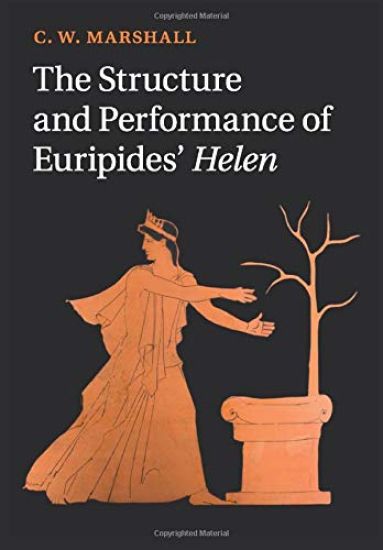
The Structure and Performance of Euripides' Helen
C. W. Marshall
Cambridge University Press
2017
pokkari
Using Euripides' play Helen as the main point of reference, C. W. Marshall's detailed study expands our understanding of Athenian tragedy and provides new interpretations of how Euripides created meaning in performance. Marshall focuses on dramatic structure to show how assumptions held by the ancient audience shaped meaning in Helen and to demonstrate how Euripides' play draws extensively on the satyr play Proteus, which was part of Aeschylus' Oresteia. Structure is presented not as a theoretical abstraction, but as a crucial component of the experience of performance, working with music, the chorus and the other plays in the tetralogy. Euripides' Andromeda in particular is shown to have resonances with Helen not previously described. Arguing that the role of the director is key, Marshall shows that the choices that a director can make about role doubling, gestures, blocking, humour, and masks play a crucial part in forming the meaning of Helen.
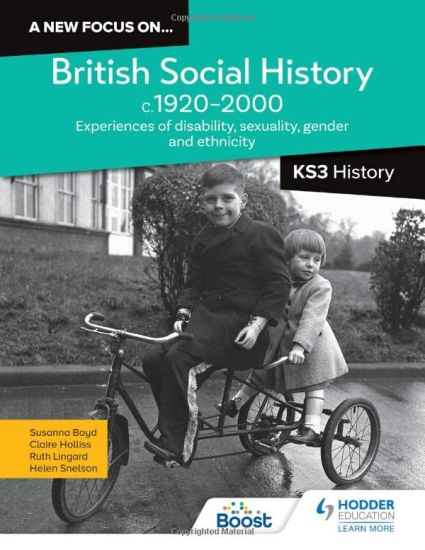
new focus on...British Social History, c.1920â??2000 for KS3 History: Experiences of disability, sexuality, gender and ethnicity
Helen Snelson; Ruth Lingard
HODDER EDUCATION
2023
pokkari
Take a fresh look at life in 20th century Britain, through the eyes of those whose history has too often been neglected. This is the first time that a school textbook has woven together experiences of disability, the LGBTQ+ community, women and Gypsy, Roma and Traveller people, against the backdrop of key events and changes in this 80-year period.