Kirjojen hintavertailu. Mukana 12 390 323 kirjaa ja 12 kauppaa.

Kirjahaku

Etsi kirjoja tekijän nimen, kirjan nimen tai ISBN:n perusteella.

1000 tulosta hakusanalla Henri Rohan

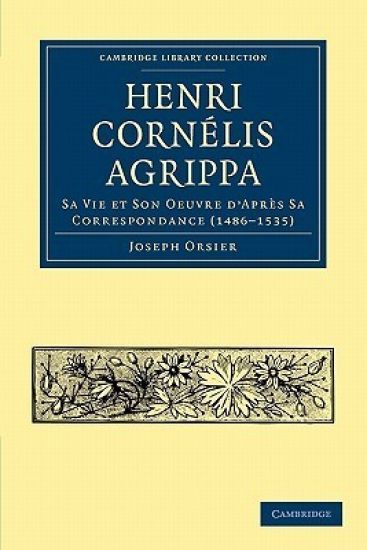
Henri Cornélis Agrippa

Henri Cornélis Agrippa

Joseph Orsier

Cambridge University Press
2011
pokkari
Heinrich Cornelius Agrippa (1486–1535) was a controversial Renaissance theologian and writer who published work on the occult and magic, and his writings influenced later leading literary figures such as Goethe. Agrippa, although born near Cologne, spent his life travelling around Europe, to Italy, Spain, France, England, Switzerland and the Netherlands. He wrote his De occulta philosophia in 1511 (though it was not published until twenty years later) and its three volumes are the best-known works on Renaissance magic, though Agrippa tried to distance himself from the occult side and instead stress more metaphysical aspects. In Henri Cornélis Agrippa, published in 1911, writer Joseph Orsier examines Agrippa's life. The first part of the work discusses Agrippa's travels, writings, thoughts and controversies. The second part is a translation collection of seventy of his letters, dating from 1509 to 1532, to and from a range of correspondents, including Erasmus.
Henri Bertin and the Representation of China in Eighteenth-Century France
This is an in-depth study of the intellectual, technical, and artistic encounters between Europe and China in the late eighteenth century, focusing on the purposeful acquisition of information and images that characterized a direct engagement with the idea of "China."The central figure in this story is Henri-Léonard Bertin (1720–1792), who served as a minister of state under Louis XV and, briefly, Louis XVI. Both his official position and personal passion for all things Chinese placed him at the center of intersecting networks of like-minded individuals who shared his ideal vision of China as a nation from which France had much to learn. John Finlay examines a fascinating episode in the rich history of cross-cultural exchange between China and Europe in the early modern period, and this book will be an important and timely contribution to a very current discussion about Sino-French cultural relations.This book will be of interest to scholars in art history, visual culture, European and Chinese history.
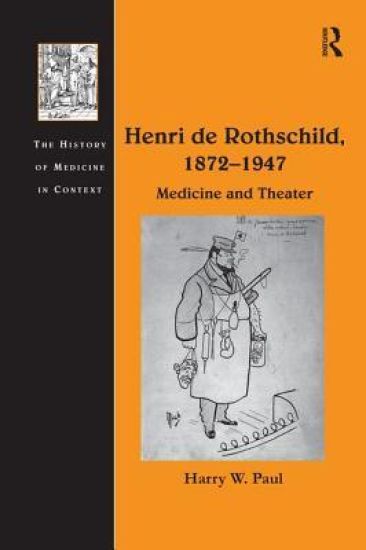
Henri de Rothschild, 1872–1947

Henri de Rothschild, 1872–1947

Harry W. Paul

Routledge
2016
nidottu
Dr Henri de Rothschild was a fifth generation Rothschild and perhaps the most famous of the Paris Rothschilds of the fin-de-siècle period. A 'sleeping partner' of the bank and the non-drinking owner of Mouton-Rothschild, Henri spent much of his life building medical institutions and promoting scientific medicine, including the promotion of Ehrlich's Salvarsan to cure syphilis and the use of radium to cure cancer. His hospital in a working class area of northern Paris boasted the latest in medical advances. Henri was particularly influential in developing the new science of infant feeding, while his broader concerns with infant health led to his playing a prominent role in the development of the specialty of pediatrics. This biography of Henri de Rothschild focuses on his medical achievements and that of his close family in France. Henri, his wife Mathilde and his mother Thérèse all had busy medical careers during World War I. The book also gives an account of both women's experiences of the war. Along with his explicitly scientific medical concerns, Henri was also a prolific playwright and, under the pseudonym André Pascal, wrote several plays about doctors. This book situates the plays, and particularly the themes of charlatanism, women doctors and medical ethics, in their contemporary context of the social and medical life of Paris. A fascinating and vividly written study of a somewhat neglected figure in the history of the illustrious Rothschild family, this book will make a valuable addition to the libraries of scholars in the history of medicine and those studying child health and welfare, the portrayal of doctors in literature, and more broadly the social and cultural life of early-twentieth century Paris.
Henri Dutilleux

Henri Dutilleux

Caroline Potter

Routledge
2016
nidottu
Henri Dutilleux (born 1916) is one of France’s leading composers, though until recently his music received more attention in the United States than in Europe. A fiercely independent composer who pursues his own musical path regardless of fashion, he has never courted the public eye, yet in this book he is revealed as a composer very much engaged with the work of other artists from all spheres. Caroline Potter’s fascinating survey examines the relation of some of these artists to Dutilleux’s music. In literature, the notions of memory and time found in the writings of Baudelaire and Proust have had profound effects on his compositional development, whilst the visual arts have informed his aesthetic ideas and their expression in both his music and even in his meticulously produced scores. Always a perfectionist, Dutilleux now rejects those earlier works which are not representative of his mature style. By analysing these early pieces, Dr Potter traces the evolution of his musical style, and she investigates his compositional process and use of particular referential devices in later works. Whilst his music is unequivocally of our time, Dutilleux has never lost the ability to communicate with a wide-ranging audience. Drawing on interviews with the composer, this study provides penetrating insights into this complex composer’s musical world.
Henri Dutilleux: Music - Mystery and Memory
Born in 1916, Henri Dutilleux is one of France’s leading composers, enjoying an international reputation for his beautifully crafted works. This is the first translation into English of a series of interviews between Dutilleux and the French writer and journalist Claude Glayman which took place in 1996. Dutilleux discusses aspects of his life including his early training at the Paris Conservatoire, the German occupation of France and the time that he spent in the United States. The interviews reveal much about his music and his approach to composition, as well as the influences on his musical style. Originally published by Actes Sud in 1997, this English edition is the work of translator Roger Nichols, one of the UK’s leading specialists on French music.
Henri Tajfel: Explorer of Identity and Difference
This book offers a biographical account of Henri Tajfel, one of the most influential European social psychologists of the twentieth century, offering unique insights into his ground-breaking work in the areas of social perception, social identity and intergroup relations.The author, Rupert Brown, paints a vivid and personal portrait of Tajfel’s life, his academic career and its significance to social psychology, and the key ideas he developed. It traces Tajfel’s life from his birth in Poland just after the end of World War I, his time as a prisoner-of-war in World War II, his work with Jewish orphans and other displaced persons after that war, and thence to his short but glittering academic career as a social psychologist. Based on a range of sources including interviews, archival material, correspondence, photographs, and scholarly output, Brown expertly weaves together Tajfel’s personal narrative with his evolving intellectual interests and major scientific discoveries. Following a chronological structure with each chapter dedicated to a significant transition period in Tajfel’s life, the book ends with an appraisal of two of his principal posthumous legacies: the European Association of Social Psychology, a project always close to Tajfel’s heart and for which he worked tirelessly; and the 'social identity approach' to social psychology initiated by Tajfel over forty years ago and now one of the discipline’s most important perspectives.This is fascinating reading for students, established scholars, and anyone interested in social psychology and the life and lasting contribution of this celebrated scholar.
Henri Tajfel: Explorer of Identity and Difference
This book offers a biographical account of Henri Tajfel, one of the most influential European social psychologists of the twentieth century, offering unique insights into his ground-breaking work in the areas of social perception, social identity and intergroup relations.The author, Rupert Brown, paints a vivid and personal portrait of Tajfel’s life, his academic career and its significance to social psychology, and the key ideas he developed. It traces Tajfel’s life from his birth in Poland just after the end of World War I, his time as a prisoner-of-war in World War II, his work with Jewish orphans and other displaced persons after that war, and thence to his short but glittering academic career as a social psychologist. Based on a range of sources including interviews, archival material, correspondence, photographs, and scholarly output, Brown expertly weaves together Tajfel’s personal narrative with his evolving intellectual interests and major scientific discoveries. Following a chronological structure with each chapter dedicated to a significant transition period in Tajfel’s life, the book ends with an appraisal of two of his principal posthumous legacies: the European Association of Social Psychology, a project always close to Tajfel’s heart and for which he worked tirelessly; and the 'social identity approach' to social psychology initiated by Tajfel over forty years ago and now one of the discipline’s most important perspectives.This is fascinating reading for students, established scholars, and anyone interested in social psychology and the life and lasting contribution of this celebrated scholar.
Henri Saint-Simon, (1760-1825) (RLE Social Theory)
Keith Taylor has undertaken a thorough study of the full range of writings by the brilliant French thinker Henri Saint-Simon (1760–1825), including his unpublished manuscripts, and the result is the first comprehensive and truly representative selection in English from the works of this founding father of social science and socialism, whose ideas exerted a formative influence on such major and diverse intellectual figures as Comte, Proudhon, Marx and Engels, Herzen, Carlyle and Durkheim. When Saint-Simon's writings first appeared, they aroused little more than amusement and curiosity. The ideas they contained – ideas concerning the application of scientific method to the study of man and society, the coming of the new 'scientific-industrial' age in which the State would assume responsibility for promoting social welfare, the prospects for international cooperation and integration in Europe, man's need for a secular religion – were widely dismissed. But the boldness and originality of Saint-Simon's work had a lasting impact on subsequent thinkers and played a major role in the development of European social thought throughout the nineteenth and into the twentieth centuries.Keith Taylor's introductory essay places Saint-Simon's writings in their proper historical context, offers a penetrating reassessment of their significance as a contribution to social theory, and considers the extent of their influence on modern thought. It indicates the inadequacies of many previous interpretations of Saint-Simon's thinking, and highlights, in particular, the tendency of most recent commentators to disregard some crucial features of his political philosophy. This selection is an essential insight into a modern understanding of Saint-Simon from a young English scholar. Nowhere else in English may be found so wide-ranging a selection from Saint-Simon's writings presenting such a balanced view of his thought.
Henri Saint-Simon, (1760-1825) (RLE Social Theory)
Keith Taylor has undertaken a thorough study of the full range of writings by the brilliant French thinker Henri Saint-Simon (1760–1825), including his unpublished manuscripts, and the result is the first comprehensive and truly representative selection in English from the works of this founding father of social science and socialism, whose ideas exerted a formative influence on such major and diverse intellectual figures as Comte, Proudhon, Marx and Engels, Herzen, Carlyle and Durkheim. When Saint-Simon's writings first appeared, they aroused little more than amusement and curiosity. The ideas they contained – ideas concerning the application of scientific method to the study of man and society, the coming of the new 'scientific-industrial' age in which the State would assume responsibility for promoting social welfare, the prospects for international cooperation and integration in Europe, man's need for a secular religion – were widely dismissed. But the boldness and originality of Saint-Simon's work had a lasting impact on subsequent thinkers and played a major role in the development of European social thought throughout the nineteenth and into the twentieth centuries.Keith Taylor's introductory essay places Saint-Simon's writings in their proper historical context, offers a penetrating reassessment of their significance as a contribution to social theory, and considers the extent of their influence on modern thought. It indicates the inadequacies of many previous interpretations of Saint-Simon's thinking, and highlights, in particular, the tendency of most recent commentators to disregard some crucial features of his political philosophy. This selection is an essential insight into a modern understanding of Saint-Simon from a young English scholar. Nowhere else in English may be found so wide-ranging a selection from Saint-Simon's writings presenting such a balanced view of his thought.