
Kirjahaku
Etsi kirjoja tekijän nimen, kirjan nimen tai ISBN:n perusteella.
918 tulosta hakusanalla Howarth Troy

By Loyalty Divided: A Scandalous Seduction
Francine Howarth
Createspace Independent Publishing Platform
2013
nidottu
This 17th century steamy romance is set against the backdrop of Charles Stuart's attempt to wrest England from Oliver Cromwell's clutches (1651), and ventures to that of the royal court in exile.Once renowned as the Toast of Clifton, Elizabeth Mountjoy strives to shake off rumours she was ever mistress to Charles II, for she's madly in love with Captain Thomas Thornton: a Parliamentarian Captain of Horse. Unfortunately, past betrayal haunts Thomas, and when the chance to right a wrong comes his way he once again fights for the King, but to lose his estate lands is a high price to pay for heroism in defeat. Worse, the love of his life suffers the wrath of one of Cromwell's officers, and he's finally forced to decide who must come first, wife or King? He's not alone in facing a dilemma, for the King too is forced to put his country first before his heart whilst in exile.

We Die Alone recounts one of the most exciting escape stories to emerge from the challenges and miseries of World War II. In March 1943, a team of expatriate Norwegian commandos sailed from northern England for Nazi-occupied arctic Norway to organize and supply the Norwegian resistance. But they were betrayed and the Nazis ambushed them. Only one man survived--Jan Baalsrud. This is the incredible and gripping story of his escape.Frostbitten and snowblind, pursued by the Nazis, he dragged himself on until he reached a small arctic village. He was near death, delirious, and a virtual cripple. But the villagers, at mortal risk to themselves, were determined to save him, and--through impossible feats--they did.We Die Alone is an astonishing true story of heroism and endurance. Like Slavomir Rawicz's The Long Walk, it is also an unforgettable portrait of the determination of the human spirit.

In 1943, a group of brave Danish and Norwegian hunters carried out one of the most dramatic operations of World War II. Using dogsleds to patrol a stark 500-mile stretch of the Greenland coast, their wartime mission was to guard against Nazi interlopers—an unlikely scenario given the cruel climate. But one day, a footprint was spotted on desolate Sabine Island, along with other obvious signs of the enemy. Not expecting to find the trouble they did, the three Sledge Patrol members escaped to the nearest hunting hut only to have the Germans pursue them on foot. In the dead of the Arctic night, the men escaped capture at the last instant and, without their coats or sled dogs, walked fifty-six miles to get back to base. While the Sledge Patrol had only hunting rifles, resilience, and their knowledge of outdoor survival, the Germans were armed with machine guns and grenades and greatly outnumbered them. David Howarth skillfully relates the tensely exciting true tale of how the men of the Sledge Patrol fought capture or death in desolation by outwitting and outlasting the enemy. This is a saga of human skill, faith, and endurance—and one of the most remarkable Allied victories ever recorded.
From the author of We Die Alone, The Shetland Bus recounts the hundreds of crossings of small boats from the Shetland Islands to German-occupied Norway to supply arms to the Resistors and to rescue refugees--all under constant threat by German U-boats and winter storms.
what a day to make a girl cry
Robert Howarth
Createspace Independent Publishing Platform
2014
nidottu
Royal Secrets (The Royal Series (Book 3))
Francine Howarth
Createspace Independent Publishing Platform
2014
nidottu

A Path to Cornwall: A collection of rhyming poetry inspired by Cornwall and other places
Rick Howarth
Createspace Independent Publishing Platform
2015
nidottu
By retirement one would normally expect to have identified, explored and developed any creative potential one had but it was only as recently as August 2014 that I wrote my first verse. Since then I have hardly stopped I would encourage anyone who feels they might have some creative potential lurking inside of them to explore it, in my case I have found it very rewarding. I offer you the results of my new found inspiration in this little book. Some of the poems are specifically Cornish others obliquely so, ultimately I have lived and worked in this magical County for most of my life, but some refer to my childhood in Lancashire and other great landscape love Cumbria and the Lake District. I make no apology for stating that my poetry aims to please, you will find an almost total predominance of rhyme simply because rhyme and metered verse is my preferred medium. If I may quote the celebrated American poet Robert Frost, "Free verse is like playing tennis with the net down". I love most to write about nature, about the landscape and the creatures that reside in it, including people. The poems are roughly grouped by themes, for example the natural world, personal experiences, family, love, Cornwall, etc. I hope you enjoy them it will be a great thrill for me to think you will.

The comprehensive source on attorney licensing and how to reform it. In Shaping the Bar, Joan Howarth describes how the twin gatekeepers of the legal profession—law schools and licensers—are failing the public. Attorney licensing should be laser-focused on readiness to practice law with the minimum competence of a new attorney. According to Howarth, requirements today are both too difficult and too easy. Amid the crisis in unmet legal services, record numbers of law school graduates—disproportionately people of color—are failing bar exams that are not meaningful tests of competence to practice. At the same time, after seven years of higher education, hundreds of thousands of dollars of law school debt, two months of cramming legal rules, and success on a bar exam, a candidate can be licensed to practice law without ever having been in a law office or even seen a lawyer with a client. Howarth makes the case that the licensing rituals familiar to generations of lawyers—unfocused law degrees and obsolete bar exams—are protecting members of the profession more than the public. Beyond explaining the failures of the current system, this book presents the latest research on competent lawyering and examples of better approaches. This book presents the path forward by means of licensing changes to protect the public while building an inclusive, diverse, competent, ethical profession. Thoughtful and engaging, Shaping the Bar is both an authoritative account of attorney licensing and a pragmatic handbook for overdue equitable reform of a powerful profession.

What makes you feel happy? Can you name the things that make you happy? This baby panda can Follow along with the little panda as she spends the day with her Mommy, cuddling and eating yummy bamboo shoots. Though she learns that things were not always good for the pandas, today she can appreciate and be happy about all the wonderful things she has in the valley where she lives. Filled from cover to cover with bright pictures of pandas and the beautiful Chinese countryside, What Makes Me Happy? will help your child recognize all the things they have to be happy about, whether it's yummy food to eat or a loving parent to cuddle. Use the discussion questions at the back of this book to teach your child about the important topic of extinction and the need to protect pandas today, as well as help your child recognize their emotions and make connections to the world around them. What Makes Me Happy? will remind your child of all the things in their life that makes them happy
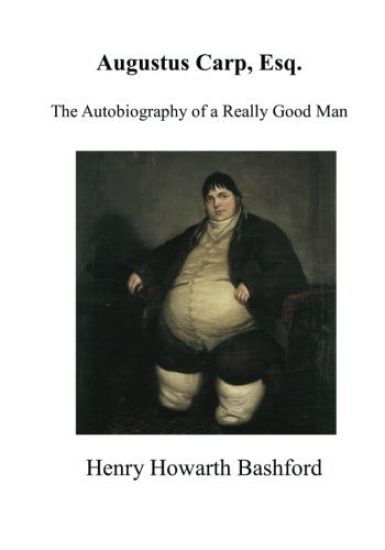
Augustus Carp, Esq.: The Autobiography of a Really Good Man
Henry Howarth Bashford
Createspace Independent Publishing Platform
2016
nidottu
Augustus Carp, Esq.The Autobiography of a Really Good ManBy Henry Howarth BashfordThe ClassicAugustus Carp, Esq., By Himself: Being the Autobiography of a Really Good Man is a satire, originally anonymous, first published in the United Kingdom in May 1924 and, later that year, by Houghton Mifflin in the United States. The author was an English physician, Sir Henry Howarth Bashford (1880-1961), and the illustrations were by "Robin" (Marjorie Blood). It is customary, I have noticed, in publishing an autobiography to preface it with some sort of apology. But there are times, and surely the present is one of them, when to do so is manifestly unnecessary. In an age when every standard of decent conduct has either been torn down or is threatened with destruction; when every newspaper is daily reporting scenes of violence, divorce, and arson; when quite young girls smoke cigarettes and even, I am assured, sometimes cigars; when mature women, the mothers of unhappy children, enter the sea in one-piece bathing-costumes; and when married men, the heads of households, prefer the flicker of the cinematograph to the Athanasian Creed - then it is obviously a task, not to be justifiably avoided, to place some higher example before the world.For some time - I am now forty-seven - I had been feeling this with increasing urgency. And when not only my wife and her four sisters, but the vicar of my parish, the Reverend Simeon Whey, approached me with the same suggestion, I felt that delay would amount to sin. That sin, by many persons, is now lightly regarded, I am, of course, only too well aware. That its very existence is denied by others is a fact equally familiar to me. But I am not one of them. On every ground I am an unflinching opponent of sin. I have continually rebuked it in others. I have strictly refrained from it in myself. And for that reason alone I have deemed it incumbent upon me to issue this volume.

Sagar Saga: Year 1: a Volunteer in 1960's India
Mick Howarth
Createspace Independent Publishing Platform
2016
nidottu
A personal memoir illustrated with 60 original photographs - 32 of them in colour. Fresh from University, the author was sent in 1967 with the British Volunteer Programme to teach at a remote University in Central India. Based on his letters and diaries of the time, and illustrated with 60 original photographs, he recounts his discovery of that recently independent nation, his integration into a society very different from his own and the pleasures and frustrations of working in a new university. Personal anecdotes are interspersed with reflections on decolonisation and the place of foreign volunteers. Initially stereotyped as a white "sahib", he found this a role which did not correspond to his North of England working class background. This first volume recounts his first year at Sagar. Later ones will describe his second year and his wider travels in India. Extracts: I went out to India in 1967. At 21, I was six months older than the independent country itself and the same age as the remote University in which I had been sent to teach. The world was in a ferment of decolonization. The decade had already been swept by MacMillan's "wind of change" with over 20 British colonies negotiating their independence and new democratic constitutions. Apartheid South Africa was excluded from the British Commonwealth and subject to international sanctions. America's neo-colonial war continued to escalate in Vietnam. The Third World was a new concept and we in the West tended to speak - depending on our degree of optimism - of Developing, Underdeveloped or even Backward Countries. Despite the initial stereotyping I faced as a fresh-faced European in post-colonial India, I was not a natural sahib.... "We have arranged a room for you in the University Guest House. Please come in," said the Professor. Two or three khaki-clad male servants were hovering around. One of them unlocked the padlock on a door and we were shown into the suite in which I would live for over a year... We finished our tour with the bathroom. "The toilet is behind the partition," said the professor, putting his head round. "Oh no " he exclaimed, horror-struck. "It's Indian style I hadn't realised." "It doesn't matter," I mumbled. I had already used a squat toilet in Bombay without doing myself any damage. "No, no. It's out of the question. You won't be able to use it." "But..." "I know Professor Mishra has a Western style toilet and his house is only 500 yards away. I will arrange for you to use his toilet." The idea of trekking over to a stranger's house whenever I needed a crap appalled me. "No, no, really. There's no need. I know how to use this. I've done it before." ... I asked for a ticket to Kishangarh but the conductor didn't realise I was with Khare and didn't believe me - so he gave me a ticket to Bijawar instead. This was the last town on the route, small, but not too small to be the capital of a former Princely State of the same name. At Bijawar we stopped in the shelter of the Maharaja's rather dilapidated palace for tea, meeting friends of Khare's & cursing the driver for his crazy driving. At the edge of town, where the pukka tarmacked road gave way to a dirt track through the jungle, we stopped and underwent a transformation from "village bus" to "shikar bus". In other words, the bus was adapted for a big game hunt. A makeshift spotlight was set up on the roof, where the hunters lay on the luggage platform with their guns and we drove on through the forest, shining our light from side to side and stopping whenever one of the shikaris banged on the roof over our heads. Once we saw a tiger - it was so big I thought it was a cow. Despite much manoeuvring, the driver couldn't get his bus into a good position for a shot, so we moved on. ...

Sagar Saga 1: Black and white edition
Mick Howarth
Createspace Independent Publishing Platform
2016
nidottu
A personal memoir illustrated with 60 original photographs. In this economy edition all are printed in black and white. Fresh from University, the author was sent in 1967 with the British Volunteer Programme to teach at a remote University in Central India. Based on his letters and diaries of the time, and illustrated with 60 original photographs, he recounts his discovery of that recently independent nation, his integration into a society very different from his own and the pleasures and frustrations of working in a new university. Personal anecdotes are interspersed with reflections on decolonisation and the place of foreign volunteers. Initially stereotyped as a white "sahib", he found this a role which did not correspond to his North of England working class background. This first volume recounts his first year at Sagar. Later ones will describe his second year and his wider travels in India. Extracts: I went out to India in 1967. At 21, I was six months older than the independent country itself and the same age as the remote University in which I had been sent to teach. The world was in a ferment of decolonization. The decade had already been swept by MacMillan's "wind of change" with over 20 British colonies negotiating their independence and new democratic constitutions. Apartheid South Africa was excluded from the British Commonwealth and subject to international sanctions. America's neo-colonial war continued to escalate in Vietnam. The Third World was a new concept and we in the West tended to speak - depending on our degree of optimism - of Developing, Underdeveloped or even Backward Countries. Despite the initial stereotyping I faced as a fresh-faced European in post-colonial India, I was not a natural sahib.... "We have arranged a room for you in the University Guest House. Please come in," said the Professor. Two or three khaki-clad male servants were hovering around. One of them unlocked the padlock on a door and we were shown into the suite in which I would live for over a year... We finished our tour with the bathroom. "The toilet is behind the partition," said the professor, putting his head round. "Oh no " he exclaimed, horror-struck. "It's Indian style I hadn't realised." "It doesn't matter," I mumbled. I had already used a squat toilet in Bombay without doing myself any damage. "No, no. It's out of the question. You won't be able to use it." "But..." "I know Professor Mishra has a Western style toilet and his house is only 500 yards away. I will arrange for you to use his toilet." The idea of trekking over to a stranger's house whenever I needed a crap appalled me. "No, no, really. There's no need. I know how to use this. I've done it before." ... I asked for a ticket to Kishangarh but the conductor didn't realise I was with Khare and didn't believe me - so he gave me a ticket to Bijawar instead. This was the last town on the route, small, but not too small to be the capital of a former Princely State of the same name. At Bijawar we stopped in the shelter of the Maharaja's rather dilapidated palace for tea, meeting friends of Khare's & cursing the driver for his crazy driving. At the edge of town, where the pukka tarmacked road gave way to a dirt track through the jungle, we stopped and underwent a transformation from "village bus" to "shikar bus". In other words, the bus was adapted for a big game hunt. A makeshift spotlight was set up on the roof, where the hunters lay on the luggage platform with their guns and we drove on through the forest, shining our light from side to side and stopping whenever one of the shikaris banged on the roof over our heads. Once we saw a tiger - it was so big I thought it was a cow. Despite much manoeuvring, the driver couldn't get his bus into a good position for a shot, so we moved on. ...

Most teens love to watch movies—whether a young adult fantasy or the latest comic-book-to screen adaptation. Alongside the usual summer blockbusters, though, are more down to earth fare, movies that best define what it means to be an adolescent. Such films provide insight and depth into the challenges and issues that many teens experience as they move from childhood into adulthood. In Movies to See before You Graduate from High School, Michael Howarth examines sixty coming-of-age films that are essential viewing for teenagers. Whether serious or silly, scary or profound, the films discussed here comment on the trials and tribulations of adolescence. Each entry provides a plot summary, identifies key themes, and includes other useful details such as running time and MPAA rating. Most important in each entry is the “gist” section—a relaxed and informal discussion of the film’s merits and why teens should add it to their viewing list. The films discussed here span five decades, but the many of titles are recent features that contemporary teens will appreciate—from Easy A and Edge of Seventeen to Lady Bird and Love, Simon. The films also represent a range of genres, including comedy, horror, animation, and drama. Additional elements include classic lines of dialogue, “double feature” suggestions, and more than 30 photos. And with five dozen titles to choose from, some teens will want to catch up as soon as possible! Movies to See before You Graduate from High School is their guide to some of the best films for young adult audiences.