The book "Benchmarking in Marketing" explores how businesses can measure and improve their marketing performance by comparing strategies, processes, and metrics against industry leaders. It covers various types of benchmarking, including internal, competitive, functional, strategic, process, and digital benchmarking. The book outlines a structured benchmarking process, from identifying key areas and selecting partners to data collection, analysis, and implementation. Key marketing performance metrics such as customer satisfaction, market share, brand awareness, digital marketing performance, and customer acquisition and retention are discussed in detail. By leveraging benchmarking, organizations can enhance efficiency, optimize campaigns, and gain a competitive edge in an evolving market.
Dawn, a whispered promise in the hues of the morning sky, unveils a canvas of hope and renewal with each gentle stroke of sunlight. Where the morning sky whispers promises, our publication unfurls a canvas of hope and renewal with every tender stroke of sunlight. This silent emergence signals the transition from darkness to the golden embrace of a new day. Witnessing the heartfelt response from our community of poets, authors, and artists is nothing short of overwhelming. It brings me great joy to share the invaluable contributions of these creative minds, including a soul-touching story by Dr. Tarana Yasmin from Patna and Dr. Ratan Bhattacharjee, alongside the poignant verses of Shahid Khan, Muzzammil Shah, Smrutikant Nayak, Gulafshan Salam Khan, Ms. TilKumari Sharma from Nepal, Ilona Lakatos from Hungary, Binod Dawadi, Aparna Mukherjee and the remarkable artwork of both national and international talents. - Iram Fatima 'Ashi', Editor-in-Chief, Saudi Arabia (NRI)
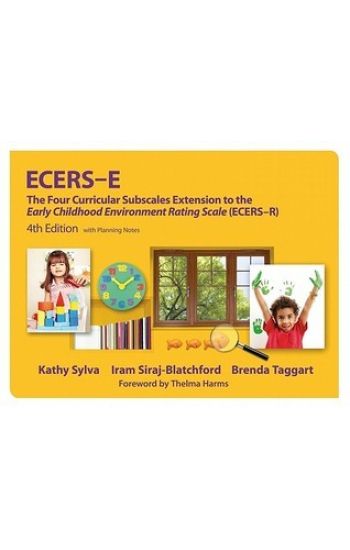
ECERS-E is designed to be used with the Early Childhood Rating Scale-Revised (ECERS-R), an internationally recognized measure of quality in education and care written by Thelma Harms, Richard M. Clifford, and Debby Cryer. It not only complements the ECERS-R but extends the scales to provide additional insights into important aspects of literacy, mathematics, science and environment, as well as practices related to issues of diversity. Given the current focus on emerging literacy and numeracy skills, the ECERS-E provides unique guidance on the kinds of environments that enhance learning in preschool settings. The curriculum domains within the scales bear important relationships to children’s (age 3–5) cognitive and social/behavioral developmental outcomes.Using the ECERS-E alongside the ECERS-R gives users a more complete picture of what a high-quality early childhood education program can look like. It can be used by program directors, teaching staff, agency staff, and in teacher training programs.Convenient organization:Literacy Items:Print in the environmentBook and literacy areasAdults reading with childrenSounds in wordsEmergent writing/mark makingTalking and listeningMathematics Items:Counting and application of countingReading and representing simple numbersActivities: ShapeActivities: Sorting, matching and comparingScience and Environment Items:Natural materialsAreas featuring science/science materialsActivities: Non livingActivities: Living processesActivities: Food preparationDiversity Items:Planning for individual learning needsGender equality and awarenessRace equality and awareness
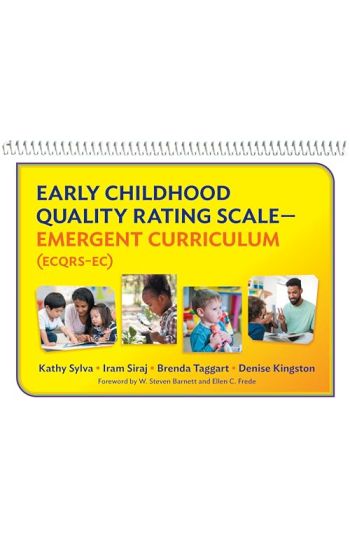
"Using the ECQRS-EC as a teacher self-assessment tool would be extremely effective for ensuring that teachers understand the intentional pedagogical strategies that enhance learning... Large-scale use in state and other continuous improvement systems can help to provide all children with the early childhood education each needs to thrive." —From the Foreword by W. Steven Barnett and Ellen C. Frede, co-directors, National Institute for Early Education Research, Rutgers, the State University of New Jersey Young children's learning depends on a wide range of experiences that support their holistic development. While many different curricular frameworks are used around the world, there is increasing agreement that the emerging academic skills of language and literacy, mathematics, and science should be supported by a playful pedagogy in the early years. The Early Childhood Quality Rating Scale—Emergent Curriculum (ECQRS-EC) is designed to measure quality in these key areas within preschool settings. In addition to three content-area subscales, this evidence-based tool includes a subscale dedicated to diversity and inclusion to help educators support gender and cultural differences in children 3– years old who are developing at different rates. Because it recognizes the important role of the adult in providing children with high-quality interactions, this new quality rating scale can be used for research, teacher self-evaluation, and program improvement, audit, and regulation. Book Features: Focuses on the role of the early childhood educator, their pedagogy, and planning.Items are firmly grounded in culturally and developmentally appropriate practice.Diversity Subscale, "Supporting Diversity and Inclusion," reflects the importance of sensitivity to supporting special needs and being inclusive of all cultures, including Indigenous people.
The Early Childhood Quality Rating Scale – Emergent Curriculum (ECQRS–EC) is designed to measure the quality of support for literacy, mathematics, and science in pre-school settings.Although different curricular frameworks are used around the world, there is increasing agreement that emerging academic skills should be supported by a playful pedagogy. The ECQRS–EC substantially updates the ECERS–E, which was the first observational scale to focus directly on the development of emergent academic skills. This evidence-based tool also includes a subscale dedicated to diversity and inclusion to help educators support gender and cultural differences in children aged 3–6 years old who are developing at different rates.This revised quality rating scale recognises the important role of the adult in providing children with high-quality interactions and can be used for research, teacher self-evaluation, and programme improvement, audit and regulation.
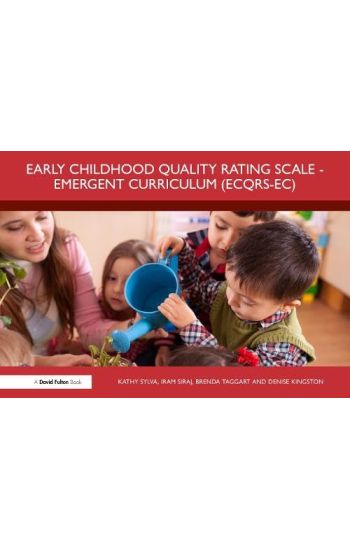
The Early Childhood Quality Rating Scale – Emergent Curriculum (ECQRS–EC) is designed to measure the quality of support for literacy, mathematics, and science in pre-school settings.Although different curricular frameworks are used around the world, there is increasing agreement that emerging academic skills should be supported by a playful pedagogy. The ECQRS–EC substantially updates the ECERS–E, which was the first observational scale to focus directly on the development of emergent academic skills. This evidence-based tool also includes a subscale dedicated to diversity and inclusion to help educators support gender and cultural differences in children aged 3–6 years old who are developing at different rates.This revised quality rating scale recognises the important role of the adult in providing children with high-quality interactions and can be used for research, teacher self-evaluation, and programme improvement, audit and regulation.
This revised new edition of The Movement Environment Rating Scale (MOVERS) offers a brand-new method of measuring the quality of environment and pedagogy in which young children are encouraged to move and be physically active.As physical development is a key component of an educational curriculum, MOVERS offers practitioners the opportunity to accurately assess the quality of a child’s physical experiences, and the environmental and pedagogical quality of these experiences. The MOVERS is placed firmly in the family of CLIQRS – Curriculum, Leadership and Interaction Quality Rating Scales, which includes the Early Childhood Quality Rating Scale – Emergent Curriculum (ECQRS-EC), the Sustained Shared Thinking and Emotional Well-being Scale (SSTEW) and the Pedagogical Leadership in the Early Years (PLEY) scale, all of which have a similar format to previously mentioned scales, making it easy for educators already familiar with these well-established scales to adopt them and adapt them to their own unique settings. MOVERS has four sub-scales:- curriculum, environment and resources for physical development- pedagogy for physical development- supporting physical activity and critical thinking- parents/carers and staff.This book will be an invaluable tool for research, self-evaluation and improvement, audit and regulation. With additional notes derived using the feedback from extensive use of this resource by practitioners in hundreds of settings and early years specialists around the world, it has also been rigorously updated according to latest research, practice and policy.
This revised new edition of The Movement Environment Rating Scale (MOVERS) offers a brand-new method of measuring the quality of environment and pedagogy in which young children are encouraged to move and be physically active.As physical development is a key component of an educational curriculum, MOVERS offers practitioners the opportunity to accurately assess the quality of a child’s physical experiences, and the environmental and pedagogical quality of these experiences. The MOVERS is placed firmly in the family of CLIQRS – Curriculum, Leadership and Interaction Quality Rating Scales, which includes the Early Childhood Quality Rating Scale – Emergent Curriculum (ECQRS-EC), the Sustained Shared Thinking and Emotional Well-being Scale (SSTEW) and the Pedagogical Leadership in the Early Years (PLEY) scale, all of which have a similar format to previously mentioned scales, making it easy for educators already familiar with these well-established scales to adopt them and adapt them to their own unique settings. MOVERS has four sub-scales:- curriculum, environment and resources for physical development- pedagogy for physical development- supporting physical activity and critical thinking- parents/carers and staff.This book will be an invaluable tool for research, self-evaluation and improvement, audit and regulation. With additional notes derived using the feedback from extensive use of this resource by practitioners in hundreds of settings and early years specialists around the world, it has also been rigorously updated according to latest research, practice and policy.
The Improving Maths Pedagogy and Practice scale (IMPP) is an innovative way of assessing and improving the quality and effectiveness of mathematics teaching in the first few years of primary or elementary schooling. It is informed by the evidence base of practice shown to improve children’s outcomes, and extensive professional development delivered by the authors.The IMPP supports both the ‘how’ and ‘what’ of teaching mathematics to young children, encourages positive dispositions towards maths, and addresses issues such as maths anxiety and disengagement. It focuses on teaching developmentally appropriate maths with understanding, using ‘maths talk’, child-friendly contexts, concrete, pictorial and abstract representations to their best effect.This unique measurement scale supports –the teaching of early mathematics in primary/elementary schools, using the evidence base of what works best to support fluency and masteryteachers’ content and pedagogical content knowledge of mathematics, including comprehensive sets of practical examplesquality improvement processes and self-assessment of the mathematics taught in classroomschildren learning mathematics with understanding, which also supports their engagement, enjoyment and achievementsresearchers, auditors and/or inspectors looking for a measure of mathematical quality and effectiveness in the classroomThe IMPP will help teachers and school leadership successfully develop their children’s mathematical understanding, reasoning and problem solving. Educators can use the scale for self-evaluation of their own practice, so they can build on what they already do well and improve where required. Leadership teams and mentors can use it to audit quality, support positive discussions and set effective development targets. The scale is particularly useful when supporting children living with disadvantage, and those with additional learning needs and maths anxiety.