This book has been considered by academicians and scholars of great significance and value to literature. This forms a part of the knowledge base for future generations. So that the book is never forgotten we have represented this book in a print format as the same form as it was originally first published. Hence any marks or annotations seen are left intentionally to preserve its true nature.
Italiennes, poesies politiques de Camille Sant-Helena, publiees par J.-P. VeyratDate de l'edition originale: 1832Ce livre est la reproduction fidele d'une oeuvre publiee avant 1920 et fait partie d'une collection de livres reimprimes a la demande editee par Hachette Livre, dans le cadre d'un partenariat avec la Bibliotheque nationale de France, offrant l'opportunite d'acceder a des ouvrages anciens et souvent rares issus des fonds patrimoniaux de la BnF.Les oeuvres faisant partie de cette collection ont ete numerisees par la BnF et sont presentes sur Gallica, sa bibliotheque numerique.En entreprenant de redonner vie a ces ouvrages au travers d'une collection de livres reimprimes a la demande, nous leur donnons la possibilite de rencontrer un public elargi et participons a la transmission de connaissances et de savoirs parfois difficilement accessibles.Nous avons cherche a concilier la reproduction fidele d'un livre ancien a partir de sa version numerisee avec le souci d'un confort de lecture optimal. Nous esperons que les ouvrages de cette nouvelle collection vous apporteront entiere satisfaction.Pour plus d'informations, rendez-vous sur www.hachettebnf.fr
This work has been selected by scholars as being culturally important, and is part of the knowledge base of civilization as we know it. This work was reproduced from the original artifact, and remains as true to the original work as possible. Therefore, you will see the original copyright references, library stamps (as most of these works have been housed in our most important libraries around the world), and other notations in the work.This work is in the public domain in the United States of America, and possibly other nations. Within the United States, you may freely copy and distribute this work, as no entity (individual or corporate) has a copyright on the body of the work.As a reproduction of a historical artifact, this work may contain missing or blurred pages, poor pictures, errant marks, etc. Scholars believe, and we concur, that this work is important enough to be preserved, reproduced, and made generally available to the public. We appreciate your support of the preservation process, and thank you for being an important part of keeping this knowledge alive and relevant.
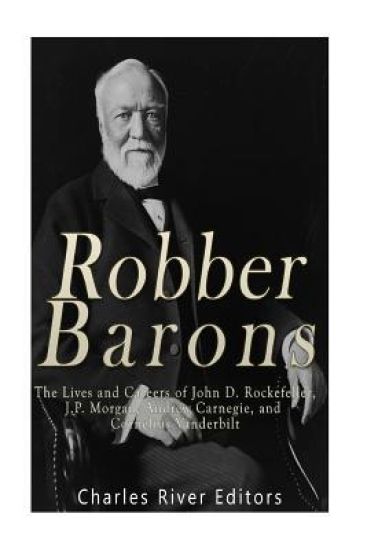
*Includes pictures *Includes the business magnates' quotes about life and work *Includes online resources and a bibliography for further reading The Gilded Age and the dawn of the 20th century are often remembered as an era full of monopolies, trusts, and economic giants in heavy industries like oil and steel. Men like Andrew Carnegie built empires like Carnegie Steel, and financiers like J.P. Morgan merged and consolidated them. The era also made names like Astor, Cooke, and Vanderbilt instantly recognizable across the globe. Over time, the unfathomable wealth generated by the businesses made the individuals on top incredibly rich, and that in turn led to immense criticism and an infamous epithet used to rail against them: robber barons. Dozens of men were called "robber barons", but few of them were as notorious as Cornelius Vanderbilt, who also happened to be one of the nation's first business titans. Vanderbilt was a railroad and shipping magnate at a time that the industry was almost brand new, but he rode his success to become one of the richest and most powerful men in American history. When historians are asked to name the richest man in history, a name that often pops up is that of John D. Rockefeller, who co-founded Standard Oil and turned it into the first real trust in the United States. Rockefeller had been groomed ambitiously by a huckster father nicknamed "Devil Bill", who was just as willing to cheat his son as an unsuspecting public, and John certainly chased his dreams of living long and large. Rockefeller forged his empire in the first few decades of his life and nearly worked himself to death by the time he was 50, which helped compel him to retire for the last several decades of his life. At one point, Rockefeller's wealth was worth more than 1.5% of the entire country's gross domestic product, and by adjusting for inflation, he is arguably the richest man in American history if not world history. When robber barons across America took the reins of vast industries, they needed financing, and many of them turned to the most famous banker of all: John Pierpont Morgan. It was J.P. Morgan who bankrolled the consolidation of behemoth corporations across various industries, including the merging of Edison General Electric and Thomson-Houston Electric Company, which subsequently became General Electric, still known simply as GE across the world today. Similarly, he financed Federal Steel Company and consolidated various other steel businesses to help form the United States Steel Corporation. While critics complained about the outsized influence that these gigantic businesses had, Morgan's massive wealth also gave him unprecedented power in the financial sector and the ability to deal with politicians. In fact, Morgan played an important part in the Panic of 1907 and the subsequent decision to create the Federal Reserve as a monetary oversight. Ironically, one of America's most famous robber barons, Andrew Carnegie, epitomized the American Dream, migrating with his poor family to America in the mid-19th century and rising to the top of the business world in his adopted country. A prodigious writer in addition to his keen sense of business, Carnegie was one of the most outspoken champions of capitalism at a time when there was pushback among lower social classes who witnessed the great disparities in wealth; as he once put it, "Upon the sacredness of property civilization itself depends-the right of the laborer to his hundred dollars in the savings bank, and equally the legal right of the millionaire to his millions." In a similar vein, he said, "Those who would administer wisely must, indeed, be wise, for one of the serious obstacles to the improvement of our race is indiscriminate charity."
*Includes pictures *Includes the business magnates' quotes about life and work *Includes online resources and a bibliography for further reading The Gilded Age and the dawn of the 20th century are often remembered as an era full of monopolies, trusts, and economic giants in heavy industries like oil and steel. Men like Andrew Carnegie built empires like Carnegie Steel, and financiers like J.P. Morgan merged and consolidated them. The era also made names like Astor, Cooke, and Vanderbilt instantly recognizable across the globe. Over time, the unfathomable wealth generated by the businesses made the individuals on top incredibly rich, and that in turn led to immense criticism and an infamous epithet used to rail against them: robber barons. Dozens of men were called "robber barons", but few of them were as notorious as Cornelius Vanderbilt, who also happened to be one of the nation's first business titans. Vanderbilt was a railroad and shipping magnate at a time that the industry was almost brand new, but he rode his success to become one of the richest and most powerful men in American history. When historians are asked to name the richest man in history, a name that often pops up is that of John D. Rockefeller, who co-founded Standard Oil and turned it into the first real trust in the United States. Rockefeller had been groomed ambitiously by a huckster father nicknamed "Devil Bill", who was just as willing to cheat his son as an unsuspecting public, and John certainly chased his dreams of living long and large. Rockefeller forged his empire in the first few decades of his life and nearly worked himself to death by the time he was 50, which helped compel him to retire for the last several decades of his life. At one point, Rockefeller's wealth was worth more than 1.5% of the entire country's gross domestic product, and by adjusting for inflation, he is arguably the richest man in American history if not world history. When robber barons across America took the reins of vast industries, they needed financing, and many of them turned to the most famous banker of all: John Pierpont Morgan. It was J.P. Morgan who bankrolled the consolidation of behemoth corporations across various industries, including the merging of Edison General Electric and Thomson-Houston Electric Company, which subsequently became General Electric, still known simply as GE across the world today. Similarly, he financed Federal Steel Company and consolidated various other steel businesses to help form the United States Steel Corporation. While critics complained about the outsized influence that these gigantic businesses had, Morgan's massive wealth also gave him unprecedented power in the financial sector and the ability to deal with politicians. In fact, Morgan played an important part in the Panic of 1907 and the subsequent decision to create the Federal Reserve as a monetary oversight. Ironically, one of America's most famous robber barons, Andrew Carnegie, epitomized the American Dream, migrating with his poor family to America in the mid-19th century and rising to the top of the business world in his adopted country. A prodigious writer in addition to his keen sense of business, Carnegie was one of the most outspoken champions of capitalism at a time when there was pushback among lower social classes who witnessed the great disparities in wealth; as he once put it, "Upon the sacredness of property civilization itself depends-the right of the laborer to his hundred dollars in the savings bank, and equally the legal right of the millionaire to his millions." In a similar vein, he said, "Those who would administer wisely must, indeed, be wise, for one of the serious obstacles to the improvement of our race is indiscriminate charity."










![Calcoen, a Dutch Narrative of the Second Voyage of Vasco Da Gama to Calicut, Printed at Antwerp Circa 1504. [A Facs.] With Intr. and Tr. by J.P. Berjeau](/covers/9781024129618.jpg)
![Calcoen, a Dutch Narrative of the Second Voyage of Vasco Da Gama to Calicut, Printed at Antwerp Circa 1504. [A Facs.] With Intr. and Tr. by J.P. Berjeau](/covers/9781024134735.jpg)





![A Few Odds And Ends, For Cheerful Friends [poems, Signed J.p.c.]](/covers/9781377047553.jpg)