Kirjojen hintavertailu. Mukana 11 518 949 kirjaa ja 12 kauppaa.

Kirjahaku

Etsi kirjoja tekijän nimen, kirjan nimen tai ISBN:n perusteella.

1000 tulosta hakusanalla Jacques Matter

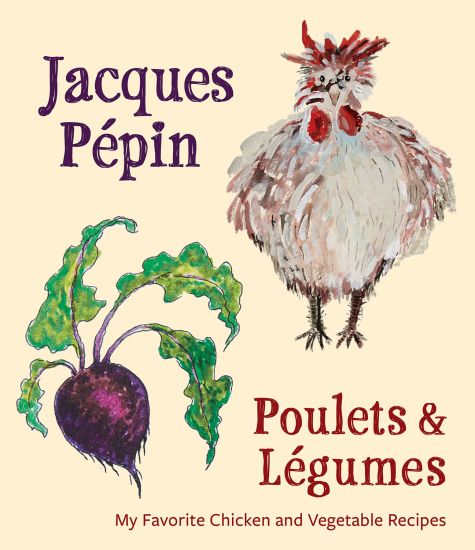
Jacques Penpin Poulets & Legumes

Jacques Penpin Poulets & Legumes

Jacques Pepin

Rux Martin/Houghton Mifflin Harcourt
2018
sidottu
The legendary cooking teacher whom GQ calls “the most impactful living chef in America” shares his favourite chicken and vegetable recipes from a half-century career spanning two continents. Some, like Poulet à la Crème and Baker’s Wife Potatoes, recall the country French dishes of his childhood, while Chicken with Cognac Sauce and Velvet Spinach come from his days in fine French restaurants. Most, though, are born in his contemporary Connecticut kitchen. All have that trademark Pépin touch: made with just a few steps but sublime enough for company, from Roast Split Chicken with Mustard Crust to Caramelised Tomatoes Provençal. Charmingly illustrated with Pépin’s paintings, this little compendium is perfect for revitalising every cook’s repertoire.
Jacques Pépin

Jacques Pépin

Candice Ransom; Tatsiana Burgaud

RANDOM HOUSE USA INC
2024
sidottu
Dream big with a Little Golden Book biography about French chef Jacques P pin, who taught countless fans how to cook french meals--and carve lemons into the shape of pigs. Little Golden Book biographies are the perfect introduction to nonfiction for young readers--as well as fans of all ages This Little Golden Book about Jacques P pin--the beloved French chef, artist, and close friend of Julia Child--is an inspiring read-aloud for young foodies and their parents. Look for more Little Golden Book biographies: - Harry Belafonte - Tony Bennett - Iris Apfel - Oprah Winfrey - Julia Child
Jacques Pépin More Fast Food My Way

Jacques Pépin More Fast Food My Way

Jacques Pépin

Harvest Publications
2008
sidottu
From "a great teacher and truly a master technician" (Julia Child), a new cookbook full of faster-than-ever food, including dozens of elegant "minute" recipes Jacques P pin Fast Food My Way was an immediate sensation, captivating cooks and critics, who called it "fabulous," "chic," and "elegant." Now America's first and most enduring celebrity chef does himself one better, with recipes that are faster, fresher, and easier than ever. Only Jacques could have come up with dishes so innovative and uncomplicated. "Minute recipes" Nearly no-cook recipes fit for company: Cured Salmon Morsels, Glazed Sausage Bits Smashing appetizers: Scallop Pancakes, zipped together in a blender (10 minutes) Almost instant soups: Creamy Leek and Mushroom Soup (7 minutes) Fast, festive dinners: Stuffed Pork Fillet on Grape Tomatoes (18 minutes) Stunning desserts: Mini Almond Cakes in Raspberry Sauce (15 minutes)
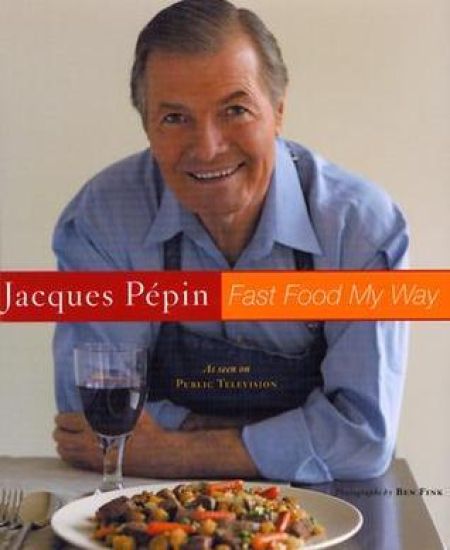
Jacques Pepin Fast Food My Way

Jacques Pepin Fast Food My Way

Jacques Pépin

Harvest Publications
2004
sidottu
In Jacques P pin Fast Food My Way, the man who taught millions of Americans how to cook shares the techniques he honed in the most famous kitchens of the world to show you how to create simple, special meals in minutes. In this companion volume to his new series on public television, Jacques shows you how to create great-tasting dishes ranging from stunning salads such as Tomato and Mozzarella Fans to Supreme of Chicken with Balsamic Vinegar and Shallot Sauce to his breathtaking Almond Cake with Berries, all special enough for company, yet easy enough for those weekday evenings when you have no time. Fast food Jacques's way involves no compromises in taste but saves you hours in the kitchen. His Instant Beef Tenderloin Stew, for instance, not only is far faster to make than traditional versions, but tastes brighter and fresher. With concise, clear directions, Jacques shares the secrets of his kitchen. He teaches you how to season a salmon fillet perfectly and cook it in a low oven, right on the serving platter. You'll learn how to make a satisfying homemade vegetable soup in seconds, a baked potato in half the usual time, and a succulent roast that takes minutes, not hours, to prepare. He also shows you how to create elegant meals from convenience foods: a bean dip that will keep guests coming back for more, silky soups, and caramelized peaches made from canned peaches. With Jacques P pin Fast Food My Way at your side, the best food is always the simplest.
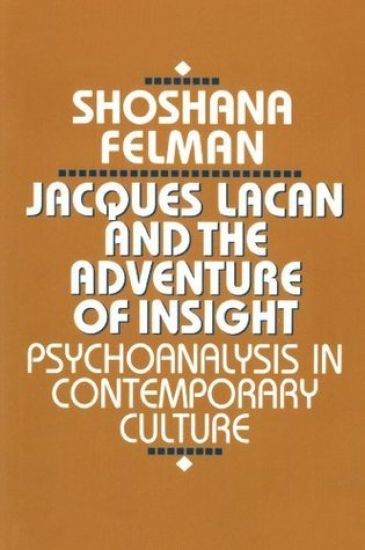
Jacques Lacan and the Adventure of Insight

Jacques Lacan and the Adventure of Insight

Shoshana Felman

Harvard University Press
1989
nidottu
Jacques Lacan, one of the most influential and controversial French thinkers of the twentieth century, was a practicing and teaching psychoanalyst in Paris, but his revolutionary seminars on Freud reached out far beyond professional circles: they were enthusiastically attended by writers, artists, scientists, philosophers, and intellectuals from many disciplines.Shoshana Felman elucidates the power and originality of Lacan’s work. She brilliantly analyzes Lacan’s investigation of psychoanalysis not as dogma but as an ongoing self-critical process of discovery. By focusing on Lacan’s singular way of making Freud’s thought new again—and of thus enabling us to participate in the very moment of intellectual struggle and insight—Felman shows how this moment of illumination has become crucial to contemporary thinking and has redefined insight as such. This book is a groundbreaking statement not only on Lacan but on psychoanalysis in general.Felman argues that, contrary to popular opinion, Lacan’s preoccupation is with psychoanalytic practice rather than with theory for its own sake. His true clinical originality consists not in the incidental innovations that separate his theory from other psychoanalytic schools, but in the insight he gives us into the structural foundations of what is common to the practice of all schools: the transference action and the psychoanalytic dialogue. In chapters on Poe’s tale “The Purloined Letter”; Sophocles’s Oedipus plays, a case report by Melanie Klein, and Freud’s writings, Felman demonstrates Lacan’s rediscovery of these texts as renewed and renewable intellectual adventures and as parables of the psychoanalytic encounter. The book explores these questions: How and why does psychoanalytic practice work? What accounts for clinical success? What did Freud learn from the literary Oedipus, and how does Freud text take us beyond Oedipus? How does psychoanalysis inform, and radically displace, our conception of what learning is and of what reading is?This book will be an intellectual event not only for clinicians and literary critics, but also for the broader audience of readers interested in contemporary thought.
Jacques Rivette

Jacques Rivette

Douglas Morrey; Alison Smith

Manchester University Press
2010
sidottu
Jacques Rivette is perhaps the best-kept secret of French cinema. A founding figure in the New Wave, and at the centre of the Cahiers du cinéma team, he developed into one of the most unusual and adventurous French directors of the last sixty years, yet his work remains little-known in comparison with his contemporaries, and this study is the first in English to look at the full span of his career. Starting with his decisively influential film criticism of the 1950s, it moves from the New Wave through the complex, experimental films of the 1970s to the challenging, playful dramas which ensured his visibility during the following two decades, and ends in the present, including Rivette’s most recent films, Histoire de Marie et Julien (2003) and Ne touchez pas la hache (2007).The book takes a thematic approach, offering detailed discussion of key elements of Rivette’s film world, including games, conspiracy and jealousy, as well as a study of what Rivette’s cinema adds to our understanding of key theoretical concepts in Film Studies such as narrative, space and adaptation. There are many close analyses of sequences from Rivette’s films including Paris nous appartient (1961), Céline et Julie vont en bateau (1974) and La Belle Noiseuse (1991).
Jacques Demy

Jacques Demy

Darren Waldron

Manchester University Press
2014
sidottu
Saccharine for some, poignant for others, Jacques Demy’s ‘enchanted’ world is familiar to generations of French audiences accustomed to watching Christmas repeats of his fairytale Peau d’âne (1970) or seeing Catherine Deneuve and Françoise Dorléac prance and pirouette in Les Demoiselles de Rochefort (1966). Demy achieved international recognition with Les Parapluies de Cherbourg (1963), which was awarded the Palme d’Or at Cannes. However, beneath the apparently sugary coating of his films lie more philosophical reflections on some of the most pressing issues that preoccupy Western societies, including affect, subjectivity, self/other relations and free will. This wide-ranging book addresses many of the key aspects of Demy's cinema, including his associations with the New Wave, his unique approach to musicals, his adaptations of fairytales, his representations of gender and sexuality and his legacy as an iconic director for generations of audiences and filmmakers.
Jacques Rivette

Jacques Rivette

Douglas Morrey; Alison Smith

Manchester University Press
2015
nidottu
Jacques Rivette is perhaps the best-kept secret of French cinema. A founding figure in the New Wave, and at the centre of the Cahiers du cinéma team, he developed into one of the most unusual and adventurous French directors of the last sixty years, yet his work remains little-known in comparison with his contemporaries, and this study is the first in English to look at the full span of his career. Starting with his decisively influential film criticism of the 1950s, it moves from the New Wave through the complex, experimental films of the 1970s to the challenging, playful dramas which ensured his visibility during the following two decades, and ends in the present, including Rivette’s most recent films, Histoire de Marie et Julien (2003) and Ne touchez pas la hache (2007).The book takes a thematic approach, offering detailed discussion of key elements of Rivette’s film world, including games, conspiracy and jealousy, as well as a study of what Rivette’s cinema adds to our understanding of key theoretical concepts in Film Studies such as narrative, space and adaptation.
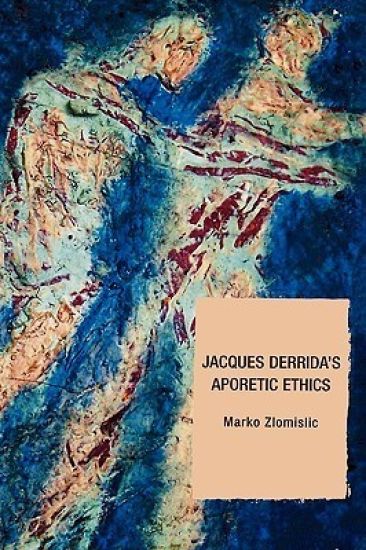
Jacques Derrida's Aporetic Ethics

Jacques Derrida's Aporetic Ethics

Marko Zlomislic

Lexington Books
2007
sidottu
Jacques Derrida's Aporetic Ethics offers a new approach to the study of Derrida's philosophy. Challenging many scholarly articles and books, Marko Zlomislic argues against the popular conception of Derrida as a philosophical relativist. By evaluating objective evidence and through logical arguments, Zlomislic argues that Derrida has been concerned with ethics since his first published works. Indeed, Derrida's arguments have presented a new understanding of ethics and the concept of decision. Zlomislic provides a substantive in-depth argument for reading Derrida's ethics and, due to the central ethical concerns, Derrida's entire philosophy.Jacques Derrida's Aporetic Ethics is essential reading for anyone with an interest in this essential thinker of the twentieth century.
Jacques Lacan

Jacques Lacan

Martin Murray

Pluto Press
2015
pokkari
*Winner of the CHOICE Outstanding Academic Book Prize, 2016* The wide-ranging and brilliant ideas of the French psychoanalyst Jacques Lacan (1901-1981) have had a major influence on modern thought. His 'followers' are loyal and legion. Yet his ideas are complex and densely conveyed. Lacan's detractors have accused him of obscurantism, pretentiousness and even incoherence, his psychoanalytic practice and his personal life were complicated - he was famous and contentious in equal measure. Martin Murray provides a lucid account of Lacan's key concepts, including the mirror stage, and his relationship to Freud's ideas, amongst many others. Tracing their origins in his diverse interests: art, psychiatry, philosophy, anthropology, linguistics and psychoanalysis. Murray also investigates Lacan's professional life, personal life and institutional influence in an attempt to understand the charismatic and controversial person he became.
Jacques Lacan

Jacques Lacan

Martin Murray

Pluto Press
2015
sidottu
*Winner of the CHOICE Outstanding Academic Book Prize, 2016* The wide-ranging and brilliant ideas of the French psychoanalyst Jacques Lacan (1901-1981) have had a major influence on modern thought. His 'followers' are loyal and legion. Yet his ideas are complex and densely conveyed. Lacan's detractors have accused him of obscurantism, pretentiousness and even incoherence, his psychoanalytic practice and his personal life were complicated - he was famous and contentious in equal measure. Martin Murray provides a lucid account of Lacan's key concepts, including the mirror stage, and his relationship to Freud's ideas, amongst many others. Tracing their origins in his diverse interests: art, psychiatry, philosophy, anthropology, linguistics and psychoanalysis. Murray also investigates Lacan's professional life, personal life and institutional influence in an attempt to understand the charismatic and controversial person he became.
Jacques Delors and European Integration
Jacques Delors has been the most successful President of the European Commission in the history of the European Community. The events of his time in Brussels may have constituted the best chance yet to create a new supranational order to consolidate European political and social arrangements. Jacques Delors and European Integration reconsiders the last decade of EC history, and the Maastricht period in particular, from the point of view of Delors's unfolding strategy. The book's remarkable data sources include the author's observations of the day-to-day work of the Commission under Delors and access to key personnel and documents. The author explores the ways in which Delors and his team tried to capitalize upon the complex openings in Europe's political opportunity structures from the mid-1980s. The "1992" programme to complete the Single Market galvanized European energies and contributed to renewed optimism. Maastricht and its sequels have proven less successful. Jacques Delors and European Integration follows processes around the Maastricht Treaty from inside, observing the complex system of European institutions at work. What kind of turning point will Maastricht turn out to be? The book attempts to reach a conclusion about what, in retrospect, will certainly be seen as one of the most daring experiments at transnational politics of modern times.
Jacques Lacan

Jacques Lacan

Elisabeth Roudinesco

Polity Press
1997
sidottu
Roudinesco follows the development of Lacan's career from his early clinical practice and conflicts with the establishment, as he constantly pushed the boundaries of psychoanalysis from its roots in biology and neurology to a powerful critical tool that resonated in fields ranging from literary theory to feminist politics.
Jacques Lacan

Jacques Lacan

Elisabeth Roudinesco

Polity Press
1999
nidottu
The author offers the story of a young man from the provinces determined to leave his family fortune and its old-fashioned values behind; the young doctor in Paris who set out to reinvent clinical psychotherapy and ended up transforming the fundamental notions that shape it all.
Jacques Rancière

Jacques Rancière

Oliver Davis

Polity Press
2010
sidottu
This book is a critical introduction to contemporary French philosopher Jacques Rancière. It is the first introduction in any language to cover all of his major work and offers an accessible presentation and searching evaluation of his significant contributions to the fields of politics, pedagogy, history, literature, film theory and aesthetics. This book traces the emergence of Rancière’s thought over the last forty-five years and situates it in the diverse intellectual contexts in which it intervenes. Beginning with his egalitarian critique of his former teacher Louis Althusser, the book tracks the subsequent elaboration of Rancière’s highly original conception of equality. This approach reveals that a grasp of his early archival and historiographical work is vital for a full understanding both of his later politics and his ongoing investigation of art and aesthetics. Along the way, this book explains and analyses key terms in Rancière’s very distinctive philosophical lexicon, including the ‘police’ order, ‘disagreement’, ‘political subjectivation’, ‘literarity’, the ‘part which has no part’, the ‘regimes of art’ and ‘the distribution of the sensory’. This book argues that Rancière’s work sets a new standard in contestatory critique and concludes by reflecting on the philosophical and policy implications of his singular project.
Jacques Rancière

Jacques Rancière

Oliver Davis

Polity Press
2010
nidottu
This book is a critical introduction to contemporary French philosopher Jacques Rancière. It is the first introduction in any language to cover all of his major work and offers an accessible presentation and searching evaluation of his significant contributions to the fields of politics, pedagogy, history, literature, film theory and aesthetics. This book traces the emergence of Rancière’s thought over the last forty-five years and situates it in the diverse intellectual contexts in which it intervenes. Beginning with his egalitarian critique of his former teacher Louis Althusser, the book tracks the subsequent elaboration of Rancière’s highly original conception of equality. This approach reveals that a grasp of his early archival and historiographical work is vital for a full understanding both of his later politics and his ongoing investigation of art and aesthetics. Along the way, this book explains and analyses key terms in Rancière’s very distinctive philosophical lexicon, including the ‘police’ order, ‘disagreement’, ‘political subjectivation’, ‘literarity’, the ‘part which has no part’, the ‘regimes of art’ and ‘the distribution of the sensory’. This book argues that Rancière’s work sets a new standard in contestatory critique and concludes by reflecting on the philosophical and policy implications of his singular project.