Kirjojen hintavertailu. Mukana 11 627 362 kirjaa ja 12 kauppaa.

Kirjahaku

Etsi kirjoja tekijän nimen, kirjan nimen tai ISBN:n perusteella.

1000 tulosta hakusanalla James Pooler

The Selected Writings of James Weldon Johnson: Volume I: The New York Age Editorials (1914-1923)
Johnson's unprecedented role as civil rights leader and literary artist was a dual one that has not been replicated since his time. This volume comprises editorials form the "New York Age" organized thematically, and at a critical introduction discusses Johnson's role in the history of the black press. By painting a vivid picture of the race problem in this nation, and by his portrayal of the successes and possibilities of his race in American life and culture, he picked at white America's conscience. This collection of writings serves to support Dr Wilson's contention that the foundation of black literature had its paternity more in James Weldon Johnson than in anyone else.
The Selected Writings of James Weldon Johnson: Volume II: Social, Political, and Literary Essays
The two volumes edited by Dr Wilson, Director of the John Memorial Foundation, make an important body of Johnson's writings more readily available to scholars in African-American studies. Volume II comprises literary essays, political essays, and song lyrics. The critical introduction places Johnson in relation to other black artists, the development of African-American literature and early integrationist movements.
James Joyce and the Language of History

James Joyce and the Language of History

Robert Spoo

Oxford University Press Inc
1995
sidottu
"History is a nightmare from which I am trying to awake." Stephen Dedalus's famous complaint articulates a characteristic modern attitude toward the perceived burden of the past. As Robert Spoo shows in this study, Joyce's creative achievement, from the time of his sojourn in Rome in 1906-07 to the completion of Ulysses in 1922, cannot be understood apart from the ferment of historical thought that dominated the nineteenth and early twentieth centuries. Tracing James Joyce's historiographic art to its formative contexts, Spoo reveals a modernist author passionately engaged with the problem of history, forging a new language that both dramatizes and redefines that problem.
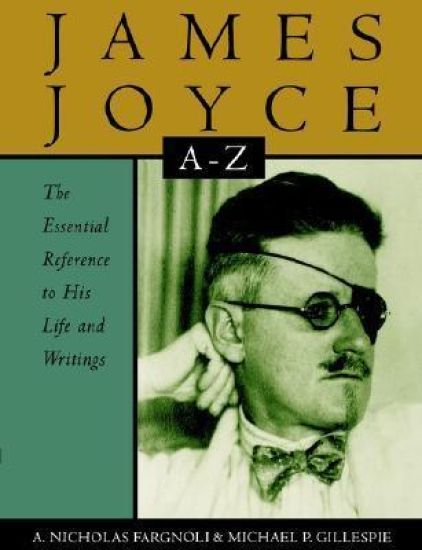
James Joyce A to Z

James Joyce A to Z

Nicholas Fargnoli; Michael Gillespie

Oxford University Press
1996
nidottu
(series copy) These encyclopedic companions are browsable, invaluable individual guides to authors and their works. Useful for students, but written with the general reader in mind, they are clear, concise, accessible, and supply the basic cultural, historical, biographical and critical information so crucial to an appreciation and enjoyment of the primary works. Each is arranged in an A-Z fashion and presents and explains the terms, people, places, and concepts encountered in the literary worlds of James Joyce, Mark Twain, and Virginia Woolf. As a keen explorer of the mundane material of everyday life, James Joyce ranks high in the canon of modernist writers. He is arguably the most influential writer of the twentieth-century, and may be the most read, studied, and taught of all modern writers. The James Joyce A-Z is the ideal companion to Joyce's life and work. Over 800 concise entries relating to all aspects of Joyce are gathered here in one easy-to-use volume of impressive scope.
James Joyce's A Portrait of the Artist as a Young Man
James Joyce's A Portrait of the Artist as a Young Man: A Casebook offers a comprehensive introduction to a landmark in modern fiction. The essays collected here will help first-time readers, teachers, and advanced scholars gain new insight into Joyce's semi-autobiographical story of an Irish boy's slow and difficult discovery of his artistic vocation. The epitome of the modernist Bildungsroman, or novel of education, Joyce's novel was controversial from the moment of its publication in 1916, and Mark Wollaeger's introduction provides an overview of the composition and early reception of A Portrait of the Artist as a Young Man as well as a survey of some of the recurrent issues debated by literary critics. The selection of the essays is designed to address major critical issues, provide detailed readings of important passages, and trace the evolution of critical responses to the novel. Essays by Hugh Kenner and Patrick Parrinder offer both indispensable overviews of the entire novel-its themes, structure, and idiom-and close attention to specific interpretive cruxes. In addition to classic responses to Portrait, such as Wayne Booth's critique of authorial "distance," Fritz Senn's unpacking of the epigraph, and Michael Levenson's reading of the diary, the collection includes a newly revised and expanded version of Maud Ellmann's groundbreaking 1982 poststructuralist essay, "Polytropic Man," and essays by Hélène Cixous, Joseph Valente, Vicki Mahaffey, Emer Nolan, Marian Eide, Marjorie Howes, and Mark Wollaeger. Some essays are oriented toward literary history, genre, biography or formalism; others draw on recent developments in queer theory and postcolonial studies; others on the turn towards history exemplified in Irish studies. All are very readable and pay close attention to intricacies of Joyce's text. Together the essays bring into focus the wide range of questions that have kept A Portrait of the Artist as a Young Man fresh for the new millennium.
James Joyce's Ulysses

James Joyce's Ulysses

Oxford University Press Inc
2004
sidottu
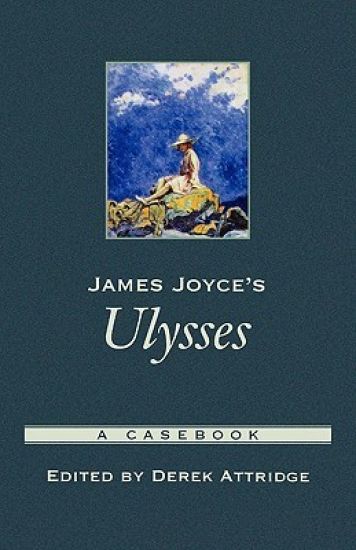
James Joyce's Ulysses is probably the most famous-or notorious-novel published in the twentieth century. Its length and difficulty mean that readers often turn to critical studies to help them in getting the most out of it. But the vast quantity of secondary literature on the book poses problems for readers, who often don't know where to begin. This casebook includes some of the most influential critics to have written on Joyce, such as Hugh Kenner and Fritz Senn, as well as newer voices who have made a considerable impact in recent years. A wide range of critical schools is represented, from textual analysis to historical and psychoanalytic approaches, from feminism to post-colonialism. One essay considers the relation between art and life, nature and culture, in Ulysses, while another explores the implications of the impassioned debates about the proper editing of Joyce's great work. In an iconoclastic discussion of the book, Leo Bersani finds reasons for giving up reading Joyce. All the contributions are characterized by scrupulous attention to Joyce's words and a sense of the powerful challenge his work offers to our ways of thinking about ourselves, our world, and our language. Also included are records of some of the conversations Joyce had with his friend Frank Budgen during the composition of Ulysses in Zurich, and in an appendix readers will find a version of the schema which Joyce drew up as a guide to his book. Derek Attridge provides an introduction that offers advice on reading Ulysses for the first time, an account of the remarkable story of its composition, and an outline of the history of the critical reception that has played such an important part in our understanding and enjoyment of this extraordinary work.
James Joyce's Ulysses

James Joyce's Ulysses

Oxford University Press Inc
2004
nidottu
James Joyce's Ulysses is probably the most famous-or notorious-novel published in the twentieth century. Its length and difficulty mean that readers often turn to critical studies to help them in getting the most out of it. But the vast quantity of secondary literature on the book poses problems for readers, who often don't know where to begin. This casebook includes some of the most influential critics to have written on Joyce, such as Hugh Kenner and Fritz Senn, as well as newer voices who have made a considerable impact in recent years. A wide range of critical schools is represented, from textual analysis to historical and psychoanalytic approaches, from feminism to post-colonialism. One essay considers the relation between art and life, nature and culture, in Ulysses, while another explores the implications of the impassioned debates about the proper editing of Joyce's great work. In an iconoclastic discussion of the book, Leo Bersani finds reasons for giving up reading Joyce. All the contributions are characterized by scrupulous attention to Joyce's words and a sense of the powerful challenge his work offers to our ways of thinking about ourselves, our world, and our language. Also included are records of some of the conversations Joyce had with his friend Frank Budgen during the composition of Ulysses in Zurich, and in an appendix readers will find a version of the schema which Joyce drew up as a guide to his book. Derek Attridge provides an introduction that offers advice on reading Ulysses for the first time, an account of the remarkable story of its composition, and an outline of the history of the critical reception that has played such an important part in our understanding and enjoyment of this extraordinary work.
James Madison and the Struggle for the Bill of Rights

James Madison and the Struggle for the Bill of Rights

Richard Labunski

Oxford University Press Inc
2006
sidottu
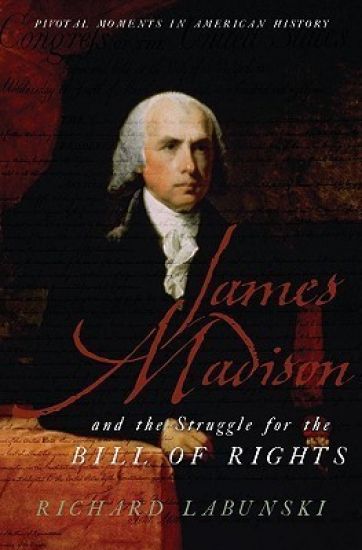
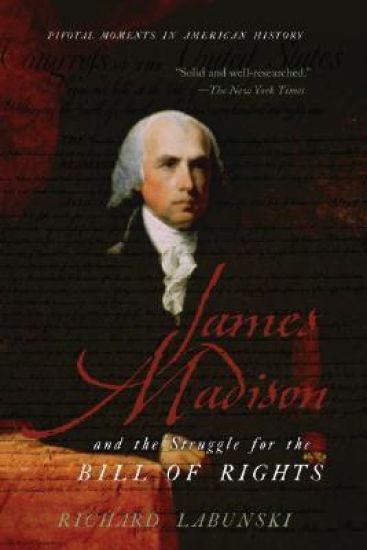
Today we hold the Constitution in such high regard that we can hardly imagine how hotly contested was its adoption. In fact, many of the thirteen states saw fierce debate over the document, and ratification was by no means certain. Virginia, the largest and most influential state, approved the Constitution by the barest of margins, and only after an epic political battle between James Madison and Patrick Henry. Now Richard Labunski offers a dramatic account of a time when the entire American experiment hung in the balance, only to be saved by the most unlikely of heroes--the diminutive and exceedingly shy Madison. Here is a vividly written account of not one but several major political struggles which changed the course of American history. Labunski takes us inside the sweltering converted theater in Richmond, where for three grueling weeks, the soft-spoken Madison and the charismatic Patrick Henry fought over whether Virginia should ratify the Constitution. The stakes were enormous. If Virginia voted no, George Washington could not become president, New York might follow suit and reject the Constitution, and the young nation would be thrust into political chaos. But Madison won the day by a handful of votes, mollifying Anti-Federalist fears by promising to add a bill of rights to the Constitution. To do this, Madison would have to win a seat in the First Congress. Labunski shows how the vengeful Henry prevented Madison's appointment to the Senate and then used his political power to ensure that Madison would run against his good friend, Revolutionary War hero James Monroe, in a House district teeming with political enemies. Overcoming great odds, Madison won by a few hundred votes, allowing him to attend the First Congress and sponsor the Bill of Rights. Packed with colorful details about life in early America, this compelling and important narrative is the first serious book about Madison written in many years. It will return this under-appreciated patriot to his rightful place among the Founding Fathers and shed new light on a key turning point in our nation's history.
The Works of James McCune Smith

The Works of James McCune Smith

James McCune Smith

Oxford University Press Inc
2007
sidottu
The first African American to receive a medical degree, this invaluable collection brings together the writings of James McCune Smith, one of the foremost intellectuals in antebellum America. The Selected Writings of James McCune Smith is one of the first anthologies featuring the works of this illustrious scholar. Perhaps best known for his introduction to Fredrick Douglass's My Bondage and My Freedom, his influence is still found in a number of aspects of modern society and social interactions. And he was considered by many to be a prophet of the twenty-first century. One of the earliest advocates of the use of "black" instead of "colored," McCune Smith treated racial identities as social constructions, arguing that American literature, music, and dance would be shaped and defined by blacks. Organized chronologically, the collection covers over 40 years of writing, including speeches, letters, and essays, and begins with McCune Smith's first speech as an 11-year old boy to the Marquis de Lafayette. Providing historical context for McCune Smith's current cultural relevance, this book showcases writings on black education and self-help, citizenship, and the fight against racism.
James Madison and the Struggle for the Bill of Rights

James Madison and the Struggle for the Bill of Rights

Richard Labunski

Oxford University Press Inc
2008
nidottu
Today we hold the Constitution in such high regard that we can hardly imagine how hotly contested was its adoption. In fact, many of the thirteen states saw fierce debate over the document, and ratification was by no means certain. Virginia, the largest and most influential state, approved the Constitution by the barest of margins, and only after an epic political battle between James Madison and Patrick Henry. Now Richard Labunski offers a dramatic account of a time when the entire American experiment hung in the balance, only to be saved by the most unlikely of heroes--the diminutive and exceedingly shy Madison. Here is a vividly written account of not one but several major political struggles which changed the course of American history. Labunski takes us inside the sweltering converted theater in Richmond, where for three grueling weeks, the soft-spoken Madison and the charismatic Patrick Henry fought over whether Virginia should ratify the Constitution. The stakes were enormous. If Virginia voted no, George Washington could not become president, New York might follow suit and reject the Constitution, and the young nation would be thrust into political chaos. But Madison won the day by a handful of votes, mollifying Anti-Federalist fears by promising to add a bill of rights to the Constitution. To do this, Madison would have to win a seat in the First Congress. Labunski shows how the vengeful Henry prevented Madison's appointment to the Senate and then used his political power to ensure that Madison would run against his good friend, Revolutionary War hero James Monroe, in a House district teeming with political enemies. Overcoming great odds, Madison won by a few hundred votes, allowing him to attend the First Congress and sponsor the Bill of Rights. Packed with colorful details about life in early America, this compelling and important narrative is the first serious book about Madison written in many years. It will return this under-appreciated patriot to his rightful place among the Founding Fathers and shed new light on a key turning point in our nation's history.
James Purdy

James Purdy

Michael Snyder

OXFORD UNIVERSITY PRESS INC
2023
sidottu
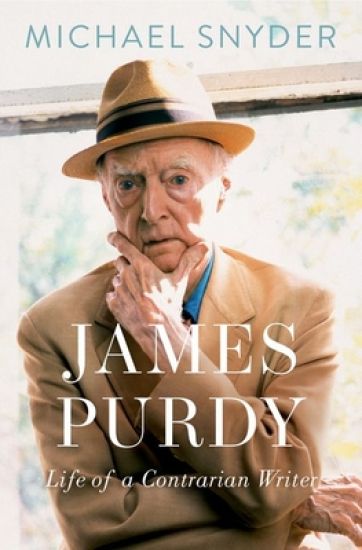
A definitive biography of a twentieth century gay author whose work has recently been rediscovered and enjoys a cult following. One of the most iconoclastic twentieth-century American novelists, James Purdy penned original and sometimes shocking works about those on the margins of American society, exploring small towns, urban life, failure, alienation, sexuality, and familial relations. In his own life, Purdy was a compelling if eccentric figure, declared an "authentic American genius" by Gore Vidal. James Purdy: Life of a Contrarian Writer is the first full-length biography of the gay American novelist, story writer, playwright, and poet. Michael Snyder has spent over a decade plumbing the mysteries of Purdy's career and personal life, including interviews with those who knew him. From his roots in northwestern Ohio, Purdy moved to the world of Bohemian artists and jazz musicians in Chicago in the late 1930s and 1940s, travelled in Spain, studied in Mexico, enlisted in the Army Air Corps, worked for the Federal Security Agency, and taught in Cuba and at a Wisconsin college for nearly a decade. All the while, he aspired to become a writer, but struggled to publish. Only when friends financed the private printing of his work did he find a champion in poet Dame Edith Sitwell, who helped get him published in England, which led to publication in the United States. After moving to New York in 1957, he spent nearly fifty years writing in Brooklyn Heights. Although Purdy's critical reputation peaked in the 1960s and he never enjoyed a bestseller, his often queer and edgy content found a diverse following that included Tennessee Williams, Langston Hughes, William Carlos Williams, Dorothy Parker, Edward Albee, Jonathan Franzen, John Waters, and many LGBTQ readers. Difficult and often contrarian, Purdy sometimes hampered his own career as he sought recognition from a conservative, cliquey New York publishing world. Conveying the potency and influence of Purdy's fierce artistic integrity, vision, and self-definition as a truth-teller, this groundbreaking literary biography recovers the life of a highly talented writer with a persistent cult following.
James Thomson (1700-1748)

James Thomson (1700-1748)

James Sambrook

Clarendon Press
1991
sidottu
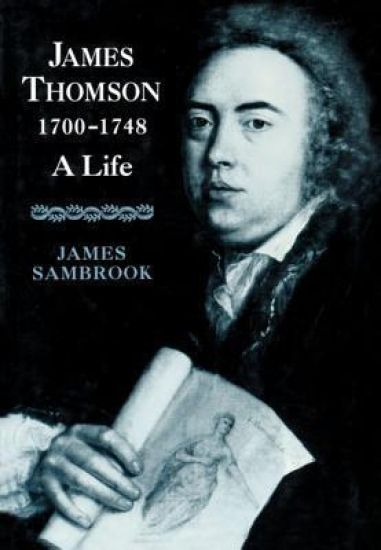
This is the first full-scale biography of the poet and playwright for forty years. On the personal side it places him in his social and cultural setting: as a welcome member of the disparate circles that surrounded Alexander Pope, Richard Savage, Aaron Hill, James Quin, George Bubb Dodington, George Lyttelton, Lady Hertford, and Frederick, Prince of Wales. More significantly, for the first time Thomson's involvement in politics is thoroughly explored. The analysis of his Scottish Whiggism and his role as the poet of Britannia and Liberty places the poetry in a clear ideological light, which at once deepens our understanding of Thomson the man, and illuminates the political groupings of the period. Drawing on his deep understanding of Thomson's poetry, which he edited for the Oxford English Texts series, James Sambrook also supplies a full critical analysis of the whole body of Thomson's writings that is unrivalled in its depth. This new Life maintains an even balance between biography, history, and literary criticism, and forms both an impressive study of the man and a companion to the highly praised Oxford English Texts edition of the poems.
Bible and Interpretation: The Collected Essays of James Barr
This is a three volume collection of the most important published papers of James Barr (1924-2006). The papers deal with questions of theology (especially biblical theology), biblical interpretation and ideas about biblical inspiration and authority, and questions to do with biblical Hebrew and Greek, along with several lexicographical studies, essays and obituaries on major figures in the history of biblical interpretation, and a number of important reviews. Many of pieces collected here have hitherto been available only in journals and hard-to-access collections. This collection will prove indispensable for anyone seeking a rounded picture of Barr's work. It incorporates work from every period of his academic life, and includes a number of discussions of fundamentalism and conservative biblical interpretation. Some pieces also shed light on less well-known aspects of Barr's work, such as his abiding interest in biblical chronology. Barr's characteristic incisive, clear, and forthright style is apparent throughout the collection. The three volumes are thematically compiled. Each is accompanied by an introduction by John Barton, providing a guide to the contents. Volume 1 begins with a biographical essay by Ernest Nicholson and John Barton. It contains major articles on theology in relation to the Bible, programmatic studies of the past and future of biblical study, and reflections on specific topics in the study of the Old Testament. Volume 2 is concerned with detailed biblical interpretation and with the history of the discipline. It also contains material on biblical fundamentalism. Volume 3 is a collection of Barr's extensive papers on linguistic matters relating to Biblical Hebrew and Greek, and to biblical translation in the ancient and the modern world.
James Joseph Sylvester: Life and Work in Letters

James Joseph Sylvester: Life and Work in Letters

Karen Hunger Parshall

Clarendon Press
1998
sidottu
In the folklore of mathematics, James Joseph Sylvester (1814-1897) is the eccentric, hot-tempered, sword-cane-wielding, nineteenth-century British Jew who, together with the taciturn Arthur Cayley, developed a theory and language of invariants that then died spectacularly in the 1890s as a result of David Hilbert's groundbreaking, `modern' techniques. This, like all folklore, has some grounding in fact but owes much to fiction. The present volume brings together for the first time 140 letters from Sylvester's correspondence in an effort to establish the true picture. It reveals - through the letters as well as through the detailed mathematical and historical commentary accompanying them - Sylvester the friend, man of principle, mathematician, poet, professor, scientific activist, social observer, traveller. It also provides a detailed look at Sylvester's thoughts and thought processes as it shows him acting in both personal and professional spheres over the course of his eighty-two year life. The Sylvester who emerges from this analysis - unlike the Sylvester of the folkloric caricature - offers deep insight into the development of the technical and social structures of mathematics.
James Anthony Froude

James Anthony Froude

Ciaran Brady

Oxford University Press
2014
nidottu
James Anthony Froude remains one of the most commonly referenced and frequently cited of Victorian public intellectuals. Known to intellectual historians as the author of a monumental History of England in the sixteenth century and as a key exponent of Victorian religious doubt, he is also frequently referenced as the author of a series of scandalously provocative novels and of a hugely controversial biography of Thomas Carlyle. Historians of the British Empire and of Ireland have frequently been compelled to address his sometimes outrageous (but often representative) historical writings. Scholars of mid-Victorian politics have no less often turned to Froude as a typical representative of Victorian fears of democracy, while more recently students of political thought have identified him as an early representative of a new form of Commonwealth civic republicanism. Yet for all that Froude remains a strangely marginalised, fragmented, and neglected figure. Ciaran Brady now addresses this remarkable gap. Based on a thorough critical examination of all of Froude's published works - many of which have been discovered and identified here for the first time - and supplemented by intensive research into Froude's private and widely scattered manuscript materials, he offers the first sustained study of Froude's life and thought. Against the common assumption that Froude's life can be divided along simple lines - the sometime enfant terrible who aged into a respectable man of letters - he argues that there was a deeper coherence underlying everything he wrote from the scandalous productions of the 1840s to the authoritative university lectures of the 1890s. In addition to providing a study of a major but neglected nineteenth century intellectual, Brady offers a critical analysis of the impulses, the aspirations, and the unquestioned assumptions underlying the Romantic project of personal renovation, and an alternative view of that unique phenomenon known as 'the Victorian sage'.
James Joyce and the Phenomenology of Film

James Joyce and the Phenomenology of Film

Cleo Hanaway-Oakley

Oxford University Press
2017
sidottu
James Joyce and the Phenomenology of Film reappraises the lines of influence said to exist between Joyce's writing and early cinema and provides an alternative to previous psychoanalytic readings of Joyce and film. Through a compelling combination of historical research and critical analysis, Cleo Hanaway-Oakley demonstrates that Joyce, early film-makers, and phenomenologists (Maurice Merleau-Ponty, in particular) share a common enterprise: all are concerned with showing, rather than explaining, the 'inherence of the self in the world'. Instead of portraying an objective, neutral world, bereft of human input, Joyce, the film-makers, and the phenomenologists present embodied, conscious engagement with the environment and others: they are interested in the world-as-it-is-lived and transcend the seemingly-rigid binaries of seer/seen, subject/object, absorptive/theatrical, and personal/impersonal. This book re-evaluates the history of body- and spectator-focused film theories, placing Merleau-Ponty at the centre of the discussion, and considers the ways in which Joyce may have encountered such theories. In a wealth of close analyses, Joyce's fiction is read alongside the work of early film-makers such as Charlie Chaplin, Georges Méliès, and Mitchell and Kenyon, and in relation to the philosophical dimensions of early-cinematic devices such as the Mutoscope, the stereoscope, and the panorama. By putting Joyce's literary work--Ulysses above all--into dialogue with both early cinema and phenomenology, this book elucidates and enlivens literature, film, and philosophy.
James Harrington

James Harrington

Rachel Hammersley

Oxford University Press
2019
sidottu
Despite not being an active participant in the English Civil War, seventeenth-century political thinker James Harrington exercised an important influence on the ideas and politics of that crucial period of history. In The Commonwealth of Oceana he sought to explain why civil war had broken out in 1642, to put the case for commonwealth government, and to offer a detailed constitutional blueprint for a new and successful English government. In this intellectual biography of Harrington, Rachel Hammersley sets a fresh analysis of this and Harrington's other writings against the background of his life and the turbulent period in which he lived. In doing so, this study seeks to move beyond the conventional view of Harrington as primarily a republican thinker, offering a broader and more comprehensive account of him which addresses the complexity of his republicanism as well as exploring his contributions to economic, historical, religious, philosophical, and scientific debates; his experimentation with vocabulary and literary form; and the relationship between his life and thought. Harrington is presented as an innovative political thinker, committed to democracy, social mobility, and meritocracy. Ultimately, this broader examination of Harrington's life and work opens a window on political, economic, religious, and scientific issues which serve to complicate understandings of the English Revolution, and sheds fresh light on the relevance of seventeenth-century ideas to the modern world.