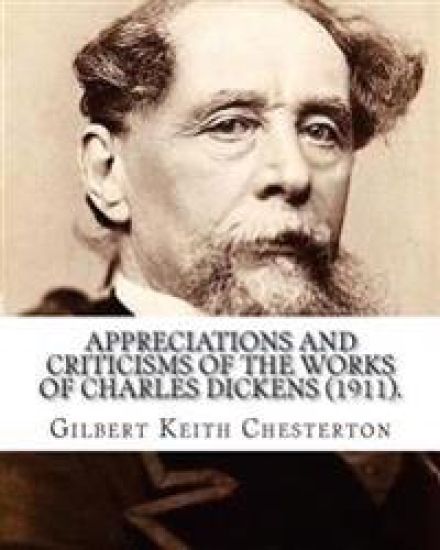
Gilbert Keith Chesterton, KC*SG (29 May 1874 - 14 June 1936), better known as G. K. Chesterton, was an English writer, poet, philosopher, dramatist, journalist, orator, lay theologian, biographer, and literary and art critic. Chesterton is often referred to as the "prince of paradox". Time magazine has observed of his writing style: "Whenever possible Chesterton made his points with popular sayings, proverbs, allegories-first carefully turning them inside out." Chesterton is well known for his fictional priest-detective Father Brown, and for his reasoned apologetics. Even some of those who disagree with him have recognised the wide appeal of such works as Orthodoxy and The Everlasting Man.Chesterton, as a political thinker, cast aspersions on both Progressivism and Conservatism, saying, "The whole modern world has divided itself into Conservatives and Progressives. The business of Progressives is to go on making mistakes. The business of the Conservatives is to prevent the mistakes from being corrected."Chesterton routinely referred to himself as an "orthodox" Christian, and came to identify this position more and more with Catholicism, eventually converting to Catholicism from High Church Anglicanism. George Bernard Shaw, Chesterton's "friendly enemy" according to Time, said of him, "He was a man of colossal genius."Biographers have identified him as a successor to such Victorian authors as Matthew Arnold, Thomas Carlyle, Cardinal John Henry Newman, and John Ruskin.. Charles John Huffam Dickens ( 7 February 1812 - 9 June 1870) was an English writer and social critic. He created some of the world's best-known fictional characters and is regarded by many as the greatest novelist of the Victorian era.His works enjoyed unprecedented popularity during his lifetime, and by the twentieth century critics and scholars had recognised him as a literary genius. Born in Portsmouth, Dickens left school to work in a factory when his father was incarcerated in a debtors' prison. Despite his lack of formal education, he edited a weekly journal for 20 years, wrote 15 novels, five novellas, hundreds of short stories and non-fiction articles, lectured and performed extensively, was an indefatigable letter writer, and campaigned vigorously for children's rights, education, and other social reforms. Dickens's literary success began with the 1836 serial publication of The Pickwick Papers. Within a few years he had become an international literary celebrity, famous for his humour, satire, and keen observation of character and society. His novels, most published in monthly or weekly instalments, pioneered the serial publication of narrative fiction, which became the dominant Victorian mode for novel publication.The instalment format allowed Dickens to evaluate his audience's reaction, and he often modified his plot and character development based on such feedback. For example, when his wife's chiropodist expressed distress at the way Miss Mowcher in David Copperfield seemed to reflect her disabilities, Dickens improved the character with positive features. His plots were carefully constructed, and he often wove elements from topical events into his narratives.Masses of the illiterate poor chipped in ha'pennies to have each new monthly episode read to them, opening up and inspiring a new class of readers.
Chief among the personnel at the Foreign Office is the Permanent Under-secretary, the senior civil servant who oversees the department and advises the Foreign Secretary. This book is a study of the twelve men who held this Office from 1854–1946.
Chief among the personnel at the Foreign Office is the Permanent Under-secretary, the senior civil servant who oversees the department and advises the Foreign Secretary. This book is a study of the twelve men who held this Office from 1854–1946.
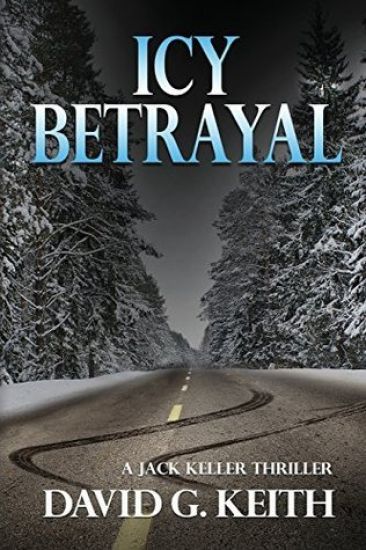
Investigator Jack Keller risks everything when a routine case becomes a quest for reconciliation. Ambitious traffic investigator Mia Serrano is young, attractive and headstrong. Her intuition leads her from a tragic traffic accident on an icy Colorado highway to something far more sinister. Despite his protests, veteran homicide investigator Jack Keller is paired with the upstart Serrano on a high profile murder case that threatens to tear the Rocklin County Sheriff's Department apart from the inside out. The young prot g must choose between love and ambition while haunted by suspicions that consume her. The seasoned investigator will be pushed to the edge as he struggles to come to terms with his troubled past. Sex, love, power and contrition collide as Keller and Serrano struggle to expose a murder plot while hiding secrets that could cost both their careers. Jack Keller faces the most personal case of his life in a wild ride of passion, deception and betrayal, served on ice.
Investigator Jack Keller, seriously injured by a crazed man seeking revenge, recovers sufficiently to return to work at the Rocklin County Sheriff's Department. It doesn't take long for him to be assigned a new murder case-a bizarre crime that involves a beheaded victim, a person he knows. He teams up once again with Detective Mia Serrano-McCallister, who is balancing her career as a homicide detective with the challenges of being a new mom to CJ. The case takes them out of the country to find the man responsible for the murder, where complications soon arise. Hold on tight as Top Shelf takes the reader on a wild ride with many twists and turns. It will keep you on the edge of your seat, all the way up to the explosive and shocking conclusion
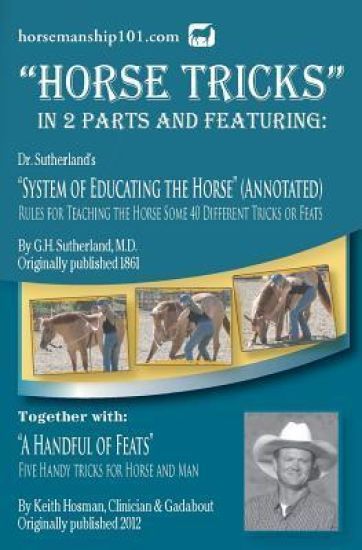
Unillustrated (no pictures), 143 pages "Old doesn't mean out-dated." - Annotated - With 5 original chapters (plus Addendum) by Keith HosmanNOTE: The free or cheap copies of "Dr. Sutherland's System of Educating the Horse" found elsewhere online are poorly scanned-in, blurry and very difficult to read. The material you'll find here in my book has been reformatted for the modern era. More importantly, I've annotated the material ("added comments") and included6 additional chapters written by myself. Check out the Table of Contents, belowThis book brings together public domain material written by G.H. Sutherland, MD and by me, Keith Hosman. It is published in two sections. The first is a collection of dozens of tricks you can teach your horse and was written in 1861 by Dr. Sutherland. The second contains five "feats" I put to paper after finding them to be quite popular at my clinics. You will also find a fix for horses that bite, should they get nippy following some of the training which calls for the horse to pick objects up with its mouth and the like. I have annotated Dr. Sutherland's work. That's a fancy way of saying that I read through his material, then added comment to each chapter based on personal experiences, modern thinking and techniques. Know that, while they may be short, each observation or insight was placed with care; each can make big changes fast somewhere in your training. I daresay you just might recoup the cost of this book somewhere in that sea of italicized notes. Still, why should you lay down your hard-earned cash for a horse-training book written generations ago? Because author G.H. Sutherland could train horses to do tricks that you'd like to learn -- and when something works, it works. Besides, in all this time, what's really changed? It's still a human using the same simple tools to teach a horse to do the same maneuvers.Table of Contents: SECTION I DR. SUTHERLAND'S SYSTEM OF EDUCATING THE HORSE With Rules for Teaching the Horse Some 39 Different Tricks or Feats CHAPTERS INCLUDE: - TO COME WHEN CALLED - TO MAKE A BOW - TO SHAKE HANDS - TO KNOCK ON THE DOOR - TO STAND ON A TABLE - TO CIRCLE AROUND - TO JUMP THE WHIP - TO JUMP THROUGH THE HOOP - TO LIE DOWN - TO KNEEL DOWN - TO SIT UP - TO SIT UP--ANOTHER METHOD - TO WALK ON THREE LEGS - TO STAND ON HIND LEGS - TO WALK ON HIND LEGS - TO SAY YES - TO SAY NO - TO WALTZ - TO PICK UP THINGS - TO HOLD THINGS - TO CARRY AND FETCH THINGS - TO TAKE OFF CAP, COAT AND MITTENS - TO UNBUCKLE SADDLE GIRTH AND TAKE OFF SADDLE - TO OPEN AND SHUT THE DOOR - TO PUMP WATER - TO FIRE OFF A PISTOL - TO RING THE BELL - TO FIND HIDDEN THINGS - TO TELL HIS ABCs - TO COUNT OR SELECT DIFFERENT NUMBERS - TO SPELL - TO READ - TO ANSWER ANY QUESTION IN THE MULTIPLICATION TABLE - TO ADD, SUBTRACT, MULTIPLY AND DIVIDE - TO BRING THE CARDS CALLED FOR - TO TELL HIS AGE, DAYS IN THE WEEK, MONTHS IN THE YEAR, ETC. - TO TELL FORTUNE - TO PLAY CARDS - TO PASS AROUND THE HATSECTION II "A Handful of Feats" as originally penned by Keith Hosman CHAPTERS INCLUDE: - Teach a Horse to Sidepass Toward You On the Ground - Teach Your Horse to Lower His Head While Standing - Teach Horse to Pick Up Its Feet when You Point - Teach Your Horse to Come to You (Using a Roundpen) - Teach Your Horse to Load Into a Trailer - From Some DistanceADDENDUMFixing "Biting Horses"
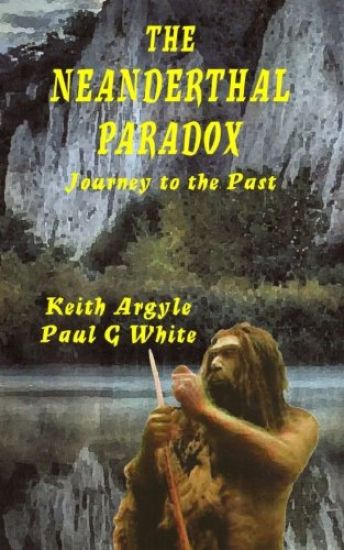
Whilst walking on his local beach, Joe Laing chances upon a tunnel in the cliffs, which is a time gateway leading to the Neanderthal Britain of 35,000 years ago. He contacts the primitive hunter-gatherers and is recognised as 'the Futama', whose legend has survived amongst the tribesmen for 250,000 years. Although Joe cannot understand the reason for the legend, he settles easily into the lives of his new friends. He witnesses the Neanderthal methods of hunting game and introduces flint-tipped throwing spears to replace the fire-hardened stabbing spears that have served the primitive people for so long. He also makes bows and arrows to enable them to bring down game from a distance. Koo-ma, the tribal shaman, is extremely intelligent, and he is quick to realise the benefits to be gained from the new technology and from other ideas Joe discusses with him. Joe is attracted to Lar-na, one of the Neanderthal women who resembles modern humans, but he must remain faithful to Ciara, his fianc e in the twenty-first century. Lar-na, however, administers drugs in Joe's food, and whilst he is under their influence, seduces him. Returning from hunting aurochs, large ancestors of modern cattle, the hunting party detours to a 'sacred' cave. The reason for its special status becomes obvious to Joe when he discovers carved friezes on the cave walls depicting two types of human: these are Neanderthals and mysterious tall figures who, he assumes, were the builders of the time tunnels. The cave contains an entrance to an extensive subterranean complex, so Joe decides to explore. When he accidentally touches one of the friezes, the carved images and strange script are translated in Joe's mind. After several months in the past, Joe reluctantly returns to his own time, only to discover that his meddling with the lives of the primitive Neanderthals has changed his own future. Instead of dying out some 25,000 years ago, the Neanderthal race has survived to inhabit the British Isles and Iceland, which they call Tarmis. Having begun their technological rise 25,000 years before modern man, the Neanderthals are far more advanced than Joe's natural timeline. (The rest of the world is inhabited by modern humans, who covet the advanced technology of Tarmis and the threat of war is never very far away.) Eventually, the rulers of Tarmis recognise Joe as the Futama from 35,000 years ago, whose son, the Na-futama built on the legacy of knowledge that Joe had left with them. Prua Landi, the new leader of the Southern People (the non-Neanderthal world) is from the distant future and is on a mission to capture Joe as a means of locating the builders of the time tunnels. When her attempt fails Prua Landi initiates a nuclear attack on Tarmis. Joe escapes back to the Neanderthal past, determined to reverse the effects of his meddling and thus reinstate his own timeline. This he finally achieves by means of a time-controlling device, which he locates in the underground complex of the sacred cave, and he is eventually able to return to the twenty-first century. He now has to explain to his fianc e why his physical appearance has changed so much when, to Ciara, he has been away only a matter of hours. And there is also the Neanderthal scientist Joe has rescued from certain death in Tarmis. The Neanderthal Paradox - Journey to the Past is the first book in a four-novel series spanning space and time. In the second book, Every Future has a Past, Joe Laing finally meets the builders of the time tunnels and discovers that his destiny is to lead them into a final, violent encounter with Prua Landi in the distant future. The third story, Future's Children, tells of Joe's son, Jo-na's fight for survival when he falls foul of the tyrant, Prua Landi. In the fourth novel, The Evil Returns Joe and his family must cross over into an alternate reality to save his people from extermination by another version of Prua Landi.
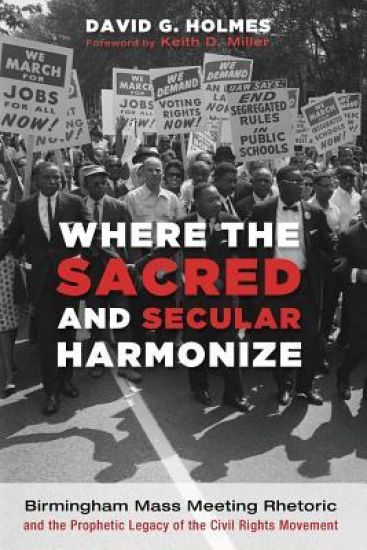
Among pivotal historical moments in the United States, the civil rights movement stands out. In Where the Sacred and Secular Harmonize: Birmingham Mass Meeting Rhetoric and the Prophetic Legacy of the Civil Rights Movement, David G. Holmes offers an original rhetorical analysis of six speeches delivered during the 1963 civil rights campaign in Birmingham, Alabama. Holmes frames his analysis within the biblical concept of prophecy. However, he stresses the idea of prophecy as sociopolitical forth-telling, rather than mystical foretelling. Based on his own transcriptions from rare recordings, Holmes examines how these orations, which clergy and laypeople delivered, address enduring themes such as the role of religion and politics, black leadership and black activism, and the political and popular legacies of the civil rights movement. Drawing upon American history, politics, hermeneutics, homiletics, and rhetoric, Holmes's discussion ranges from civil rights prophets to contemporary politicians, including Martin Luther King Jr. and Barack Obama. Where the Sacred and Secular Harmonize illustrates how the Birmingham mass meeting oratory of 1963 represented a quality of democratic discourse desperately needed today. ""I am excited to see David Holmes's work on civil rights oratory in print. Not only does Holmes recover rare texts, but additionally he refocuses our understanding on the political elements and impact of African American prophetic speech."" --Patricia Bizzell, College of the Holy Cross, Worcester, Massachusetts, co-author of The Rhetorical Tradition: Readings from Classical Times to the Present. ""David Holmes takes his reader deep inside Project C, perhaps the most important civil rights campaign of the twentieth century. With great dexterity Holmes demonstrates the rhetorical artistry of key movement speakers as they locked horns with Eugene 'Bull' Connor and the Magic City. A much-needed thickening, and thus revisioning, of our standard accounts."" --Davis W. Houck, Florida State University David G. Holmes is Professor of English and Rhetoric at Pepperdine University. The author of Revisiting Racialized Voice (2004), he is a frequent presenter at national conferences and has published articles in Rhetoric Review, College English, Black Camera, Journal of Black Studies, and Journal of Communication and Religion.
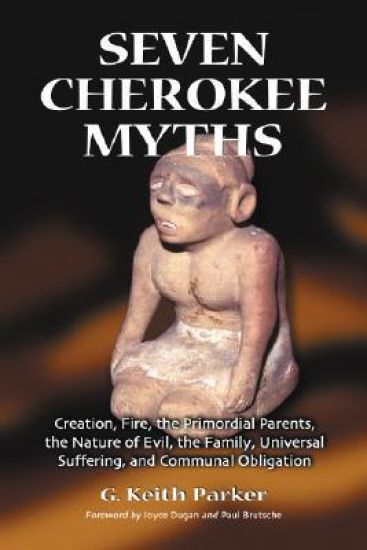
Like ancient peoples the world over, the Cherokees of the southern Appalachian Mountains passed along their traditions and beliefs through stories, songs, dances, and religious and healing rituals. With the creation of Cherokee writing by Sequoyah, some of the traditions were also recorded in books. While evoking local geography and natural phenomena, the stories were also enhanced by powerful psychological and spiritual dynamics. This work examines seven myths that grew out of Cherokee culture, looking at how they emerged to explain archetypal issues. Each of the seven stories is told in full and is followed by a detailed history and analysis that provides its background, its associated rituals, and its psychological basis. One quickly discovers that while the myths are ancient, they are strikingly modern in their understanding of human personality development, family dynamics, community solidarity, and the reality of religion or spirituality. Grounded in the experience of this American Indian people and the land they inhabited, the myths tell universal truths. Instructors considering this book for use in a course may request an examination copy here.
Applied Crowd Science outlines the theory and applications of the crowd safety course that Keith Still has developed and taught worldwide for over thirty years. It includes the background and applications of the crowd risk assessment tools, as well as essays and case studies from international users (UK, Ireland, Canada, Australia, Holland, Belgium and Japan) -- see Support Material on www.routledge.com/9781138626560. Keith’s courses are mandatory training for all UK Police Public Event Commanders.The text covers legislation and guidance for crowd safety in places of public assembly, and outlines the requirements of a crowd risk assessment for mass gatherings. It draws on Prof. Still’s expert witness experience, highlighting both the problems you need to understand for your event planning.
Originally published in 1978, this book covers all aspects of the development of local authorities; the changing types of people who worked in them – solicitors, trade unionists, politicians and reformers; the growing influence of political parties in local affairs; the widening concept of the purpose of local government and the attendant financial problems; the partnership and conflict with central government; the rise of the associations of local authorities and their influence over the many proposals to change the structure of local government in the late 20th Century.