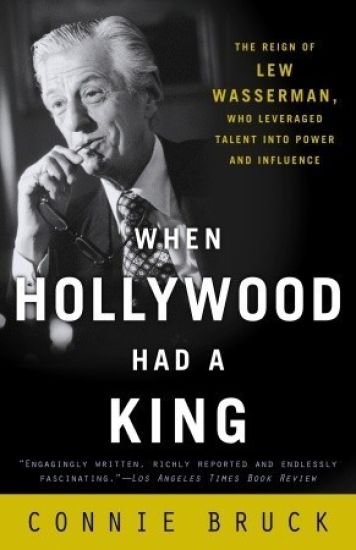
In When Hollywood Had a King, the distinguished journalist Connie Bruck tells the sweeping story of MCA and its brilliant leader, a man who transformed the entertainment industry-- businessman, politician, tactician, and visionary Lew Wasserman. The Music Corporation of America was founded in Chicago in 1924 by Dr. Jules Stein, an ophthalmologist with a gift for booking bands. Twelve years later, Stein moved his operations west to Beverly Hills and hired Lew Wasserman. From his meager beginnings as a movie-theater usher in Cleveland, Wasserman ultimately ascended to the post of president of MCA, and the company became the most powerful force in Hollywood, regarded with a mixture of fear and awe. In his signature black suit and black knit tie, Was-serman took Hollywood by storm. He shifted the balance of power from the studios--which had seven-year contractual strangleholds on the stars--to the talent, who became profit partners. When an antitrust suit forced MCA's evolution from talent agency to film- and television-production company, it was Wasserman who parlayed the control of a wide variety of entertainment and media products into a new type of Hollywood power base. There was only Washington left to conquer, and conquer it Wasserman did, quietly brokering alliances with Democratic and Republican administrations alike. That Wasserman's reach extended from the underworld to the White House only added to his mystique. Among his friends were Teamster boss Jimmy Hoffa, mob lawyer Sidney Korshak, and gangster Moe Dalitz--along with Presidents Johnson, Clinton, and especially Reagan, who enjoyed a particularly close and mutually beneficial relationship with Wasserman. He was equally intimate with Hollywood royalty, from Bette Davis and Jimmy Stewart to Steven Spielberg, who began his career at MCA and once described Wasserman's eyeglasses as looking like two giant movie screens. The history of MCA is really the history of a revolution. Lew Wasserman ushered in the Hollywood we know today. He is the link between the old-school moguls with their ironclad studio contracts and the new industry defined by multimedia conglomerates, power agents, multimillionaire actors, and profit sharing. In the hands of Connie Bruck, the story of Lew Wasserman's rise to power takes on an almost Shakespearean scope. When Hollywood Had a King reveals the industry's greatest untold story: how a stealthy, enterprising power broker became, for a time, Tinseltown's absolute monarch.
No matter what cases private eye Lew Archer takes on--a burglary, a runaway, or a disappeared person--the trail always leads to tangled family secrets and murder. Widely considered the heir to Sam Spade and Philip Marlowe, Archer dug up secrets and bodies in and around Los Angeles. Here, The Archer Files collects all the Lew Archer short stories ever published, along with thirteen unpublished "case notes" and a fascinating biographical profile of Archer by Edgar Award finalist Tom Nolan. Ross Macdonald's signature staccato prose is the real star throughout this collection, which is both a perfect introduction for the newcomer and a must-have for the Macdonald aficionado.
This work has been selected by scholars as being culturally important, and is part of the knowledge base of civilization as we know it. This work was reproduced from the original artifact, and remains as true to the original work as possible. Therefore, you will see the original copyright references, library stamps (as most of these works have been housed in our most important libraries around the world), and other notations in the work.This work is in the public domain in the United States of America, and possibly other nations. Within the United States, you may freely copy and distribute this work, as no entity (individual or corporate) has a copyright on the body of the work.As a reproduction of a historical artifact, this work may contain missing or blurred pages, poor pictures, errant marks, etc. Scholars believe, and we concur, that this work is important enough to be preserved, reproduced, and made generally available to the public. We appreciate your support of the preservation process, and thank you for being an important part of keeping this knowledge alive and relevant.
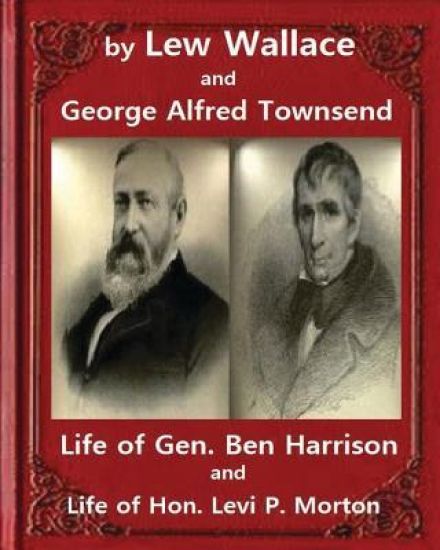
Levi Parsons Morton (May 16, 1824 - May 16, 1920) was a Representative from New York and the 22nd Vice President of the United States (1889-93). He later served as the 31st Governor of New York.Morton was born in Shoreham, Addison County, Vermont. His parents were the Reverend Daniel Oliver Morton (1788-1852), a Congregationalist minister of old New England stock, and Lucretia Parsons (1789-1862). His older brother, David Oliver Morton (1815-59), was Mayor of Toledo, Ohio, from 1849 to 1850. He left school early and worked as a clerk in a general store in Enfield, Massachusetts, taught school in Boscawen, New Hampshire, engaged in mercantile pursuits in Hanover, New Hampshire, moved to Boston, entered the dry-goods business in New York City, and engaged in banking there. He was an unsuccessful candidate for election in 1876 to the 45th Congress, but he was appointed by President Rutherford B. Hayes to be an honorary commissioner to the Paris Exhibition of 1878. Benjamin Harrison (August 20, 1833 - March 13, 1901) was the 23rd President of the United States (1889-93); he was the grandson of the ninth President, William Henry Harrison. Before ascending to the presidency, Harrison established himself as a prominent local attorney, Presbyterian church leader and politician in Indianapolis, Indiana. During the American Civil War, he served the Union as a colonel and on February 14, 1865 was confirmed by the U.S. Senate as a brevet brigadier general of volunteers to rank from January 23, 1865. After the war, he unsuccessfully ran for the governorship of Indiana. He was later elected to the U.S. Senate by the Indiana legislature. A Republican, Harrison was elected to the presidency in 1888, defeating the Democratic incumbent Grover Cleveland. Hallmarks of his administration included unprecedented economic legislation, including the McKinley Tariff, which imposed historic protective trade rates, and the Sherman Antitrust Act; Harrison facilitated the creation of the National Forests through an amendment to the Land Revision Act of 1891. He also substantially strengthened and modernized the Navy, and conducted an active foreign policy. He proposed, in vain, federal education funding as well as voting rights enforcement for African Americans during his administration. Due in large part to surplus revenues from the tariffs, federal spending reached one billion dollars for the first time during his term. The spending issue in part led to the defeat of the Republicans in the 1890 mid-term elections. Harrison was defeated by Cleveland in his bid for re-election in 1892, due to the growing unpopularity of the high tariff and high federal spending. He then returned to private life in Indianapolis but later represented the Republic of Venezuela in an international case against the United Kingdom. In 1900, he traveled to Europe as part of the case and, after a brief stay, returned to Indianapolis. He died the following year of complications from influenza. Although many have praised Harrison's commitment to African Americans' voting rights, scholars and historians generally regard his administration as below-average, and rank him in the bottom half among U.S. presidents. George Alfred Townsend (January 30, 1841 - April 15, 1914), was a noted war correspondent during the American Civil War, and a later novelist. Townsend wrote under the pen name "Gath", which was derived by adding an "H" to his initials, and inspired by the biblical passage II Samuel 1:20, "Tell it not in Gath, publish it not in the streets of Askalon." Lewis "Lew" Wallace (April 10, 1827 - February 15, 1905) was an American lawyer, Union general in the American Civil War, governor of the New Mexico Territory,
Bogdan Staschinski war ein begabter aber innerlich zerrissener KGB-Agent. Seine Geschichte ist - genauso wie die Geschichte seiner Opfer - zutiefst mit der Geschichte Deutschlands und der Ukraine im Kalten Krieg verbunden. Auf Befehl des KGB-Leiters in Moskau und des Vorsitzenden der Kommunistische Partei der Sowjetunion ver bte Staschinski 1957 und 1959 in M nchen Attentate auf die ukrainischen Exilanten Lew Rebet und Stepan Bandera. In seinen Erinnerungen erz hlt der westukrainische KGB-Agent, warum er sich dem sowjetischen Geheimdienst anschloss, wie seine Ausbildung in Kiew und Moskau verlief, wie er den nationalistischen Untergrund in der Westukraine ausspionierte und den Attent ter des ukrainisch-sowjetischen Kultschriftstellers Jaroslaw Halan aufgesp rte, warum ihn die Attentate in M nchen auf seine Landesgenossen angeblich psychisch belasteten, wie die Liebe zu Inge Pohl seine Einstellung zu der Sowjetunion ver nderte und was ihn dazu bewog, dem wohl brutalsten Geheimdienst dieser Zeit den R cken zu kehren.
When America shatters during the Civil War, Elizabeth Van Lew risks everything to save our embattled Union. As an elite member of Richmond society, abolitionist Elizabeth Van Lew delivers food to starving Union prisoners at Libby Prison, risking her status and her life. She soon exchanges coded messages, coordinates daring escapes, hides fugitives in her mansion, and smuggles them up North. Drawing on her web of contacts at every level, Miss Van Lew creates the Richmond Underground, a secret network bolstering the Union. Then she infiltrates Confederate President Jefferson Davis's home through her servant, Mary Jane, who reports on the inner workings of the Confederacy. Using a cipher, she shares troop movements and military intelligence with Union Generals and ultimately provides daily updates to General Grant. As grisly battles rage in trenches nearby, the weakened Confederates become suspicious of her every move. If she cannot save herself from persecution, how can she help to preserve America and end slavery? The true story of a bold Patriot who led the Union's most valuable spy ring of the Civil War
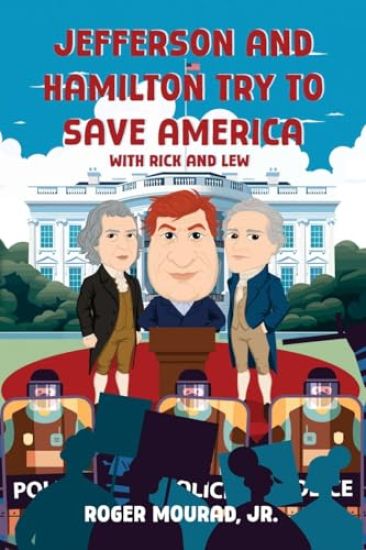
When Washington, D.C. spirals toward chaos, two of its most illustrious Founders are summoned from the grave. Thomas Jefferson and Alexander Hamilton reappear in present-day America at the desperate request of President Duck, a commander-in-chief facing mass protests, political meltdown-and a baffling condition that limits him to walking only backward. Escorted by Rick and Lew, a pair of over-the-hill potheads, the constantly quarreling Founders blunder through the modern capital, colliding with Supreme Court justices, mobs of protesters, tourists, and an unhinged English soccer fan club. As tensions rise and rival demonstrators converge on the White House steps, Jefferson and Hamilton must confront a nation that has taken their ideas to absurd extremes. With time running out and reality unraveling, they help Duck hatch a last-ditch plan to save the republic-assuming they don't tear it apart first. A fast-paced, irreverent political satire that skewers power, protest, and the founding myths that America can't quite let go of.
There was so much more to still be said after the completion of Uncensored Thoughts. So much emotion to still let go. The writing wasn't over so an embark on a journey to vol. 2 was ensued. This time around the concept of "less is more" is explored. Giving you fifty poems with each poem only being three lines. From Groovy Lew To You.
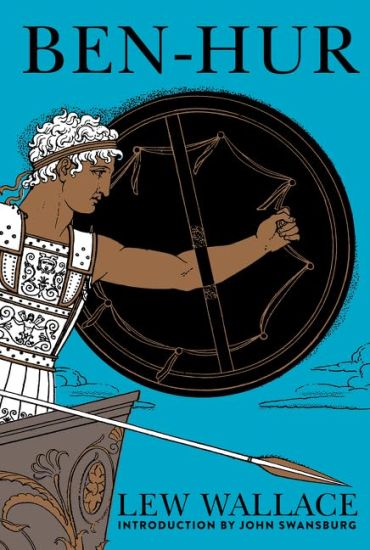
A deluxe Harper Perennial Legacy Edition, with an introduction from John Swansburg, Deputy Editor at Slate One of the best-selling books of all time, Lew Wallace's enduring epic is a tale of revenge, betrayal, honor, compassion and the power of forgiveness, set during the life of Christ. At the beginning of the first century, Judah Ben-Hur lived as a prince, descended from the royal line of Judea and one of Jerusalem's most prosperous merchant families. But his world falls apart when he is betrayed by his best friend, Messala, who falsely accuses him of an attempt to assassinate the Roman governor. Convicted without trial, Judah is sentenced to slavery on a Roman galley, while his mother and sister are imprisoned and his family's assets are seized. All seems lost, but just before boarding the ship, Ben-Hur has his first interaction with the Christ, who offers him water and hope. Their lives continue to intersect as Ben-Hur miraculously survives his time as a slave to become a charioteer, confront his betrayer, Messala, in an epic race, fall in love with the beautiful Esther, avenge his family, and become a follower of the Christ. A true epic, Ben-Hur weaves biblical history and a rich adventure plot into a timeless tale certain to entertain a new generation of readers.