Kirjojen hintavertailu. Mukana 11 342 296 kirjaa ja 12 kauppaa.

Kirjahaku

Etsi kirjoja tekijän nimen, kirjan nimen tai ISBN:n perusteella.

1000 tulosta hakusanalla Maral Atmaca

Moral Thinking

Moral Thinking

R. M. Hare

Oxford University Press
1981
nidottu
In this work, the author has fashioned out of the logical and linguistic theses of his earlier books a full-scale but readily intelligible account of moral argument.
Moral Status

Moral Status

Mary Anne Warren

Clarendon Press
2000
nidottu
Mary Anne Warren explores a theoretical question which lies at the heart of practical ethics: what are the criteria for having moral status? In other words, what are the criteria for being an entity towards which people have moral obligations? Some philosophers maintain that there is one intrinsic property--for instance, life, sentience, humanity, or moral agency. Others believe that relational properties, such as belonging to a human community, are more important. In Part I of the book, Warren argues that no single property can serve as the sole criterion for moral status; instead, life, sentience, moral agency, and social and biotic relationships are all relevant, each in a different way. She presents seven basic principles, each focusing on a property that can, in combination with others, legitimately affect an agent's moral obligations towards entities of a given type. In Part II, these principles are applied in an examination of three controversial ethical issues: voluntary euthanasia, abortion
Moral Error Theory

Moral Error Theory

Jonas Olson

Oxford University Press
2014
sidottu
Jonas Olson presents a critical survey of moral error theory, the view that there are no moral facts and so all moral claims are false. In Part I (History), he explores the historical context of the debate, and discusses the moral error theories of David Hume and of some more or less influential twentieth century philosophers, including Axel Hägerström, Bertrand Russell, Ludwig Wittgenstein, and Richard Robinson. He argues that the early cases for moral error theory are suggestive but that they would have been stronger had they included something like J. L. Mackie's arguments that moral properties and facts are metaphysically queer. Part II (Critique) focuses on these arguments. Olson identifies four queerness arguments, concerning supervenience, knowledge, motivation, and irreducible normativity, and goes on to establish that while the first three are not compelling, the fourth has considerable force, especially when combined with debunking explanations of why we tend to believe that there are moral properties and facts when in fact there are none. One conclusion of Part II is that a plausible error theory takes the form of an error theory about irreducible normativity. In Part III (Defence), Olson considers challenges according to which that kind of error theory has problematic ramifications regarding hypothetical reasons, epistemic reasons, and deliberation. He ends his discussion with a consideration of the implications of moral error theory for ordinary moral thought and talk, and for normative theorizing.
Moral Psychology and Human Agency

Moral Psychology and Human Agency

Oxford University Press
2014
sidottu
These ten original essays examine the moral and philosophical implications of developments in the science of ethics, the growing movement that seeks to use recent empirical findings to answer long-standing ethical questions. Efforts to make moral psychology a thoroughly empirical discipline have divided philosophers along methodological fault lines, isolating discussions that will profit more from intellectual exchange. This volume takes an even-handed approach, including essays from advocates of empirical ethics as well as those who are sceptical of some of its central claims. Some of these essays make novel use of empirical findings to develop philosophical research programs regarding such crucial moral phenomena as desire, emotion, and memory. Others bring new critical scrutiny to bear on some of the most influential proposals of the empirical ethics movement, including the claim that evolution undermines moral realism, the effort to recruit a dual-process model of the mind to support consequentialism against other moral theories, and the claim that ordinary evaluative judgments are seldom if ever sensitive to reasons, because moral reasoning is merely the post hoc rationalization of unthinking emotional response.
Moral Uncertainty

Moral Uncertainty

William MacAskill; Krister Bykvist; Toby Ord

Oxford University Press
2020
sidottu
This is an open access title available under the terms of a CC BY-NC-ND 4.0 International licence. It is free to read at Oxford Scholarship Online and offered as a free PDF download from OUP and selected open access locations. Very often we're uncertain about what we ought, morally, to do. We don't know how to weigh the interests of animals against humans, how strong our duties are to improve the lives of distant strangers, or how to think about the ethics of bringing new people into existence. But we still need to act. So how should we make decisions in the face of such uncertainty? Though economists and philosophers have extensively studied the issue of decision-making in the face of uncertainty about matters of fact, the question of decision-making given fundamental moral uncertainty has been neglected. Philosophers William MacAskill, Krister Bykvist, and Toby Ord try to fill this gap. Moral Uncertainty argues that there are distinctive norms that govern how one ought to make decisions. It defends an information-sensitive account of how to make such decisions by developing an analogy between moral uncertainty and social choice, arguing that the correct way to act in the face of moral uncertainty depends on whether the moral theories in which one has credence are merely ordinal, cardinal, or both cardinal and intertheoretically comparable. It tackles the problem of how to make intertheoretical comparisons, discussing potential solutions and the implications of their view for metaethics and practical ethics.
Moral Character

Moral Character

Christian B. Miller

Oxford University Press
2015
nidottu
Christian Miller presents a new account of moral character. Most of our friends, colleagues, and even family members are not virtuous people. They do not have virtues such as compassion, honesty, or courage. But at the same time, they are not vicious people either. They do not have vices such as cruelty, dishonesty, or cowardice. Instead most people today have characters which do not qualify as either virtuous or vicious. They have many positive moral features, but also many negative ones too. Our characters are decidedly mixed, and are much more complex than we might have thought. On the one hand, many of us would kill an innocent person in a matter of minutes under pressure from an authority figure as part of a psychology study. Or we would pretend to not see someone collapse from an apparent heart attack across the street. Or we would make a wide circle around someone's dropped papers rather than stop to help pick them up. Yet it is also true that many of us would help another person when we are by ourselves and hear sounds of a non-ambiguous emergency in the next room. Or we would come to the aid of a friend when feeling empathy for her need, and do so for altruistic rather than egoistic reasons. In Moral Character: An Empirical Theory Miller outlines a new picture of our moral character which involves what are called Mixed Character Traits. This picture can help make sense of how most of us are less than virtuous people but also morally better than the vicious.
Moral Error Theory

Moral Error Theory

Jonas Olson

Oxford University Press
2017
nidottu
Jonas Olson presents a critical survey of moral error theory, the view that there are no moral facts and so all moral claims are false. In Part I (History), he explores the historical context of the debate, and discusses the moral error theories of David Hume and of some more or less influential twentieth century philosophers, including Axel Hägerström, Bertrand Russell, Ludwig Wittgenstein, and Richard Robinson. He argues that the early cases for moral error theory are suggestive but that they would have been stronger had they included something like J. L. Mackie's arguments that moral properties and facts are metaphysically queer. Part II (Critique) focuses on these arguments. Olson identifies four queerness arguments, concerning supervenience, knowledge, motivation, and irreducible normativity, and goes on to establish that while the first three are not compelling, the fourth has considerable force, especially when combined with debunking explanations of why we tend to believe that there are moral properties and facts when in fact there are none. One conclusion of Part II is that a plausible error theory takes the form of an error theory about irreducible normativity. In Part III (Defence), Olson considers challenges according to which that kind of error theory has problematic ramifications regarding hypothetical reasons, epistemic reasons, and deliberation. He ends his discussion with a consideration of the implications of moral error theory for ordinary moral thought and talk, and for normative theorizing.
Moral Reason

Moral Reason

Julia Markovits

Oxford University Press
2017
nidottu
What is it to have a reason to do something? is one sort of question; what is it we have reason to do? is another. These questions are often explored separately. But our answers to them may not be independent: what reasons are may have implications for what reasons there are. So the door is opened to a troubling tension--the account of what reasons are that is most plausible in its own right could entail a view of what we have reason to do that is independently implausible. In fact, it looks like this is the case. In the first half of Moral Reason, Julia Markovits develops and defends a version of a desire-based, internalist, account of what normative reasons are. But does that account entail that there are no moral reasons that apply to all of us, regardless of what we happen to desire? It may look obvious that it does--that a bullet must be bitten somewhere. If what we have reason to do depends on what we antecedently desire, corrected only for misinformation and procedural irrationalities, and if desires differ from person to person, there seems to be no basis for assuming that everyone has reason to be moral. But the bullet may yet be avoided. In the second half of the book, Markovits shows how we may do so, building on Kant's argument for his formula of humanity to provide an internalist defense of universal moral reasons. In doing so, she provides a more satisfying answer to the age-old question: why be moral?
Moral Victories

Moral Victories

Oxford University Press
2017
sidottu
What does it mean to win a moral victory? Ideals of just and decisive triumphs often colour the call to war, yet victory is an increasingly dubious proposition in modern conflict, where negotiated settlements and festering violence have replaced formal surrenders. In the Just War and strategic studies traditions, assumptions about victory also underpin decisions to go to war but become more problematic in discussions about its conduct and conclusion. So although winning is typically considered the very object of war, we lack a clear understanding of victory itself. Likewise, we lack reliable resources for discerning a just from an unjust victory, for balancing the duty to fight ethically with the obligation to win, and for assessing the significance of changing ways of war for moral judgment. Though not amenable to easy answers, these important questions are both perennial and especially urgent. This book brings together a group of leading scholars from various disciplines to tackle them. It covers both traditions of victory - charting the historically variable notion of victory and the dialogues and fissures this opens in the just war and strategic canons - along with contemporary challenges of victory- analysing how new security contexts put pressure on these fissures and working toward clearer ideas about victory today. The result is a wide-ranging and timely collection of essays that bridges the gap between ethical, strategic, and historical approaches to war and develops new ways of thinking about it as a practical and moral proposition.
Moral Knowledge

Moral Knowledge

Sarah McGrath

Oxford University Press
2019
sidottu
Compared to other kinds of knowledge, how fragile is our knowledge of morality? Does knowledge of the difference between right and wrong fundamentally differ from knowledge of other kinds, in that it cannot be forgotten? What makes reliable evidence in fundamental moral convictions? And what are the associated problems of using testimony as a source of moral knowledge? Sarah McGrath provides novel answers to these questions and many others, as she investigates the possibilities, sources, and characteristic vulnerabilities of moral knowledge. She also considers whether there is anything wrong with simply outsourcing moral questions to a moral expert and evaluates the strengths and weaknesses of the method of equilibrium as an account of how we make up our mind about moral questions. Ultimately, McGrath concludes that moral knowledge can be acquired in any of the ways in which we acquire ordinary empirical knowledge. Our efforts to acquire and preserve such knowledge, she argues, are subject to frustration in all of the same ways that our efforts to acquire and preserve ordinary empirical knowledge are.
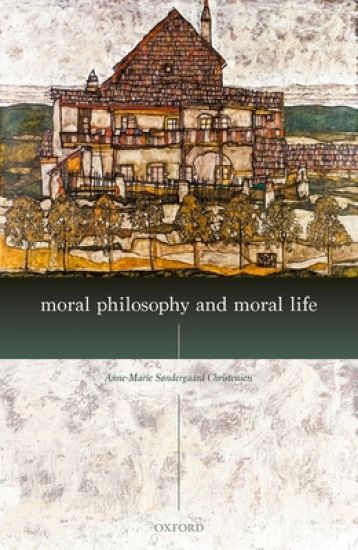
Moral Philosophy and Moral Life

Moral Philosophy and Moral Life

Anne-Marie Søndergaard Christensen

Oxford University Press
2020
sidottu
Moral Philosophy and Moral Life addresses the questions of the role of moral philosophy and its relationship to our ordinary moral lives. Christensen's argument is motivated by the belief that one of the most important obstacles for doing work in moral philosophy today is the lack of a coherent answer to the question of the role and status of moral philosophy and the theories it develops. The first part untangles various criticisms of the dominant view of moral theories that challenge the explanatory, foundational, authoritative, and action-guiding role of these theories. It also offers an alternative understanding of moral theories as descriptions of moral grammar. The second part investigates the nature of the particularities relevant for an understanding of moral life; both particularities tied to the moral subject, her character, her commitments, and her moral position, and particularities tied to the context of the subject, her moral community, and her language. The final part marks a return to moral philosophy and addresses the wider question of what the revised conception of moral theories and the affirmation of the value of the particular mean for moral philosophy by developing a descriptive, pluralistic, and elucidatory conception of moral philosophy. While the scope of the argument is wide, the aims are more moderate: to present an understanding of descriptive moral philosophy aimed at spurring debate about the status and role of moral philosophy in relation to our moral lives.
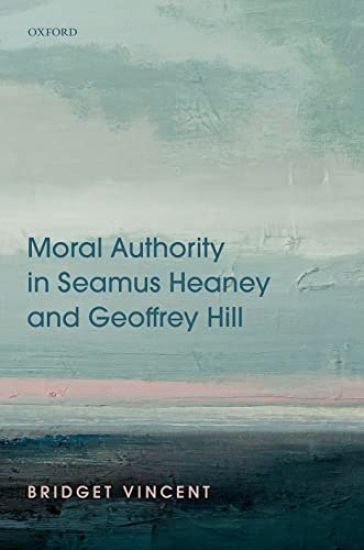
Moral Authority in Seamus Heaney and Geoffrey Hill

Moral Authority in Seamus Heaney and Geoffrey Hill

Bridget Vincent

Oxford University Press
2022
sidottu
How do poems communicate moral ideas? Can they express concepts in ways that are unique and impossible to replicate in other forms of writing? This book explores these questions by turning to two of the late twentieth century's most important poets: Seamus Heaney and Geoffrey Hill. Their work shows that a poem can act as an example of a moral concept, rather than simply a description or discussion of it. Exploring these two poets via their shared preoccupation with poetry's moral exemplarity opens up new perspectives on their work. The concept of exemplarity is shown to play an important role in these poets' most significant preoccupations, from moral complicity to the nature of lyric speech to literary influence to memorialisation, responsibility, and aesthetic autonomy. Through this new analysis of poetry, critical prose, drama, and archival materials, this book offers a major new study of ethics in the later period of these two writers--including recent underexplored posthumous works. In turn, the book also makes an important intervention in larger debates about literature and morality, and about the field of ethical criticism itself: this is the first book-length study to expand ethical criticism beyond its customary narrative focus. The ethical criticism of fiction is often an exercise in methodological advocacy, urging the use of more literary examples in moral philosophy. As this book shows, including poetry among these examples introduces new, lyric-inflected caveats about the use of literature as a form of moral example: caveats which remain invisible in narrative-centred ethical criticism.
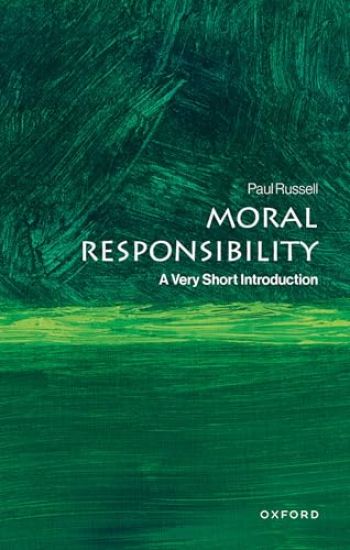
Moral Responsibility A Very Short Introduction
Very Short Introductions: Brilliant, Sharp, Inspiring Beginning in childhood, and continuing throughout our lives, we are immersed in a web of evaluations, attitudes, and practices that are evidence of our deep commitment to moral responsibility. At the same time, we may encounter puzzles and perplexities that may encourage scepticism about moral responsibility. This Very Short Introduction explores our understanding of moral responsibility and what it involves. This includes various practical problems that we face in dealing with it in a truthful, effective, and humane way. The picture presented is one that falls in the territory that lies between a consoling optimism and a bleak pessimism about our human ethical predicament. ABOUT THE SERIES: The Very Short Introductions series from Oxford University Press contains hundreds of titles in almost every subject area. These pocket-sized books are the perfect way to get ahead in a new subject quickly. Our expert authors combine facts, analysis, perspective, new ideas, and enthusiasm to make interesting and challenging topics highly readable.
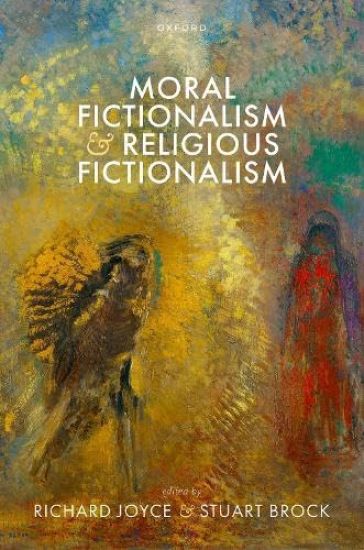
Moral Fictionalism and Religious Fictionalism
Atheism is a familiar kind of skepticism about religion. Moral error theory is an analogous kind of skepticism about morality, though less well known outside academic circles. Both kinds of skeptic face a “what next?” question: If we have decided that the subject matter (religion/morality) is mistaken, then what should we do with this way of talking and thinking? The natural assumption is that we should abolish the mistaken topic, just as we previously eliminated talk of, say, bodily humors and unicorns. The fictionalist, however, offers a less obvious recommendation. According to the fictionalist, engaging in the topic in question provides pragmatic benefits that do not depend on its truth-in a way roughly analogous to engaging with a novel or a movie. The religious fictionalist maintains that even if we were atheists, we should carry on talking, thinking, and acting as if religion were true. The moral fictionalist maintains a similar view regarding moral talk, thought, and action. Both forms of fictionalism face serious challenges. Some challenges can be levelled at either form of fictionalism (or at any form of fictionalism), whereas others are problems unique to moral fictionalism or to religious fictionalism. There are important questions to be asked about the relationship between these two kinds of fictionalism. Could moral fictionalism be plausible even if religious fictionalism is not (or vice versa)? This is a volume of thirteen previously unpublished papers on the topics of religious fictionalism, moral fictionalism, and the relation between these views.
Moral Fictionalism

Moral Fictionalism

Mark Eli Kalderon

Clarendon Press
2007
nidottu
Moral realists maintain that morality has a distinctive subject matter. Specifically, realists maintain that moral discourse is representational, that moral sentences express moral propositions - propositions that attribute moral properties to things. Non-cognitivists, in contrast, maintain that the realist imagery associated with morality is a fiction, a reification of our non-cognitive attitudes. The thought that there is a distinctively moral subject matter is regarded as something to be debunked by philosophical reflection on the way moral discourse mediates and makes public our noncognitive attitudes. The realist fiction might be understood as a philosophical misconception of a discourse that is not fundamentally representational but whose intent is rather practical. There is, however, another way to understand the realist fiction. Perhaps the subject matter of morality is a fiction that stands in no need of debunking, but is rather the means by which our attitudes are conveyed. Perhaps moral sentences express moral propositions, just as the realist maintains, but in accepting a moral sentence competent speakers do not believe the moral proposition expressed but rather adopt the relevant non-cognitive attitudes. Non-cognitivism, in its primary sense, is a claim about moral acceptance: the acceptance of a moral sentence is not moral belief but is some other attitude. Standardly, non-cognitivism has been linked to non-factualism - the claim that the content of a moral sentence does not consist in its expressing a moral proposition. Indeed, the terms 'non-cognitivism' and 'non-factualism' have been used interchangeably. But this misses an important possibility, since moral content may be representational but the acceptance of moral sentences might not be belief in the moral proposition expressed. This possibility constitutes a novel form of non-cognitivism, moral fictionalism. Whereas non-factualists seek to debunk the realist fiction of a moral subject matter, the moral fictionalist claims that that fiction stands in no need of debunking but is the means by which the non-cognitive attitudes involved in moral acceptance are conveyed by moral utterance. Moral fictionalism is non-cognitivism without a non-representational semantics.
Moral Animals

Moral Animals

Catherine Wilson

Clarendon Press
2007
nidottu
In Moral Animals Catherine Wilson develops a theory of morality based on two fundamental premises: first that moral progress implies the evolution of moral ideals involving restraint and sacrifice; second that human beings are outfitted by nature with selfish motivations, intentions, and ambitions that place constraints on what morality can demand of them. Normative claims, she goes on to show, can be understood as projective hypotheses concerning the conduct of realistically-described nonideal agents in preferred fictional worlds. Such claims differ from empirical hypotheses, insofar as they cannot be verified by observation and experiment. Yet many, though not all, moral claims are susceptible of confirmation to the extent that they command the agreement of well-informed inquirers. With this foundation in place, Wilson turns to a defence of egalitarianism intended to address the objection that the importance of our non-moral projects, our natural acquisitiveness and partiality, and our meritocratic commitments render social equality a mere abstract ideal. Employing the basic notion of a symmetrical division of the co-operative surplus, she argues that social justice with respect to global disparities in well-being, and in the condition of women relative to men, depends on the relinquishment of natural and acquired advantage that is central to the concept of morality.
Moral Dilemmas

Moral Dilemmas

Philippa Foot

Clarendon Press
2002
nidottu
In this collection - essays from the late 1970s to the '90s - Professor Foot develops further her critique of the dominant ethical theories of the second half of the 20th century, including discussion of the nature of moral judgement, practical rationality and the conflict of virtue with desire.
Moral Realism

Moral Realism

Russ Shafer-Landau

Clarendon Press
2003
sidottu
Moral Realism is a systematic defence of the idea that there are objective moral standards. In the tradition of Plato and G. E. Moore, Russ Shafer-Landau argues that there are moral principles that are true independently of what anyone, anywhere, happens to think of them. These principles are a fundamental aspect of reality, just as much as those that govern mathematics or the natural world. They may be true regardless of our ability to grasp them, and their truth is not a matter of their being ratified from any ideal standpoint, nor of being the object of actual or hypothetical consensus, nor of being an expression of our rational nature. Shafer-Landau accepts Plato's and Moore's contention that moral truths are sui generis. He rejects the currently popular efforts to conceive of ethics as a kind of science, and insists that moral truths and properties occupy a distinctive area in our ontology. Unlike scientific truths, the fundamental moral principles are knowable a priori. And unlike mathematical truths, they are essentially normative: intrinsically action-guiding, and supplying a justification for all who follow their counsel. Moral Realism is the first comprehensive treatise defending non-naturalistic moral realism in over a generation. It ranges over all of the central issues in contemporary metaethics, and will be an important source of discussion for philosophers and their students interested in issues concerning the foundations of ethics.
Moral Animals

Moral Animals

Catherine Wilson

Clarendon Press
2004
sidottu
In Moral Animals, Catherine Wilson develops a theory of morality based on two fundamental premises: first that moral progress implies the evolution of moral ideals involving restraint and sacrifice; second that human beings are outfitted by nature with selfish motivations, intentions, and ambitions that place constraints on what morality can demand of them. Normative claims, she goes on to show, can be understood as projective hypotheses concerning the conduct of realistically-described nonideal agents in preferred fictional worlds. Such claims differ from empirical hypotheses, insofar as they cannot be verified by observation and experiment. Yet many, though not all, moral claims are susceptible of confirmation to the extent that they command the agreement of well-informed inquirers. With this foundation in place, Wilson turns to a defence of egalitarianism intended to address the objection that the importance of our non-moral projects, our natural acquisitiveness and partiality, and our meritocratic commitments render social equality a mere abstract ideal. Employing the basic notion of a symmetrical division of the co-operative surplus, she argues that social justice with respect to global disparities in well-being, and in the condition of women relative to men, depends on the relinquishment of natural and acquired advantage that is central to the concept of morality.