Kirjojen hintavertailu. Mukana 11 706 473 kirjaa ja 12 kauppaa.

Kirjahaku

Etsi kirjoja tekijän nimen, kirjan nimen tai ISBN:n perusteella.

1000 tulosta hakusanalla Massimo Mazzitelli

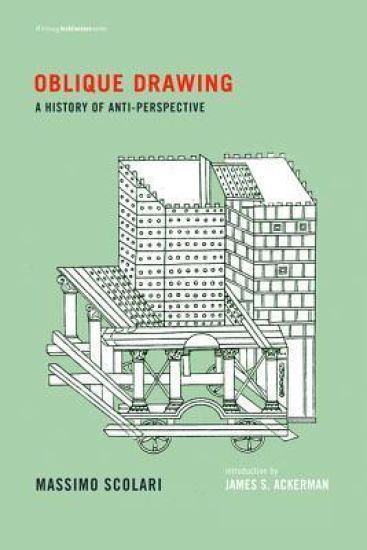
Oblique Drawing

Oblique Drawing

Massimo Scolari

MIT Press
2015
pokkari
A challenge to the hegemony of perspective: investigations into other forms of representation used by different cultures over the last two thousand years.For more than half a century, Erwin Panofsky's Perspective as Symbolic Form has dominated studies of visual representation. Despite the hegemony of central projection, or perspective, other equally important methods of representation have much to tell us. Parallel projection can be found on classical Greek vases, in Pompeiian frescoes, in Byzantine mosaics; it returned in works of the historical avant-garde, and remains the dominant form of representation in China. In Oblique Drawing, Massimo Scolari investigates "anti-perspective" visual representation over two thousand years, finding in the course of his investigation that visual and conceptual representations are manifestations of the ideological and philosophical orientations of different cultures. Images prove to be not just a form of art but a form of thought, a projection of a way of life.Scolari's generously illustrated studies show that illusionistic perspective is not the only, or even the best, representation of objects in history; parallel projection, for example, preserves in scale the actual measurements of objects it represents, avoiding the distortions of one-point perspective. Scolari analyzes the use of nonperspectival representations in pre-Renaissance images of machines and military hardware, architectural models and drawings, and illustrations of geometrical solids. He challenges Panofsky's theory of Pompeiian perspective and explains the difficulties encountered by the Chinese when they viewed Jesuit missionaries' perspectival religious images.Scolari vividly demonstrates the diversity of representational forms devised through the centuries, and shows how each one reveals something that is lacking in the others.
An Essay on Money and Distribution

An Essay on Money and Distribution

Massimo Pivetti

Palgrave Macmillan
1991
sidottu
The book develops an explanation of distribution between profits and wages, which is both logically coherent and supported by reality. It is centred upon a concept of the money rate of interest as the variable that governs the normal profitability of capital.
Keynesianism, Social Conflict and Political Economy

Keynesianism, Social Conflict and Political Economy

Massimo de Angelis

Palgrave Macmillan
2000
sidottu
This controversial book shows that there is more to economics than dry models and esoteric equations. By investigating the rise and fall of postwar Keynesianism and focusing on the experience of the United States, the author adopts an interdisciplinary approach to show that economics is rooted in the flesh and blood history of social conflict. This timely study concludes with a discussion of the viability of Keynesianism today, in the context of recurrent crisis in the global economy and the rise of new social movements.
Le ricette di dio

Le ricette di dio

Massimo Angelo Pastorino

Lulu Press
2018
nidottu
Moderno Odisseo a cavallo tra due mondi, smemorato cercatore d'amore e di senso vessato dal destino.Le ricette di dio questo sono: un romanzo, anzi due. E forse qualcosa di pi .Il primo ambientato nella Cuba post periodo especiales, il secondo nell'Italia gi in crisi economica e morale della Genova del G8, passando per gli USA dell'11 settembre e approdando ai giorni nostri nella Parigi degli attentati del 13 novembre 2015, la strage del Bataclan e tutto il resto. Il personaggio che ne protagonista viene travolto dalla storia(quella con la S maiuscola) ritrovandosi senza memoria in un paese che, nonostante le contraddizioni e le difficolt imparer ad amare. Ma quasi in una rivisitazione della 53a sukkah del Talmud Babilonese, dove per il protagonista invece di sfuggire la morte, insegue l'amore, andando proprio per questo all'incontro inevitabile con la "nera signora"
The Stakeholder Perspective

The Stakeholder Perspective

Massimo Pirozzi

CRC Press
2019
sidottu
The Stakeholder Perspective places people at the center of both projects and project management. It gives to the project management community a helpful, innovative, stakeholder-centered approach to increase projects’ delivered value and success rate. It presents a logical model also called the "Stakeholder Perspective," which acts as the reference point in a structured path to effectiveness. Starting from the analysis of a project’s stakeholders, the model integrates both rational and relational innovative approaches. Its continuous focus on stakeholder requirements and expectations helps to set a proper path, and to maintain it, in order to target success and to achieve goals in a variety of projects with different size and complexity. The book presents a set of innovative and immediately applicable techniques for effective stakeholder identification and classification, as well as analysis of stakeholder requirements and expectations, key stakeholders management, stakeholder network management, and, more generally, stakeholder relationship management. The proposed stakeholder classification model consists of just four communities, each one based on the commonality of main interests and behavior. This model features an accurate and stable identification process to increase effective communication and drastic reduce relationship complexity. A systemic approach is proposed to analyze both stakeholder requirements and expectations. The approach aids in detecting otherwise unclear stakeholder requirements and/or hidden stakeholder expectations. An interactive communication model is presented along with its individual and organizational frames of reference. Also presented are relevant cues to maximize effective and purposeful communication with key stakeholders as well as with the stakeholder network. The importance of satisfying not only the project requirements but also the stakeholder expectations is demonstrated to be the critical success factor in all projects. An innovative approach based on the perceived value and key performance indicators shows how to manage different levels of project complexity. The book also defines a complete structured path to relationship effectiveness called "Relationship Management Project," which can be tailored to enhance stakeholder and communication management processes in each one of the project management process groups (i.e. initiating, planning, executing, monitoring and controlling, and closing). The book concludes with a look ahead at Project Management X.0 and the stakeholder-centered evolution of both project and portfolio management.
6 Building Blocks for Successful Innovation

6 Building Blocks for Successful Innovation

Massimo Garbuio; Moritz Dressel

Routledge
2019
nidottu
Innovation is about ideas that make life better. But what does it really take to deliver innovative propositions? And what separates companies that drive their industries forward from those that simply talk the talk? This book takes you inside the minds of the world’s most effective innovators to answer these questions and more. In real stories from industries as diverse as healthcare, finance, technology, and telecommunications, business leaders reveal what it takes to bring new products and services to life. They weigh in on the big debates: how to design an innovative organization of diverse voices, how to protect and grow ideas so they succeed, and how to tune corporate radar to inspiration and turn the signals received into new value.An essential resource for leaders, aspiring leaders and students of entrepreneurship, business management, HRM, technology and innovation management, and design thinking, the book enables the reader to: Hear from leaders with direct responsibility for innovating in a wide range of industries and learn how they do it See how to structure for innovation, gain momentum inside an organization and use ideas to shift companies and industries Gain insight into what innovators look for when they sense the environment and learn to avoid common pitfalls and misconceptions that stop great ideas coming to life Approach innovation in a more balanced way with the 6 Building Blocks helping you prioritize execution and value delivery from inspiration to implementation
6 Building Blocks for Successful Innovation

6 Building Blocks for Successful Innovation

Massimo Garbuio; Moritz Dressel

Routledge
2019
sidottu
Innovation is about ideas that make life better. But what does it really take to deliver innovative propositions? And what separates companies that drive their industries forward from those that simply talk the talk? This book takes you inside the minds of the world’s most effective innovators to answer these questions and more. In real stories from industries as diverse as healthcare, finance, technology, and telecommunications, business leaders reveal what it takes to bring new products and services to life. They weigh in on the big debates: how to design an innovative organization of diverse voices, how to protect and grow ideas so they succeed, and how to tune corporate radar to inspiration and turn the signals received into new value.An essential resource for leaders, aspiring leaders and students of entrepreneurship, business management, HRM, technology and innovation management, and design thinking, the book enables the reader to: Hear from leaders with direct responsibility for innovating in a wide range of industries and learn how they do it See how to structure for innovation, gain momentum inside an organization and use ideas to shift companies and industries Gain insight into what innovators look for when they sense the environment and learn to avoid common pitfalls and misconceptions that stop great ideas coming to life Approach innovation in a more balanced way with the 6 Building Blocks helping you prioritize execution and value delivery from inspiration to implementation
Analysis of Grounding and Bonding Systems
Learn the theory behind grounding systems and bonding equipotential connections from a worldwide expert. Through mathematical analysis, comprehensive explanations, and detailed figures, Analysis of Grounding and Bonding Systems explains the theory and the reasons behind basic ground-electrodes (i.e., the sphere, the ground rod, and the horizontal ground wire), and more complex grounding systems (i.e., ground-grids), buried in uniform and non-uniform soils.Through calculations and explanatory diagrams, this comprehensive guide provides code-complying solutions for the safety against electric shock provided by equipotential bonding connections between exposed-conductive-parts, such as equipment enclosures, and metalwork. Details on the calculation of step and touch voltages in different types of system grounding (i.e., TT, TN, and IT) are provided, also with the aid of solved problems.Readers will learn how to minimize hazardous interactions between grounding systems, cathodically protected pipelines, and heat networks. The analysis of the effectiveness of bonding systems against electric shock in the case of contact with electric vehicles during charge in the event of ground-faults, which is an upcoming issue challenging our safety, is included.
The Anthropological Paradox

The Anthropological Paradox

Massimo De Carolis

Routledge
2019
nidottu
This book addresses how the erosion of traditional forms of political association and legal regulation has given rise to a pluralism of "imperfect communities" constantly exposed to the risk of dissolution. These are niches and micro-worlds that are connected through precarious and ambivalent ties. Such a far-reaching transformation affects at one and the same time both our psychic and social identity. The book argues that this phenomenon is linked to the proliferation of new forms of psychic "disorder" – depression, personality disorder, dissociation – typical of hypermodern societies. However, while these can easily turn into genuine disorders, they can also open onto richer forms of identity, more complex than those of the past. Based on this analysis, the book’s main claim is that this dynamic epitomizes a general anthropological paradox – one that has always marked the human animal: humans are bound by their own biological constitution to fend off disorder by drawing the boundaries of artificial niches, and yet they are inclined to expose themselves to unlimited contingency so that they can find a truly suitable environment.Pursuing a novel understanding of the apparent collapse of traditional juridico-political settings, this book makes the case that the emergence of dissociations at several levels – individual, social, political, legal – does not stem from a lack of political imagination. Rather, it is a situation with which humans are inevitably confronted: a perennial tension between the limited and the unlimited, between the desire to take refuge and the desire to cross borders.
Analysis of Grounding and Bonding Systems
Learn the theory behind grounding systems and bonding equipotential connections from a worldwide expert. Through mathematical analysis, comprehensive explanations, and detailed figures, Analysis of Grounding and Bonding Systems explains the theory and the reasons behind basic ground-electrodes (i.e., the sphere, the ground rod, and the horizontal ground wire), and more complex grounding systems (i.e., ground-grids), buried in uniform and non-uniform soils.Through calculations and explanatory diagrams, this comprehensive guide provides code-complying solutions for the safety against electric shock provided by equipotential bonding connections between exposed-conductive-parts, such as equipment enclosures, and metalwork. Details on the calculation of step and touch voltages in different types of system grounding (i.e., TT, TN, and IT) are provided, also with the aid of solved problems.Readers will learn how to minimize hazardous interactions between grounding systems, cathodically protected pipelines, and heat networks. The analysis of the effectiveness of bonding systems against electric shock in the case of contact with electric vehicles during charge in the event of ground-faults, which is an upcoming issue challenging our safety, is included.
Computational Power

Computational Power

Massimo Durante

Routledge
2021
sidottu
We delegate more and more decisions and tasks to artificial agents, machine-learning mechanisms, and algorithmic procedures or, in other words, to computational systems. Not that we are driven by powerful ambitions of colonizing the Moon, replacing humans with legions of androids, creating sci-fi scenarios à la Matrix or masterminding some sort of Person of Interest-like Machine. No, the current digital revolution based on computational power is chiefly an everyday revolution. It is therefore that much more profound, unnoticed and widespread, for it affects our customary habits and routines and alters the very texture of our day-to-day lives. This opens a precise line of inquiry, which constitutes the basic thesis of the present text: our computational power is exercised by trying to adapt not just the world but also our representation of reality to how computationally based ICTs work. The impact of this technology is such that it does not leave things as they are: it changes the nature of agents, habits, objects and institutions and hence it subverts the existing order, without necessarily generating a new one. I argue that this power is often not distributed in an egalitarian manner but, on the contrary, is likely to result in concentrations of wealth, in dominant positions or in unjust competitive advantages. This opens up a struggle, with respect to which the task of reaffirming the fundamental values, the guiding principles, the priorities and the rules of the game, which can transform, or attempt to transform, a fierce confrontation between enemies in a fair competition between opponents rests on us.
Computational Power

Computational Power

Massimo Durante

Routledge
2021
nidottu
We delegate more and more decisions and tasks to artificial agents, machine-learning mechanisms, and algorithmic procedures or, in other words, to computational systems. Not that we are driven by powerful ambitions of colonizing the Moon, replacing humans with legions of androids, creating sci-fi scenarios à la Matrix or masterminding some sort of Person of Interest-like Machine. No, the current digital revolution based on computational power is chiefly an everyday revolution. It is therefore that much more profound, unnoticed and widespread, for it affects our customary habits and routines and alters the very texture of our day-to-day lives. This opens a precise line of inquiry, which constitutes the basic thesis of the present text: our computational power is exercised by trying to adapt not just the world but also our representation of reality to how computationally based ICTs work. The impact of this technology is such that it does not leave things as they are: it changes the nature of agents, habits, objects and institutions and hence it subverts the existing order, without necessarily generating a new one. I argue that this power is often not distributed in an egalitarian manner but, on the contrary, is likely to result in concentrations of wealth, in dominant positions or in unjust competitive advantages. This opens up a struggle, with respect to which the task of reaffirming the fundamental values, the guiding principles, the priorities and the rules of the game, which can transform, or attempt to transform, a fierce confrontation between enemies in a fair competition between opponents rests on us.
Al-Ghazali and the Divine

Al-Ghazali and the Divine

Massimo Campanini

Routledge
2020
nidottu
This book examines the philosophy of al-Ghazali, analysing his conception of God within Islamic theology. Seeking to contribute to the greater understanding of Muslim thought, it analyses his ‘orthodox’ theory, based on the notion that the spiritual struggle (jihad) and philosophical enquiry are informed by the possession of firm science (‘ilm). Exploring a wide range of Arab texts and Arab primary literature, this book therefore examines a crucial period of Medieval Islamic history, whilst emphasizing the multifarious and by no means monolithic components of the Muslim outlook. In seeking to understand Islamic religion as a creative and progressive heritage, it also demonstrates the moderate and equilibrate character of mainstream Islam, and ultimately argues that al-Ghazali’s thought is the best expression of Islamic intellectuality and spirituality.Taking a theoretical approach, this book will be useful to students and scholars of Islamic philosophy, theology and history.
The Making of a Postsecular Society

The Making of a Postsecular Society

Massimo Rosati

Routledge
2020
nidottu
Drawing on the thought of Durkheim, this volume focuses on societal changes at the symbolic level to develop a new conceptualisation of the emergence of postsecular societies. Neo-Durkheimian categories are applied to the case of Turkey, which in recent years has shifted from a strong Republican and Kemalist view of secularism to a more Anglo-Saxon perspective. Turkish society thus constitutes an interesting case that blurs modernist distinctions between the secular and the religious and which could be described as ’postsecular’. Presenting three symbolic case studies - the enduring image of the founder of the Republic Atatürk, the contested site of Ayasofia, and the remembering and commemoration of the murdered journalist Hrant Dink - The Making of a Postsecular Society analyses the cultural relationship that the modern Republic has always had with Europe, considering the possible implications of the Turkish model of secularism for a specifically European self-understanding of modernity. Based on a rigorous construction of theoretical categories and on a close scrutiny of the common challenges confronting Europe and its Turkish neighbour long considered ’other’ with regard to the accommodation of religious difference, this book sheds light on the possibilities for Europe to find new ways of arranging the relationship between the secular and the religious. As such, it will appeal to scholars of social theory, the sociology of religion, secularisation and religious difference, and social change.
Ritual and the Sacred

Ritual and the Sacred

Massimo Rosati

Routledge
2020
nidottu
Ritual and the Sacred discusses some of the most important issues of modern socio-political life through the lens of a neo-Durkheimian perspective. Building on the main lesson of Durkheim's Elementary Forms of Religious Life, this book articulates values and practices common to non-Western and religious traditions that have the capacity to shape our modern way of living. Central to this volume is the question of modernity and scepticism with regard to mainstream Western wisdom; Rosati focuses on the notion of societal self-reassessment and self-revision, illustrating a willingness to learn from ’primitive’ societies. This reassessment necessitates us to rethink the central roles played by ritual and the sacred as building blocks of social and individual life, both of which remain salient features within the modern world. This title will be of key interest to sociologists of religion, philosophy politics and social theorists.
Cross-Cultural Perspectives on Hagiographical Strategies
This book examines the potential of conducting studies in comparative hagiology, through parallel literary and historical analyses of spiritual life writings pertaining to distinct religious contexts. In particular, it focuses on a comparative analysis of the early sources on the medieval Christian Saint Francis of Assisi (1182-1226) and the Tibetan Buddhist Milarepa (c. 1052-1135), up to and including the so-called ‘standard versions’ of their life stories written by Bonaventure of Bagnoregio (1221-1274) and Tsangnyön Heruka (1452-1507) respectively.The book thus demonstrates how in the social and religious contexts of both 1200s Italy and 1400s Tibet, narratives of the lives, deeds and teachings of two individuals recognized as spiritual champions were seen as the most effective means to promote spiritual, doctrinal and political agendas. Therefore, as well being highly relevant to those studying hagiographical sources, this book will be of interest to scholars working across the fields of religion and the comparative study of religious phenomena, as well as history and literature in the pre-modern period.
The Birth of Intersubjectivity

The Birth of Intersubjectivity

Massimo Ammaniti; Vittorio Gallese

WW Norton Co
2013
sidottu
This book, the exciting collaboration of a developmental psychoanalyst at the forefront of functional magnetic resonance attachment research and a leading neurobiological researcher on mirror neurons, presents a fresh and innovative look at intersubjectivity from a neurobiological and developmental perspective. Grounding their analysis of intersubjectivity in the newest advances from developmental neuroscience, modern attachment theory, and relational psychoanalysis, Massimo Ammaniti and Vittorio Gallese illustrate how brain development changes simultaneously with relationally induced alterations in the subjectivities of both mother and infant. Ammaniti and Gallese combine extensive current interdisciplinary research with in-depth clinical interviews that highlight the expectant mother’s changing subjective states and the various typologies of maternal representations. Building on Gallese’s seminal work with mirror neurons and embodied simulation theory, the authors construct a model of intersubjectivity that stresses not symbolic representations but intercorporeality from a second-person perspective. Charting the prenatal and perinatal events that serve as the neurobiological foundation for postnatal reciprocal affective communications, they conclude with direct clinical applications of early assessments and interventions, including interventions with pregnant mothers. This volume is essential for clinicians specializing in attachment disorders and relational trauma, child psychotherapists, infant mental health workers, pediatricians, psychoanalysts, and developmental researchers. It combines fascinating new information and illustrative clinical experience to illustrate the early intersubjective origins of our own and our patients’ internal worlds.
Religious Conversion and Identity

Religious Conversion and Identity

Massimo Leone

Routledge
2003
sidottu
The way in which people change and represent their spiritual evolution is often determined by recurrent language structures. Through the analysis of ancient and modern stories and their words and images, this book describes the nature of conversion through explorations of the encounter with the religious message, the discomfort of spiritual uncertainty, the loss of personal and social identity, the anxiety of destabilization, the reconstitution of the self and the discovery of a new language of the soul.
The Qur'an

The Qur'an

Massimo Campanini

Routledge
2010
sidottu
The Qur’an: Modern Muslim Interpretations offers a lucid guide to how Muslims have read the Qur’an in the twentieth and twenty-first centuries. Massimo Campanini explores early approaches to the understanding of the Qur’an, including that of the Salafis and the construction of the Islamic Renaissance Movement, contrasting the development of traditionalist and ‘scientific’ interpretations and examining the work of the phenomenologists who followed. This lively book explores the radical ideas of Sayyid Qutb and his followers, a significant part of what is known as political Islamism, and investigates the idea of exegesis as a liberation theology, through the work of Esack and Wadud. Students taking courses on the interpretation of the Qur’an will find this an invaluable aid to their study, and it is essential reading for all those interested in how Muslims have understood the Qur’an in the contemporary period.