Kirjojen hintavertailu. Mukana 11 342 296 kirjaa ja 12 kauppaa.

Kirjahaku

Etsi kirjoja tekijän nimen, kirjan nimen tai ISBN:n perusteella.

1000 tulosta hakusanalla Max Pece

Max is Missing

Max is Missing

Peter Porter

Picador
2001
pokkari
Few poets now writing share Porter’s sense of the big picture, his ability to read the small event against the waxings and wanings of culture and empire. Whether these poems look at Europe through the strata of its Golden Ages, revisit the Australia of his childhood or turn their surreal wit to the quieter domestic landscape, together they amount to a sustained meditation on the spirit that bears comparison with the late poems of Wallace Stevens. Magisterial in its perspective and possessed of a rare intellectual sanity, Max is Missing is Porter’s most charged and direct work since The Cost of Seriousness.
Max Weber and the Culture of Anarchy
This is a specially commissioned set of essays on the themes of Max Weber, culture, anarchy and politics. It presents the first complete publication (in both English and German) of a series of letters written by Max Weber in 1913 and 1914 during his stays at the anarchist settlement of Ascona. The letters show Weber debating with the issues of free love, eroticism, patriarchy, anarchism, terrorism, pacifism, political and personal convictions and power. These themes are taken up by the contributors in a wider discussion of the relation of culture and politics.
Max Weber, Democracy and Modernization
These essays bring Weber's sociology to bear on the current transformation of the political landscape. After the collapse of communism, many states are faced with the challenges of democratization: they need to establish their legitimacy in an uncertain economic climate and within a new geopolitical order. The essays in this volume develop Weberian concepts and apply his comparative-historical method to deepen our understanding of these problems. They cover a wide range of examples, from the United States to Western and Eastern Europe, and from Russia and Japan to the Islamic states.
Max Weber, Democracy and Modernization
These essays bring Weber's sociology to bear on the current transformation of the political landscape. After the collapse of communism, many states are faced with the challenges of democratization: they need to establish their legitimacy in an uncertain economic climate and within a new geopolitical order. The essays in this volume develop Weberian concepts and apply his comparative-historical method to deepen our understanding of these problems. They cover a wide range of examples, from the United States to Western and Eastern Europe, and from Russia and Japan to the Islamic states.
Max Weber and the Culture of Anarchy
This is a specially commissioned set of essays on the themes of Max Weber, culture, anarchy and politics. It presents the first complete publication (in both English and German) of a series of letters written by Max Weber in 1913 and 1914 during his stays at the anarchist settlement of Ascona. The letters show Weber debating with the issues of free love, eroticism, patriarchy, anarchism, terrorism, pacifism, political and personal convictions and power. These themes are taken up by the contributors in a wider discussion of the relation of culture and politics.
Max Weber and Postmodern Theory

Max Weber and Postmodern Theory

N. Gane

Palgrave Macmillan
2002
sidottu
This book explores the contemporary nature of Max Weber's work by looking in detail at his key concepts of rationalization and disenchantment. Thematic parallels are drawn between Weber's rationalization thesis and the critiques of contemporary culture developed by Jean-Francois Lyotard, Michel Foucault and Jean Baudrillard. It is suggested that these three 'postmoden' thinkers develop and respond to Weber's analysis of modernity by pursuing radical strategies of affirmation and re-enchantment. Examining the work of these three key thinkers in this way casts new light both on postmodern theory and on Weber's sociology of rationalization.
Max Weber's Interpretive Sociology of Law
This book presents a clear and precise account of the structure and content of Max Weber's sociology of law: situating its methodological and epistemological specificity in relation to other approaches to the sociology of law; as well as offering a critical evaluation of Weber's usefulness for contemporary socio-legal research. The book is divided into three parts. The first part deals with the methodological foundations of Weber's sociology of law. The second analyses the central theme of this sociology, the rationalisation of law, from the perspective of its internal logical coherence, its empirical validity, and finally its legitimacy. The third part questions the present-day relevance of the Weberian sociology of law for socio-legal research, notably with regard to legal pluralism. Max Weber, it is demonstrated, is not merely a 'founding father' of the sociology of law; rather, his methodology, concepts, and empirical analyses remain highly useful to the further development of work in this area.
Max Weber's Sociology of Civilizations: A Reconstruction
This volume examines civilizations through the broad lens articulated by the works of Max Weber. In focusing upon his comparative-historical mode of analysis and his causal explanations for the sources, contours, and trajectories of civilizations, this study reconstructs Weber’s sociology in a manner that provides clear guidelines to researchers seeking to investigate civilizations systematically. Through detailed interpretations of the West’s unique development from Antiquity to the Modern era, precise comparisons to the long-range and singular pathways taken by China and India, and careful demarcations of the "particular rationalisms" of several civilizations, the author addresses Weber’s powerful model-building on the one hand and his opposition to organic holism and structural presuppositions on the other hand. Both a broad-ranging conceptual framework and case-based empirical investigations are pivotal to Weber. His research strategy emphasizes further the "subjective meanings" of actors East and West and the deep cultural origins of groups. Finally, this volume masterfully conveys Weber’s contextual and multi-causal methodology rooted in a tight interweaving of the present with the past. Max Weber’s Sociology of Civilizations: A Reconstruction will appeal to comparative sociologists and historians, as well as to theorists of all persuasions. The social scientist pursuing a cross-civilizational agenda will here discover the distinct contribution of Weber’s "interpretive understanding" procedures to the now-essential field of civilizational analysis.
Max Weber's Sociology of Civilizations: A Reconstruction
This volume examines civilizations through the broad lens articulated by the works of Max Weber. In focusing upon his comparative-historical mode of analysis and his causal explanations for the sources, contours, and trajectories of civilizations, this study reconstructs Weber’s sociology in a manner that provides clear guidelines to researchers seeking to investigate civilizations systematically. Through detailed interpretations of the West’s unique development from Antiquity to the Modern era, precise comparisons to the long-range and singular pathways taken by China and India, and careful demarcations of the "particular rationalisms" of several civilizations, the author addresses Weber’s powerful model-building on the one hand and his opposition to organic holism and structural presuppositions on the other hand. Both a broad-ranging conceptual framework and case-based empirical investigations are pivotal to Weber. His research strategy emphasizes further the "subjective meanings" of actors East and West and the deep cultural origins of groups. Finally, this volume masterfully conveys Weber’s contextual and multi-causal methodology rooted in a tight interweaving of the present with the past. Max Weber’s Sociology of Civilizations: A Reconstruction will appeal to comparative sociologists and historians, as well as to theorists of all persuasions. The social scientist pursuing a cross-civilizational agenda will here discover the distinct contribution of Weber’s "interpretive understanding" procedures to the now-essential field of civilizational analysis.
Max Weber's Theory of Modernity

Max Weber's Theory of Modernity

Michael Symonds

Routledge
2020
nidottu
This book illuminates an important dimension of the work of Max Weber. Weber’s theory of meaning and modernity is articulated through an understanding of his account of the way in which the pursuit of meaning in the modern world has been shaped by the loss of Western religion and how such pursuit gives sense to the phenomena of human suffering and death. Through a close, scholarly reading of Weber’s extensive writings and Vocation Lectures, the author explores the concepts of ’paradox’ and ’brotherliness’ as found in Weber’s work, in order to offer an original exposition of Weber’s actual theory of how meaning and meaninglessness work in the modern world. In addition to making a substantial and highly original contribution to the sociology of modernity, the book applies the theory of meaning extracted from Weber’s thought, addressing the claim that Weber’s work has been rendered out-dated by the supposed re-enchantment of the modern world, as well as discussing the ways this theory can contribute to our understanding of the development of specific forms of modernity. A rigorous examination of the thought of one of the most important figures in classical sociology, this volume will appeal to scholars of sociology, social theory and philosophy with interests in modernity, Weber and the concept of meaning.
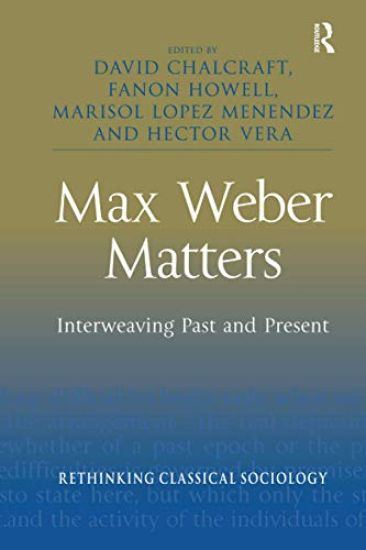
Max Weber Matters
This volume clearly communicates that Weber’s influence is of great significance to the history of social science, and to appreciating the theoretical work of other social scientists in the modern age. Its insightful and timely publication comprises topical and innovative work discussing Weber in a range of historical and contemporary questions including: the controversy surrounding the Da Vinci code; the charismatic role of martyrs; the nuclear weapons strategy in a post-cold-war age and the affinity between Hindu belief systems and disenchanted computer science. Max Weber Matters illustrates the multidisciplinary and continued relevance of Weber’s work and will be of interest to scholars across a range of disciplines, including historians, sociologists, political scientists and social theorists.
Max Weber and the Path from Political Economy to Economic Sociology
This book examines the largely-neglected shift in Max Weber’s work from political economy to economic sociology. Considering the importance of his recognition—made during his research on the Protestant Ethic—of the reciprocal influences that exist between economics and society and the role of this realization in prompting him to rethink the study of political economy, the author sheds fresh light on his emerging belief that the study of the relationship between economic factors and social issues required a new discipline. A study that charts an important development in the thought of one of the founding figures of sociology, this volume will appeal to scholars of social theory with interests in the history of the field and the legacy of Max Weber.
Max Weber and the Path from Political Economy to Economic Sociology
This book examines the largely-neglected shift in Max Weber’s work from political economy to economic sociology. Considering the importance of his recognition—made during his research on the Protestant Ethic—of the reciprocal influences that exist between economics and society and the role of this realization in prompting him to rethink the study of political economy, the author sheds fresh light on his emerging belief that the study of the relationship between economic factors and social issues required a new discipline. A study that charts an important development in the thought of one of the founding figures of sociology, this volume will appeal to scholars of social theory with interests in the history of the field and the legacy of Max Weber.
Max Booth Future Sleuth

Max Booth Future Sleuth

Cameron Macintosh

Readhowyouwant
2020
pokkari
There's a new sleuth in town " he's fun, funny, and very 2424 It's 2424. Super Sleuth Max Booth is uncovering the secrets of 20th century gadgets with his faithful but slightly neurotic robodog, Oscar. There are sinister characters and challenges along the way. Join the adventure in this fabulous series full of mystery, surprises and suspense. Ideal for reluctant readers. Max and his robo-dog, Oscar, are baffled by the discovery of a tiny device that looks like a grain of rice. Using their future-sleuthy skills, they figure out what it is " an ID chip that should have been implanted into a very special dog ]400 years ago They unleash the truth of a long-lost treasure. But, Bluggsville's savviest sleuths could be hounded off the treasure trail for good.
Max Booth Future Sleuth

Max Booth Future Sleuth

Cameron Macintosh

Readhowyouwant
2020
pokkari
In the year 2424, it seems crazy that people once needed film to take photos. Max and Oscar - Bluggsville's smartest sleuths - are shocked when they find a 400-year-old roll of film. They're even more shocked to discover that it still seems to contain someone's happy snap.
Max Booth Future Sleuth #6

Max Booth Future Sleuth #6

Cameron Macintosh

Readhowyouwant
2021
pokkari
There's a new sleuth in town - he's fun, funny, and very 2424 It's 2424. Super Sleuth Max Booth is uncovering the secrets of 20th century gadgets with his faithful but slightly neurotic robodog, Oscar. There are sinister characters and challenges along the way. Join the adventure in this fabulous series full of mystery, surprises and suspense. Ideal for reluctant readers. IF YOU HAVE A MAP, YOU MUST KNOW WHERE YOU'RE GOING ] RIGHT? TODAY, MAX ISN'T SO SURE When Max and his brainy beagle-bot, Oscar, find a 400-year-old navigation unit, they're shocked to discover that it still seems to work. They trace its owner's last journey and find themselves on the road to very big trouble Far from home, Max and Oscar cross paths with a bunch of bungling burglars, trying to zip away with a precious piece of old-tech art. Max and Oscar will need to map out a rapid plan to catch the thieves and navigate their way out of danger .
Max-Plus Linear Stochastic Systems and Perturbation Analysis

Max-Plus Linear Stochastic Systems and Perturbation Analysis

Bernd F. Heidergott

Springer-Verlag New York Inc.
2006
sidottu
During the last decade, the area of stochastic max-plus linear systems has witnessed a rapid development, which created a growing interest in this area. This book provides a thorough treatment of the theory of stochastic max-plus linear systems. Max-plus algebra is an algebraic approach to discrete event systems (DES), like queuing networks that are prone to synchronization. Perturbation analysis studies the sensitivity of the performance of DES with respect to changes in a particular system parameter. The first part of the book addresses modeling issues and stability theory for stochastic max-plus systems. The second part of the book treats perturbation analysis of max-plus systems: a calculus for differentiation of max-plus systems is developed. This calculus leads to numerical evaluations of performance indices of max-plus linear stochastic systems, such as the Lyapunov exponent or waiting times.
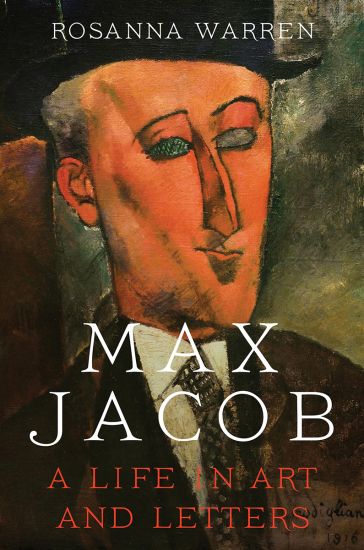
Max Jacob: A Life in Art and Letters

Max Jacob: A Life in Art and Letters

Rosanna Warren

W. W. Norton Company
2020
sidottu
Though less of a household name than his contemporaries in early twentieth century Paris, Jewish homosexual poet Max Jacob was Pablo Picasso's initiator into French culture, Guillaume Apollinaire's guide out of the haze of symbolism, and Jean Cocteau's loyal friend. As Picasso reinvented painting, Jacob helped to reinvent poetry with compressed, hard-edged prose poems and synapse-skipping verse lyrics, the product of a complex amalgamation of Jewish, Breton, Parisian, and Roman Catholic influences.In Max Jacob, the poet's life plays out against the vivid backdrop of bohemian Paris from the turn of the twentieth century through the divisions of World War II. Acclaimed poet Rosanna Warren transports us to Picasso's ramshackle studio in Montmartre, where Cubism was born; introduces the artists gathered at a seedy bar on the left bank, where Max would often hold court; and offers a front-row seat to the artistic squabbles that shaped the Modernist movement.Jacob's complex understanding of faith, art, and sexuality animates this sweeping work. In 1909, he saw a vision of Christ in his shabby room in Montmartre, and in 1915 he converted formally from Judaism to Catholicism--with Picasso as his godfather. In his later years, Jacob split his time between Paris and the monastery of Beno t-sur-Loire. In February 1944, he was arrested by the Gestapo and sent to Drancy, where he would die a few days later.More than thirty years in the making, this landmark biography offers a compelling, tragic portrait of Jacob as a man and as an artist alongside a rich study of his groundbreaking poetry--in Warren's own stunning translations. Max Jacob is a nuanced, deeply researched, and essential contribution to Modernist scholarship.
Max And The Tag Along Moon

Max And The Tag Along Moon

Floyd Cooper

Philomel Books,U.S.
2013
sidottu
"Has the moon ever followed you home at night?" Max loves his grandpa. When they must say good-bye after a visit, Grandpa reminds Max that the moon above them at Grandpa's house is the same moon that will follow him all the way home. And on that swervy-curvy car ride back home Max smiles as the moon tags along, thinking of Grandpa. But when the sky darkens and the moon disappears behind clouds, Max worries that it did not follow him home after all. Yet when the clouds part and light streams through his window, he realizes that Grandpa was right--the moon was with him all along.Floyd Cooper received the Coretta Scott King Award for "The Blacker the Berry," two Coretta Scott King Honors for "Honey in Broomwheat Tea" and "I Have Heard of a Land," and an NAACP image award. His books have also been named to numerous best books list and been given many Parents Choice Awards. In "Max and the Tag-Along Moon, "his lush paintings perfectly capture the wonder of the moon, the love between grandfather and grandson, and that feeling of magic every child experiences when the moon follows him home.