Kirjojen hintavertailu. Mukana 12 423 136 kirjaa ja 12 kauppaa.

Kirjahaku

Etsi kirjoja tekijän nimen, kirjan nimen tai ISBN:n perusteella.

1000 tulosta hakusanalla Michael J. Rodgers Jr.

The Forgotten Presidents

The Forgotten Presidents

Michael J. Gerhardt

Oxford University Press Inc
2013
sidottu
In The Constitutional Legacy of Forgotten Presidents, eminent constitutional scholar Michael Gerhardt covers the presidencies of thirteen "forgotten" presidents and shows why their presidencies were far more consequential than most believe. Through engaging chapters on Martin Van Buren, Chester Arthur, William Howard Taft, and Jimmy Carter (among others), Gerhardt explains how forgotten presidencies have ushered in some most important constitutional changes in American history. From the early nineteenth century onward, the lesser presidents played an important role in shaping major developments such as the growth of federal power at the expense of the states and the expansion of executive authority vis-à-vis Congress. Gerhardt claims that the problem with forgotten presidents, such as Millard Fillmore and Franklin Pierce, was not that they were weak, ineffective, or indecisive but rather that they had remarkably strong constitutional convictions that provoked stronger, often overwhelming political opposition. These presidents are forgotten because they sacrificed their political fortunes for the sake of defending constitutional commitments that often placed them on the losing side of history. By revealing these often-untold presidential legacies, Gerhardt debunks some of the most widely-believed myths about the American presidency. Most importantly, perhaps, is his assertion that Abraham Lincoln and Andrew Jackson, two of the most famous American presidents of the nineteenth century, were not the only strong presidents in their era. Gerhardt's analysis also points to another startling conclusion about the American presidency: that the presidency's gradual pull is institutional and not the product of individual great men's wills. A powerfully insightful study, The Constitutional Legacy of Forgotten Presidents will reshape our understanding of American political and legal history.
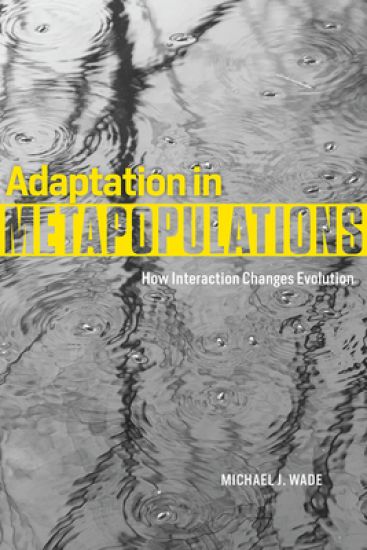
Adaptation in Metapopulations

Adaptation in Metapopulations

Michael J. Wade

University of Chicago Press
2016
sidottu
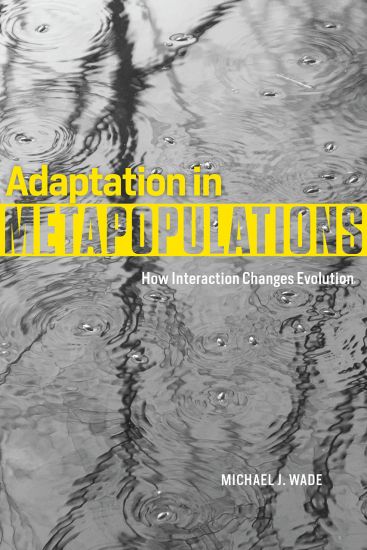
All organisms live in clusters, but such fractured local populations, or demes, nonetheless maintain connectivity with one another by some amount of gene flow between them. Most such metapopulations occur naturally, like clusters of amphibians in vernal ponds or baboon troops spread across the African veldt. Others have been created as human activities fragment natural landscapes, as in stands of trees separated by roads. As landscape change has accelerated, understanding how these metapopulations function—and specifically how they adapt—has become crucial to ecology and to our very understanding of evolution itself. With Adaptation in Metapopulations, Michael J. Wade explores a key component of this new understanding of evolution: interaction. Synthesizing decades of work in the lab and in the field in a book both empirically grounded and underpinned by a strong conceptual framework, Wade looks at the role of interaction across scales from gene selection to selection at the level of individuals, kin, and groups. In so doing, he integrates molecular and organismal biology to reveal the true complexities of evolutionary dynamics from genes to metapopulations.
Adaptation in Metapopulations

Adaptation in Metapopulations

Michael J. Wade

University of Chicago Press
2016
nidottu
All organisms live in clusters, but such fractured local populations, or demes, nonetheless maintain connectivity with one another by some amount of gene flow between them. Most such metapopulations occur naturally, like clusters of amphibians in vernal ponds or baboon troops spread across the African veldt. Others have been created as human activities fragment natural landscapes, as in stands of trees separated by roads. As landscape change has accelerated, understanding how these metapopulations function—and specifically how they adapt—has become crucial to ecology and to our very understanding of evolution itself. With Adaptation in Metapopulations, Michael J. Wade explores a key component of this new understanding of evolution: interaction. Synthesizing decades of work in the lab and in the field in a book both empirically grounded and underpinned by a strong conceptual framework, Wade looks at the role of interaction across scales from gene selection to selection at the level of individuals, kin, and groups. In so doing, he integrates molecular and organismal biology to reveal the true complexities of evolutionary dynamics from genes to metapopulations.
Insurgent Democracy

Insurgent Democracy

Michael J. Lansing

University of Chicago Press
2015
sidottu
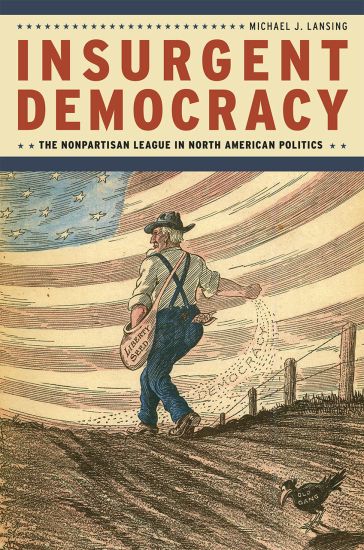
In 1915, western farmers mounted one of the most significant challenges to party politics America has seen: the Nonpartisan League, which sought to empower citizens and restrain corporate influence. Before its collapse in the 1920s, the League counted over 250,000 paying members, spread to thirteen states and two Canadian provinces, controlled North Dakota's state government, and birthed new farmer-labor alliances. Yet today it is all but forgotten, neglected even by scholars. Michael J. Lansing aims to change that. Insurgent Democracy offers a new look at the Nonpartisan League and a new way to understand its rise and fall in the United States and Canada. Lansing argues that, rather than a spasm of populist rage that inevitably burned itself out, the story of the League is in fact an instructive example of how popular movements can create lasting change. Depicting the League as a transnational response to economic inequity, Lansing not only resurrects its story of citizen activism, but also allows us to see its potential to inform contemporary movements.
This Land Is Your Land

This Land Is Your Land

Michael J. Lannoo

University of Chicago Press
2018
sidottu
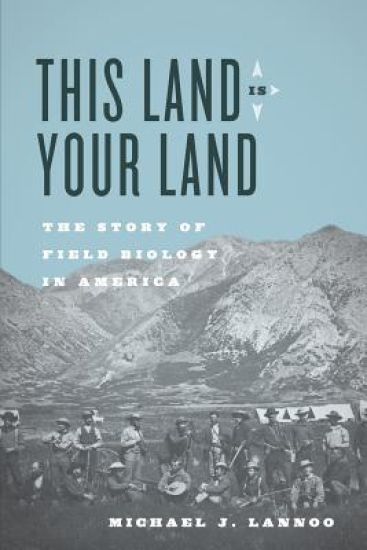
Field biology is enjoying a resurgence due to several factors, the most important being the realization that there is no ecology, no conservation, and no ecosystem restoration without an understanding of the basic relationships between species and their environments—an understanding gleaned only through field-based natural history. With this resurgence, modern field biologists find themselves asking fundamental existential questions such as: Where did we come from? What is our story? Are we part of a larger legacy? In This Land Is Your Land, seasoned field biologist Michael J. Lannoo answers these questions and more in a tale rooted in the people and institutions of the Midwest. It is a story told from the ground up, a rubber boot–based natural history of field biology in America. Lannoo illuminates characters such as John Wesley Powell, William Temple Hornaday, and Olaus and Adolph Murie—homegrown midwestern field biologists who either headed east to populate major research centers or went west to conduct their fieldwork along the frontier. From the pioneering work of Victor Shelford, Henry Chandler Cowles, and Aldo Leopold to contemporary insights from biologists such as Jim Furnish and historians such as William Cronon, Lannoo’s unearthing of American—and particularly midwestern—field biologists reveals how these scientists influenced American ecology, conservation biology, and restoration ecology, and in turn drove global conservation efforts through environmental legislation and land set-asides. This Land Is Your Land reveals the little-known legacy of midwestern field biologists, whose ethos and discoveries have enabled us to preserve and understand not just their land, but all lands.
Insurgent Democracy

Insurgent Democracy

Michael J. Lansing

University of Chicago Press
2016
nidottu
In 1915, western farmers mounted one of the most significant challenges to party politics America has seen: the Nonpartisan League, which sought to empower citizens and restrain corporate influence. Before its collapse in the 1920s, the League counted over 250,000 paying members, spread to thirteen states and two Canadian provinces, controlled North Dakota's state government, and birthed new farmer-labor alliances. Yet today it is all but forgotten, neglected even by scholars. Michael J. Lansing aims to change that. Insurgent Democracy offers a new look at the Nonpartisan League and a new way to understand its rise and fall in the United States and Canada. Lansing argues that, rather than a spasm of populist rage that inevitably burned itself out, the story of the League is in fact an instructive example of how popular movements can create lasting change. Depicting the League as a transnational response to economic inequity, Lansing not only resurrects its story of citizen activism, but also allows us to see its potential to inform contemporary movements.
The Federal Impeachment Process

The Federal Impeachment Process

Michael J Gerhardt

University of Chicago Press
2019
pokkari
Twenty years after President Clinton's impeachment proceedings, talk of impeachment is again in the air. But what are the grounds for impeaching a sitting president? Who is subject to impeachment? Is impeachment effective as a safeguard against presidential misconduct? What challenges does today's highly partisan political climate pose to the impeachment process, and what, if any, meaningful alternatives are there for handling presidential misconduct? For more than twenty years, The Federal Impeachment Process has served as the most complete analysis of the constitutional and legal issues raised in every impeachment proceeding in American history. Impeachment, Michael J. Gerhardt shows, is an inherently political process designed to expose and remedy political crimes--serious breaches of duty or injuries to the Republic. Subject neither to judicial review nor to presidential veto, it is a unique congressional power that involves both political and constitutional considerations, including the gravity of the offense charged, the harm to the constitutional order, and the link between an official's misconduct and duties. For this third edition, Gerhardt updates the book to cover cases since President Clinton, as well as recent scholarly debates. He discusses the issues arising from the possible impeachment of Donald Trump, including whether a sitting president may be investigated, prosecuted, and convicted for criminal misconduct or whether impeachment and conviction in Congress is the only way to sanction a sitting president; what the "Emoluments Clause" means and whether it might provide the basis for the removal of the president; whether gross incompetence may serve as the basis for impeachment; and the extent to which federal conflicts of interest laws apply to the president and other high ranking officials. Significantly updated, this book will remain the standard work on the federal impeachment process for years to come.
This Land Is Your Land

This Land Is Your Land

Michael J. Lannoo

University of Chicago Press
2018
nidottu
Field biology is enjoying a resurgence due to several factors, the most important being the realization that there is no ecology, no conservation, and no ecosystem restoration without an understanding of the basic relationships between species and their environments—an understanding gleaned only through field-based natural history. With this resurgence, modern field biologists find themselves asking fundamental existential questions such as: Where did we come from? What is our story? Are we part of a larger legacy? In This Land Is Your Land, seasoned field biologist Michael J. Lannoo answers these questions and more in a tale rooted in the people and institutions of the Midwest. It is a story told from the ground up, a rubber boot–based natural history of field biology in America. Lannoo illuminates characters such as John Wesley Powell, William Temple Hornaday, and Olaus and Adolph Murie—homegrown midwestern field biologists who either headed east to populate major research centers or went west to conduct their fieldwork along the frontier. From the pioneering work of Victor Shelford, Henry Chandler Cowles, and Aldo Leopold to contemporary insights from biologists such as Jim Furnish and historians such as William Cronon, Lannoo’s unearthing of American—and particularly midwestern—field biologists reveals how these scientists influenced American ecology, conservation biology, and restoration ecology, and in turn drove global conservation efforts through environmental legislation and land set-asides. This Land Is Your Land reveals the little-known legacy of midwestern field biologists, whose ethos and discoveries have enabled us to preserve and understand not just their land, but all lands.
Hope and Scorn

Hope and Scorn

Michael J Brown

University of Chicago Press
2020
sidottu
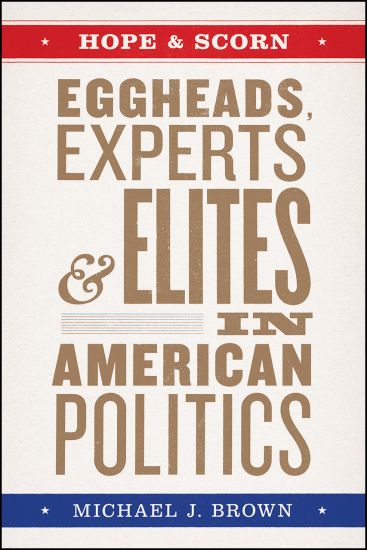
Intellectuals "have been both rallying points and railed against in American politics, vessels of hope and targets of scorn," writes Michael J. Brown as he invigorates a recurrent debate in American life: are intellectual public figures essential voices of knowledge and wisdom, or out-of-touch elites? Hope and Scorn investigates the role of high-profile experts and thinkers in American life and their ever-fluctuating relationship with the political and public spheres. From Eisenhower's era to Obama's, the intellectual's role in modern democracy has been up for debate. What makes an intellectual, and who can claim that privileged title? What are intellectuals' obligations to society, and how, if at all, are their contributions compatible with democracy? For some, intellectuals were models of civic engagement. For others, the rise of the intellectual signaled the fall of the citizen. Carrying us through six key moments in this debate, Brown expertly untangles the shifting anxieties and aspirations for democracy in America in the second half of the twentieth century and beyond. Hope and Scorn begins with "egghead" politicians like Adlai Stevenson; profiles scholars like Richard Hofstadter and scholars-turned-politicians like H. Stuart Hughes; and ends with the rise of a new class of public intellectual typified by bell hooks and Cornel West. In clear and unburdened prose, Brown explicates issues of power, authority, political backlash, and more. Hope and Scorn is an essential guide to American concerns about intellectuals, their myriad shortcomings, and their formidable abilities.
Tungara Frog

Tungara Frog

Michael J. Ryan

University of Chicago Press
1992
nidottu
In a Panamanian pond, male tungara frogs (Physalaemus pustulosus) gather in choruses, giving their advertisement call to the females that move among them. If a female chooses to make physical contact with a male, he will clasp her and eventually fertilize her eggs. But in vying for the females, the males whose calls are most attractive may also attract the interest of another creature: the fringe-lipped bat, a frog eater. In the Tungara Frog, the most detailed and informative single study available of frogs and their reproductive behavior, Michael J. Ryan demonstrates the interplay of sexual and natural selection. Using techniques from ethology, behavioral ecology, sensory physiology, physiological ecology, and theoretical population genetics in his research, Ryan shows that large males with low-frequency calls mate most successfully. He examines in detail a number of explanations for the females' preferences, and he considers possible evolutionary forces leading to the males' success. Though certain vocalizations allow males to obtain mates and thus should be favored by sexual selection, this study highlights two important costs of such sexual displays: the frogs expand considerable energy in their mating calls, and they advertise their whereabouts to predators. Ryan considers in detail how predators, especially the frige-lipped bat (Trachops cirrhosus), affect the evolution of the tungara frog's calls.
We Are All Whalers

We Are All Whalers

Michael J Moore

University of Chicago Press
2021
sidottu
The image most of us have of whalers includes harpoons and intentional trauma. Yet eating commercially caught seafood leads to whales’ entanglement and slow death in rope and nets, and the global shipping routes that bring us readily available goods often lead to death by collision. We—all of us—are whalers, marine scientist and veterinarian Michael J. Moore contends. But we do not have to be. Drawing on over forty years of fieldwork with humpback, pilot, fin, and in particular, North Atlantic right whales—a species whose population has declined more than twenty percent since 2017—Moore takes us with him as he performs whale necropsies on animals stranded on beaches, in his independent research alongside whalers using explosive harpoons, and as he tracks injured whales to deliver sedatives. The whales’ plight is a complex, confounding, and disturbing one. We learn of existing but poorly enforced conservation laws and of perennial (and often failed) efforts to balance the push for fisheries profit versus the protection of endangered species caught by accident. But despite these challenges, Moore’s tale is an optimistic one. He shows us how technologies for rope-less fishing and the acoustic tracking of whale migrations make a dramatic difference. And he looks ahead with hope as our growing understanding of these extraordinary creatures fuels an ever-stronger drive for change.
We Are All Whalers

We Are All Whalers

Michael J Moore

THE UNIVERSITY OF CHICAGO PRESS
2022
nidottu
Relating his experiences caring for endangered whales, a veterinarian and marine scientist shows we can all share in the salvation of these imperiled animals.The image most of us have of whalers includes harpoons and intentional trauma. Yet eating commercially caught seafood leads to whales’ entanglement and slow death in rope and nets, and the global shipping routes that bring us readily available goods often lead to death by collision. We—all of us—are whalers, marine scientist and veterinarian Michael J. Moore contends. But we do not have to be.Drawing on over forty years of fieldwork with humpback, pilot, fin, and, in particular, North Atlantic right whales—a species whose population has declined more than 20 percent since 2017—Moore takes us with him as he performs whale necropsies on animals stranded on beaches, in his independent research alongside whalers using explosive harpoons, and as he tracks injured whales to deliver sedatives. The whales’ plight is a complex, confounding, and disturbing one. We learn of existing but poorly enforced conservation laws and of perennial (and often failed) efforts to balance the push for fisheries profit versus the protection of endangered species caught by accident.But despite these challenges, Moore’s tale is an optimistic one. He shows us how technologies for ropeless fishing and the acoustic tracking of whale migrations make a dramatic difference. And he looks ahead with hope as our growing understanding of these extraordinary creatures fuels an ever-stronger drive for change.For more information on Moore’s book and research, please visit his webpage at the Woods Hole Oceanographic Institution.
Jacobitism in Britain and the United States, 1880–1910

Jacobitism in Britain and the United States, 1880–1910

Michael J. Connolly

MCGILL-QUEEN'S UNIVERSITY PRESS
2023
sidottu
In the late nineteenth century a resurgent Jacobite movement emerged in Britain and the United States, highlighting the virtues of the Stuart monarchs in contrast to liberal, democratic, and materialist Victorian Britain and Gilded Age America. Compared with similarly aligned protest movements of the era – socialism, anarchism, nihilism, populism, and progressivism – the rise of Jacobitism receives little attention.Born in the Glorious Revolution of 1688, Jacobitism had been in steep decline since the mid-eighteenth century. But between 1880 and 1910, Jacobite organizations popped up across Britain, then spread to the United States, publishing royalist magazines, organizing public demonstrations, offering Anglo-Catholic masses to fallen Stuart kings, and praying at Stuart statues and tombs. Michael Connolly explains the rise and fall of Anglo-American Jacobitism, places it in context, and reveals its significance as a response to and a driver of the political forces of the period. Understanding the Jacobite movement clarifies Victorian Anglo-American anxiety over liberalism, democracy, industrialization, and emerging modernity. In an age when worries over liberalism are again ascendant, Jacobitism in Britain and the United States, 1880–1910 traces the complex genealogy of this unease.
Counterfactuals and Scientific Realism

Counterfactuals and Scientific Realism

Michael J. Shaffer

Palgrave Macmillan
2012
sidottu
The author attempts to show that scientific realism is compatible with the presence of idealization in the sciences. His main contention is that idealized theories can be treated as counterfactuals about how things are in worlds that are similar to but simpler than the actual world.
More Than You Know

More Than You Know

Michael J. Mauboussin

Columbia University Press
2013
pokkari
Since its first publication, Michael J. Mauboussin's popular guide to wise investing has been translated into eight languages and has been named best business book by BusinessWeek and best economics book by Strategy+Business. Now updated to reflect current research and expanded to include new chapters on investment philosophy, psychology, and strategy and science as they pertain to money management, this volume is more than ever the best chance to know more than the average investor. Offering invaluable tools to better understand the concepts of choice and risk, More Than You Know is a unique blend of practical advice and sound theory, sampling from a wide variety of sources and disciplines. Mauboussin builds on the ideas of visionaries, including Warren Buffett and E. O. Wilson, but also finds wisdom in a broad and deep range of fields, such as casino gambling, horse racing, psychology, and evolutionary biology. He analyzes the strategies of poker experts David Sklansky and Puggy Pearson and pinpoints parallels between mate selection in guppies and stock market booms. For this edition, Mauboussin includes fresh thoughts on human cognition, management assessment, game theory, the role of intuition, and the mechanisms driving the market's mood swings, and explains what these topics tell us about smart investing. More Than You Know is written with the professional investor in mind but extends far beyond the world of economics and finance. Mauboussin groups his essays into four parts-Investment Philosophy, Psychology of Investing, Innovation and Competitive Strategy, and Science and Complexity Theory-and he includes substantial references for further reading. A true eye-opener, More Than You Know shows how a multidisciplinary approach that pays close attention to process and the psychology of decision making offers the best chance for long-term financial results.
Sacred Economies

Sacred Economies

Michael J. Walsh

Columbia University Press
2010
sidottu
Buddhist monasteries in medieval China employed a variety of practices to ensure their ascendancy and survival. Most successful was the exchange of material goods for salvation, as in the donation of land, which allowed monks to spread their teachings throughout China. By investigating a variety of socioeconomic spaces produced and perpetuated by Chinese monasteries, Michael J. Walsh reveals the "sacred economies" that shaped early Buddhism and its relationship with consumption and salvation. Centering his study on Tiantong, a Buddhist monastery that has thrived for close to seventeen centuries in southeast China, Walsh follows three main topics: the spaces monks produced, within and around which a community could pursue a meaningful existence; the social and economic avenues through which monasteries provided diverse sacred resources and secured the primacy of Buddhist teachings within an agrarian culture; and the nature of "transactive" participation within monastic spaces, which later became a fundamental component of a broader Chinese religiosity. Unpacking these sacred economies and repositioning them within the history of religion in China, Walsh encourages a different approach to the study of Chinese religion, emphasizing the critical link between religious exchange and the production of material culture.
Expectations Investing

Expectations Investing

Michael J. Mauboussin; Alfred Rappaport

Columbia University Press
2021
sidottu
Most investment books try to assess the attractiveness of a stock price by estimating the value of the company. Expectations Investing provides a powerful and insightful alternative to identifying gaps between price and value.Michael J. Mauboussin and Alfred Rappaport suggest that an investor start with a known quantity, the stock price, and ask what it implies for future financial results. After showing how to read expectations, Mauboussin and Rappaport provide a guide to rigorous strategic and financial analysis to help investors assess the likelihood of revisions to these expectations. Their framework traces value creation from the triggers that shape a company’s performance to the impact on the value drivers. This allows a practitioner of expectations investing to determine whether a stock is an attractive buy or sell candidate.Investors who read this book will be able to evaluate stocks of companies in any sector or geography more effectively than those who use the standard approaches of most investors. Managers can use the book’s principles to devise, adjust, and communicate their company’s strategy in light of shareholder expectations.This revised and updated edition reflects the many changes in accounting and the business landscape since the book was first published and provides a wealth of new examples and case studies.
What Money Can't Buy

What Money Can't Buy

Michael J. Sandel

Penguin Books Ltd.
2013
pokkari
Should we financially reward children for good marks? Is it ethical to pay people to donate organs? What about hiring mercenaries to fight our wars, outsourcing inmates to for-profit prisons or selling citizenship? In this title, the author asks: Isn't there something wrong with a world in which everything is for sale?
Portraits Of Dread, A Gallery Of Decidedly Evil Short Stories
In this collection, MOTHER CALLED TODAY a woman becomes increasingly fearful of her demanding mother's incessant phone calls. She has a horrible secret about her mother, something she is too scared to share with anyone. THE LITTLE MAN ON TOP OF THE WARDROBE Four year old James has always been good about going to bed but recently he's been too scared to go to sleep. There is a little man on top of his wardrobe and it wants his soul.Of course that's just his overactive childhood imagination Isn't it? A GLUTTON FOR PUNISHMENT we visit a future that isn't too hard to imagine. It's a world where the overweight are social pariahs, where a government controls their eating and shopping and failure to loose weight after three attempts results in the obese being sent to a detention camp. Lynda has just been sent to one such camp and she's about to learn a horrifying government secret which shows they till have one final use for the overweight.
The Great Calendar Reform

The Great Calendar Reform

Michael J Walsh

Lulu.com
2018
sidottu
The calendar introduced by Pope Gregory XIII is now the most widely used civil calendar in the world. The older calendar introduced by Julius Caesar in 45 B.C. underestimated the length of the year by about 11 minutes. As centuries passed, the accumulated error grew. By the late 1500s the Julian calendar was behind by twelve days. Set amid the backdrop of the Reformation and the Renaissance, a time of great schism in the Christian world, the story of the calendar reform is an intriguing one. A central part concerns the antagonistic relationship between two of the great intellectual figures of the 16th century: the pro-reform mathematician Christopher Clavius and the anti-reform literary scholar Joseph Scaliger. In this book, the author provides an accessible mathematical description of the old and new calendars as well as a detailed discussion of the historical context for, and the main players involved in the calendar reform.