

Kirjahaku
Etsi kirjoja tekijän nimen, kirjan nimen tai ISBN:n perusteella.
876 tulosta hakusanalla Michaelangelo Rodriguez
The Sonnets Of Michael Angelo Buonarroti (1901)
Michelangelo Buonarroti
KESSINGER PUBLISHING, LLC
2008
pokkari
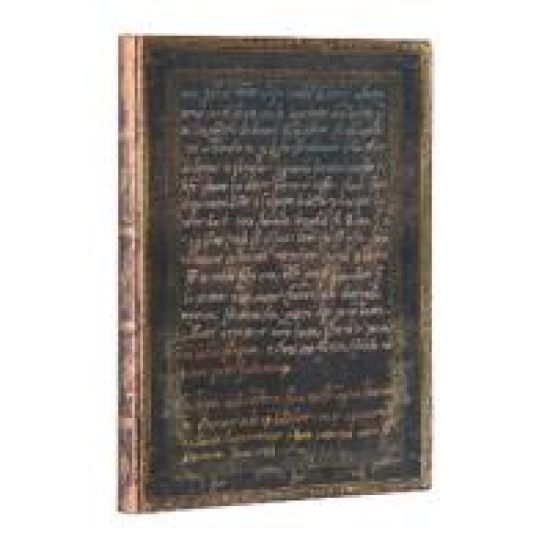
Michelangelo, Handwriting (Embellished Manuscripts Collection) Ultra Lined Softcover Flexi Journal (Elastic Band Closure)
Paperblanks
2023
nidottu
Michelangelo Buonarroti’s (1475–1564) mind was an incessant battlefield. The opposing forces of religious faith and pagan beauty warred across his consciousness. They also helped spur him to create a pantheon of artistic masterpieces.Considered one of the masters of the Italian Renaissance, over the course of his lifetime he produced the finest frescoes and many of the most revered sculptures in the world. Michelangelo possessed a genius as severe and uncompromising as it was fertile. He was renowned for his fierce solitude, yet was one of the great chroniclers of the human form. His anatomical studies are haunting in their expressiveness and precision, while his tombs, such as those designed for Julius II and the Medicis, inspire wordless awe and perhaps even dread.This letter, written in Michelangelo’s own hand, demonstrates with every stroke of the pen the refinement and passion of one of the greatest artists humanity has produced. And with the Sistine Chapel’s The Creation of Adam featured on the back cover, the point of creation beautifully bookends this Embellished Manuscript notebook.
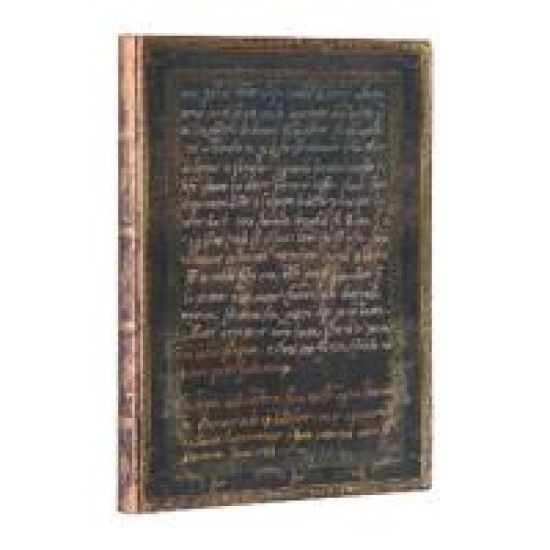
Michelangelo, Handwriting (Embellished Manuscripts Collection) Ultra Unlined Softcover Flexi Journal (Elastic Band Closure)
Paperblanks
2023
nidottu
Michelangelo Buonarroti’s (1475–1564) mind was an incessant battlefield. The opposing forces of religious faith and pagan beauty warred across his consciousness. They also helped spur him to create a pantheon of artistic masterpieces.Considered one of the masters of the Italian Renaissance, over the course of his lifetime he produced the finest frescoes and many of the most revered sculptures in the world. Michelangelo possessed a genius as severe and uncompromising as it was fertile. He was renowned for his fierce solitude, yet was one of the great chroniclers of the human form. His anatomical studies are haunting in their expressiveness and precision, while his tombs, such as those designed for Julius II and the Medicis, inspire wordless awe and perhaps even dread.This letter, written in Michelangelo’s own hand, demonstrates with every stroke of the pen the refinement and passion of one of the greatest artists humanity has produced. And with the Sistine Chapel’s The Creation of Adam featured on the back cover, the point of creation beautifully bookends this Embellished Manuscript notebook.
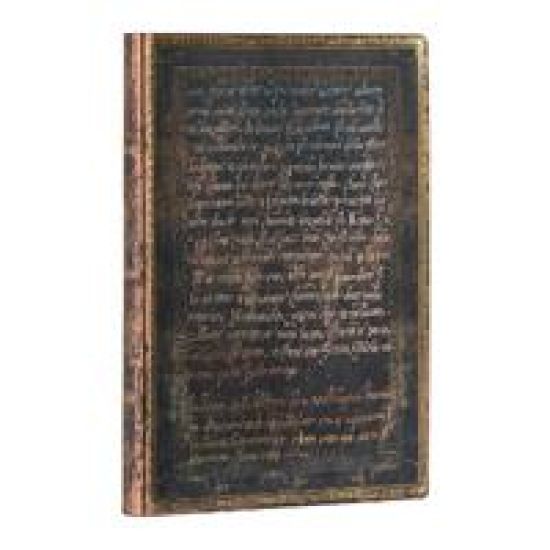
Michelangelo, Handwriting (Embellished Manuscripts Collection) Midi Lined Softcover Flexi Journal (Elastic Band Closure)
Paperblanks
2023
nidottu
Considered one of the masters of the Italian Renaissance, Michelangelo Buonarroti (1475–1564) produced the finest frescoes and many of the most revered sculptures in the world. He was renowned for his fierce solitude, yet was one of the great chroniclers of the human form.This letter, written in Michelanglo’s own hand, demonstrates with every stroke of the pen the refinement and passion of one of the greatest artists humanity has produced. And with the Sistine Chapel’s The Creation of Adam featured on the back cover, the point of creation beautifully bookends this Embellished Manuscript notebook.
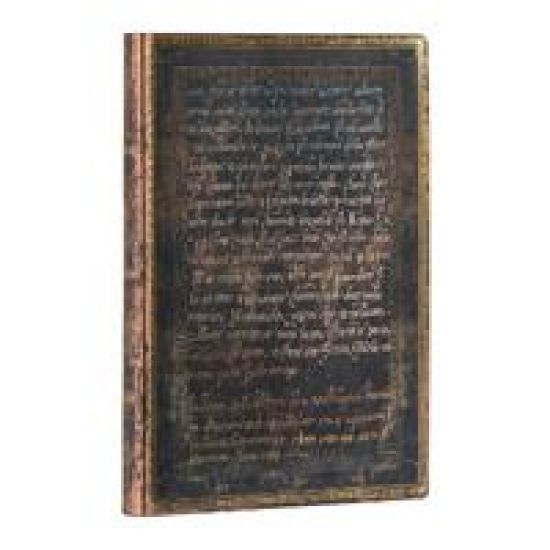
Michelangelo, Handwriting (Embellished Manuscripts Collection) Midi Unlined Softcover Flexi Journal (Elastic Band Closure)
Paperblanks
2023
nidottu
Considered one of the masters of the Italian Renaissance, Michelangelo Buonarroti (1475–1564) produced the finest frescoes and many of the most revered sculptures in the world. He was renowned for his fierce solitude, yet was one of the great chroniclers of the human form.This letter, written in Michelanglo’s own hand, demonstrates with every stroke of the pen the refinement and passion of one of the greatest artists humanity has produced. And with the Sistine Chapel’s The Creation of Adam featured on the back cover, the point of creation beautifully bookends this Embellished Manuscript notebook.
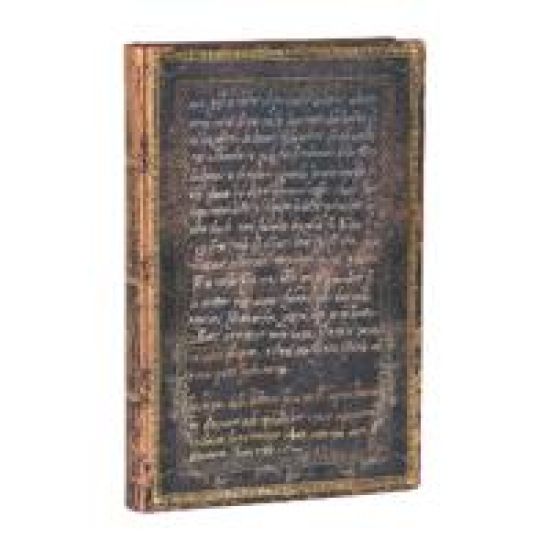
Michelangelo, Handwriting (Embellished Manuscripts Collection) Mini Lined Softcover Flexi Journal (Elastic Band Closure)
Paperblanks
2023
nidottu
Michelangelo Buonarroti (1475–1564) is considered one of the masters of the Italian Renaissance. This handwritten letter demonstrates the refinement and passion of one of the greatest artists humanity has produced. And with the Sistine Chapel’s The Creation of Adam featured on the back cover, the point of creation beautifully bookends this Embellished Manuscript notebook.
Michelangelo's Shoulder
John Moncure Wetterau
Createspace Independent Publishing Platform
2009
nidottu

Michael Angelo Buonarroti, Sculptor, Painter, Architect - The Story Of His Life And Labours
Charles Christopher Black
READ BOOKS
2011
pokkari
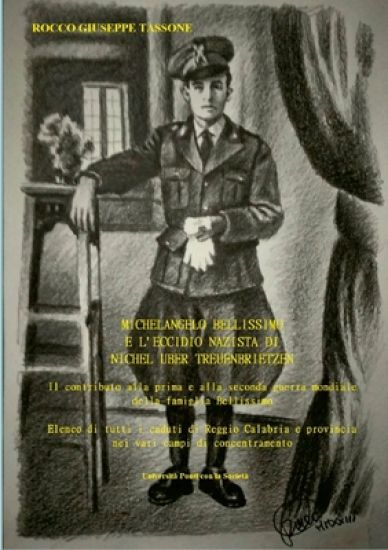
Michelangelo Bellissimo E l'Eccidio Nazista Di Nichel Uber Treuenbrietzen
Rocco Giuseppe Tassone
Lulu.com
2023
pokkari
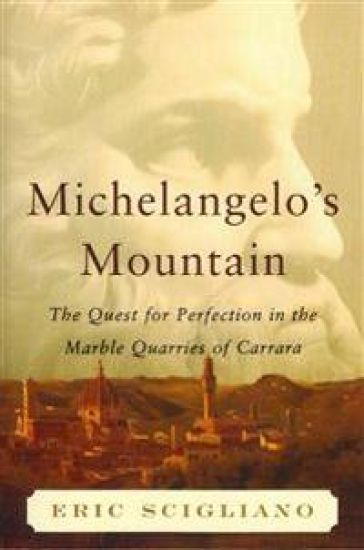
Discover the fascinating, crucial, and often dangerous relationship between Michelangelo and the stone quarries of Carrara in this clear-eyed and well-researched exploration that “recounts the artist's large life and lasting works with care and reverence” (Booklist).No artist looms so large in Western consciousness and culture as Michelangelo Buonarroti, the most celebrated sculptor of all time. And no place on earth provides a stone so capable of simulating the warmth and vitality of human flesh and incarnating the genius of a Michelangelo as the statuario of Carrara, the storied marble mecca at Tuscany's northwest corner. It was there, where shadowy Etruscans and Roman slaves once toiled, that Michelangelo risked his life in dozens of harrowing expeditions to secure the precious stone for his Pietà, Moses, and other masterpieces. Many books have recounted Michelangelo’s achievements in Florence and Rome. Michelangelo’s Mountain goes beyond all of them, revealing his escapades and ordeals in the spectacular landscape that was the third pole of his tumultuous career and the third wellspring of his art. Eric Scigliano brings this haunting place and eternally fascinating artist to life in a sweeping tale peopled by popes and poets, mad dukes and mythic monsters, scheming courtiers and rough-hewn quarrymen. He recounts the saga of the David, the improbable masterpiece that Michelangelo created against all odds, of the twin Hercules that he tried to erect beside it, and of the Salieri-like nemesis who snatched away the commission, turning a sculptural testament to liberty into a bitter symbol of tyranny and giving Florence the colossus it loves to hate. In showing how the artist, land, and stone transformed one another, Scigliano brings fresh insight to Michelangelo's most cherished works and illuminates his struggles with the princes and potentates of Carrara, Rome, and Medici Florence, who raised intrigue to a high art.
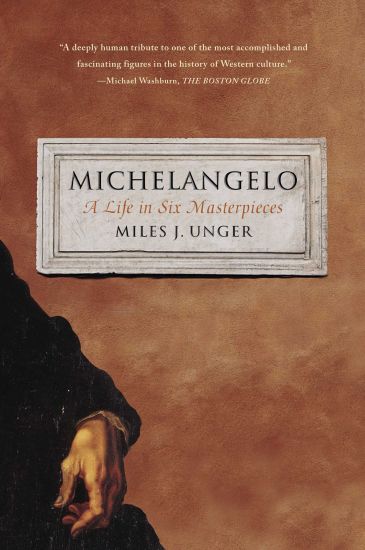
Among the immortals-Leonardo, Rembrandt, Picasso-Michelangelo stands alone as a master of painting, sculpture, and architecture. He was not only the greatest artist in an age of giants, but a man who reinvented the practice of art itself. Throughout his long career he clashed with patrons by insisting that he had no master but his own demanding muse and promoting the novel idea that it was the artist, rather than the lord who paid for it, who was creative force behind the work. Miles Unger narrates the astonishing life of this driven and difficult man through six of his greatest masterpieces. Each work expanded the expressive range of the medium, from the Pietà Michelangelo carved as a brash young man, to the apocalyptic Last Judgment, the work of an old man tested by personal trials. Throughout the course of his career he explored the full range of human possibility. In the gargantuan David he depicts Man in the glory of his youth, while in the tombs he carved for the Medici he offers a sustained meditation on death and the afterlife. In the Sistine Chapel ceiling he tells the epic story of Creation, from the perfection of God's initial procreative act to the corruption introduced by His imperfect children. In the final decades of his life, his hands too unsteady to wield the brush and chisel, he exercised his mind by raising the soaring vaults and dome of St. Peter's in a final tribute to his God. A work of deep artistic understanding, Miles Unger's Michelangelobrings to life the irascible, egotistical, and undeniably brilliant man whose artistry continues to amaze and inspire us after 500 years.
Through the Eyes' of an Addict: Michelangelo's Tales of an American Life/ the poetries and pholosephies of Mikie and Me
Michelangelo Valdez
Createspace Independent Publishing Platform
2010
nidottu
Michelangelo's Poetry and Iconography in the Heart of the Reformation
Ambra Moroncini
Routledge
2017
sidottu
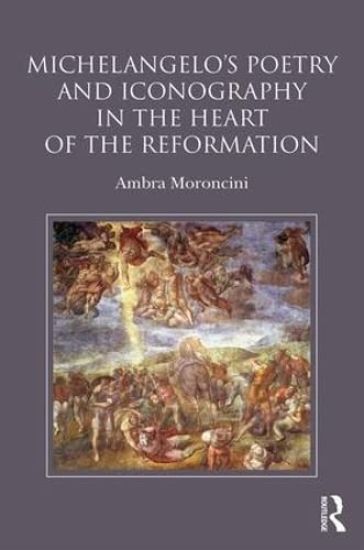
Contextualizing Michelangelo’s poetry and spirituality within the framework of the religious Zeitgeist of his era, this study investigates his poetic production to shed new light on the artist’s religious beliefs and unique language of art. Author Ambra Moroncini looks first and foremost at Michelangelo the poet and proposes a thought-provoking reading of Michelangelo’s most controversial artistic production between 1536 and c.1550: The Last Judgment, his devotional drawings made for Vittoria Colonna, and his last frescoes for the Pauline Chapel. Using theological and literary analyses which draw upon reformist and Protestant scriptural writings, as well as on Michelangelo’s own rime spirituali and Vittoria Colonna’s spiritual lyrics, Moroncini proposes a compelling argument for the impact that the Reformation had on one of the greatest minds of the Italian Renaissance. It brings to light how, in the second quarter of the sixteenth century in Italy, Michelangelo’s poetry and aesthetic conception were strongly inspired by the revived theologia crucis of evangelical spirituality, rather than by the theologia gloriae of Catholic teaching.
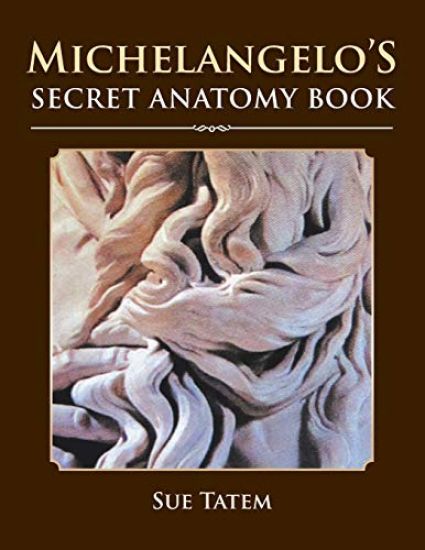
Michelangelo used images of human anatomy throughout his work. Nearly the entire body is there, albeit in pieces. Michelangelo began his career with extensive dissections of human corpses and ended his career talking about illustrating an anatomy book. He was hinting, as the anatomy was already there in his art. Perhaps at the time he made the art, he worried that it was too dangerous for his own person to reveal the secular anatomy theme. At the time, Renaissance scholars were studying human anatomy and trying to work out how the organs functioned. Many of them, like Leonardo da Vinci and Vesalius, self-published using their art. Herein are some of Michelangelo's "self-published" contributions, human anatomy in his art and self-portraits, in the Sistine Chapel, paintings, and sculpture.
Michelangelo - Beethoven - Shakespeare: 15 Things Common to Great Achievers
Impact Web; Israelmore Ayivor
Createspace Independent Publishing Platform
2013
nidottu

Though known primarily as a sculptor and painter, Michelangelo was also a poet. In his lifetime, Michelangelo wrote over 300 poems, many of which were works of devotion and love poems of a spiritual and mystical nature. In 1961, Joseph Tusiani offered the first English translations of the complete corpus of Michelangelo’s poems. These translations illuminated the subtleties of both the source and target language, giving Michelangelo’s verse a freshness, a depth, and an inventiveness that time has not been able to obscure. The Complete Poems of Michelangelo reproduces Tusiani’s masterful translation. In addition to Tusiani’s introduction and translations, this new edition contains Michelangelo’s original Italian poetry, a chronology of his life and works, a biographical profile of Tusiani, and an interview with Tusiani exploring his musings on classic literature and the subtle art of translation. The Complete Poems of Michelangelo sheds light on Tusiani’s many exceptional accomplishments during his long and prolific life as a scholar, poet, translator, and artist.
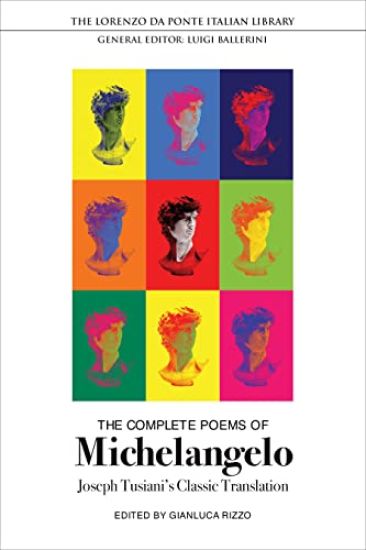
Though known primarily as a sculptor and painter, Michelangelo was also a poet. In his lifetime, Michelangelo wrote over 300 poems, many of which were works of devotion and love poems of a spiritual and mystical nature. In 1961, Joseph Tusiani offered the first English translations of the complete corpus of Michelangelo’s poems. These translations illuminated the subtleties of both the source and target language, giving Michelangelo’s verse a freshness, a depth, and an inventiveness that time has not been able to obscure. The Complete Poems of Michelangelo reproduces Tusiani’s masterful translation. In addition to Tusiani’s introduction and translations, this new edition contains Michelangelo’s original Italian poetry, a chronology of his life and works, a biographical profile of Tusiani, and an interview with Tusiani exploring his musings on classic literature and the subtle art of translation. The Complete Poems of Michelangelo sheds light on Tusiani’s many exceptional accomplishments during his long and prolific life as a scholar, poet, translator, and artist.