Kirjojen hintavertailu. Mukana 11 244 527 kirjaa ja 12 kauppaa.

Kirjahaku

Etsi kirjoja tekijän nimen, kirjan nimen tai ISBN:n perusteella.

1000 tulosta hakusanalla Nancy C. Butler

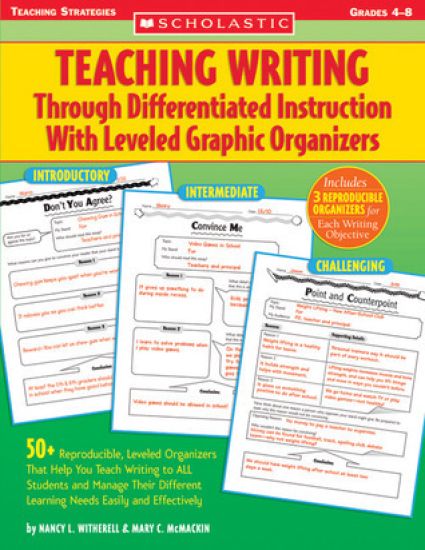
Teaching Writing Through Differentiated Instruction with Leveled Graphic Organizers

Teaching Writing Through Differentiated Instruction with Leveled Graphic Organizers

Nancy L. Witherell; Mary C. McMackin; Nancy Witherell

Scholastic Teaching Resources
2005
nidottu
Leveled organizers with lesson tips and model writing samples help ALL students master the skills and concepts they need to succeed on standardized essay tests and beyond. Designed for teachers who want to teach writing effectively to students of different ability levels, this resource offers lessons, leveled organizers, and writing models to make planning and gathering materials a cinch. Seventeen units cover topics from structuring paragraphs to using elaboration to develop ideas, to persuasive essay writing. Helps ALL students master the writing skills and concepts they need to succeed on standardized tests and beyond.
What Drives Third World City Growth?

What Drives Third World City Growth?

Allen C. Kelley; Nancy Burley

Princeton University Press
2014
pokkari
The book shows that earlier studies exaggerated the effects of rural land scarcity, foreign capital inflows, and population growth on Third World urbanization. More critical were imbalances of productivity advance across sectors and terms of trade between primary products and manufactures. Originally published in 1984. The Princeton Legacy Library uses the latest print-on-demand technology to again make available previously out-of-print books from the distinguished backlist of Princeton University Press. These editions preserve the original texts of these important books while presenting them in durable paperback and hardcover editions. The goal of the Princeton Legacy Library is to vastly increase access to the rich scholarly heritage found in the thousands of books published by Princeton University Press since its founding in 1905.
What Drives Third World City Growth?

What Drives Third World City Growth?

Allen C. Kelley; Nancy Burley

Princeton University Press
2016
sidottu
The book shows that earlier studies exaggerated the effects of rural land scarcity, foreign capital inflows, and population growth on Third World urbanization. More critical were imbalances of productivity advance across sectors and terms of trade between primary products and manufactures. Originally published in 1984. The Princeton Legacy Library uses the latest print-on-demand technology to again make available previously out-of-print books from the distinguished backlist of Princeton University Press. These editions preserve the original texts of these important books while presenting them in durable paperback and hardcover editions. The goal of the Princeton Legacy Library is to vastly increase access to the rich scholarly heritage found in the thousands of books published by Princeton University Press since its founding in 1905.
Observation Drawing with Children

Observation Drawing with Children

Nancy Ray Smith; Laraine Cicchetti; Margaret C. Clark; Margaret Kennedy

Teachers' College Press
1997
nidottu
This book offers teachers guidance in helping children develop the mental and physical abilities used in the discovery and creation of meaning through drawing by: Giving students extensive experience with materials • Keeping in mind developmental guidelines • Planning lessons with clearly defined objectives and in carefully crafted sequence • Choosing objects suitable for the given age group and appropriate to lesson objectives • Fostering aesthetic qualities • Motivating and responding to children as they draw.Each chapter begins with a Developmental Framework that will help teachers keep developmental characteristics in mind when planning art curricula. The book contains 23 detailed Lesson Plans for classes ranging from Kindergarten through Sixth Grade. Each plan includes the Objective, the Materials to be used, the Room Arrangement, Motivational Dialogue in the form of teacher's questions and children's responses, Evaluation of the results, and suggested Extensions. Examples of children's drawings accompany each lesson.
Teaching/Writing in Third Spaces

Teaching/Writing in Third Spaces

Rhonda C. Grego; Nancy S. Thompson

Southern Illinois University Press
2007
nidottu
Teaching/Writing in Third Spaces: The Studio Model examines a dynamic approach to teaching composition that reimagines not only the physical space in which writing and learning occurs but also the place occupied by composition in the power structure of universities and colleges. In response to financial and programmatic cutbacks at the University of South Carolina in the 1990s, authors Rhonda C. Grego and Nancy S. Thompson used their academic backgrounds in composition and English education, along with their personal histories in working-class families, to look at compositional spaces and places with an eye to challenging the embedded issues of race, class, and gender within the university hierarchies. The result was a supplemental writing program that they called the writing studio. The studio model emphasizes individual participation in a small group that allows students to present work they are preparing for outside classes, discuss their challenges, and refine their ideas with other students and staff facilitators. This ""interactional inquiry"" is replicated and reinforced by the facilitators, who meet in their own small groups to analyze larger patterns, possibilities, and needs as they arise in their studios. Grego and Thompson argue that because the studio is physically and institutionally ""outside but alongside"" both students' other coursework and the hierarchy of the institution, it represents a ""third space,"" a unique position in which to effect institutional change. The focus on interactional inquiry challenges traditional power hierarchies within classrooms and shifts the nature of discourse. As a bottom-up approach to the development of educational programs within institutions that have different needs, demographies, and histories, the studio model can address a multitude of different institutional needs with little disruption to the curriculum. The studio model allows university administrators, teachers, student aides, and students to continually adapt to changing institutional environments with new teaching and learning strategies. ""Teaching/Writing in Third Spaces"" provides an alternative approach to traditional basic writing courses that can be adopted in educational institutions of all types and at all levels.
IBM SPSS for Introductory Statistics

IBM SPSS for Introductory Statistics

Karen C. Barrett; Nancy L. Leech; Gene W. Gloeckner; George A. Morgan

TAYLOR FRANCIS LTD
2025
nidottu
IBM SPSS for Introductory Statistics is designed to help students learn how to analyze and interpret research. In easy-to-understand language, the authors show readers how to choose the appropriate statistic based on the design, and to interpret outputs appropriately. There is such a wide variety of options and statistics in SPSS that knowing which ones to use and how to interpret the outputs can be difficult. This book assists students with these challenges.Comprehensive and user-friendly, this book prepares readers for each step in the research process: design, entering and checking data, testing assumptions, assessing reliability and validity, computing descriptive and inferential parametric and nonparametric statistics, and writing about results. Dialog windows and SPSS syntax, along with the output, are provided. Several realistic data sets are used to solve the chapter problems and are available as an online resource.This edition includes:• Updated chapters and screenshots• Additional SPSS work problems• Callout boxes for each chapter, indicating crucial elements of APA style and referencing outputs.IBM SPSS for Introductory Statistics is an invaluable supplemental (or lab text) book for students. In addition, this book and its companion, IBM SPSS for Intermediate Statistics, are useful as guides/reminders to faculty and professionals regarding the specific steps to take to use SPSS and/or how to use and interpret parts of SPSS with which they are unfamiliar.
IBM SPSS for Introductory Statistics

IBM SPSS for Introductory Statistics

Karen C. Barrett; Nancy L. Leech; Gene W. Gloeckner; George A. Morgan

TAYLOR FRANCIS LTD
2025
sidottu
IBM SPSS for Introductory Statistics is designed to help students learn how to analyze and interpret research. In easy-to-understand language, the authors show readers how to choose the appropriate statistic based on the design, and to interpret outputs appropriately. There is such a wide variety of options and statistics in SPSS that knowing which ones to use and how to interpret the outputs can be difficult. This book assists students with these challenges.Comprehensive and user-friendly, this book prepares readers for each step in the research process: design, entering and checking data, testing assumptions, assessing reliability and validity, computing descriptive and inferential parametric and nonparametric statistics, and writing about results. Dialog windows and SPSS syntax, along with the output, are provided. Several realistic data sets are used to solve the chapter problems and are available as an online resource.This edition includes:• Updated chapters and screenshots• Additional SPSS work problems• Callout boxes for each chapter, indicating crucial elements of APA style and referencing outputs.IBM SPSS for Introductory Statistics is an invaluable supplemental (or lab text) book for students. In addition, this book and its companion, IBM SPSS for Intermediate Statistics, are useful as guides/reminders to faculty and professionals regarding the specific steps to take to use SPSS and/or how to use and interpret parts of SPSS with which they are unfamiliar.
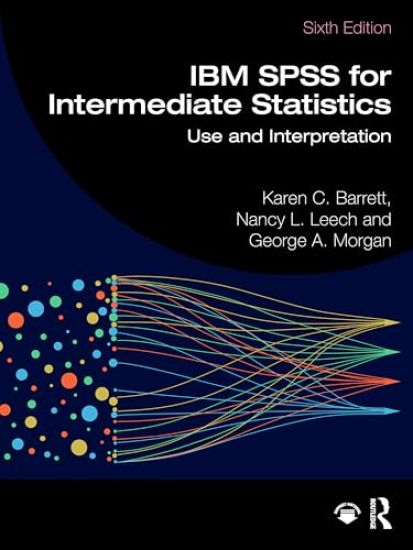
IBM SPSS for Intermediate Statistics

IBM SPSS for Intermediate Statistics

Karen C. Barrett; Nancy L. Leech; George A. Morgan

TAYLOR FRANCIS LTD
2025
nidottu
IBM SPSS for Intermediate Statistics, sixth edition, is designed to help readers analyze and interpret research data using IBM SPSS.This user-friendly book shows readers how to choose the appropriate statistic based on the design; perform intermediate statistics, including multivariate statistics; interpret output; and write about the results. The book reviews research designs and how to assess the accuracy and reliability of data; how to determine whether data meet the assumptions of statistical tests; how to calculate and interpret effect sizes for intermediate statistics; how to compute and interpret post-hoc power; and an overview of basic statistics for those who need a review. Unique chapters on multilevel linear modeling; multivariate analysis of variance (MANOVA); assessing reliability of data; multiple imputation; mediation, moderation, and canonical correlation; discriminant analyses; logistic regression; and factor analysis are provided. SPSS syntax is included for those who prefer this format. Pedagogical features include call-out boxes to highlight key points, interpretation sections and questions, realistic data sets for practice, and information on how to get started with SPSS, as well as appendices reviewing basic statistics, discussing how to write research questions, providing answers to the odd numbered interpretation questions, and providing references for further reading.An ideal supplement for courses in either intermediate/advanced statistics or research methods taught in departments of psychology, education, and other social and health sciences, this book is also appreciated by researchers in these areas looking for a handy reference for SPSS commands and how to interpret SPSS outputs.The new edition features: Updated for IBM SPSS version 29, but the book can be used with most other versionsMore information on how to get started in SPSS (Ch. 1)Updated discussion of which effect sizes can be calculated for various programs in SPSSUpdated information on multiple regression methods (Ch. 7)Updated chapter on how use a variable as a mediator or a moderator, using only SPSS (Ch. 8)All chapters updated to include effect sizes that are availableUpdated screens and outputsUpdated web resources for instructors, including PowerPoint slides, interpretation question and extra SPSS problem answers; and for students, data sets, and chapter outlines and study guides.
IBM SPSS for Intermediate Statistics

IBM SPSS for Intermediate Statistics

Karen C. Barrett; Nancy L. Leech; George A. Morgan

TAYLOR FRANCIS LTD
2025
sidottu
IBM SPSS for Intermediate Statistics, sixth edition, is designed to help readers analyze and interpret research data using IBM SPSS.This user-friendly book shows readers how to choose the appropriate statistic based on the design; perform intermediate statistics, including multivariate statistics; interpret output; and write about the results. The book reviews research designs and how to assess the accuracy and reliability of data; how to determine whether data meet the assumptions of statistical tests; how to calculate and interpret effect sizes for intermediate statistics; how to compute and interpret post-hoc power; and an overview of basic statistics for those who need a review. Unique chapters on multilevel linear modeling; multivariate analysis of variance (MANOVA); assessing reliability of data; multiple imputation; mediation, moderation, and canonical correlation; discriminant analyses; logistic regression; and factor analysis are provided. SPSS syntax is included for those who prefer this format. Pedagogical features include call-out boxes to highlight key points, interpretation sections and questions, realistic data sets for practice, and information on how to get started with SPSS, as well as appendices reviewing basic statistics, discussing how to write research questions, providing answers to the odd numbered interpretation questions, and providing references for further reading.An ideal supplement for courses in either intermediate/advanced statistics or research methods taught in departments of psychology, education, and other social and health sciences, this book is also appreciated by researchers in these areas looking for a handy reference for SPSS commands and how to interpret SPSS outputs.The new edition features: Updated for IBM SPSS version 29, but the book can be used with most other versionsMore information on how to get started in SPSS (Ch. 1)Updated discussion of which effect sizes can be calculated for various programs in SPSSUpdated information on multiple regression methods (Ch. 7)Updated chapter on how use a variable as a mediator or a moderator, using only SPSS (Ch. 8)All chapters updated to include effect sizes that are availableUpdated screens and outputsUpdated web resources for instructors, including PowerPoint slides, interpretation question and extra SPSS problem answers; and for students, data sets, and chapter outlines and study guides.
IBM SPSS for Intermediate Statistics

IBM SPSS for Intermediate Statistics

Karen C. Barrett; Nancy L. Leech; George A. Morgan

Routledge
2014
sidottu
Designed to help readers analyze and interpret research data using IBM SPSS, this user-friendly book shows readers how to choose the appropriate statistic based on the design; perform intermediate statistics, including multivariate statistics; interpret output; and write about the results. The book reviews research designs and how to assess the accuracy and reliability of data; how to determine whether data meet the assumptions of statistical tests; how to calculate and interpret effect sizes for intermediate statistics, including odds ratios for logistic analysis; how to compute and interpret post-hoc power; and an overview of basic statistics for those who need a review. Unique chapters on multilevel linear modeling; multivariate analysis of variance (MANOVA); assessing reliability of data; multiple imputation; mediation, moderation, and canonical correlation; and factor analysis are provided. SPSS syntax with output is included for those who prefer this format. The new edition features: • IBM SPSS version 22; although the book can be used with most older and newer versions • New discusiion of intraclass correlations (Ch. 3)• Expanded discussion of effect sizes that includes confidence intervals of effect sizes (ch.5) • New information on part and partial correlations and how they are interpreted and a new discussion on backward elimination, another useful multiple regression method (Ch. 6) • New chapter on how to use a variable as a mediator or a moderator (ch. 7)• Revised chapter on multilevel and hierarchical linear modeling (ch. 12) • A new chapter (ch. 13) on multiple imputation that demonstrates how to deal with missing data • Updated web resources for instructors including PowerPoint slides and answers to interpretation questions and extra problems and for students, data sets, chapter outlines, and study guides. IBM SPSS for Intermediate Statistics, Fifth Edition provides helpful teaching tools: • all of the key SPSS windows needed to perform the analyses • outputs with call-out boxes to highlight key points • interpretation sections and questions to help students better understand and interpret the output • extra problems with realistic data sets for practice using intermediate statistics • Appendices on how to get started with SPSS, write research questions, and basic statistics. An ideal supplement for courses in either intermediate/advanced statistics or research methods taught in departments of psychology, education, and other social, behavioral, and health sciences. This book is also appreciated by researchers in these areas looking for a handy reference for SPSS
Designing Systems and Processes for Managing Disputes

Designing Systems and Processes for Managing Disputes

Nancy H. Rogers; Robert C. Bordone; Frank E. A. Sander

Aspen Publishing
2018
nidottu
Designing Systems and Processes for Managing Disputes features a hands-on, interdisciplinary approach with wide-ranging practical applications. Seven real-life case studies and numerous examples have students designing and implementing a process for resolving and preventing disputes where traditional processes have failed. This is a must-read for students and practitioners alike. New to the Second Edition: A chapter-long focus on facilitation skills for designers The addition of a seventh central case study related to processes following the Trayvon Martin shooting in Sanford, Florida A new appendix with an overview of mediation for students who have not taken a prior course in mediation An interesting new story by a Brazilian judge who used Designing Systems and Processes for Managing Disputes to create new processes to resolve multiple cases, some pending over 20 years, arising from lands taken to create a new national park A new question focusing on the issues related to designing court-connected mediation programs Updates throughout all chapters and the appendix Professors and students will benefit from: Focus on skills development for dispute systems designers A multidisciplinary approach Biographies of designers, providing students with a sense of how to get into dispute systems design work An appendix assisting students who have no background in dispute resolution, with brief overviews of negotiation, mediation, and arbitration Problems and exercises to help students apply their learning Examples of complex disputes Featured disputes including eBay, a child abuse claims tribunals, court-related mediation, intra-institutional disputes, and community and post-violence conflicts
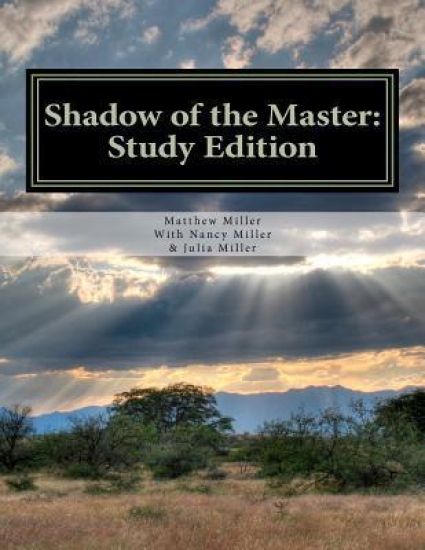
Shadow of the Master: Study Edition: Study Edition

Shadow of the Master: Study Edition: Study Edition

Nancy H. Miller; Julia C. Miller; Matthew R. Miller

Createspace Independent Publishing Platform
2012
nidottu
SHADOW OF THE MASTER is a short novel that provides a unique and fresh perspective on the greatest story ever told-the life and ministry of Jesus Christ. This perspective is viewed through the eyes of a "thirteenth disciple", a dog that accompanied Him along the way. The story takes you through the travels of Jesus and His disciples from the point-of-view of Shadow, a stray dog that takes up with the group after Jesus shows him kindness. Scripturally based and written to appeal to all ages, SHADOW OF THE MASTER will warm your heart with its special view on the Gospels. This Study Edition contains Bible verses and discussion questions for further thought after each chapter, making it ideal for an individual or group study of the life of Jesus through the eyes of Shadow
Saying No to Say Yes

Saying No to Say Yes

David C. Olsen; Nancy G. Devor

Alban Institute, Inc
2015
nidottu
This book explores the difficulties clergy face when they attempt to say no by setting effective boundaries in order to say yes to the life-giving call of ministry. It illustrates the benefits of good boundaries, even as it traces the legacy of denominational boundary trainings in the wake of the public clergy sexual misconduct crisis. Devor and Olsen supplement anecdotes from their experience leading boundary trainings with an examination of clergy/congregation dynamics through the lenses of both self-psychology and family systems theory elucidating how some obstacles to effective boundary setting are caused by innate personality tendencies that are exacerbated by a stressful church environment. A perfect storm occurs when clergy vulnerabilities and systemic congregational anxiety interact, leading to burn-out and boundary problems which hinder pastoral excellence. Readers will find both practice questions to assist them in a deeper assessment of personal and systemic obstacles as well as strategies for setting boundaries, creating the space needed to pursue excellence in ministry."
Saying No to Say Yes

Saying No to Say Yes

David C. Olsen; Nancy G. Devor

Alban Institute, Inc
2015
sidottu
This book explores the difficulties clergy face when they attempt to say no by setting effective boundaries in order to say yes to the life-giving call of ministry. It illustrates the benefits of good boundaries, even as it traces the legacy of denominational boundary trainings in the wake of the public clergy sexual misconduct crisis. Devor and Olsen supplement anecdotes from their experience leading boundary trainings with an examination of clergy/congregation dynamics through the lenses of both self-psychology and family systems theory elucidating how some obstacles to effective boundary setting are caused by innate personality tendencies that are exacerbated by a stressful church environment. A perfect storm occurs when clergy vulnerabilities and systemic congregational anxiety interact, leading to burn-out and boundary problems which hinder pastoral excellence. Readers will find both practice questions to assist them in a deeper assessment of personal and systemic obstacles as well as strategies for setting boundaries, creating the space needed to pursue excellence in ministry."
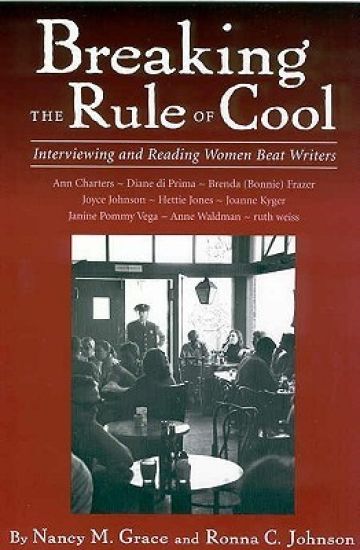
Breaking the Rule of Cool

Breaking the Rule of Cool

Nancy M. Grace; Ronna C. Johnson

University Press of Mississippi
2004
nidottu
The Beat movement nurtured many female dissidents and artists who contributed to Beat culture and connected the Beats with the second wave of the women's movement. Although they have often been eclipsed by the men of the Beat Generation, the women's contributions to Beat literature are considerable. Covering writers from the beginning of the movement in the 1950s and extending to the present, this book features interviews with nine of the best-known women Beat writers, including Diane di Prima, ruth weiss, Joyce Johnson, Hettie Jones, Joanne Kyger, Brenda Frazer (Bonnie Bremser), Janine Pommy Vega, Anne Waldman, and the critic Ann Charters. Each is presented by a biographical essay that details her literary or scholarly accomplishments. In these recent interviews the nine writers recall their lives in Beat bohemia and discuss their artistic practices. Nancy M. Grace outlines the goals and revelations of the interviews, and introduces the community of female Beat writers created in their conversations with the authors. Although they have not received attention equal to the men, women Beat writers rebelled against mainstream roles for young women and were exuberant participants in creating the Beat scene. Mapping their unique identities in the Beat movement, Ronna C. Johnson shows how their poetry, fiction, and memoirs broke the male rule that defined Beat women as silent bohemian ""chicks"" rather than artistic peers. Breaking the Rule of Cool combines the interviews with literary criticism and biography to illustrate the vivacity and intensity of women Beat writers, and argues that American literature was revitalized as much by the women's work as by that of their male counterparts. Nancy M. Grace, a professor of English at the College of Wooster, is the author of The Feminized Male Character in Twentieth-Century Literature. Her work has appeared in Contemporary Literature, the Beat Scene, and the Artful Dodge. Ronna C. Johnson, a lecturer in English and American Studies at Tufts University, has been published in College Literature, the Review of Contemporary Fiction, and the Poetry Project Newsletter. Johnson and Grace are the editors of and contributors to Girls Who Wore Black: Women Writing the Beat Generation.
IBM SPSS for Intermediate Statistics

IBM SPSS for Intermediate Statistics

Karen C. Barrett; Nancy L. Leech; George A. Morgan

Routledge
2014
nidottu
Designed to help readers analyze and interpret research data using IBM SPSS, this user-friendly book shows readers how to choose the appropriate statistic based on the design; perform intermediate statistics, including multivariate statistics; interpret output; and write about the results. The book reviews research designs and how to assess the accuracy and reliability of data; how to determine whether data meet the assumptions of statistical tests; how to calculate and interpret effect sizes for intermediate statistics, including odds ratios for logistic analysis; how to compute and interpret post-hoc power; and an overview of basic statistics for those who need a review. Unique chapters on multilevel linear modeling; multivariate analysis of variance (MANOVA); assessing reliability of data; multiple imputation; mediation, moderation, and canonical correlation; and factor analysis are provided. SPSS syntax with output is included for those who prefer this format. The new edition features: • IBM SPSS version 22; although the book can be used with most older and newer versions • New discusiion of intraclass correlations (Ch. 3)• Expanded discussion of effect sizes that includes confidence intervals of effect sizes (ch.5) • New information on part and partial correlations and how they are interpreted and a new discussion on backward elimination, another useful multiple regression method (Ch. 6) • New chapter on how to use a variable as a mediator or a moderator (ch. 7)• Revised chapter on multilevel and hierarchical linear modeling (ch. 12) • A new chapter (ch. 13) on multiple imputation that demonstrates how to deal with missing data • Updated web resources for instructors including PowerPoint slides and answers to interpretation questions and extra problems and for students, data sets, chapter outlines, and study guides. IBM SPSS for Intermediate Statistics, Fifth Edition provides helpful teaching tools: • all of the key SPSS windows needed to perform the analyses • outputs with call-out boxes to highlight key points • interpretation sections and questions to help students better understand and interpret the output • extra problems with realistic data sets for practice using intermediate statistics • Appendices on how to get started with SPSS, write research questions, and basic statistics. An ideal supplement for courses in either intermediate/advanced statistics or research methods taught in departments of psychology, education, and other social, behavioral, and health sciences. This book is also appreciated by researchers in these areas looking for a handy reference for SPSS
The True Costs of College

The True Costs of College

Nancy Kendall; Denise Goerisch; Esther C. Kim; Franklin Vernon; Matthew Wolfgram

Springer Nature Switzerland AG
2020
sidottu
This book examines the true costs of attendance faced by low- and moderate-income students on four public college campuses, and the consequences of these costs on students’ academic pathways and their social, financial, health, and emotional well-being. The authors’ exploration of the true costs of academics, living expenses, and student services leads them to conclude that current college policies and practices do not support low-income and otherwise marginalized students’ well-being or success. To counter this, they suggest that reform efforts should begin by asking value-based questions about the goals of public higher education, and end by crafting class-responsive policies. They propose three tools that policymakers can use to do this work, and steps that every person can take to revitalize public support for public education, equity-producing policies, and democratic participation in the public arena.
Gender, Sex, and Sexualities

Gender, Sex, and Sexualities

Nancy K. Dess; Jeanne Marecek; Leslie C. Bell

Oxford University Press Inc
2019
nidottu
For decades, the field of gender, sex, and sexualities has been a focal point of increasing interest. This inquiry has been ignited by successive waves of dramatic social change, chief among them: the re-emergence of feminist movements in the U.S. and Europe in the late 1960s; the sustained (and increasingly successful) bids for legal, social, and religious acceptance of non-heterosexual sexualities in many parts of the world; and the burgeoning number of people (whether cisgendered, gender-variant, trans, or questioning) whose individual and collective experiences of gender and sexuality warrant deeper understanding and further progress toward a fuller realization of human potential and civil rights. In psychology, the intellectual project of understanding gender, sex, and sexualities encompasses a variety of subfields spanning neuroscience and developmental, cognitive, social, and cultural psychology, as well as critical theory. As such, these approaches have inspired new and different psychological questions, as well as increased interest in previously unfamiliar topics of investigation. Edited by Nancy K. Dess, Jeanne Marecek, and Leslie C. Bell, Gender, Sex, and Sexualities offers both students and scholars the tools they need to consider and approach such questions as: how do children come to embrace (or repudiate) gendered activities and identities; how do people experience intimacy, desire, and sexual arousal; and what strategies can psychologists use to de-center their own points of view and effectively contribute to a decolonial psychology? As a result, this volume will open new avenues of inquiry as well as cross-disciplinary conversations for readers everywhere.