Kirjojen hintavertailu. Mukana 12 390 323 kirjaa ja 12 kauppaa.

Kirjahaku

Etsi kirjoja tekijän nimen, kirjan nimen tai ISBN:n perusteella.

1000 tulosta hakusanalla Nancy C. Roberts

Differentiating for Success: How to Build Literacy Instruction for All Students
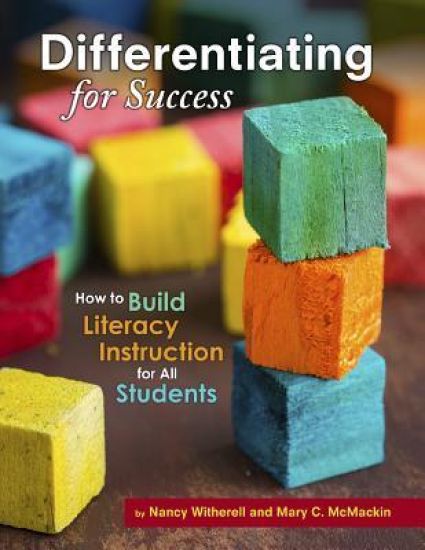
Creating differentiated instruction is an essential yet time-consuming component of effective teaching. Since students learn at different paces and in different ways, some students may be able to apply a targeted comprehension skill in cognitively complex ways immediately after being taught the skill while other students may need additional scaffolding in order to grasp it. All students, regardless of their skill level, benefit from activities that are at their just right level. This means activities are not too difficult or too easy. In this book, Nancy Witherell and Mary McMackin share easy-to-follow lesson plans that address key reading skills for students in grades 3 to 5. A set of three, tiered, differentiated follow-up activities accompanies each lesson. Fiction and nonfiction mentor text suggestions are included.

La gestión del conocimiento y la innovación en función de los proyecto

La gestión del conocimiento y la innovación en función de los proyecto

Nancy Moré Cuesta; José C Torres; Ernesto Alvarado

Editorial Academica Espanola
2018
pokkari
Una de las caracter sticas m s relevantes de la sociedad actual es el vertiginoso avance de la ciencia y sus aplicaciones tecnol gicas, lo cual incide y modifica, no solo la organizaci n del sistema productivo, sino tambi n impacta en la calidad de la vida laboral y social. Esto exige a los Consejos de la administraci n Municipal (CAM) que tomen en cuenta los cambios que operan en el desarrollo econ mico del pa s y lo contextualicen a sus territorios.
Black Tales for White Children

Black Tales for White Children

C H Stigand; Nancy Yulee Stigand

ALPHA EDITION
2021
pokkari
Black Tales for White Children, is many of the old classic books which have been considered important throughout the human history. They are now extremely scarce and very expensive antique. So that this work is never forgotten we republish these books in high quality, using the original text and artwork so that they can be preserved for the present and future generations. This whole book has been reformatted, retyped and designed. These books are not made of scanned copies of their original work and hence the text is clear and readable.
The Household and the War for the Cosmos

The Household and the War for the Cosmos

C R Wiley; Nancy Pearcey

Canon Press
2019
pokkari
Your household is not just a shelter from a war zone; it is the command center from where you launch your attacks. It's this vision of the world, with the Christian family at the heart, that modern parents desperately need to recover. In this truly original book, C.R. Wiley shows that, although the family has become dislocated and pushed to the side by modern society, this wasn't always the case. At one time, the world was not seen as a random assortment of time and matter, but as an ordered whole-as a Cosmos. Because people saw themselves as part of an ordered whole, they also believed that they had obligations to the people around them. They were not just autonomous individuals, but members of households with unique duties to past and future generations. Words like "piety" and "religion" did not refer to what you did in your quiet time, but were more like the seemingly obsolete values of "duty" and "honor." C.R. Wiley illustrates these ancient values through the Roman Aeneas, and shows how this founding myth inspired people to things we need. However, he also shows how this myth failed and it was succeeded by a greater myth-the myth of Abraham and His God's war for the cosmos.
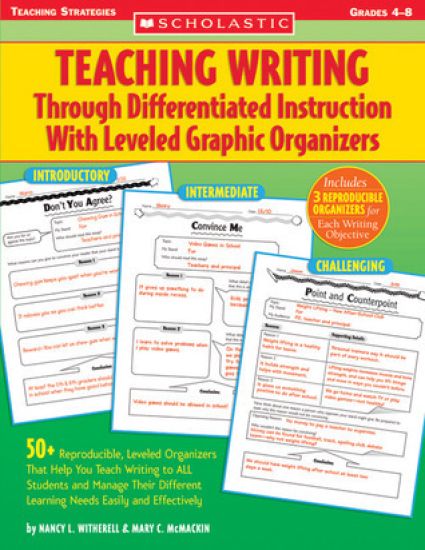
Teaching Writing Through Differentiated Instruction with Leveled Graphic Organizers

Teaching Writing Through Differentiated Instruction with Leveled Graphic Organizers

Nancy L. Witherell; Mary C. McMackin; Nancy Witherell

Scholastic Teaching Resources
2005
nidottu
Leveled organizers with lesson tips and model writing samples help ALL students master the skills and concepts they need to succeed on standardized essay tests and beyond. Designed for teachers who want to teach writing effectively to students of different ability levels, this resource offers lessons, leveled organizers, and writing models to make planning and gathering materials a cinch. Seventeen units cover topics from structuring paragraphs to using elaboration to develop ideas, to persuasive essay writing. Helps ALL students master the writing skills and concepts they need to succeed on standardized tests and beyond.
What Drives Third World City Growth?

What Drives Third World City Growth?

Allen C. Kelley; Nancy Burley

Princeton University Press
2014
pokkari
The book shows that earlier studies exaggerated the effects of rural land scarcity, foreign capital inflows, and population growth on Third World urbanization. More critical were imbalances of productivity advance across sectors and terms of trade between primary products and manufactures. Originally published in 1984. The Princeton Legacy Library uses the latest print-on-demand technology to again make available previously out-of-print books from the distinguished backlist of Princeton University Press. These editions preserve the original texts of these important books while presenting them in durable paperback and hardcover editions. The goal of the Princeton Legacy Library is to vastly increase access to the rich scholarly heritage found in the thousands of books published by Princeton University Press since its founding in 1905.
What Drives Third World City Growth?

What Drives Third World City Growth?

Allen C. Kelley; Nancy Burley

Princeton University Press
2016
sidottu
The book shows that earlier studies exaggerated the effects of rural land scarcity, foreign capital inflows, and population growth on Third World urbanization. More critical were imbalances of productivity advance across sectors and terms of trade between primary products and manufactures. Originally published in 1984. The Princeton Legacy Library uses the latest print-on-demand technology to again make available previously out-of-print books from the distinguished backlist of Princeton University Press. These editions preserve the original texts of these important books while presenting them in durable paperback and hardcover editions. The goal of the Princeton Legacy Library is to vastly increase access to the rich scholarly heritage found in the thousands of books published by Princeton University Press since its founding in 1905.
Observation Drawing with Children

Observation Drawing with Children

Nancy Ray Smith; Laraine Cicchetti; Margaret C. Clark; Margaret Kennedy

Teachers' College Press
1997
nidottu
This book offers teachers guidance in helping children develop the mental and physical abilities used in the discovery and creation of meaning through drawing by: Giving students extensive experience with materials • Keeping in mind developmental guidelines • Planning lessons with clearly defined objectives and in carefully crafted sequence • Choosing objects suitable for the given age group and appropriate to lesson objectives • Fostering aesthetic qualities • Motivating and responding to children as they draw.Each chapter begins with a Developmental Framework that will help teachers keep developmental characteristics in mind when planning art curricula. The book contains 23 detailed Lesson Plans for classes ranging from Kindergarten through Sixth Grade. Each plan includes the Objective, the Materials to be used, the Room Arrangement, Motivational Dialogue in the form of teacher's questions and children's responses, Evaluation of the results, and suggested Extensions. Examples of children's drawings accompany each lesson.
Teaching/Writing in Third Spaces

Teaching/Writing in Third Spaces

Rhonda C. Grego; Nancy S. Thompson

Southern Illinois University Press
2007
nidottu
Teaching/Writing in Third Spaces: The Studio Model examines a dynamic approach to teaching composition that reimagines not only the physical space in which writing and learning occurs but also the place occupied by composition in the power structure of universities and colleges. In response to financial and programmatic cutbacks at the University of South Carolina in the 1990s, authors Rhonda C. Grego and Nancy S. Thompson used their academic backgrounds in composition and English education, along with their personal histories in working-class families, to look at compositional spaces and places with an eye to challenging the embedded issues of race, class, and gender within the university hierarchies. The result was a supplemental writing program that they called the writing studio. The studio model emphasizes individual participation in a small group that allows students to present work they are preparing for outside classes, discuss their challenges, and refine their ideas with other students and staff facilitators. This ""interactional inquiry"" is replicated and reinforced by the facilitators, who meet in their own small groups to analyze larger patterns, possibilities, and needs as they arise in their studios. Grego and Thompson argue that because the studio is physically and institutionally ""outside but alongside"" both students' other coursework and the hierarchy of the institution, it represents a ""third space,"" a unique position in which to effect institutional change. The focus on interactional inquiry challenges traditional power hierarchies within classrooms and shifts the nature of discourse. As a bottom-up approach to the development of educational programs within institutions that have different needs, demographies, and histories, the studio model can address a multitude of different institutional needs with little disruption to the curriculum. The studio model allows university administrators, teachers, student aides, and students to continually adapt to changing institutional environments with new teaching and learning strategies. ""Teaching/Writing in Third Spaces"" provides an alternative approach to traditional basic writing courses that can be adopted in educational institutions of all types and at all levels.
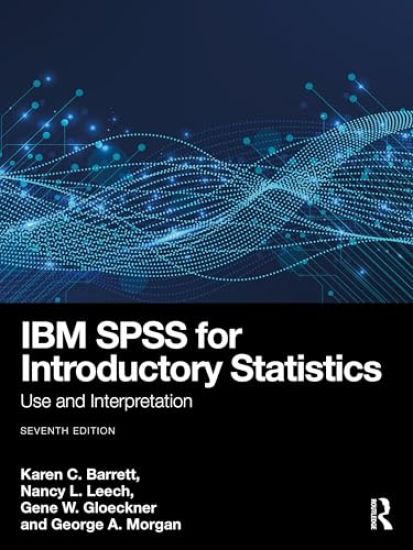
IBM SPSS for Introductory Statistics

IBM SPSS for Introductory Statistics

Karen C. Barrett; Nancy L. Leech; Gene W. Gloeckner; George A. Morgan

TAYLOR FRANCIS LTD
2025
nidottu
IBM SPSS for Introductory Statistics is designed to help students learn how to analyze and interpret research. In easy-to-understand language, the authors show readers how to choose the appropriate statistic based on the design, and to interpret outputs appropriately. There is such a wide variety of options and statistics in SPSS that knowing which ones to use and how to interpret the outputs can be difficult. This book assists students with these challenges.Comprehensive and user-friendly, this book prepares readers for each step in the research process: design, entering and checking data, testing assumptions, assessing reliability and validity, computing descriptive and inferential parametric and nonparametric statistics, and writing about results. Dialog windows and SPSS syntax, along with the output, are provided. Several realistic data sets are used to solve the chapter problems and are available as an online resource.This edition includes:• Updated chapters and screenshots• Additional SPSS work problems• Callout boxes for each chapter, indicating crucial elements of APA style and referencing outputs.IBM SPSS for Introductory Statistics is an invaluable supplemental (or lab text) book for students. In addition, this book and its companion, IBM SPSS for Intermediate Statistics, are useful as guides/reminders to faculty and professionals regarding the specific steps to take to use SPSS and/or how to use and interpret parts of SPSS with which they are unfamiliar.
IBM SPSS for Introductory Statistics

IBM SPSS for Introductory Statistics

Karen C. Barrett; Nancy L. Leech; Gene W. Gloeckner; George A. Morgan

TAYLOR FRANCIS LTD
2025
sidottu
IBM SPSS for Introductory Statistics is designed to help students learn how to analyze and interpret research. In easy-to-understand language, the authors show readers how to choose the appropriate statistic based on the design, and to interpret outputs appropriately. There is such a wide variety of options and statistics in SPSS that knowing which ones to use and how to interpret the outputs can be difficult. This book assists students with these challenges.Comprehensive and user-friendly, this book prepares readers for each step in the research process: design, entering and checking data, testing assumptions, assessing reliability and validity, computing descriptive and inferential parametric and nonparametric statistics, and writing about results. Dialog windows and SPSS syntax, along with the output, are provided. Several realistic data sets are used to solve the chapter problems and are available as an online resource.This edition includes:• Updated chapters and screenshots• Additional SPSS work problems• Callout boxes for each chapter, indicating crucial elements of APA style and referencing outputs.IBM SPSS for Introductory Statistics is an invaluable supplemental (or lab text) book for students. In addition, this book and its companion, IBM SPSS for Intermediate Statistics, are useful as guides/reminders to faculty and professionals regarding the specific steps to take to use SPSS and/or how to use and interpret parts of SPSS with which they are unfamiliar.
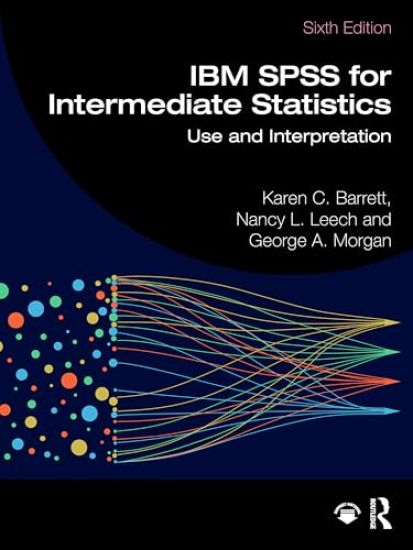
IBM SPSS for Intermediate Statistics

IBM SPSS for Intermediate Statistics

Karen C. Barrett; Nancy L. Leech; George A. Morgan

TAYLOR FRANCIS LTD
2025
nidottu
IBM SPSS for Intermediate Statistics, sixth edition, is designed to help readers analyze and interpret research data using IBM SPSS.This user-friendly book shows readers how to choose the appropriate statistic based on the design; perform intermediate statistics, including multivariate statistics; interpret output; and write about the results. The book reviews research designs and how to assess the accuracy and reliability of data; how to determine whether data meet the assumptions of statistical tests; how to calculate and interpret effect sizes for intermediate statistics; how to compute and interpret post-hoc power; and an overview of basic statistics for those who need a review. Unique chapters on multilevel linear modeling; multivariate analysis of variance (MANOVA); assessing reliability of data; multiple imputation; mediation, moderation, and canonical correlation; discriminant analyses; logistic regression; and factor analysis are provided. SPSS syntax is included for those who prefer this format. Pedagogical features include call-out boxes to highlight key points, interpretation sections and questions, realistic data sets for practice, and information on how to get started with SPSS, as well as appendices reviewing basic statistics, discussing how to write research questions, providing answers to the odd numbered interpretation questions, and providing references for further reading.An ideal supplement for courses in either intermediate/advanced statistics or research methods taught in departments of psychology, education, and other social and health sciences, this book is also appreciated by researchers in these areas looking for a handy reference for SPSS commands and how to interpret SPSS outputs.The new edition features: Updated for IBM SPSS version 29, but the book can be used with most other versionsMore information on how to get started in SPSS (Ch. 1)Updated discussion of which effect sizes can be calculated for various programs in SPSSUpdated information on multiple regression methods (Ch. 7)Updated chapter on how use a variable as a mediator or a moderator, using only SPSS (Ch. 8)All chapters updated to include effect sizes that are availableUpdated screens and outputsUpdated web resources for instructors, including PowerPoint slides, interpretation question and extra SPSS problem answers; and for students, data sets, and chapter outlines and study guides.
IBM SPSS for Intermediate Statistics

IBM SPSS for Intermediate Statistics

Karen C. Barrett; Nancy L. Leech; George A. Morgan

TAYLOR FRANCIS LTD
2025
sidottu
IBM SPSS for Intermediate Statistics, sixth edition, is designed to help readers analyze and interpret research data using IBM SPSS.This user-friendly book shows readers how to choose the appropriate statistic based on the design; perform intermediate statistics, including multivariate statistics; interpret output; and write about the results. The book reviews research designs and how to assess the accuracy and reliability of data; how to determine whether data meet the assumptions of statistical tests; how to calculate and interpret effect sizes for intermediate statistics; how to compute and interpret post-hoc power; and an overview of basic statistics for those who need a review. Unique chapters on multilevel linear modeling; multivariate analysis of variance (MANOVA); assessing reliability of data; multiple imputation; mediation, moderation, and canonical correlation; discriminant analyses; logistic regression; and factor analysis are provided. SPSS syntax is included for those who prefer this format. Pedagogical features include call-out boxes to highlight key points, interpretation sections and questions, realistic data sets for practice, and information on how to get started with SPSS, as well as appendices reviewing basic statistics, discussing how to write research questions, providing answers to the odd numbered interpretation questions, and providing references for further reading.An ideal supplement for courses in either intermediate/advanced statistics or research methods taught in departments of psychology, education, and other social and health sciences, this book is also appreciated by researchers in these areas looking for a handy reference for SPSS commands and how to interpret SPSS outputs.The new edition features: Updated for IBM SPSS version 29, but the book can be used with most other versionsMore information on how to get started in SPSS (Ch. 1)Updated discussion of which effect sizes can be calculated for various programs in SPSSUpdated information on multiple regression methods (Ch. 7)Updated chapter on how use a variable as a mediator or a moderator, using only SPSS (Ch. 8)All chapters updated to include effect sizes that are availableUpdated screens and outputsUpdated web resources for instructors, including PowerPoint slides, interpretation question and extra SPSS problem answers; and for students, data sets, and chapter outlines and study guides.
IBM SPSS for Intermediate Statistics

IBM SPSS for Intermediate Statistics

Karen C. Barrett; Nancy L. Leech; George A. Morgan

Routledge
2014
sidottu
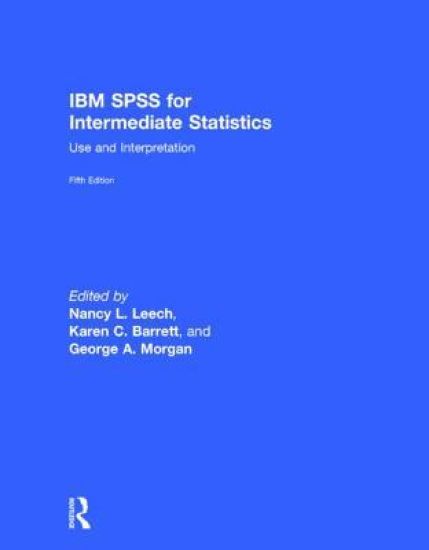
Designed to help readers analyze and interpret research data using IBM SPSS, this user-friendly book shows readers how to choose the appropriate statistic based on the design; perform intermediate statistics, including multivariate statistics; interpret output; and write about the results. The book reviews research designs and how to assess the accuracy and reliability of data; how to determine whether data meet the assumptions of statistical tests; how to calculate and interpret effect sizes for intermediate statistics, including odds ratios for logistic analysis; how to compute and interpret post-hoc power; and an overview of basic statistics for those who need a review. Unique chapters on multilevel linear modeling; multivariate analysis of variance (MANOVA); assessing reliability of data; multiple imputation; mediation, moderation, and canonical correlation; and factor analysis are provided. SPSS syntax with output is included for those who prefer this format. The new edition features: • IBM SPSS version 22; although the book can be used with most older and newer versions • New discusiion of intraclass correlations (Ch. 3)• Expanded discussion of effect sizes that includes confidence intervals of effect sizes (ch.5) • New information on part and partial correlations and how they are interpreted and a new discussion on backward elimination, another useful multiple regression method (Ch. 6) • New chapter on how to use a variable as a mediator or a moderator (ch. 7)• Revised chapter on multilevel and hierarchical linear modeling (ch. 12) • A new chapter (ch. 13) on multiple imputation that demonstrates how to deal with missing data • Updated web resources for instructors including PowerPoint slides and answers to interpretation questions and extra problems and for students, data sets, chapter outlines, and study guides. IBM SPSS for Intermediate Statistics, Fifth Edition provides helpful teaching tools: • all of the key SPSS windows needed to perform the analyses • outputs with call-out boxes to highlight key points • interpretation sections and questions to help students better understand and interpret the output • extra problems with realistic data sets for practice using intermediate statistics • Appendices on how to get started with SPSS, write research questions, and basic statistics. An ideal supplement for courses in either intermediate/advanced statistics or research methods taught in departments of psychology, education, and other social, behavioral, and health sciences. This book is also appreciated by researchers in these areas looking for a handy reference for SPSS
Shadow of the Master: Study Edition: Study Edition

Shadow of the Master: Study Edition: Study Edition

Nancy H. Miller; Julia C. Miller; Matthew R. Miller

Createspace Independent Publishing Platform
2012
nidottu
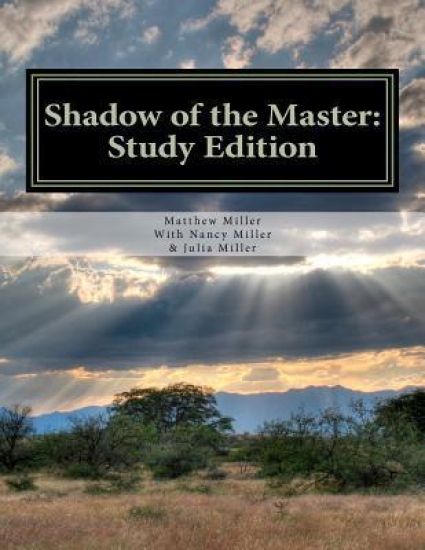
SHADOW OF THE MASTER is a short novel that provides a unique and fresh perspective on the greatest story ever told-the life and ministry of Jesus Christ. This perspective is viewed through the eyes of a "thirteenth disciple", a dog that accompanied Him along the way. The story takes you through the travels of Jesus and His disciples from the point-of-view of Shadow, a stray dog that takes up with the group after Jesus shows him kindness. Scripturally based and written to appeal to all ages, SHADOW OF THE MASTER will warm your heart with its special view on the Gospels. This Study Edition contains Bible verses and discussion questions for further thought after each chapter, making it ideal for an individual or group study of the life of Jesus through the eyes of Shadow
Saying No to Say Yes

Saying No to Say Yes

David C. Olsen; Nancy G. Devor

Alban Institute, Inc
2015
nidottu
This book explores the difficulties clergy face when they attempt to say no by setting effective boundaries in order to say yes to the life-giving call of ministry. It illustrates the benefits of good boundaries, even as it traces the legacy of denominational boundary trainings in the wake of the public clergy sexual misconduct crisis. Devor and Olsen supplement anecdotes from their experience leading boundary trainings with an examination of clergy/congregation dynamics through the lenses of both self-psychology and family systems theory elucidating how some obstacles to effective boundary setting are caused by innate personality tendencies that are exacerbated by a stressful church environment. A perfect storm occurs when clergy vulnerabilities and systemic congregational anxiety interact, leading to burn-out and boundary problems which hinder pastoral excellence. Readers will find both practice questions to assist them in a deeper assessment of personal and systemic obstacles as well as strategies for setting boundaries, creating the space needed to pursue excellence in ministry."