

Kirjahaku
Etsi kirjoja tekijän nimen, kirjan nimen tai ISBN:n perusteella.
1000 tulosta hakusanalla Sharad Mathur

This book will teach you the core concepts of blockchain technology in a concise manner through straightforward, concrete examples using a range of programming languages, including Python and Solidity. The 50 programs presented in this book are all you need to gain a firm understanding of blockchain and how to implement it. The book begins with an introduction to the fundamentals of blockchain technology, followed by a review of its types, framework, applications and challenges. Moving ahead, you will learn basic blockchain programming with hash functions, authentication code, and Merkle trees. You will then dive into the basics of bitcoin, including wallets, digital keys, transactions, digital signatures, and more. This is followed by a crash course on Ethereum programming, its network, and ecosystem. As you progress through the book, you will also learn about Hyperledger and put your newly-gained knowledge to work through case studies and example applications. After reading this book, you will understand blockchain’s underlying concepts and its common implementations. What You Will Learn Master theoretical and practical implementations of various blockchain components using PythonImplement hashing, Merkel trees, and smart contracts using the Solidity programming language for various applicationsGrasp the internal structure of EVM and its implementation in smart contractsUnderstand why blockchain plays an essential role in cryptocurrencies and identify possible applications beyond cryptocurrenciesInvestigate and apply alternative blockchain solutions using Hyperledger, including its integration and deploymentExplore research opportunities through case studies and gain an overview of implementation using various languages Who Is This Book For: Anyone who is new to blockchain and wants to gain anan understanding of how it works and can be implemented.


Amit to Arohi: Theme = ?
Harshad Sharad Bansode
Createspace Independent Publishing Platform
2014
nidottu

Immortal Friendship: The Three Friends Adventure
Swarangi Sharad Patil
Createspace Independent Publishing Platform
2014
nidottu


Mari Bari Manhethi: Diasporik Poems and Prose
Pragna Sharad Dadbhawala
Createspace Independent Publishing Platform
2016
nidottu

Everything that happens happens for a reason In the forest of the sundarbans, lives Reno, a spotted deer; Cuteclaws, a royal Bengal tigress; Yang, a golden Jackal; Yogi, an elephant and Larned, a Munda tribal man. As their paths criss-cross, many practical life lessons for readers are churned out. The story, a modern fable, depicts the struggles of its characters as each one of them tries to live out their destiny in a sometimes loving, sometimes caring and sometimes brutal jungle. The mundane life of sundarbans turns into a scintillating drama of love, power and achievements, with the invisible hand of God crafting each moment with precision. Laws of Jungle will makes you smile at the chaos of life.


Evaluation of Sexual Maturity Rating & Personalty trait of Adolescent
D Sharad Gedam; MD Waseem Uddin; Maya Chansoria
LAP Lambert Academic Publishing
2013
pokkari

Standardization of Ayurvedic Drug 'Daruharidra' & its Allied Species
Srivastava Sharad
LAP Lambert Academic Publishing
2013
pokkari

The Property Rights of Hindu Women
Mishra Sharad Chandra
LAP Lambert Academic Publishing
2013
pokkari

Aesthetic Dermatology
Jaishree Sharad; Maya Vedamurthy
Jaypee Brothers Medical Publishers
2018
sidottu
This book is a comprehensive guide to aesthetic dermatology for clinicians and trainees. Divided into four sections, the text begins with discussion on cosmeceuticals (moisturisers, sunscreens, anti-aging products etc). The next section covers Botulinum Toxin (Botox) treatments, and section three examines soft tissue augmentation such as facial fillers and hand rejuvenation. The final chapters discuss adjunctive treatments including basic peels, thread lift, laser hair removal, microneedling and body contouring. Each procedure is described in detail, along with its advantages and disadvantages. The book is highly illustrated with nearly 600 clinical photographs, diagrams and tables, and features access to videos demonstrating cosmetic procedures. Key points Comprehensive guide to aesthetic dermatologyEach procedure explained in detail with advantages and disadvantagesHighly illustrated with clinical photographs, diagrams and tablesIncludes access to videos demonstrating cosmetic procedures
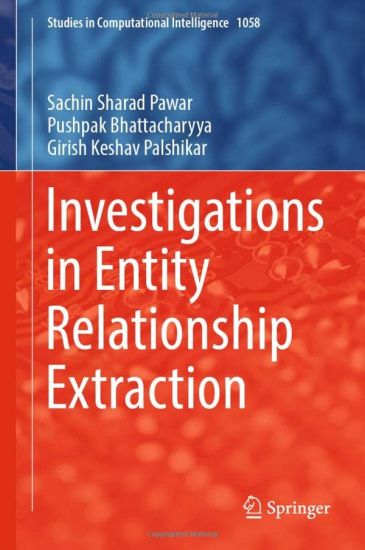
Investigations in Entity Relationship Extraction
Sachin Sharad Pawar; Pushpak Bhattacharyya; Girish Keshav Palshikar
SPRINGER VERLAG, SINGAPORE
2022
sidottu
The book covers several entity and relation extraction techniques starting from the traditional feature-based techniques to the recent techniques using deep neural models. Two important focus areas of the book are – i) joint extraction techniques where the tasks of entity and relation extraction are jointly solved, and ii) extraction of complex relations where relation types can be N-ary and cross-sentence. The first part of the book introduces the entity and relation extraction tasks and explains the motivation in detail. It covers all the background machine learning concepts necessary to understand the entity and relation extraction techniques explained later. The second part of the book provides a detailed survey of the traditional entity and relation extraction problems covering several techniques proposed in the last two decades. The third part of the book focuses on joint extraction techniques which attempt to address both the tasks of entity and relation extraction jointly. Several joint extraction techniques are surveyed and summarized in the book. It also covers two joint extraction techniques in detail which are based on the authors’ work. The fourth and the last part of the book focus on complex relation extraction, where the relation types may be N-ary (having more than two entity arguments) and cross-sentence (entity arguments may span multiple sentences). The book highlights several challenges and some recent techniques developed for the extraction of such complex relations including the authors’ technique. The book also covers a few domain-specific applications where the techniques for joint extraction as well as complex relation extraction are applied.
Investigations in Entity Relationship Extraction
Sachin Sharad Pawar; Pushpak Bhattacharyya; Girish Keshav Palshikar
SPRINGER VERLAG, SINGAPORE
2023
nidottu
The book covers several entity and relation extraction techniques starting from the traditional feature-based techniques to the recent techniques using deep neural models. Two important focus areas of the book are – i) joint extraction techniques where the tasks of entity and relation extraction are jointly solved, and ii) extraction of complex relations where relation types can be N-ary and cross-sentence. The first part of the book introduces the entity and relation extraction tasks and explains the motivation in detail. It covers all the background machine learning concepts necessary to understand the entity and relation extraction techniques explained later. The second part of the book provides a detailed survey of the traditional entity and relation extraction problems covering several techniques proposed in the last two decades. The third part of the book focuses on joint extraction techniques which attempt to address both the tasks of entity and relation extraction jointly. Several joint extraction techniques are surveyed and summarized in the book. It also covers two joint extraction techniques in detail which are based on the authors’ work. The fourth and the last part of the book focus on complex relation extraction, where the relation types may be N-ary (having more than two entity arguments) and cross-sentence (entity arguments may span multiple sentences). The book highlights several challenges and some recent techniques developed for the extraction of such complex relations including the authors’ technique. The book also covers a few domain-specific applications where the techniques for joint extraction as well as complex relation extraction are applied.
Performance Analysis of Real-Time Embedded Software
Yau-Tsun Steven Li; Sharad Malik
Springer
1998
sidottu
Embedded systems are characterized by the presence of processors running application-specific software. Recent years have seen a large growth of such systems, and this trend is projected to continue with the growth of systems on a chip. Many of these systems have strict performance and cost requirements. To design these systems, sophisticated timing analysis tools are needed to accurately determine the extreme case (best case and worst case) performance of the software components. Existing techniques for this analysis have one or more of the following limitations: they cannot model complicated programsthey cannot model advanced micro-architectural features of the processor, such as cache memories and pipelines they cannot be easily retargeted for new hardware platforms. In Performance Analysis of Real-Time Embedded Software, a new timing analysis technique is presented to overcome the above limitations. The technique determines the bounds on the extreme case (best case and worst case) execution time of a program when running on a given hardware system. It partitions the problem into two sub-problems: program path analysis and microarchitecture modeling. Performance Analysis of Real-Time Embedded Software will be of interest to Design Automation professionals as well as designers of circuits and systems.
Basic Computational Techniques for Data Analysis
D Narayana; Sharad Ranjan; Nupur Tyagi
TAYLOR FRANCIS LTD
2023
sidottu
This book is designed to equip students to navigate through MS Excel and basic data computation methods, which are essential tools in research or professional settings and in classrooms. It illustrates the concepts used in research and data analysis and economic and financial decision-making in business and in daily life. The book will help students acquire knowledge and develop skills in statistical techniques and financial analysis using MS Excel. With illustrations and examples, it will help the readers to:Visualize, present, and analyze data through MS Excel spreadsheets and tables and create personal or business spreadsheetsLearn how to work with spreadsheets, use formulae, and perform calculations and analysisCreate tables including Pivot TablesBecome familiar with basic statistical and financial measuresDesign creative spread sheets and communicate effectively in business using spreadsheets and data analysisThis revised and updated second edition will be an essential resource for students of economics, commerce, management, and other social science subjects, and will be useful to those studying econometrics, financial technology, basic computational techniques, data analysis, and applied economics.ContentThe book intends to illustrate the concepts used in economic and financial decision-making in business and in daily life; it helps demonstrate a deeper understanding from both theoretical and practical perspectives. An effort has been made to make the book student-friendly by using simple language and giving a number of illustrations in each chapter, solved in such a simple manner that they can be easily understood by the students. Practical questions have been included at the end of each chapter so that the students can independently solve them and test their understanding of the concepts and computations introduced in the chapter.OutcomeAt the end, students will be able to describe what a spreadsheet is and what Excel’s capabilities are and can work with elements that make up the structure of a worksheet. They will be able to work with spreadsheets and enter data in Excel, use formulae and calculations, and create tables, charts and pivot tables. They will be familiar with basic statistical and financial measures of general use. They will be able to do basic computations in statistics and finance in Excel. Students will acquire the capacity to create personal and/or business spreadsheets following current professional and/or industry standards. Their potential for critical thinking to design and create spreadsheets and communicate in a business setting using spreadsheet vocabulary will be enhanced.The educational background required for the student to understand the text is some basic English and Mathematics of school-leaving level. Some fl air for numbers will be an asset and for them it will be a breeze; others will have to make an effort but ample illustrations and practice questions make life simple, whether it is basic statistics or slightly intricate finance!
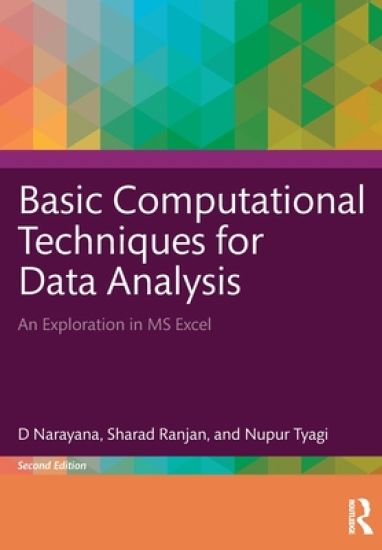
Basic Computational Techniques for Data Analysis
D Narayana; Sharad Ranjan; Nupur Tyagi
TAYLOR FRANCIS LTD
2023
nidottu
This book is designed to equip students to navigate through MS Excel and basic data computation methods, which are essential tools in research or professional settings and in classrooms. It illustrates the concepts used in research and data analysis and economic and financial decision-making in business and in daily life. The book will help students acquire knowledge and develop skills in statistical techniques and financial analysis using MS Excel. With illustrations and examples, it will help the readers to:Visualize, present, and analyze data through MS Excel spreadsheets and tables and create personal or business spreadsheetsLearn how to work with spreadsheets, use formulae, and perform calculations and analysisCreate tables including Pivot TablesBecome familiar with basic statistical and financial measuresDesign creative spread sheets and communicate effectively in business using spreadsheets and data analysisThis revised and updated second edition will be an essential resource for students of economics, commerce, management, and other social science subjects, and will be useful to those studying econometrics, financial technology, basic computational techniques, data analysis, and applied economics.ContentThe book intends to illustrate the concepts used in economic and financial decision-making in business and in daily life; it helps demonstrate a deeper understanding from both theoretical and practical perspectives. An effort has been made to make the book student-friendly by using simple language and giving a number of illustrations in each chapter, solved in such a simple manner that they can be easily understood by the students. Practical questions have been included at the end of each chapter so that the students can independently solve them and test their understanding of the concepts and computations introduced in the chapter.OutcomeAt the end, students will be able to describe what a spreadsheet is and what Excel’s capabilities are and can work with elements that make up the structure of a worksheet. They will be able to work with spreadsheets and enter data in Excel, use formulae and calculations, and create tables, charts and pivot tables. They will be familiar with basic statistical and financial measures of general use. They will be able to do basic computations in statistics and finance in Excel. Students will acquire the capacity to create personal and/or business spreadsheets following current professional and/or industry standards. Their potential for critical thinking to design and create spreadsheets and communicate in a business setting using spreadsheet vocabulary will be enhanced.The educational background required for the student to understand the text is some basic English and Mathematics of school-leaving level. Some fl air for numbers will be an asset and for them it will be a breeze; others will have to make an effort but ample illustrations and practice questions make life simple, whether it is basic statistics or slightly intricate finance!
Performance Analysis of Real-Time Embedded Software
Yau-Tsun Steven Li; Sharad Malik
Springer-Verlag New York Inc.
2012
nidottu
Embedded systems are characterized by the presence of processors running application-specific software. Recent years have seen a large growth of such systems, and this trend is projected to continue with the growth of systems on a chip. Many of these systems have strict performance and cost requirements. To design these systems, sophisticated timing analysis tools are needed to accurately determine the extreme case (best case and worst case) performance of the software components. Existing techniques for this analysis have one or more of the following limitations: they cannot model complicated programsthey cannot model advanced micro-architectural features of the processor, such as cache memories and pipelines they cannot be easily retargeted for new hardware platforms. In Performance Analysis of Real-Time Embedded Software, a new timing analysis technique is presented to overcome the above limitations. The technique determines the bounds on the extreme case (best case and worst case) execution time of a program when running on a given hardware system. It partitions the problem into two sub-problems: program path analysis and microarchitecture modeling. Performance Analysis of Real-Time Embedded Software will be of interest to Design Automation professionals as well as designers of circuits and systems.
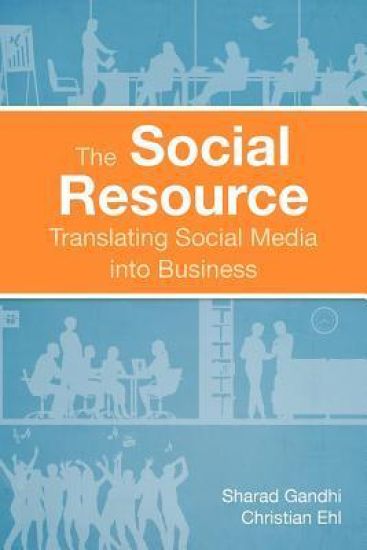
The Social Resource - Translating Social Media into Business
Christian Ehl; Sharad Gandhi
Createspace Independent Publishing Platform
2011
nidottu